Margo Steahly has joined Capital Square 1030 in Richmond as national sales director. The real estate investment and management firm said that Steahly will be responsible for national accounts and East Coast sales of 1031 DST (Delaware statutory trust) programs sponsored by Capital Square.
According to the company, Steahly has 20 years of experience ranging from wealth management to sales of DSTs and other private placement products.
Before joining Capital Square, Steahly was director of internal sales for Sandlapper Capital Investments LLC. Prior to that, she served as director of tenant-in-common sales at Dallas-based ORIX USA, where she assisted in the development of the company’s business platform.
Capital Square sponsors real estate exchange programs that qualify for tax deferral under Section 1031 of the Internal Revenue Code. It uses the Delaware Statutory Trust structure to make real estate available to a larger number of investors.
As of January, the firm said it had a growing national portfolio of 58 real estate assets valued at nearly $650 million (based on investment cost).
Apex Clean Energy will build a new 130,000-square-foot headquarters in downtown Charlottesville and will occupy nearly half the space in the building.
According to Cushman & Wakefield | Thalhimer, which assisted the company with the lease, Apex will lease 60,000 square feet in the seven-story headquarters that will be built on Garrett Street. The developer will be Riverbend Development with design handled by William McDonough + Partners out of Charlottesville.
The remaining space will be leased to other tenants, including 10,000 square feet of street-level retail space.
Steve Bowers, vice president of marketing and communications for Apex, said the company expects to break ground on the project by mid-year, and the buildout is expected to take 18 to 24 months.
Apex Clean Energy builds, owns and operates utility-scale wind and solar power facilities. In Virginia, it’s the company behind wind farm projects in Botetourt and Pulaski counties.
John Pritzlaff of Thalhimer’s Charlottesville office assisted Apex with the lease.
Aria Legacy Group (ALG) has acquired West Creek Manor Apartments in Roanoke from the Virginia Housing Development Authority for $5.9 million. The purchase is the Lakewood, N.J.-based firm’s second multifamily investment in the state and its first in the Roanoke Valley region.
“We are particularly excited about Roanoke,” Joe Novoseller, managing principal of ALG, said in a statement. “It is positioned among the nation’s leading mid-sized communities for economic growth and offers exceptional quality of life in terms of its location, outdoor and cultural activities, burgeoning food and music scene, and more.”
Located on Westside Boulevard, the 25-building, 197-unit, garden-style community offers one-, two- and three-bedroom apartments. Built in 1974 and renovated in 2010, West Creek Manor has a multi-purpose community room, playground, 24-hour laundry facility and on-site management. It is located on the city bus line, minutes from the VA Hospital and major area employers.
ALG acquired the 152-unit Maple Ridge Apartments in the historic district of Lynchburg in December for $8.5 million.
A privately held real estate company, ALG acquires, owns and manages multifamily properties on the East Coast.
LIUNA, the Laborers’ International Union of North America, said Monday that it has entered into a second agreement with the Virginia Community College System to train state residents for jobs related to a new pipeline project.
The agreement aims to put people to work on the Mountain Valley Pipeline project, which will distribute natural gas through pipelines running from West Virginia to Virginia. LIUNA said in a news release that as many as 2,400 skilled workers will be needed in Virginia for the project. Work is expected to begin this year and continue for about 18 months.
“Local residents will have the opportunity to learn skills leading to good construction careers, and the region will benefit both economically and environmentally from the benefits of clean natural gas,” Dennis Martire, vice president and mid-Atlantic regional manager of LIUNA, said in a statement.
In January, the union and college system announced a partnership to train Virginia residents for similar jobs building the Atlantic Coast Pipeline energy project, a 600-mile project that will stretch from West Virginia through parts of Virginia and into eastern North Carolina.
Under the agreement between the union and the college system on the Mountain Valley pipeline, at least a fourth of workers hired will live in the vicinity of the project, which will run from the West Virginia line through Southwest Virginia. The community college system will help identify potential workers and, in a joint venture with LIUNA, will assist in training them. According to the union, the project will be built by contractors who have committed to a $20 hourly wage, a $45 per day per diem and free family health care.
Workers assigned to the project will include existing members of LIUNA Local 980, based in Roanoke, as well as new hires identified through the college system’s schools in the counties of Giles, Craig, Roanoke, Montgomery Franklin and Pittsylvania. This area also includes the cities of Radford, Blacksburg, Christiansburg, Rocky Mount, Roanoke, Salem and Danville.
LIUNA’s mid-Atlantic Region includes more than 40,000 workers predominantly in the construction industry in Pennsylvania, Maryland, West Virginia, the District of Columbia, Virginia and North Carolina.
Norfolk-based S. L. Nusbaum Realty Co. has joined forces with another local company, Atlantic Dominion Distributors, on a $35 million apartment community in Virginia Beach.
Work began in December on the 282-unit Mezzo Apartment Homes, a gated community on Virginia Beach Boulevard that will offer multiple floor plans and upscale amenities.
One-, two-, and three bedroom units are planned with lake views, along with studio apartments. According to Nusbaum, rents will range from $1,075 to $1,750.
Amenities will include secured access, a clubhouse, swimming pool, fitness center, business center, outdoor grilling area, recreational activity area (bocce, corn hole, etc.) fire pits, dog park, private garages and a car wash facility.
Green building features, such as Energy Star windows and appliances and sensor lights in bathrooms and closets, are also part of the package.
The project’s location on Virginia Beach Boulevard next to Haynes Furniture and across from St. Gregory the Great Catholic Church and School is close to retail, restaurant, employment options, and the Interstate 64/264 interchange.
Hoy Construction will serve as the project's general contractor. Other members of the development team are TS3, architect; MSA PC, civil engineer; and Details Ltd., interior design services. Siska Aurand Landscape Architects Inc. provided landscape, pool and outdoor amenity design services.
The completion timetable for Mezzo is 2020, with the first units available for occupancy in the first quarter of 2019.
Back in 1992, the iconic and irascible political strategist James Carville coined the phrase, “The economy, stupid.” This was his rallying cry in keeping Bill Clinton’s campaign workers on message during his successful run against President George H.W. Bush. The phrase reminded Clinton’s followers that the country was in recession and people were hurting. Remembered today in a slight variation — “It’s the economy stupid” — there has probably never been a more effective political message.
Regardless of party, or even the state of the economy, candidates have run on various versions of Carville’s phrase ever since. In 2009, Virginia candidate Bob McDonnell bested Creigh Deeds by 17 points in the race for governor with the slogan, “Bob’s for Jobs.”
More recently in last year’s governor’s race, Republican Ed Gillespie spun the message of a state in need of economic improvement in his ill-fated campaign against Democrat Ralph Northam. In fact, both candidates ran on their own vision of economic opportunity. Apparently for voters, Northam came across as a bit more believable.
If jobs and the economy are so important, why doesn’t economic development get a little more respect? Here’s what I mean:
Virginia’s General Assembly spends appreciably more time worrying about who controls economic development purse strings than it does on the money that goes into that purse. Are we really doing what’s needed to win job-creating projects that will drive our economy forward?
Take, for example, the Governor’s Opportunity Fund. The name of this discretionary incentive pool was fine when one party controlled both the governor’s office and the General Assembly, but its name just wouldn’t do when a new party moved into the Executive Mansion. It’s now called the Commonwealth Opportunity Fund (COF) — same fund, different name.
Regardless of what it is called; the COF is not a simple process. The statute controlling it runs almost 3,000 words — none having to do with whether adequate funds will be available in any given biennial budget cycle.
In recent years, the COF has been set in the range of $20 million; that’s less than a tenth of what other states frequently will put into a single major manufacturing deal. Who’s for jobs?
In January, Alabama won a 4,000-job Toyota-Mazda manufacturing plant with an incentive package of $379 million in tax abatements and investment rebates as well as the construction of a worker training facility. Who’s for jobs? Alabama, that’s for sure.
Yes, things can go wrong. Lindenburg in Appomattox and Tranlin (now known as Vastly) in Chesterfield are two examples that come to mind. That’s why clawback provisions in such deals are important and should be enforced. On the other hand, only about $6.4 million was at risk in these two deals, some of which may yet be recovered. Put through the amplified rhetoric of a political campaign, that may sound like a big number to some. But keep in mind that we’re talking about a total state budget that exceeds $100 billion; $6.4 million is little more than a rounding error. The issue is one of spending priorities. Is economic development really among them?
Furthermore, it’s not like private industry never overpays on acquisitions. In fact, studies show that companies overvalue deals nearly 100 percent of the time. These things happen; call them growing pains.
Giving economic development its due respect isn’t just a problem for the legislature. The media (if I don’t say so myself) seem to have a hard time understanding it, too. Take the recent kerfuffle over the details on three Virginia’s localities’ bids on Amazon‘s second headquarters project.
Freedom of Information requests were denied by agencies on the basis of protecting competitive bidding positions. Fingers flew on keyboards to craft editorials decrying the lack of transparency. Teeth were gnashed; hands were wrung. The pejorative phrase “corporate welfare” was bandied about newsrooms as if something sinister was being hidden.
Really? Have any of these editors really been in a competitive bidding process? Most likely only from a distance when someone else was buying their employer’s newspaper. Maybe there’s an ax to grind. Virginia cannot win these projects if we simply allow other states with deeper economic development pockets to first see our hand and then raise the ante.
Marketing is another issue. Other states routinely launch advertising campaigns at a cost in the range of $10 million to $20 million. New York spent $207 million during a recent period for economic development and tourism ads. Virginia isn’t on the same playing field as these competitors. If you want to be the best state for business, you’ve got to play like the best.
Yes, it’s the economy. Jobs drive our economy. There’s no second-place prize in economic development.
This is the sixth year that Virginia Business has published a list of the state’s Most Influential Virginians. We keep the list to 50 people, with new faces coming on each year and other people rotating off.
What do we look for? Entrepreneurs. Visionaries. People who build structures and communities. Our focus is on business leaders who reside in Virginia. Virginia Business does not consider elected officials or college and university presidents.
In many cases, these leaders serve on state and community boards, putting their expertise — and sometimes their money — to work far beyond the boardroom.
One of the new faces this year is Buddy Rizer, a man known as the dean of data centers in Virginia. Over the past decade, Rizer has helped position Northern Virginia as the No. 1 data center in the U.S., bringing jobs and new tax revenue to Loudoun County.
Lynne Doughtie also makes her debut. She’s the chairman and CEO of KPMG U.S. — one of the world’s leading professional services firms. Doughtie graduated from Virginia Tech where she remains active on several advisory boards. In spite of a heavy travel schedule, she continues to reside in the Richmond area with her family.
From the Southwest part of the state is Steven C. Smith, president and CEO of Food City Stores Inc., based in Abingdon. Smith’s father started the company in 1955 with a single store in Grundy, and it has grown to a chain of 132 stores.
Altogether, there are nine new leaders on this year’s list along with some familiar names. We hope you enjoy reading about the playmakers who are driving change in many sectors including economic development, banking, hospitality, health care and real estate, to name a few.
Virginia Business presents its sixth annual Big Book at a time of economic and political change.
In December, a Republican-controlled Congress passed the most sweeping federal tax reform bill in 30 years, a move widely applauded by the nation’s business community.
Just one month before, however, Virginia Republicans were defeated in races for governor, lieutenant governor and attorney general and nearly lost their majority in the House of Delegates. The Democratic wave of victories was seen as a reaction to the 2016 election of President Donald Trump.
The events suggest two possible scenarios for the upcoming mid-term elections this fall:
Under one scenario, tax reform infuses new confidence in the U.S. economy, giving congressional Republicans momentum going into the elections.
Under the second scenario, growing opposition to Trump’s impulsive leadership leads to a political wave like the one seen in Virginia, resulting in Democratic majorities in both houses of Congress.
The direction of the federal government in either case will have a big impact on Virginia’s economy. Federal spending accounts for 30 percent of the Old Dominion’s gross domestic product (GDP).
In its “2017 State of the Commonwealth Report,” released in November, the Center for Economic Analysis and Policy at Old Dominion University noted that Virginia’s real GDP growth in 2016 was 0.6 percent, at a time when the U.S. economy was expanding at 1.6 percent.
The center predicted that Virginia’s 2017 GDP would clock in at 1.8 percent, still expected to be below the national average. In figures released in late January by the U.S. Bureau of Economic Analysis, Virginia’s third-quarter GDP was 2.3 percent.
ODU economists blame Virginia’s sluggish performance on lower federal government spending. In fiscal year 2015, Virginia was the top state in annual federal spending per capita ($17,502), annual per capita spending on federal contracts ($5,819) and annual per-capita defense spending ($6,324). Virginia also had annual total federal salaries and wages of more than $20 billion.
In his State of the Union address in January, Trump called on Congress to end defense spending limits, known as sequestration, set in the 2011 Budget Control Act. The two-year spending bill passed by Congress in February raises spending caps and provides an additional $165 billion to the Pentagon.
The Big Book section includes two stories looking at how the actions of the federal government already are impacting Virginia businesses.
One story examines the effects of tax reform on banks, manufacturers, contractors, real estate companies and accounting firms.
The second story looks at the potential fallout from the Trump administration’s plan to end Temporary Protected Status for 190,0000 to 200,000 Salvadorans living in the U.S. The Washington, D.C., area is home to one of the largest concentrations of Salvadorans
in the U.S. where they work in a variety of industries.
The Big Book also marks a significant milestone for one of the oldest law firms in Virginia, Roanoke-based Woods Rogers. The company, which employs 78 attorneys in offices in Roanoke, Charlottesville, Lynchburg and Richmond, is celebrating its 125th anniversary this year.
As it has for the past five years, the Big Book includes charts and lists examining wide swaths of the commonwealth’s economy.
Editor’s note: This story has been updated with a photo gallery (at end of story).
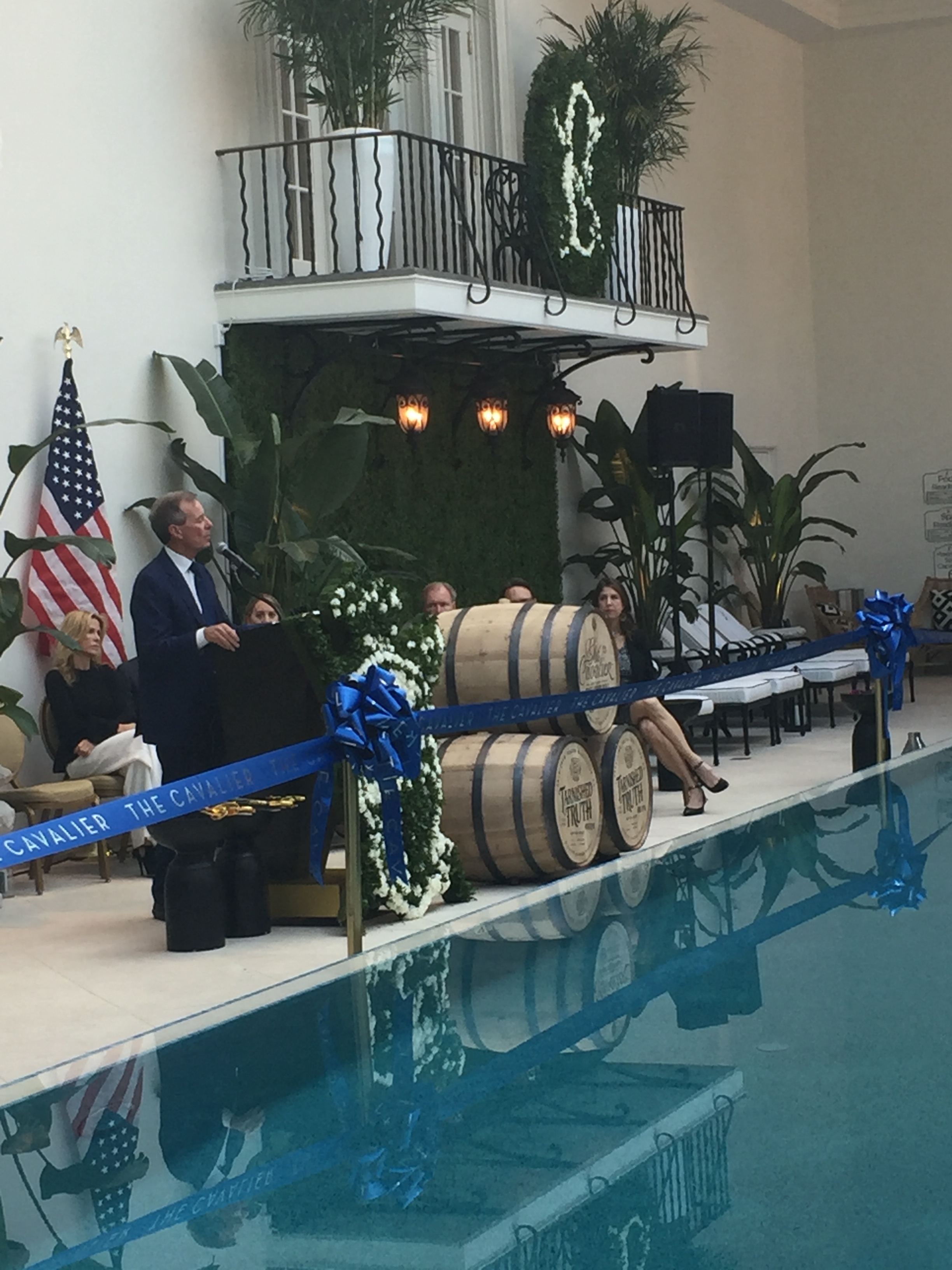
The spirits of people gathered for Friday’s ribbon cutting ceremony for the Cavalier Hotel in Virginia Beach were as high as the nor'easter winds that moved the ceremony from the lawn of the historic landmark to an area surrounding the indoor pool.
Alongside shimmering water and urns filled with lush birds of paradise plants, nearly 400 people gathered to celebrate the reopening of The Cavalier, an $81 million renovation project nearly five years in the making.
“It’s been a long time coming, and it’s been a quite a process,” said Bruce Thompson, the project’s developer and a partner in Cavalier Associates, a group of local business men whose bid to purchase and renovate the hotel was credited Friday with saving the building from the auction block. The other partners are Frank Reidy, George Metzger, Bart Frye, Ed Ruffian and John Lawson.
In 2012, a judge ordered that the property be sold to resolve a lawsuit over minority shareholder rights filed by warring factions of the property’s owners, the Disthene Group.
While some developers wanted to demolish the 85-year-old hotel and put up high-density projects, Thompson, the CEO of Gold Key| PHR, a Virginia Beach based hospitality company, said he and his partners considered it “an honor and a privilege” to save a structure that had played such an important role in the fabric of the community. The seven-story hotel at 4200 Atlantic Ave. had been a venue for weddings, meetings and vacations ever since the Cavalier opened in 1927.
By the time Cavalier Associates bought the 22-acre property in 2013 along with another hotel across the street for $35 million, The Cavalier was in a state of ruin, Thompson told the audience. Consequently, the project took more money and more time than Thompson’s group or the city of Virginia Beach had envisioned. What started out as a two-year, $40 million renovation doubled in price and took more than twice as long as originally anticipated. “It took a village to make it happen,” Thompson said, crediting the other parties who were involved.
The city stepped up with nearly $25 million in money and incentives to help finance the renovation, which also benefitted from state historic tax credits. The old hotel on the beach was demolished, and a Marriott Hotel and an Embassy Suites will be built at that location as part of a larger project that will bring more conference space to the beach resort city. Thompson’s group also developed a new residential community of homes, cottages and bungalows on the grounds surrounding the Cavalier.
May brings the reopening of the oceanfront Cavalier Beach Club, which was known for hosting some of the most popular bands of the Big Band era. All told, the Cavalier project represents an investment of more than $200 million.
Julie Langan, director of the Virginia Department of Historic Resources, was one of the speakers during the opening ceremony. She praised the city and Cavalier Associates for stepping up to preserve The Cavalier. “This is an extremely important project for the state, because it will be a boost to heritage tourism, “ she told Virginia Business. “It will be the poster child for the historic tax credit program.”
Virginia Beach Mayor Will Sessoms also spoke. He said he brought his 94-year-old mother to the ceremony. “She threatened to disown me, if the city didn’t save the hotel,” he joked.
“Today, the past meets the present and the future. We were proud to partner with you to save this castle on the hill,” Sessoms told Thompson. According to the mayor, the renovated 85-room Cavalier is expected to generate $41 million to $52 million in new tax revenue in the first 20 years. The property employs 200 people year-round and 330 during its busiest seasons.
“Our vision is to grow Virginia Beach into a year-round tourism destination. The Cavalier has been restored and will help us with that vision,” the mayor said.
The property, which will be operated by Gold Key | PHR, is a member of Marriott’s Autograph Collection, an exclusive group of luxury boutique hotels. Mike Frye, a vice president of lodging development for Marriot, said when he first walked through the hotel four years ago to consider it as a candidate for the collection, “It wasn’t a hotel. It was dilapidated. It was tired. The rooms were tiny. It was a remnant of a bygone era.”
Frye told the gathering at the ceremony that he and a colleague wrestled with whether the property could qualify for the collection, because so much time and money would be needed to bring the property to Marriott’s Autograph standards. While such hotels are independently owned and operated, a collection branding makes a property more distinctive. “But what we came back to every single time was that every great independent hotel has someone with passion, vision and drive, and it has a community behind it. We said, ‘That’s what is here. Let’s work as a team and make this happen. ‘”
In 2014, the Cavalier’s application for inclusion on the National Register of Historic Places was approved, a development that helped set the course for the renovation. Thompson called the designation “both a blessing and curse.” While it helped win historic tax credits to defray the cost, it also meant painstaking detail to the structure’s architectural integrity.
“This was the toughest job we’ve ever done,” said Lawson, whose company, W. M. Jordan in Newport News, served as the general contractor.
One challenge was replacing or making new all of the building’s steel. Due to the need to preserve the building’s exterior, all the steel work had to be done from the inside of the building.
Overall, Thompson said the biggest challenge was “trying to find what the exact condition of the hotel was, trying to get to the end of the rehabilitation process … At the end of the third year, a year after we thought we’d be open, we were still in reconstruction and every day was a surprise.’’
As the rehabilitation stretched on, Thompson said the original interior design firm grew frustrated and stopped work on the job. Meanwhile millions of dollars in change orders kept coming.
Many of the hotel’s old bones, like the Hunt Room’s fireplace, were structurally compromised. To repair the fireplace, brick masons had to remove each brick one at a time, reinforce the fireplace with steel beams and re-lay each brick in its original order and location.
Once the rehabilitation work was done, “it only took a year for us to do the renovation,” said Thompson. “But the first three and half to four years, it didn’t seem like there was any end to the black hole that money was going into,” Thompson said.
The delays and need for more money — the Virginia Beach City Council originally committed to $18 million and later agreed to put up an additional $6.5 million in financial incentives — drew some public criticism.
Yet, Thompson noted that the community’s interest in the iconic hotel was evident during two weeks of free public tours that drew 10,000 people.
A luncheon and tours of the hotel followed Friday’s ribbon cutting. Many people took advantage of a chance to sign a barrel from the hotel’s new onsite bourbon distillery, Tarnished Truth, located next to the Hunt Room, a restaurant and lounge in the hotel’s lower level. Thompson said people who signed would be invited back 10 years later to receive a bottle of the 10-year aged liquor.
Besides the new distillery, people toured the hotel’s three restaurants, its lobby with original checkerboard terrazzo floor and a new spa. Another high point was visiting the suites of the partners of Cavalier Associates. Thompson said the partners all agreed to hire interior designers and to foot the bill for a themed suite, which created another unique element for the hotel.
The theme in each of the spacious suites is different. Thompson’s suite, complete with a victrola and a coat rack of ladies hats from the 1920s, is dedicated to the flappers and the big bands that used to play in the hotel’s Crystal Ballroom.
Lawson went with a nautical theme. His suite is decorated in hues of blue and yellow, with brass accessories and nautical paintings. The idea was to create the feel of a captain’s quarters.
Lawson, who attended the celebration, noted that his room, 602, was the place where Adolph Coors of the Coors beer fortune had stayed in June 1929 before he was found dead on the ground outside the hotel. “Obviously, I’m not a superstitious fellow. I’m sleeping there tonight,” said Lawson.
The celebration continued into Friday evening with invited guests enjoying a cocktail reception, dinner and dancing to the big band sounds of Good Shot Judy in the Crystal Ballroom.
With partygoers bedecked in tuxedos and women wearing beaded dresses and headbands that evoked the 1920s, it was easy to reimagine the grandeur of the Cavalier’s heyday when it attracted presidents and movie stars.
The hotel officially opens to the public on Wednesday, March 7. The public is invited to a grand illumination and fireworks display that will be held on the lawn at nightfall.
Service Employees International Union (SEIU) Virginia 512
Fairfax
17,141
4
ChamberRVA
Richmond
12,283
5
Capital Results LLC
Richmond
12,223
6
Virginia21
Richmond
11,949
7
Virginia American Federation of Labor and Congress of Industrial Organizations (AFL-CIO)
Henrico County
11,228
8
Virginia Trial Lawyers Association
Richmond
10,706
9
Virginia Municipal League
Richmond
9,340
10
Chesapeake Bay Foundation
Richmond
9,283
Note: This is a list of entertainment and gifts that lobbyists reported providing to legislative and executive officials.
Source: Virginia Public Access Project
We use cookies on our website to give you the most relevant experience by remembering your preferences and repeat visits. By clicking “Accept All”, you consent to the use of ALL the cookies. However, you may visit "Cookie Settings" to provide a controlled consent.
This website uses cookies to improve your experience while you navigate through the website. Out of these, the cookies that are categorized as necessary are stored on your browser as they are essential for the working of basic functionalities of the website. We also use third-party cookies that help us analyze and understand how you use this website. These cookies will be stored in your browser only with your consent. You also have the option to opt-out of these cookies. But opting out of some of these cookies may affect your browsing experience.
Necessary cookies are absolutely essential for the website to function properly. These cookies ensure basic functionalities and security features of the website, anonymously.
Cookie
Duration
Description
cookielawinfo-checkbox-analytics
11 months
This cookie is set by GDPR Cookie Consent plugin. The cookie is used to store the user consent for the cookies in the category "Analytics".
cookielawinfo-checkbox-functional
11 months
The cookie is set by GDPR cookie consent to record the user consent for the cookies in the category "Functional".
cookielawinfo-checkbox-necessary
11 months
This cookie is set by GDPR Cookie Consent plugin. The cookies is used to store the user consent for the cookies in the category "Necessary".
cookielawinfo-checkbox-others
11 months
This cookie is set by GDPR Cookie Consent plugin. The cookie is used to store the user consent for the cookies in the category "Other.
cookielawinfo-checkbox-performance
11 months
This cookie is set by GDPR Cookie Consent plugin. The cookie is used to store the user consent for the cookies in the category "Performance".
viewed_cookie_policy
11 months
The cookie is set by the GDPR Cookie Consent plugin and is used to store whether or not user has consented to the use of cookies. It does not store any personal data.
viewed_cookie_policy
11 months
The cookie is set by the GDPR Cookie Consent plugin and is used to store whether or not user has consented to the use of cookies. It does not store any personal data.
Functional cookies help to perform certain functionalities like sharing the content of the website on social media platforms, collect feedbacks, and other third-party features.
Performance cookies are used to understand and analyze the key performance indexes of the website which helps in delivering a better user experience for the visitors.
Analytical cookies are used to understand how visitors interact with the website. These cookies help provide information on metrics the number of visitors, bounce rate, traffic source, etc.
Advertisement cookies are used to provide visitors with relevant ads and marketing campaigns. These cookies track visitors across websites and collect information to provide customized ads.

 Sign In
 Free Newsletter

 Back in 1992, the iconic and irascible political strategist James Carville coined the phrase, “The economy, stupid.” This was his rallying cry in keeping Bill Clinton’s campaign workers on message during his successful run against President George H.W. Bush. The phrase reminded Clinton’s followers that the country was in recession and people were hurting. Remembered today in a slight variation — “It’s the economy stupid” — there has probably never been a more effective political message.