Sign In
Upcoming Event
 Free Newsletter

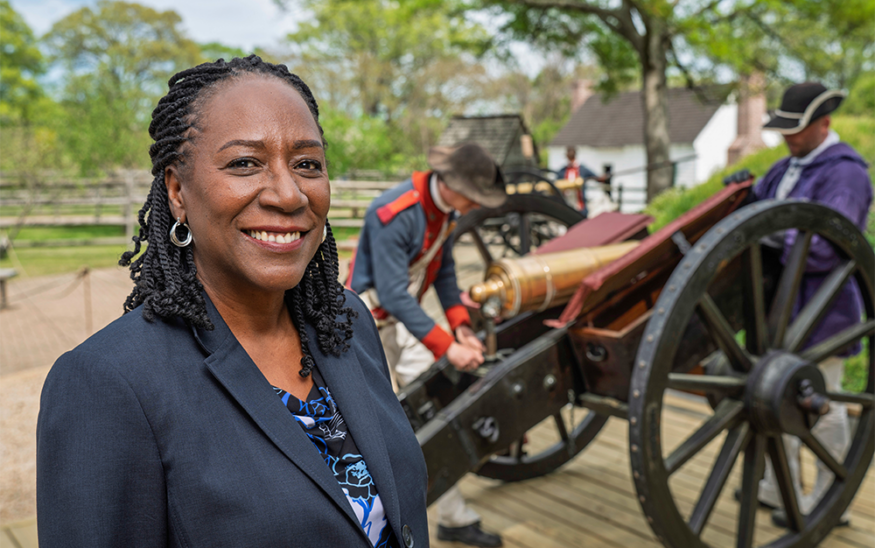
Tourism related to America’s 250th birthday is up, says Christy S. Coleman, executive director of the Jamestown- Yorktown Foundation, which saw May guided tours getting booked last August. Photo by Matthew R.O. Brown
Tourism related to America’s 250th birthday is up, says Christy S. Coleman, executive director of the Jamestown- Yorktown Foundation, which saw May guided tours getting booked last August. Photo by Matthew R.O. Brown
Virginia tourism sites bank on America’s 250th birthday



Summary:
- St. John’s Church reenactments attract over 250 visitors
- VA250 commission awarded $27 million for semiquincentennial events
- Richmond hotel occupancy rises 4% year-over-year in February
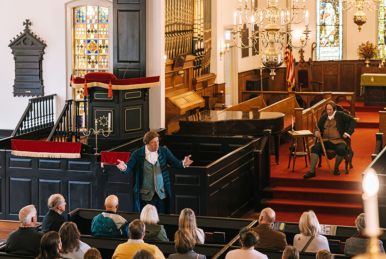
In late February, almost a year after the 250th anniversary of Patrick Henry’s “Give me liberty, or give me death!” speech at St. John’s Church in Richmond, something unexpected happened inside the church’s hallowed halls.
St. John’s was heading into what was supposed to be a quiet year, at least compared to 2025, the 250th anniversary of Henry’s speech. Even though 2026 is the 250th anniversary of the Declaration of Independence, St. John’s Church Foundation Executive Director Stephen Wilson thought there was no way this year’s tourism attendance would outperform 2025.
But then, in February, 260 people showed up to the church’s first speech reenactment of the year, an event that usually attracts 70 to 80 visitors. Wilson figured it was a fluke, but then a month later, at the March 23 reenactment, 250 people showed up when he was expecting 100.
Wilson is cautious about making predictions, often assuming higher than expected attendance is an anomaly. But something is clearly going on, he says: At the end of March, reenactments for June already had dozens of people signed up. This time last year, there were maybe around four in the books.
“I always think winds are going to dry off on us, but they’re not right now,” he says. “Right now, we’re hot.”
Part of what’s driving this, he says, is the massive statewide celebration of the 250th anniversary of the Declaration of Independence. Planning for the U.S. semiquincentennial has been underway in Virginia since the General Assembly created the state American Revolution 250 Commission (VA250) in 2020.
Virginia had 44.7 million overnight visitors in 2024, an increase of more than 1 million over 2023. VA250 projects that the semiquincentennial could attract 7 million to 10 million visitors, with as much as $1.5 billion in economic impact statewide.
To meet the moment, tourism officials are creating one-of-a-kind experiences and highlighting the unique historical characteristics of their museums and attractions in hopes that interest in Virginia and U.S. history will be enough to offset economic uncertainty in leisure travel.
While she’s hesitant to deliver a prediction, Virginia Tourism Corp. President and CEO Rita McClenny says she hopes visitation to Virginia will increase by 3.4% over 2024 this year, driven by the semiquincentennial.
“Virginia history is so rich,” McClenny says, “and this is the time for everyone in the world to come to Virginia because we were the first.”
Uncertain travel landscape
In 2020, the General Assembly created VA250 as a centralized hub for coordinating the semiquincentennial celebration.
The VA250 commission has dozens of local committees across the state and partnerships with municipalities, businesses and universities. Its focuses include marketing, paid and earned media, and events.
Its “Signature Event Series” will bring international tall ships and military ships to Norfolk for Sail250 Virginia and a celebration of the anniversary of Richard Henry Lee’s Resolution for Independence at the Stratford Hall Historic Preserve.
It’s also running the VA250 Mobile Museum Experience, bringing traveling history lessons to schools and events across Virginia, and the VA250 Passport, a faux passport that promotes 70 museums and historic sites, encouraging tourists to visit sites and collect stamps for admission discounts and prizes. More than 16,000 passports have been distributed from January through March, McClenny says, largely at the commonwealth’s 12 welcome centers.
The commission received $27 million from the state to support its mission from 2020 through 2031, says spokesperson Erin Bagnell. The money is used primarily for grants supporting events and programs related to the semiquincentennial. Its operations are expected to continue into 2031, which will mark the 250th anniversary of the Siege of Yorktown and the British surrender. VA250’s corporate financial supporters include Dominion Energy, Colonial Williamsburg, CoStar Group, TowneBank and Altria.
VA250’s honorary national chair, Carly Fiorina, the Colonial Williamsburg Foundation chair and former Hewlett-Packard CEO, says that Virginia has a responsibility to lead in telling the story of the nation’s founding.
“This moment creates an opportunity for communities across the commonwealth to translate heritage into sustained economic vitality,” Fiorina said in a statement. “We are not only honoring Virginia’s history but also fostering long-term economic growth by driving traffic to historical sites, attractions and local businesses.”
The semiquincentennial comes at a time when the frenzied momentum from post-pandemic travel is showing signs of slowing.
Leisure travel sentiment has shifted over the past few years, says Christy S. Coleman, executive director of the Jamestown-Yorktown Foundation, which oversees the Jamestown Settlement living history museum and the American Revolution Museum at Yorktown.
Since the pandemic, trips to historic areas have gotten shorter, averaging around two days as opposed to three or four, she says. International travel was down last year, especially from Canada, Coleman says, and travel industry data indicates people making less than $100,000 a year are becoming choosier when it comes to travel spending.
But Katherine O’Donnell, president and CEO of Richmond Region Tourism, says there’s a ton of interest in traveling for the semiquincentennial. O’Donnell cites a November 2025 study of 1,000 American travelers from travel market research firm Longwoods International, which found 61% of travelers who knew about the country’s 250th celebration said they were likely to take an overnight trip tied to it. The study was commissioned by travel marketing consultancy Miles Partnership.
So far this year, tourism has been strong in the Richmond area, O’Donnell says. Hotel occupancy was 60% in February, a 4% year-over-year increase. This, Richmond Region Tourism spokesperson Grantland Steele says, can be attributed partly to historic tourism, but also meetings and conventions and leisure travel.
At the end of January, Richmond Region tourism launched its new “Always Revolutionary” ad campaign, marketing the area’s history. It targets visitors in regional drive markets and East Coast travelers for whom Richmond is an “easy and appealing overnight destination,” Steele says.
For the semiquincentennial, the big events in Richmond will be Richmond SailFest from June 12-16 and IllumiNATION, a June 25-28 nighttime celebration at the Virginia Museum of History & Culture with video art projections on the building’s facade.
Economic uncertainty remains a concern for leisure travelers, O’Donnell says. Bookings aren’t coming super far in advance, likely indicating people are still deciding if they’re going to travel at all over the next few months. But Richmond has enough groups coming to travel for events like the 2026 National Speech & Debate Tournament this summer for guaranteed business, O’Donnell said.
“I’m hearing overall, particularly in March and spring, people are feeling good,” O’Donnell says of tourism industry partners in Richmond. But “in terms of leisure travel, people are not booking very far out because of instability in the economy and globally.”
‘Epicenter’ of celebration
Jamestown-Yorktown Foundation museums stand to benefit most from the event McClenny calls the “epicenter” of the semiquincentennial: the Fourth of July celebration at Colonial Williamsburg, a multiday event featuring visits with historic interpreters portraying key figures like George Washington and the Marquis de Lafayette, a performance of the musical “1776” at the Kimball Theatre, and more.
It will culminate with a fireworks spectacular that will be “the best fireworks in our history,” according to Ronald L. Hurst, chief mission officer at Colonial Williamsburg Foundation. “Usually, we do programming every day, but the big program is generally just on the Fourth of July. This year, the programming will be over several days.”
Hurst and foundation spokesman Kevin Crossett declined to provide details on what bookings are looking like for this summer and what the foundation anticipates the financial impact of the semiquincentennial will be. Crossett said the nonprofit foundation doesn’t release that information. The foundation’s website says Colonial Williamsburg sees more than half a million visitors each year; previous reporting shows the historic site had close to 1 million visitors in 1999 and 534,000 in 2019.
Data from local destination marketing organization Visit Williamsburg shows that the Williamsburg area — including James City and York counties and the city of Williamsburg — saw about $983 million in visitor spending in 2024, up from $974 million in 2023. In 2019, before COVID, visitor spending was $809 million.
The Jamestown-Yorktown Foundation museums, which see a total of 425,000 visitors a year, could benefit from the Colonial Williamsburg Fourth of July celebration, Coleman says, especially if repairs are completed on the Colonial Parkway.
“If construction is complete and opens up the stretch, I would be really more enthusiastic and say, ‘Yeah, we’re definitely going to get people to come through,’” Coleman says.
The four-year, $123 million roadway project involves rehabbing pavement and shoulders, repairing the Williamsburg Tunnel and 11 bridges, as well as making drainage and stormwater improvements and guardrail upgrades. Originally expected to be finished by June, the project is scheduled to be fully complete by “late fall,” according to the National Parks Service.
Nevertheless, the museums have had a busy year so far, Coleman adds. For its current fiscal year, which ends June 30, the foundation has seen 225,000 travelers so far, compared with 224,000 last year.
Groups have been booking much farther in advance this year as well. Guided group tours have been booked through May 2026 since August 2025, she says.
“The fall season through December would usually be booked by August, and then there would be another round of spring bookings,” Coleman says. “But teachers have gotten on it — they know they gotta do it now, especially if they want a guided tour experience.”
Other tours themed to American Revolution tourism and the 250th anniversary are occurring at the Virginia estates of America’s first and third presidents.
In May, Thomas Jefferson’s Monticello will hold a special home tour guided by Mr. Jefferson himself, played by historical interpreter Bill Barker, with Jefferson reflecting on the ideals and legacy of the Revolution. Monticello will also hold its traditional Fourth of July celebration, which will include a naturalization ceremony.
And George Washington’s Mount Vernon is also going big on VA250. Throughout the year, Mount Vernon will host a flurry of events, including an exhibition, “George Washington: A Revolutionary Life,” focusing on how the decisions Washington made in his lifetime reverberate into the 21st century.
Even if people are a bit wary of traveling with higher prices at the gas pump, the semiquincentennial events will likely have the intended result of boosting Virginia history tourism, tourism officials say.
“We’re cautiously optimistic,” Coleman says. “We’re going to offer amazing opportunities for visitors of all ages and types. We have fabulous exhibitions and programs planned, and it’s significant for us.”
!