Sign In
Upcoming Event
 Free Newsletter

Port-driven logistics market rebalances
Developers pause constructing new industrial buildings in Hampton Roads
Cathy Jett April 29, 2026//
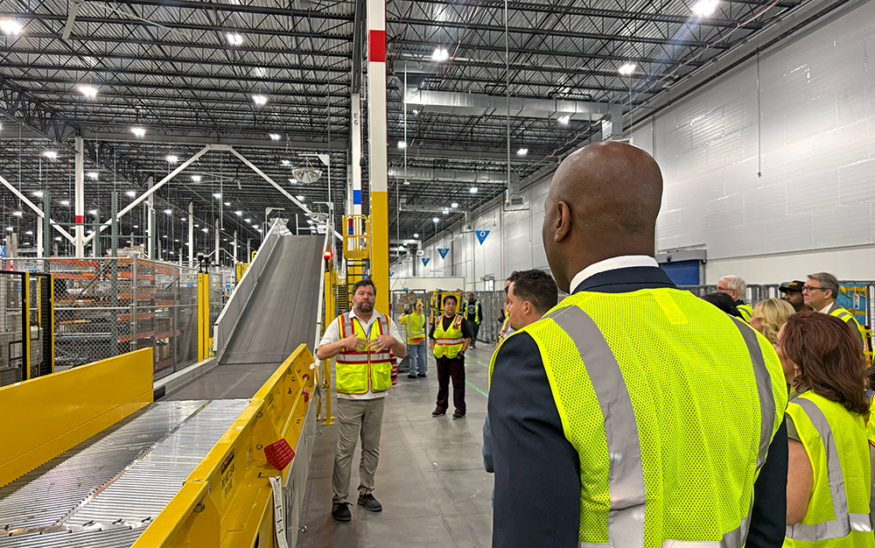
Virginia officials tour Amazon’s delivery station in Virginia Beach, one of multiple facilities built recently in Hampton Roads. Photo courtesy Amazon
Virginia officials tour Amazon’s delivery station in Virginia Beach, one of multiple facilities built recently in Hampton Roads. Photo courtesy Amazon
Port-driven logistics market rebalances
Developers pause constructing new industrial buildings in Hampton Roads
Cathy Jett// April 29, 2026//



Summary:
- Developers pause speculative warehousing in Hampton Roads
- Tariffs have affected need for industrial space, although leasing is expected to increase
- Vacancy rate rose to 14.6% for large industrial buildings at end of 2025
Developers have paused speculative construction of large warehousing and logistics spaces in Hampton Roads, as the industrial market tied to the Port of Virginia adjusts to a recent wave of new supply.
Much of that space was planned during the pandemic but delivered into a softer market as tariffs enacted in 2025 weighed on port activity.
“Everyone was anticipating an increased demand for space in that area based on the way the market tightened up during the pandemic, and the tariffs certainly weren’t on anyone’s radar when construction started on most of those projects,” says Liz Greving, research manager with commercial real estate firm Cushman & Wakefield | Thalhimer.
The Port of Virginia saw several years of sustained growth until 2025, when tariffs and retaliatory trade measures amid President Donald Trump’s trade war affected exports, particularly of corn and soy to China. Annual TEU (20-foot equivalent units) volume fell 8.1%, imports slipped 5.1%, and Class A vacancy in buildings over 100,000 square feet ended the year at 14.6%, according to the latest data generated for Thalhimer.
However, leasing activity is expected to increase, and vacancy rates are expected to decline this year. Bo McKown, senior vice president for Thalhimer’s Capital Markets Group, says he’s already seeing an uptick in defense-related inquiries from large-scale users such as General Dynamics, RTX and Boeing, as well as ancillary users and subcontractors, as tensions in Iran continued through March.
“Hampton Roads is still highly sought after by investors and tenants and developers specifically,” he says. “The main draw for investment there is its proximity to the Port of Virginia. Right now, it’s the third largest port on the East Coast, the No. 1 rail-served port, and it’s really been growing at a significant clip over the past five years.”
The port finished its six-year $450 million dredging project in February, making it the deepest and widest harbor on the East Coast. Today the port allows two-way access for ultra-large container ships, the biggest boxship class in the Atlantic trade lanes.
This, along with such regional improvements as the $3.9 billion Hampton Roads Bridge-Tunnel expansion set to be complete in 2027, “position the new Class A warehouse developments completed in recent months throughout Hampton Roads for a strong rebound of warehouse tenants in 2026,” says Lang Williams, an executive vice president at Colliers.
Meanwhile, shallow-bay buildings totaling 50,000 square feet or less “have seen a ton of demand, and the vacancy rate in those buildings is sometimes as low as 1% to 2% depending on what submarket you’re in,” McKown notes.
Tenants for these types of buildings are diverse, ranging from roofers, landscapers and HVAC companies to last-mile distribution businesses, he says. “We could certainly use more product delivered catering to those small and midsize tenants.”
Overall vacancy in Hampton Roads ended 2025 at 7.1%, an increase of 50 basis points quarter-over-quarter and a jump of 270 basis points year-over-year, according to Thalhimer’s Hampton Roads fourth-quarter Marketbeat report for industrial properties.
While Hampton Roads is absorbing a wave of new supply, a very different dynamic is playing out inland.
Logistics space is in high demand near the Virginia Inland Port in Front Royal, where the vacancy rate is “effectively zero,” according to Daniel M. DiLella Jr., senior vice president at Equus Capital Partners.
That supply constraint could ease somewhat as new Class A industrial space breaks ground this year in the Interstate 66 Industrial Park in nearby Warren County. Those buildings are expected to attract a mix of inland port users and companies expanding from Northern Virginia, including firms supporting the data center industry.
Geoff Poston, senior vice president at Cushman & Wakefield | Thalhimer, points to “flight to quality” as some industrial tenants seek to relocate from older, higher-cost infill structures to newer facilities with greater clearance height, power capacity and modern features.
“They’re saying, ‘Man, I can go lease in Suffolk. It’s further away and a longer drive, but it’s brand-new space with all the bells and whistles and a cheaper rate,” he says.
While data center growth in Virginia hasn’t yet reached Hampton Roads, competition for power availability and capacity is becoming more important as industrial tenants seek newer facilities with greater electrical capacity and modern features, such as automation, robotics and electric truck fleets.
Amazon’s recent developments reflect the evolution of these facilities. The company opened a 3.2 million-square-foot fulfillment center in Virginia Beach in November 2025 that uses advanced robotics, along with a nearby delivery station in September 2024 that deploys electric vans.
“Power is a major driver,” Poston says, “because it’s increasingly difficult to find space with sufficient capacity to meet modern needs.”
T