Sign In
Upcoming Event
 Free Newsletter

What’s next after Virginia Supreme Court’s redistricting decision?
Democrats search for next steps as midterms approach
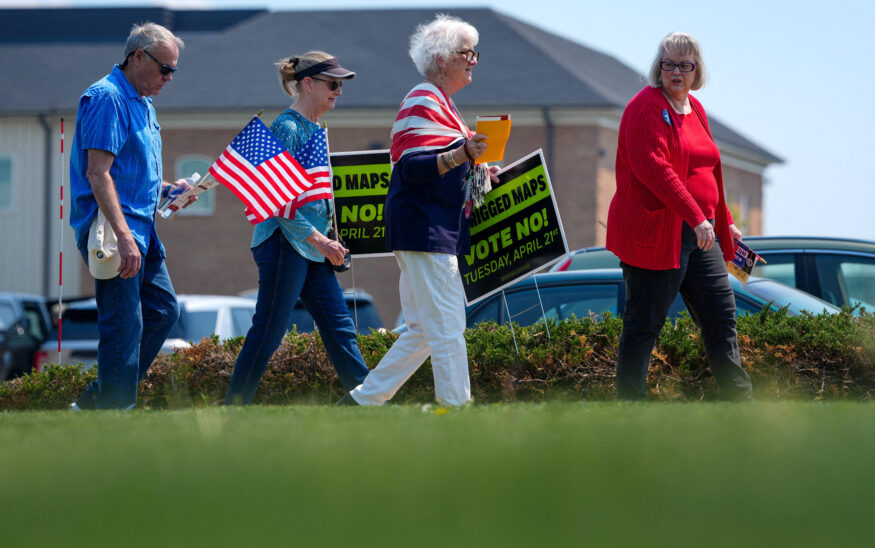
Supporters depart a campaign rally against Virginia Democrats' proposed state redistricting constitutional amendment ahead of the referendum special election on April 21, in Bridgewater, Virginia, April 11, 2026. REUTERS/Ken Cedeno/File Photo
Supporters depart a campaign rally against Virginia Democrats' proposed state redistricting constitutional amendment ahead of the referendum special election on April 21, in Bridgewater, Virginia, April 11, 2026. REUTERS/Ken Cedeno/File Photo
What’s next after Virginia Supreme Court’s redistricting decision?
Democrats search for next steps as midterms approach



SUMMARY:
State Senate Majority Leader Scott Surovell called it “a pretty unprecedented step in the 250-year history of democracy and our commonwealth.”
Senate Minority Leader Ryan McDougle said it “affirmed that even the General Assembly must follow the law.”
And Richmond appellate attorney Rachel Yates said it is an example of how “our Supreme Court loves a technical argument.”
The eyes of the political world have been on Virginia in recent days following the Supreme Court of Virginia’s 4-3 decision in Scott v. McDougle on Friday to throw out a constitutional amendment that would have allowed the General Assembly to redraw Virginia’s congressional electoral maps ahead of the 2026 midterms.
The maps, which were approved by voters by a 2.9-point margin April 21, 17 days prior to the decision, would have given Democrats an advantage in all but one of Virginia’s 11 congressional districts.
In the majority opinion, Justice D. Arthur Kelsey wrote that the legislature violated Article XII, Section I of the Constitution of Virginia, creating a violation that “incurably taints the resulting referendum vote and nullifies its legal efficacy.”
In tossing the maps, Kelsey wrote that the case hinged on the definition of a general election — whether it is Election Day itself or the entire period encompassing early voting. The majority favored the broader definition.
“[W]e hold that the definition of ‘general election’ in Article XII, Section I describes the combined actions of voters casting ballots and officers of election receiving those votes and closing the polls on the last day of the election,” Kelsey wrote.
Chief Justice Cleo E. Powell’s dissent said that the majority “broadened the meaning of the word ‘election,’ as used in the Virginia Constitution, to include the early voting period.”
“This is in direct conflict with how both Virginia and federal law define an election,” Powell wrote.
Three days later, House Speaker Don Scott, Senate President Pro Tempore L. Louise Lucas and Surovell filed an emergency appeal with the U.S. Supreme Court to stay the ruling, based on “the novel and manifestly atextual interpretation” of what defines an “election.”
“A stay is warranted because the decision by the Supreme Court of Virginia is deeply mistaken on two critical issues of federal law,” the petition stated. Those areas of federal law are on what the petitioners allege is an expressly fixed single-day definition of “election” and that the state’s high court “transgressed the ordinary bounds of judicial review such that it arrogated to itself the power vested in the state legislature to regulate federal elections.”
While the emergency appeal for stay remained pending before the U.S. Supreme Court on Wednesday, some experts who spoke with Virginia Lawyers Weekly believed time was running out for the new maps to be implemented by the 2026 midterms.
“My guess is the [U.S.] Supreme Court would not have any interest in adjudicating,” said Stephen Farnsworth, professor of political science at the University of Mary Washington. “It’s not a particularly favorable time, more generally, for Democratic initiatives before the current Supreme Court, and that’s above and beyond the issue of state constitutional interpretation.”
Decision reaction
The state high court decision marked the latest chapter in efforts by both major political parties in several states to draw congressional maps in favor of their parties to gain control of the House of Representatives following the midterm elections — a process commonly referred to as gerrymandering.
With states achieving varying degrees of success with redistricting, the Supreme Court of Virginia’s decision to negate the referendum following a statewide vote drew strong reactions across the political spectrum.
“It’s obviously disappointing, and I think it’s inconsistent with how the General Assembly has interpreted the word ‘election’ within [the Virginia Constitution] since the constitution of 1971 was adopted,” Surovell said. “We built an entire statutory framework around that understanding, which the court did not give a lot of weight to.”
Additionally, Surovell said, “To my knowledge, it is also the first time the Supreme Court of Virginia has struck down the validity and the results of a statewide election.”
In an emailed statement, McDougle said the ruling “affirms what we all know: you cannot violate the Constitution to change the Constitution.”
McDougle also credited the justices’ “careful and thorough review” of the matter.
“This ruling is not a partisan one — it is a constitutional one,” McDougle said. “The rule of law is the foundation of our commonwealth, and today it has been upheld.”
Addressing appellate attorneys, Yates, who leads Yates Appellate Law, said the decision had some main takeaways for practitioners and cautioned the jump to assume political bias played a role.
“When we have a split decision like this, it makes it harder for non-attorneys not to view this as a political decision,” Yates said. “But we also need our justices to vote with their consciences and to do what they believe is proper.
“I’m certain the Supreme Court did what it could to try to reach consensus, but they simply couldn’t do it here,” Yates added.
Fairfax County attorney Juli Porto, who practices appellate law at Blankingship & Keith, said she found the opinion notable “for its treatment of the relationship between statutory definitions and constitutional text.
“The majority’s refusal to allow Code § 24.2-101’s definition of ‘general election’ to control the constitutional analysis shows that the Court will not allow the General Assembly to effectively amend the Constitution by redefining its terms through ordinary legislation,” Porto continued.
In elaborating on how the high court “loves a technical argument,” Yates said the decision states the process of the referendum was wrong.
“It reiterates how important procedure is, and Virginia lawyers should take note,” Yates added. “There were very skilled advocates on both sides.”
Apart from the major redistricting question, Surovell said he believes the decision brings up a separate issue. Article II, Section 9 of the Constitution of Virginia states that no voter can be “compelled to perform military service … nor to attend any court as suitor, juror, or witness; nor shall any such voter be subject to arrest under any civil process during his attendance at election.”
Under the majority’s definition, Surovell said, the period where a person in theory could avoid appearing in court expands.
“Aside from creating logistical problems in civil cases, it creates potentially more significant problems in the criminal context,” Surovell said. “I think you’re going to see a lot of unintended consequences flow from this ruling.”
What’s next?
In the aftermath of the court’s decision, Democrats in Virginia and nationally were left searching for next steps to attempt to institute the maps prior to the 2026 midterms, resulting in the state legislators’ Monday appeal to the U.S. Supreme Court.
However, Farnsworth noted that time is quickly running out, with primaries slated to be held in August.
“The window is rapidly closing,” Farnsworth said, although “one could imagine a primary in September, which would give the Supreme Court a few more weeks.”
Farnsworth said that with all things considered, “the wise approach for candidates and voters and donors is to assume that the old lines from two years ago will be the lines that voters are looking at this year.”
Former Gov. L. Douglas Wilder, who serves as a distinguished professor at Virginia Commonwealth University’s Wilder School of Government and Public Affairs, said he believes there are no further options to get the maps approved by November’s elections.
“You pretty much have concluded that there are no legislative avenues left,” said Wilder, a Democrat. “No, there’s nothing else for them to do.”
Wilder juxtaposed the current redistricting push with the change at the beginning of the decade towards the bipartisan redistricting commission, which ultimately deadlocked and led to the Supreme Court of Virginia’s drawing the current legislative maps in 2021.
“Now to come back to try to resurrect legislative control over it was not well thought out, nor was it well done as far as the people are concerned,” Wilder said. “The effect would be that there’s no real place that the people feel they can rest their hopes in what is best in terms of redistricting.”
Looking ahead, Farnsworth said that he would not be surprised if the “10-1” maps are revisited at a later date.
“With the current makeup of the House of Delegates, it wouldn’t surprise me if we look at another redistricting election in two years,” Farnsworth said, citing the Democratic Party’s view of Virginia as a place to “point to where they have the opportunity to pick up a number of districts.”
Political impact
Apart from the legal implications, political scientists and experts have discussed potential political and electoral impacts of the redistricting referendum.
Under the current maps, in a midterm election anticipated to be a referendum on President Donald Trump, whose favorability ratings have fallen, Farnsworth said the “dynamics in Virginia are such that Democrats might pick up one to two seats under the old lines.
“It’s not as much as the four seats that were anticipated under the new lines, but it is a significant gain in a delegation that’s currently 6-to-5,” he added.
Despite the party’s loss at the Supreme Court of Virginia, “it’s still a dynamic overall in the country that favors the Democrats,” said Farnsworth, adding that on average in a midterm election, the party in opposition to the president gains 17 seats in the House of Representatives.
Mark J. Rozell, dean of the Schar School of Policy and Government at George Mason University, said the midterm referendum was “a risky strategy given that it was open to court challenge and that it inflamed rural opposition” against Democrats heading into the election.
“It was unnecessary given the likelihood of a Democratic wave midterm election cycle where the party could easily pick up two and perhaps three seats under the current districts,” Rozell said.
While efforts to institute the new maps appear to be stalled, Rozell said a strategy shift is in store for Democrats heading into the election season.
“At this point, Democrats need to recommit their energies to the current districts and hope that any lingering bad feelings among opponents of the referendum are largely forgotten by the time the voting starts,” he said.
Virginia’s fall elections will hinge on the question of “who is taking and making a case for the voters,” Wilder said.
“That has to start at the top,” he added. “Who is really going to do something about the cost of living? Who is going to be doing something and going to be meaningfully involved with healthcare?”
The former governor, who worked as an attorney prior to his political career, emphasized that “all politics, the best politics, are local.
“And when you talk about politics, you’re talking about money,” Wilder added. “And there’s no subject that you can bring up in government or politics that doesn’t involve money, how it’s being spent and who spends it.”
F