Sign In
Upcoming Event
 Free Newsletter

Virginia offshore wind project now producing power
Trump administration issued stop-work order in December 2025
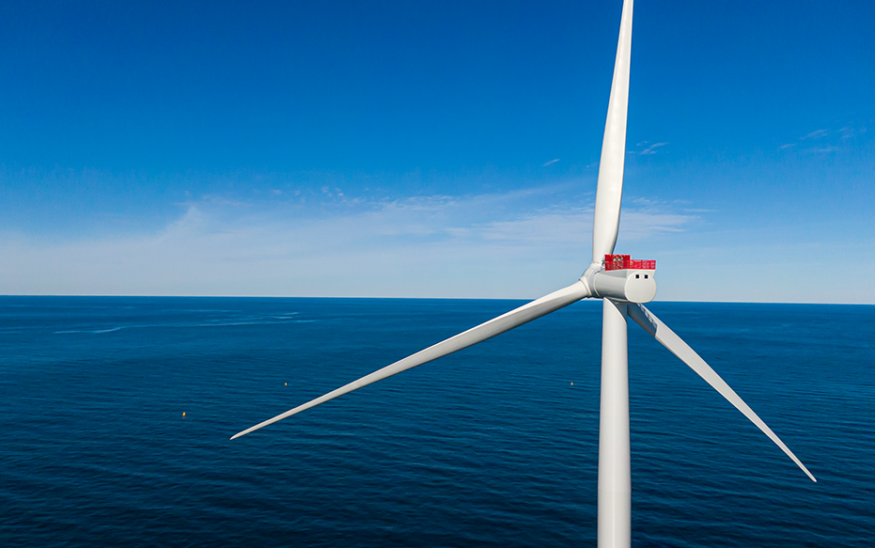
Dominion Energy’s $11.5 billion offshore wind project off the coast of Virginia Beach began supplying energy in March. Photo courtesy Dominion Energy
Dominion Energy’s $11.5 billion offshore wind project off the coast of Virginia Beach began supplying energy in March. Photo courtesy Dominion Energy
Virginia offshore wind project now producing power
Trump administration issued stop-work order in December 2025



Summary:
- Dominion Energy‘s $11.5 billion offshore wind project set to power 660,000 homes
- U.S. District Court allows construction to continue despite Trump administration stop-work order
- Project expected to be complete in early 2027
After more than a decade of planning, construction, cost increases and opposition from the Trump administration, Dominion Energy’s Coastal Virginia Offshore Wind project achieved a major milestone on March 23, when its first commercial turbine began sending electricity to the grid.
Located 27 miles off the Virginia Beach coast, Dominion’s $11.5 billion project is the nation’s largest commercial offshore wind farm. According to the Richmond-based Fortune 500 utility, the first turbine can generate 14.7 megawatts of energy. Additional turbines will begin delivering power as they are installed.
Slated for completion in early 2027, CVOW is more than 70% finished and will include 176 wind turbines producing up to 9.5 million megawatt-hours annually, enough to provide electricity to up to 660,000 homes.
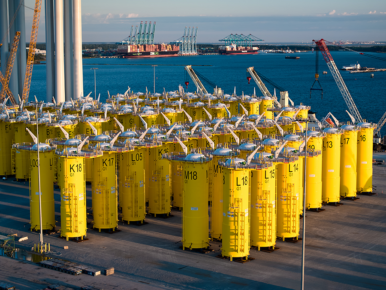
In addition, three offshore substations and all 176 monopile foundations have been installed, along with 173 of the 176 transition pieces that connect the foundations to the turbine towers. Deepwater export cables and approximately 56% of the near-shore export cables are in place, as well as about one-third of the interarray cables linking the turbines to a central collection point.
Dominion has positioned CVOW as critical to its “diverse energy supply strategy” to meet growing demands for electricity throughout Virginia, including powering military installations and defense manufacturers ranking among the largest in the world, as well as the globe’s biggest data center market.
Federal turbulence
Supplying power to the grid comes after a tumultuous few months in which Dominion went to court to fight the Trump administration’s latest salvo in its campaign against wind energy. Citing national security risks, the U.S. Department of Interior in December 2025 issued 90-day stop-work orders on CVOW and four other East Coast offshore wind farms under construction after the Pentagon expressed concerns that turbine blade movement and the reflective towers interfere with radar. The administration asserted that the suspension would allow time for the Interior Department, the Department of Justice and other agencies to work with leaseholders to assess risk mitigation.
Dominion and the other offshore wind developers filed civil suits asking courts to block the order. Calling the directive “arbitrary and capricious,” Dominion argued that it had worked extensively with the military during the project’s development to address radar, training and operational readiness issues arising from CVOW’s construction. The utility also noted that two pilot turbines have been generating enough electricity to power 3,000 homes since October 2020, without impacting national security.
In mid-January, Judge Jamar Walker of the U.S. District Court for the Eastern District of Virginia ruled that construction could continue on CVOW while Dominion pursues its lawsuit, stating that the Interior Department had not provided sufficient rational to halt work. The other East Coast offshore wind projects also won court victories, paving the way for construction to resume. The Trump administration has announced plans to appeal the rulings.
Erik Milito, president of the National Ocean Industries Association, a lobbying group for offshore oil, gas, wind and ocean minerals businesses, believes the court injunctions are a positive sign for the nascent U.S. offshore wind industry.
“These projects are in pretty good shape, but anything could happen,” he says, noting President Donald Trump’s longstanding aversion to wind energy projects. “In the end, it comes down to one person — the president, who just doesn’t like offshore wind.”
The stop-work order contributed to a $300 million increase in CVOW’s price tag, which rose from $11.2 billion to approximately $11.5 billion. Dominion has noted that the 26-day construction pause cost the company $228 million, with expenses going toward equipment storage, contractual penalties, interruptions in using time-sensitive vessels and idled workers. Tariffs on steel and other materials added another $137 million to the project.
As of Dec. 31, 2025, Dominion had invested $9.3 billion in the project, with the utility funding $1.2 billion of the remaining costs.
During Dominion’s fourth-quarter earnings call in February, CEO Robert M. Blue reiterated that CVOW is the quickest way to deliver low-cost electricity. “We continue to believe it just makes sense for this project to be allowed to continue. Slowing it down, as was demonstrated with the last stop-work order, adds costs, and adding costs and delays in the data center capital of the world doesn’t make sense.”
Blue added that the current budget includes a contingency for weather delays through July 2027. “If the project extends beyond that, and we don’t expect it will, we estimate that each additional quarter to complete turbine installation would add between $150 [million] and $200 million to the project cost.”
According to a cost-sharing agreement approved by the Virginia State Corporation Commission in 2022, project expenses from $10.3 billion to $11.3 billion would be split 50/50 between Dominion and consumers, while the utility will pay charges between $11.3 billion and $13.7 billion. Dominion splits half of its share of the costs with its financing partner, Stonepeak, an investment firm that owns a 50% noncontrolling interest in CVOW.
Previous price hikes due to higher onshore electrical interconnection rates and higher network upgrade costs assigned by regional grid operator PJM Interconnection were reflected in CVOW’s 2025 budget increase to $10.7 billion. As a result, the expected average impact over the life of the project to a typical residential customer was a 43-cent-per-month rate increase. Over the life of the project, residential customers will see a net 57-cent monthly credit due to PJM energy and capacity benefits and renewable energy certificate values. Currently, customers pay about $11 per month for CVOW, although Dominion has asked the SCC to decrease that fee by 90 cents.
According to Dominion, nearly 1,000 Virginia-based laborers, including more than 800 in Hampton Road, have worked on CVOW or with other businesses supporting the project. More than 1,000 local jobs will support ongoing operations and maintenance of the wind farm after commercial operation begins.
With a national supply chain industry growing up around offshore wind, the U.S. has seen $25 billion in investments in new ports, vessels and factories.
Sam Salustro, senior vice president of market and policy strategy for Oceanic Network, says that Hampton Roads, where the Port of Virginia invested $233 million to update the Portsmouth Marine Terminal for offshore wind components, is poised to become an epicenter for the industry.
“Offshore wind is proving itself every single day,” Salustro says. “It lines up with all the national priorities and helps states mitigate the rising costs of energy and is really going to help states like Virginia deal with the demand coming online.”
However, Salustro cautions that developers and investors could become wary of financing the supply chain if the Trump administration continues to fight against offshore wind. In March, the federal government announced it would pay French energy developer TotalEnergies $1 billion to cancel two offshore wind projects off the coasts of North Carolina and New York, redirecting funding to oil and natural gas projects, which could present a new maneuver by the administration to block offshore wind.
“States should be able to attract a ton of onshore manufacturing to support the industry,” Salustro says. “Normally at this time of the industrial development cycle, you get investors to make products, but no one can stand up and say they want to build a new factory and get financing.”
Southeastern Wind Coalition President Katharine Kollins agrees, noting that suspension of work on CVOW and the other East Coast offshore wind farms created significant uncertainty in terms of investment, jobs and regulated electricity planning.
“Stopping these five projects means $30 billion of fully permitted economic activity was paused,” she says. “That threatens more than $112 billion in supply chain assets in the U.S. and over 12,000 direct American jobs directly supporting the buildout of these projects. That’s a lot of economic opportunity put at risk.”
Together, the five offshore wind farms are projected to generate almost 6 gigawatts of electricity along the East Coast, enough to power almost 2.5 million homes and help states keep rising power costs in check, Kollins says.
“Offshore wind is a free resource with no incremental fuel costs. Anybody who looks at the situation on its face can recognize that these projects bring electricity to places that need new electrons the most. Meeting our energy needs requires an all-of-the-above strategy that puts every electron to work, including offshore wind.”
e