Sign In
Upcoming Event
 Free Newsletter

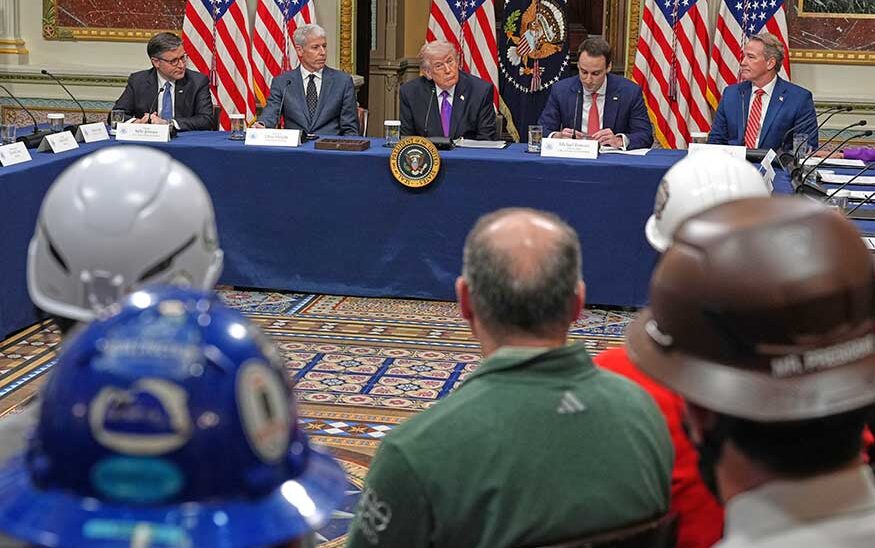
President Donald Trump meets with tech leaders March 4 as they sign a pledge that their companies will pay for power infrastructure upgrades needed for their platforms. AP Photo/Jacquelyn Martin
President Donald Trump meets with tech leaders March 4 as they sign a pledge that their companies will pay for power infrastructure upgrades needed for their platforms. AP Photo/Jacquelyn Martin
More data centers equal more electricity demand
Jim Morrison// March 31, 2026//



Summary:
- Virginia leads the U.S. with nearly 650 data centers, according to Pew Research.
- Dominion Energy reports a 5-6% annual increase in electricity demand due to data centers.
- The General Assembly’s JLARC projects average monthly electricity demand will double within a decade.
Eight of the highest demand days for electricity in Virginia occurred during the cold snap earlier this year, with a record set on Feb. 9. Those topped the previous record set during the summer of 2025, according to Dominion Energy. And when this summer’s hottest days roll around, new records will be set again.
Five years ago, Virginia’s annual increase for power was projected to be about 1%. Today, it’s between 5% and 6%, a thirst the state’s utility Dominion Energy is pushing hard to meet.
The reason? Virginia is the data center capital of the world. And data centers burn through electricity (and water) faster than you can flip a light switch. A typical data center consumes as much energy as 100,000 households, while hyperscale data centers can guzzle the equivalent of electricity used by 3.65 million average households, or produced by five standard nuclear reactors.
Data centers bring significant local tax revenue and some jobs, but they’re also straining the state’s ability to supply the enormous, unexpected surge in electricity demand. They’re also coming under fire by residents who are concerned about power use, water consumption, noise and other factors.
According to a Pew Research report from last year, Virginia leads all states with nearly 650 of the 4,000 data centers in the country. Northern Virginia has more data centers than anywhere in the world, with 13% of all capacity globally.
A 2024 analysis by the General Assembly’s Joint Legislative Audit and Review Commission projects that average monthly demand will double within a decade with current data center growth, and in February, Dominion wrote in a report to the Virginia State Corporation Commission that it has about 70,000 megawatts per day under request for future data centers, about three times the current load.
On the positive side of the ledger, the JLARC study found that the data center industry is estimated to contribute 74,000 jobs, $5.5 billion in labor income and $9.1 billion to Virginia’s economy annually, though most of those benefits derive from the construction phase rather than data centers’ ongoing operations.
In some places, they also contribute a sizable portion of a locality’s tax revenue though they benefit from tax exemptions. For fiscal 2025, data center operators reported exempt equipment and software investment of approximately $33.2 billion and an aggregate reported tax benefit of approximately $1.9 billion, according to the Virginia Economic Development Partnership.
“Virginia is really ground zero for data center growth across the country,” says McKenna Beck, the climate solutions fellow at the Natural Resources Defense Council who tracks the power sector. “Especially Northern Virginia has grappled with data center growth for much, much longer than any other state or region in the U.S. So, in some ways, Virginia is and Dominion is ahead of the curve and managing the impacts of data centers. A lot of other states are looking to Virginia to see what policy decisions will be made.”
Those policy decisions include how to meet the crushing demand and how to ensure the data centers pay their share of all costs. But those discussions also occur in the shadow of the state’s clean energy act and the billions in property tax revenue the centers pay, a potential windfall for portions of the commonwealth that have struggled to attract development.
Throw into the mix a host of energy legislation that attempts to close loopholes in charging data centers, concerns by environmentalists that the demand will mean a return to relying on fossil fuels, and an out-of-the-blue initiative by the Trump administration and several governors, including Glenn Youngkin, for the 13-state power consortium PJM Interconnection to hold an emergency auction that could result in $15 billion of new power plants financed by data center owners, something that’s never happened.
In March, President Donald Trump hosted the nation’s largest tech companies, including Google, Microsoft and OpenAI, as they pledged to cover costs for additional grid improvement and new power plants needed for larger data centers that can handle artificial intelligence use.
The question ahead is how to generate this needed energy and whether the Virginia Clean Economy Act, passed in 2020, is an impediment with its requirement to phase out most use of fossil fuels by 2050.
“Building enough infrastructure to meet unconstrained energy demand will be very difficult to achieve, with or without meeting the Virginia Clean Economy Act (VCEA) requirements,” the JLARC study concluded. “New solar facilities, wind generation, natural gas plants, and increased transmission capacity would all be required to meet unconstrained demand, and the number of projects needed would be very difficult to achieve.”
New solar would have to be added at twice the 2024 rate. Offshore wind would exceed the capabilities of the sites secured for future development. Natural gas plants would need to be added at a faster rate than the busiest period of their growth.
The JLARC study found that data centers were paying their way, but higher demand would require new generation and transmission in the future that would not otherwise be built, “so energy prices are likely to increase for all customers.”
Passing along those costs to other users is what the state and Dominion Energy have sought to correct over the past couple of years.
To energy consultant Glenn Davis, a former Republican delegate and director of the Department of Energy in the Youngkin administration, the PJM auction is necessary.
“This auction would provide a structural shift from how the market has traditionally operated. For the first time, large-load customers like data centers could directly support 15-year power purchase agreements through the PJM framework,” he says. “With the scale of load growth, we’re seeing that mechanism could unlock potentially $10 billion to $15 billion in new power plant investment.”
But there are questions about the proposed PJM auction. It’s never been done. It’s not clear how it would be done. Virginia, unlike some of the other states in PJM, is supplied by Dominion, a vertically integrated and regulated utility.
Aaron Ruby, director of Virginia and offshore media for Dominion, says the utility’s Integrated Resource Plan calls for 33 gigawatts of power over the next 20 years to meet demand. Dominion supplies about 85% of the power customers use, purchasing the rest from PJM.
“We recognize that from a reliability standpoint and from a cost standpoint, it makes sense for us to generate even more of our own power and to be less reliant on power that we have to purchase from the PJM market,” he says. “That is going to enhance the reliability of our system, and it’s going to protect our customers from the rising costs of purchases in the PJM market.”
The second part of that is protecting consumers from infrastructure costs created by data center power demand. To do that, Dominion created a new rate structure charging data centers and large-load customers a higher rate that was approved by the SCC last year.
Coping with high demand
When demand spikes, as it does on the coldest and hottest days, Dominion purchases power from PJM. A bill sponsored by Sen. L. Louise Lucas, D-Portsmouth, in the 2026 General Assembly would allow Dominion to pass along the total cost to large-load customers, including data centers, increasing their costs by about 16% while reducing residential costs by about 4%, or $5.50 per month.
As of early March, Lucas’ bill was headed to conference to bring it into compliance with a House bill.
Ruby says Dominion is ahead of the shift to renewable energy required by the Virginia Clean Economy Act of 2020. “We have far exceeded the interim targets for solar, battery storage and offshore wind,” he says.
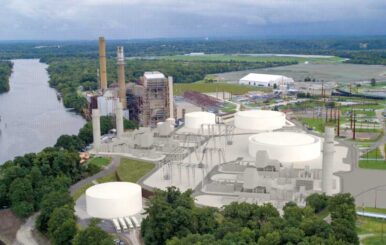
The utility is planning to build eight natural gas-powered plants. The first, the $1.47 billion Chesterfield Energy Reliability Center (CERC), met opposition from environmental groups but was approved by the SCC, citing a provision in the VCEA that allows for a reliability exception to the ban on new fossil fuel construction.
Offshore wind, Ruby says, generates power 40% to 50% of the time. Solar about 25%. Battery storage in its current format can hold about four to six hours of electricity. “That’s why we’ve got to have a balanced, diverse mix of energy sources, increasingly generating more power from renewables in the next 15 years or so, generating power from next-generation nuclear, but also continuing to rely on always reliable, always available, quickly dispatchable natural gas.”
However, Damian Pitt, associate director of policy and community engagement at Virginia Commonwealth University’s Institute for Sustainable Energy and Environment, says the goals of the VCEA, which predates the pandemic and exponential AI growth, could be met without natural gas.
“The technologies for wind, solar and battery storage are all still there, and we certainly have the sort of technical capacity to ramp those up to meet the data center demand,” he says. “But you know, there are questions about the political viability of that, given the current federal administration’s actions to remove tax credits and to try to stop offshore wind projects.”
In December 2025, the Department of the Interior’s Bureau of Ocean Energy Management placed a 90-day pause on construction of five East Coast offshore wind projects, including Dominion’s Coastal Virginia Offshore Wind. Dominion sued the federal government and received a judge’s OK to continue work on the $11.5 billion project while the lawsuit continues.
Davis is among those who believes the VCEA needs to be amended to become more friendly to natural gas so the state can meet current energy demand and continue the economic growth spurred by data centers and the tax revenue they generate.
Beck acknowledges the reality that natural gas plants are being built nationwide to meet the demand. But that’s shortsighted, she says.
“It’s really critical right now to push back against that narrative, which is that gas is faster and cheaper to supply data centers,” she says. “In reality, we have more clean energy in the queue waiting to get connected to the grid than currently exists on the entire U.S. power grid today. So, if we can somehow speed up those connections, data centers would have the clean energy they need.”
Focus on natural gas
In a state where Dominion wields significant political clout, Brennan Gilmore of Clean Virginia, the nonprofit founded by Charlottesville investor Michael Bills in 2018 to fund political campaigns by Virginia candidates who decline Dominion funding, says it’s not surprising that gas plants have moved to the forefront to meet unexpected demand.
“That’s the best answer for the utility. It’s the best answer for the utility shareholders,” he says. “It’s not the best and only answer to how we respond to this demand question.”
Gilmore says a combination of a bigger push toward renewables and energy efficiency programs, including having some data centers flex their hours away from peak demand, could reduce costs overall and still move the state to a zero-emissions future.
“As long as there’s a gatekeeper [Dominion], Virginia is not going to be at the forefront of states that are harnessing all these many, many technologies that can allow us to lower demand,” he says.
For Davis, data centers offer the promise of economic development and, in the southwest or central portions of Virginia, “it would change the landscape overnight.” He noted that in some cases, property taxes from data centers are nearing 40% of a locality’s revenue, although the 2024 JLARC study reported that varies widely.
Traditionally, a local economy would typically need a large workforce, good schools and good roads to grow. But data centers, which don’t create many permanent jobs, spin off taxes and the initial construction that fuels growth — and that leads to better schools, better roads and better infrastructure.
“It’s not a traditional economic development project where you’re getting tax revenue, and you go build more roads and more schools because you have growth in population,” Davis says. “It’s money that can be spent to grow the existing infrastructure. And that starts this whole domino effect.”
-