Sign In
Upcoming Event
 Free Newsletter

Port of Virginia expands capacity with $1.4B gateway program
Looking back and forward at the port’s progress
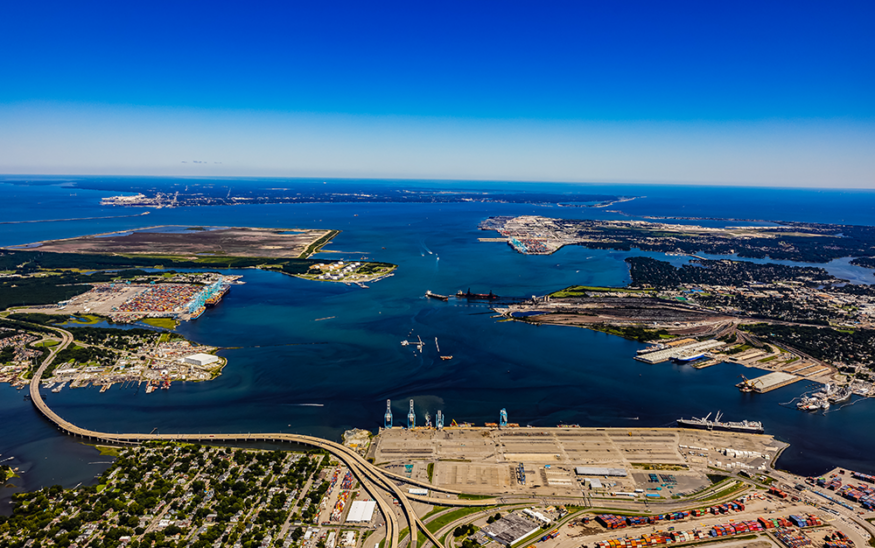
Photo courtesy Port of Virginia
Photo courtesy Port of Virginia
Port of Virginia expands capacity with $1.4B gateway program
Looking back and forward at the port’s progress



Summary:
- Port of Virginia completes $450 million dredging project
- Virginia Port Authority interim CEO Sarah McCoy leads expansion
- Port capacity to reach 5.8 million TEUs with new berths by 2027
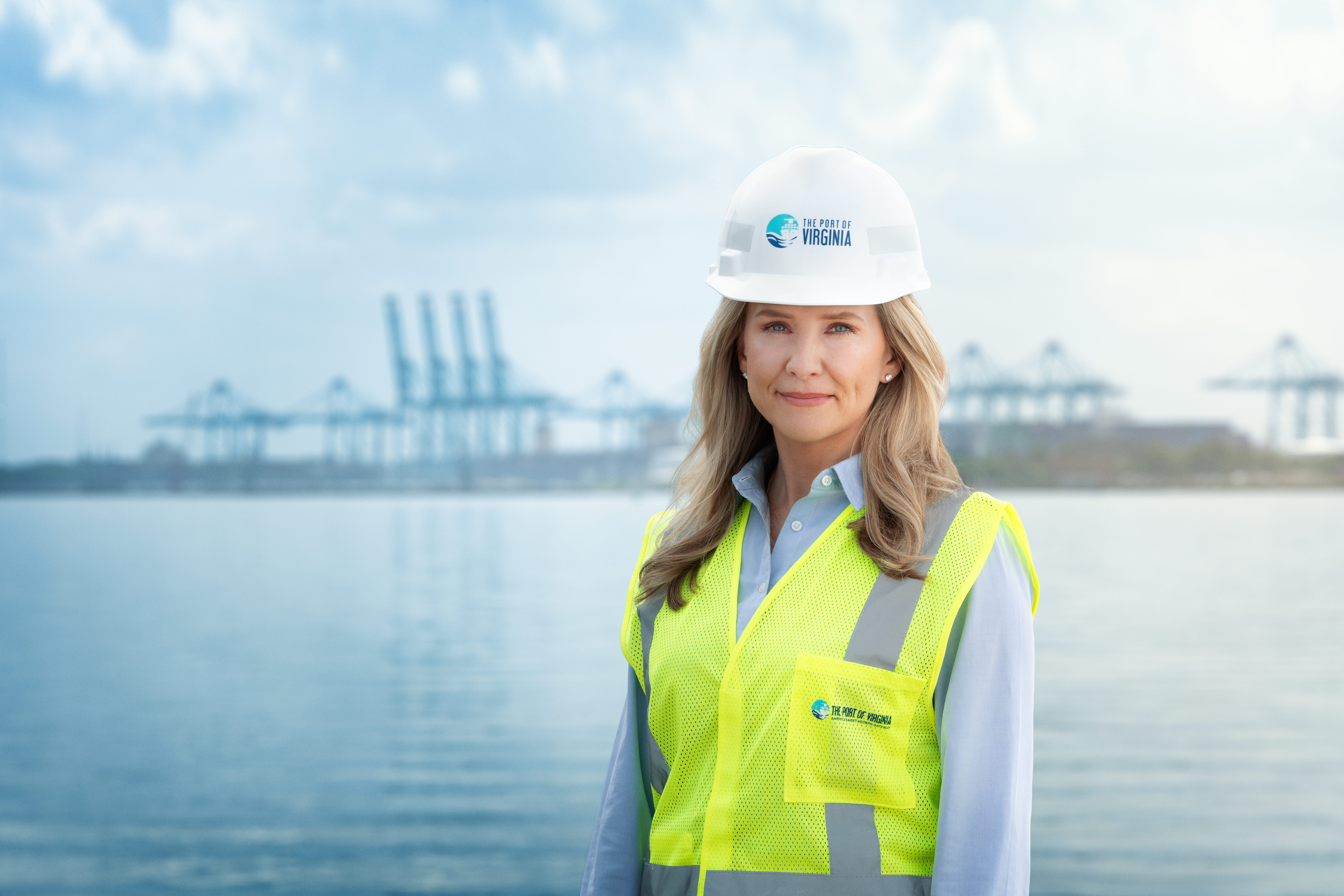
The Port of Virginia calls itself “America’s Most Modern Gateway,” but it’s more than just a catchy slogan.
In February, the port — the nation’s sixth busiest — became the East Coast’s deepest port with the conclusion of its $450 million dredging project started in 2019. In addition to the deepening and widening of the harbor, the port is midway through the $1.4 billion Gateway Investment Program begun in 2023.
“We have really structured our whole strategy around this mantra, and it means something to us, inasmuch as we are both the owner and the operator of our marine terminals,” says Sarah McCoy, the Virginia Port Authority’s interim CEO.
That consolidation — being both owner and operator — separates Virginia’s port from those in New York and California, where shippers commonly deal with dozens of different businesses.
“That gives us the flexibility to address our customers’ needs holistically,” McCoy adds. “They have one through line in, and it can solve all their problems.”
The Port of Virginia is owned by the Virginia Port Authority, an agency of the state. Virginia International Terminals, a limited liability company owned by the authority, operates four marine terminals in Hampton Roads, as well as an inland marine terminal in Richmond and the Virginia Inland Port at Front Royal. While the port owns Norfolk International Terminals, the largest of the four terminals, it leases Virginia International Gateway in Portsmouth.
McCoy, previously the port’s chief administrative officer, stepped in as interim CEO in January following the departure of Stephen A. Edwards, who led the port since 2021 and initiated the capital campaign, which continues today with the $650 million renovation of the Norfolk International Terminals’ North Berth expected to be completed in mid-2027.
Edwards succeeded John Reinhart, the port’s CEO from 2014 to 2020, who is widely credited with turning around the port, which had previously lost $120 million between 2009 and 2014. [Editor’s note: John Reinhart died at the age of 72 on April 12.]
Twelve years after the port’s financial low point, when the state considered selling the property, the Port of Virginia is now one of the state’s main economic drivers, accounting for $124.1 billion in total spending and $5.8 billion in local tax revenues, as well as creating more than 565,000 direct and indirect jobs, approximately one in 10 jobs in the state.
In addition to the seven-year dredging project, the port has expanded rail capacity to 2 million units a year and converted the Portsmouth Marine Terminal into a deepwater lift facility. The port also has created an operating system across its terminals that allows it to collect and digest data and analyze what is working, another benefit of a unified port.
The ability to nimbly respond is vital with an ever-changing marketplace, letting the port compete with its peers.
“What we’re doing that sets us apart from any other port on the U.S. East Coast is building for the needs of our customers today and as they grow in five, 10 and 15 years,” McCoy says. “There’s no one else with these class cranes, with this efficiency of yard planning, reservation system, deepest channel — all of that combined. That forward look for both the needs of today and tomorrow makes us the most modern gateway.”
Expanding freight capacity
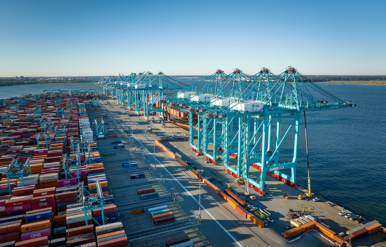
The port has 29 ship-to-shore cranes on deep water and recently announced the capacity at NIT to accommodate four ultra-large container vessels at once. The vessels, larger than aircraft carriers, with capacities exceeding 24,000 20-foot equivalent units (TEUs), are considered the future of shipping, maximizing fuel efficiency and lowering costs per unit.
A fifth ultra-large container vessel berth is scheduled to be in operation in 2027. When that is complete, the port will have the capacity to process 5.8 million TEUs annually.
In 2025, the port handled 3.23 million TEUs, a reflection of decreased business last year across ports nationally due to the Trump administration’s tariff campaign, says Vinod Agarwal, professor of economics at Old Dominion University.
The U.S. Supreme Court ruled earlier this year that some of the White House’s tariffs were enacted illegally under emergency measures, but President Donald Trump immediately ordered 10% tariffs under a different group of laws.
Tariffs aside, McCoy and other officials say the port’s biggest selling point is a forward- looking strategy that creates capacity and efficiencies before they are needed.
Cary Hagen, chief commercial officer of Norfolk-based logistics company CV International, agrees with this assessment. Before joining CVI, Hagen worked for the port authority and Virginia International Terminals, which operates Virginia International Gateway.
“Throughout my career at both VPA and VIG, we were constantly revising these long-term, 40-year plans but then dialing it back to one-, three-, five-, 10-year plans,” he says. “It was inevitable that things were changing. Ships were getting larger. The trading patterns were evolving.”
That means the port can offer stability in an ever-changing industry, McCoy notes.
“We are selling certainty in an uncertain world, and in order to do that, we have to make sure our capabilities can handle today and tomorrow,” she says. “We’re selling capabilities that the supply chain can be certain in [that] when you drop your box in Virginia, you are certain it is going to move out of our facilities, move along our integrated freight strategy, into the hinterland, and to its destination point. That is not something that other ports to the north or south, for that matter, can guarantee.”
That sort of certainty and efficiency is the product of those decades of planning that led to a series of recent improvements.
Deepening and widening the channel means the port can not only welcome the largest ships but also creates a two-way passage for vessels over 20,000 TEUs. At other East Coast ports, the larger vessels of the last few years have to wait outside the channel to allow other ships to pass, slowing their transport. Some of those ports can also only accept smaller ships because of overhead bridges, not an issue with the Port of Virginia.
“The widening and deepening of the channels, that forethought really enabled Virginia to be fluid with the ultra-large container ships,” Hagen says.
Truck and rail improvements
Improving rail capacity and using technology to get trucks in and out faster is another selling point driving traffic. McCoy says 36% to 40% of the port’s cargo departs via rail, attracting bigger ship lines. “They can trust that they can put bigger surges of cargo through Virginia,” she says. “We can handle it, and we can get it out.”
The port’s rail connectivity reaches as far west as Kansas City, Missouri, Chicago and St. Louis, according to its 2025 annual report. The top export commodities included pharmaceuticals, nuclear reactors and machinery, plastics and vehicles, while the top imports were nuclear reactors and machinery, electrical machinery, pharmaceuticals and vehicles.
The bulk of imports are loaded onto trucks covering a 250- to 300-mile radius from the port, serving state businesses, bolstering the regional economy. At the north gate of NIT near the Navy base, technology allows truck drivers to drive through and be scanned without stopping.
While the port doesn’t have 13 million consumers in its backyard, as do their competitors to the north and south, transit times to key cities are faster from Hampton Roads. Cargo can get to the Ohio River Valley faster from Norfolk than from New York, McCoy says.
Helping with speed to market is the inland port opened in 1989 in Front Royal, which offers access to Washington, D.C., Maryland and Pennsylvania, making it competitive with the ports in Baltimore and New York.
“Virginia has to be better, and we are, and our operational metrics show that,” McCoy says. “We keep an eye on that every single day, because we know that the speed to market matters.”
Rick Holden, vice president of business development at Richmond-based Riverside Logistics, says the port’s centralized management helped it navigate COVID-19, and recent improvements position it well for the future.
“The port has done a good job of staying ahead of the curve and looking ahead to what capacity they’re going to need down the road and tried to manage that in a proactive way instead of a reactive way,” he adds. “They’ve upgraded the equipment substantially over the past 10 or 15 years. They’ve added a lot of automation, which makes us much more efficient than many of the other ports in the country and in the world. We are the most efficient on the East Coast and probably one of the most efficient in the U.S.”
Automation has been a point of contention between the port and the International Longshoremen’s Union, which represents port workers. In October 2024, the union held a three-day strike at ports from New England to the Gulf Coast, bringing all work to a halt over pay and automation conflicts. While the wages were settled in a quick agreement, rules on automated technology at the ports — which the union says will decrease the number of jobs — are still under discussion.
In February, a federal court dismissed without prejudice an ILU lawsuit against the Virginia Port Authority in which the union argued the authority had interfered with a new master contract with a terminal operator. The federal judge’s ruling allows the union to refile its lawsuit.
Despite the Port of Virginia’s higher level of automation, the union’s records showed that hiring of longshoremen
had increased, according to The New York Times.
McCoy says that automation spurs development in the commonwealth, resulting in more than 6 million square feet of warehouse and logistics space in the past year, drawing companies like Amazon, Target and Lego. “The goal really is to drive economic investment,” she says. “We have been charged with that, and we’re doing a good job.”
Attracting that kind of investment is a coordinated effort that includes working with developers on warehouse space and the state on widening Interstate 64 and U.S. Route 58 feeding into I-95, key arteries.
“You can’t just add all this cargo volume to your capability, to your port, but then not think about the road and rail infrastructure that supports it,” she says. “It’s not just port investment; it’s commonwealth investment in our road and rail capabilities, alongside our port capabilities. So, we like to say that we have an integrated freight plan from sea buoy to doorstep, wider, deeper channels, capacity on the terminal, and then widened roads all the way to your distribution center.”
What’s next? Marketing, McCoy says. “It is leveraging our infrastructure and our capabilities to build the marketplace in Virginia brick by brick. Not everyone knows about Virginia’s capabilities. We are going to the marketplace. We are shouting it from the rooftops.”
-