Sign In
Upcoming Event
 Free Newsletter


Atlantic Park
Virginia Beach
Virginia Business //June 30, 2026//



Address: Atlantic Avenue between 18th and 20th streets, Virginia Beach
Project Type: Public-private partnership
Project Size: 1,878,234 square feet
Project Cost: $350 million (construction cost: $242 million)
Owner: Venture Realty Group, plus other partners
Contractor: W.M. Jordan Co.
Architects: Hanbury; Gensler; Cooper Carry; AO Architecture
Interior Designer: Gensler
Engineers: Kimley-Horn (civil); Uzun + Case (structural); Barrett, Woodyard & Associates (MEP); Coffman Engineers
Attorney: Kaufman & Canoles
Subcontractor: James River Exteriors
Other contractors: Glenbrook Development; Wavegarden
For nearly 30 years, the 13-acre block at the Virginia Beach Oceanfront that was once home to the Virginia Beach Civic Center (aka The Dome) sat as empty surface parking. When the city issued a request for redevelopment proposals for the former civic center site in 2017, it set in motion the largest public-private partnership in the city’s history. Atlantic Park opened in summer 2025, featuring a world-class man-made surf lagoon, a new music venue and a mixed-use neighborhood. The development was backed by the city, Venture Realty Group, music superstar Pharrell Williams and other investors.
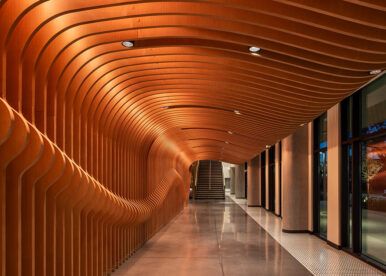 At the heart of Atlantic Park is its Wavegarden Cove surf lagoon — the first of its kind on the East Coast and the first in the world integrated into an urban environment, sitting just one block from the Atlantic Ocean. Spanning 120,000 square feet and delivering up to 1,000 waves per hour, the lagoon’s proprietary machinery was manufactured in Spain, shipped to Virginia Beach in 50 containers and assembled on-site. Its precision engineering required concrete work held to 1-inch accuracy, with the structure supported by 415 augured tensioned concrete piles.
Anchoring the entertainment component is the 70,000-square-foot Dome by Rutter Mills, a direct successor in spirit to the original civic center — designed by R. Buckminster Fuller and host to the Rolling Stones, Jimi Hendrix and Ray Charles — that was demolished in 1994. The new 3,500-seat indoor-outdoor venue, operated by Live Nation Entertainment, opened in May 2025 with Three Dog Night, the last act to have performed at the original Dome.
The rest of the development encompasses 309 luxury apartments, 110,000-plus square feet of retail and dining, a 20-room boutique hotel called The Sitio and 1,650 structured parking spaces across two garages — all on a site that required dewatering 74 million gallons of groundwater before a single building could rise.
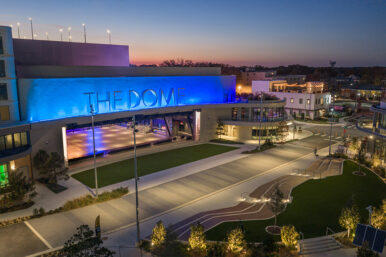 “Atlantic Park is the most complicated, innovative and successful mixed-use development we have experienced,” says John R. Lawson II, executive chairman of W.M. Jordan Co., the project’s general contractor and an investor.
The $350 million development logged nearly 1 million worker hours with zero recordable safety incidents. The project team digitally mapped all existing underground utilities with laser scanning, then rebuilt the public infrastructure below and around the site. Sustainability extended to the finishing touches: 25 oak and poplar trees cleared during construction were repurposed by local firm Benevolent Design Co. into furniture and room signs for The Sitio, with the hotel’s registration desk formed from a single oak trunk weighing 1,500 pounds.
C