Sign In
Upcoming Event
 Free Newsletter

SCC orders Dominion to develop policy shifting transmission costs to data centers
Order aims to reduce ratepayer burden
Josh Janney //August 5, 2026//
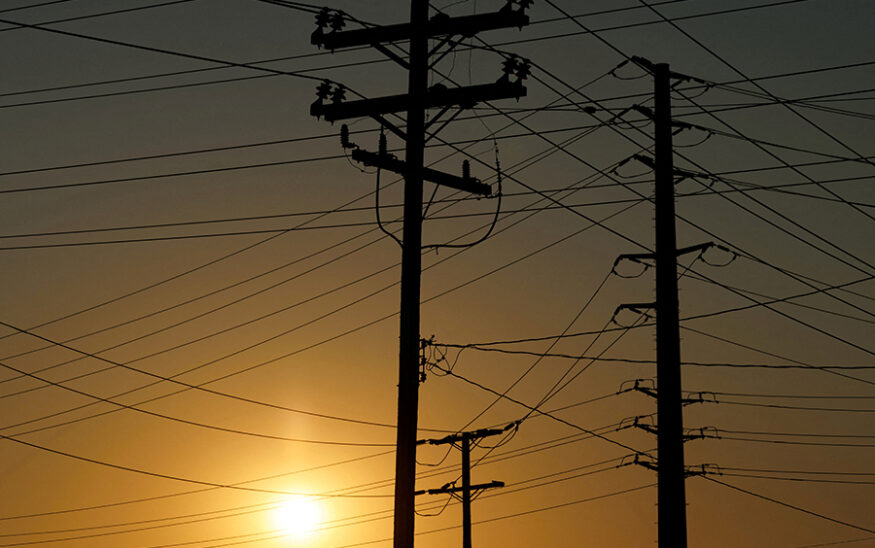
Electrical transmission poles and lines are shown in the early morning of a hot summer day in Commerce, California, U.S, August 7, 2025. REUTERS/Mike Blake/File Photo
Electrical transmission poles and lines are shown in the early morning of a hot summer day in Commerce, California, U.S, August 7, 2025. REUTERS/Mike Blake/File Photo
SCC orders Dominion to develop policy shifting transmission costs to data centers
Order aims to reduce ratepayer burden
Josh Janney //August 5, 2026//



SUMMARY:
-
- Virginia SCC orders Dominion Energy to file policy to charge data centers and other large customers for power infrastructure
- Draft is due in 90 days, aims to lower burden on typical residential customers
- State’s chief energy officer wrote to commission urging order in July 9 filing
The Virginia State Corporation Commission has ordered Dominion Energy to draft a policy for data centers and other large-load customers to pay for transmission lines and other power infrastructure built specifically to serve their facilities, a move praised by Gov. Abigail Spanberger.
The order, issued July 31, arrived in response to the Richmond-based Fortune 500 utility’s earlier proposal to increase typical residential customers’ bills by $2.90 a month, in order for Dominion to recover about $1.539 billion associated with its electric transmission system during the coming year.
Spanberger’s administration, though, filed a document in July urging the SCC to require large electricity users like data centers to pay upfront for transmission lines and other facilities built to serve their buildings. By the time the governor got involved, the SCC had already lowered the projected increase to 94 cents a month for typical residential customers, shifting more of the cost to large-load customers. The new surcharge takes effect Sept. 1.
With the SCC’s order, Dominion has 90 days to file a new policy with the SCC applying to “direct connect” infrastructure, such as substations and transmission lines needed to connect large-load customers to the electric grid.
“While accelerating this transmission build-out is critical, it must be planned and paid for responsibly,” Chief Energy Officer Josephus Allmond said in a July 9 filing to the commission. “Just and prudent transmission development and cost-allocation measures are essential to protecting Virginia families and small businesses. Achieving this balance requires improved transmission planning coupled with cost-allocation methods that assign costs fairly, including directly to large load customers driving the need for that infrastructure.”
Spanberger praised the SCC’s order and said she would continue to work with the General Assembly to make sure data centers “pay their fair share,” adding, “I am proud that after my administration urged state regulators to protect Virginia families and small businesses from shouldering the cost of new transmission infrastructure meant to serve data centers, the SCC listened. This order — which is projected to save Virginians hundreds of millions of dollars — makes sure that data centers are paying the full cost of the transmission infrastructure their developments require.”
The SCC’s order comes at a time when community and political opposition to data centers is growing, particularly in Virginia, which hosts between 600 and 700 data centers, with more in the pipeline. Many Virginia localities — including Loudoun County, with the world’s greatest concentration of data centers — are quickly moving to eliminate by-right zoning for future data centers, requiring developers to seek case-by-case permits.
Other local governments, including Virginia Beach, are considering moratoriums and overall bans on new data center campuses, which are growing ever larger to handle AI-driven internet use increase. In Botetourt County, community members have raised concerns about the amount of water Google’s data center project is expected to use to cool its facilities; at full buildout, the tech giant anticipated up to 8 million gallons a day, but Google has now said it intends to use air-cooling technology instead of water in its first building. Even so, critics of data centers say they will cost residents money in higher power rates, and Botetourt supervisors recently voted to establish a commission to study Google’s project.
Spanberger and state Senate Democrats came to a last-minute budget compromise in late June to assess data centers an electricity usage tax for the next two years, bringing in up to $600 million a year. Some senators had sought to immediately repeal the state’s sales and use tax exemption for data center operators that is set to expire in 2035 and annually costs the state and localities more than $1 billion in tax revenue, but Spanberger and state delegates refused to do that before ordering a state study. Sen. Louise Lucas, the repeal’s most vocal proponent, called the governor a “data center diva” during town hall appearances throughout the state this summer.
However, proponents of the data center industry say it supports local tax revenue to the tune of billions each year, without creating burdens on emergency services, school systems and public transportation.
A Dominion spokesperson said Wednesday the utility would comment later on the SCC order.
g