Sign In
Upcoming Event
 Free Newsletter

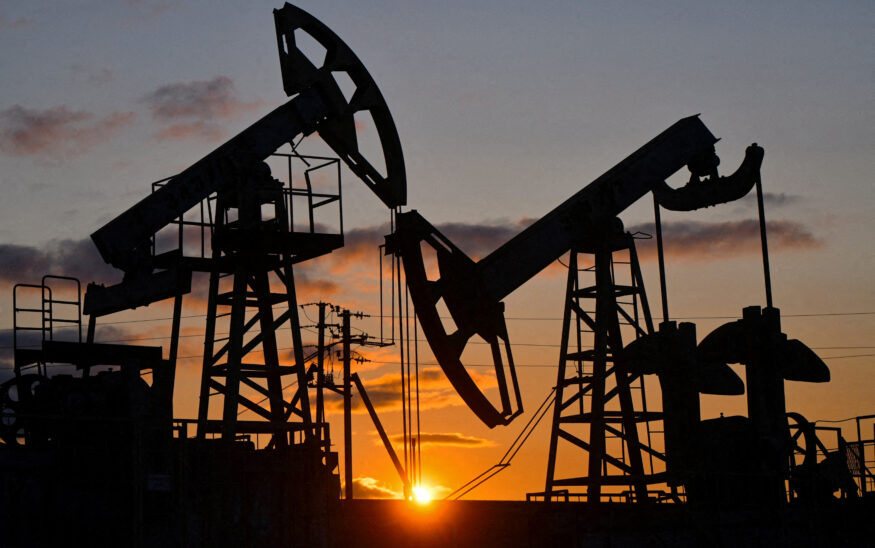
A view shows oil pump jacks outside Almetyevsk in the Republic of Tatarstan, Russia June 4, 2023. REUTERS/Alexander Manzyuk/File Photo
A view shows oil pump jacks outside Almetyevsk in the Republic of Tatarstan, Russia June 4, 2023. REUTERS/Alexander Manzyuk/File Photo
Oil prices up 2% as Trump and Iran’s comments dent peace hopes



Summary:
- Brent crude up 2.4% to $108.22 a barrel
- Iran foreign minister Abbas Araqchi signals readiness for diplomacy or conflict
- Trump agrees with Xi Jinping on preventing Iran nuclear weapon
LONDON, May 15 (Reuters) – Oil prices gained about 2% on Friday after comments from U.S. President Donald Trump and Iran’s foreign minister further dented hopes of a deal to end ship attacks and seizures around the Strait of Hormuz.
Brent crude futures gained $2.50, or 2.4%, to $108.22 a barrel by 1139 GMT. U.S. West Texas Intermediate futures were up $2.86, or 2.4%, at $104.03.
Over the week, Brent has climbed 6.8% and WTI 9.0% on uncertainty over the shaky ceasefire in the Iran conflict.
“The tone between the U.S. and Iran has once again become significantly more confrontational. While the ceasefire holds, hopes for a swift reopening of the Strait of Hormuz have faded,” Commerzbank analysts said.
Iran has “no trust” in the U.S. and is only interested in negotiating with Washington if it is serious, foreign minister Abbas Araqchi said on Friday, adding that Iran is prepared to go back to fighting but also prepared for diplomatic solutions.
Trump said he was running out of patience with Iran and that he had agreed with Chinese President Xi Jinping that Iran cannot be allowed to have a nuclear weapon and must reopen the Strait of Hormuz.
President Xi did not comment on his discussions with Trump about Iran, though China’s foreign ministry issued a statement. “This conflict, which should never have happened, has no reason to continue,” the ministry said.
Among deals the market was looking for from the U.S.-China summit, Trump said China wants to buy oil from the United States. Trump also said he could lift sanctions on Chinese companies that buy Iranian oil.
“Market focus is back on the deadlock and a blockaded Strait of Hormuz, with a tail risk of renewed military escalation,” said Vandana Hari, founder of oil market analysis provider Vanda Insights.
Iran’s Revolutionary Guards said that 30 vessels had crossed the Strait of Hormuz between Wednesday evening and Thursday, still far short of the 140 a day that was typical before the war, but a substantial increase if confirmed.
“An increasing number of vessels are filtering through the Strait … although currently this has a more tangible impact on sentiment than on the actual oil balance,” said PVM analyst Tamas Varga.
Shipping analytics firm Kpler said on Thursday that 10 ships had sailed through the strait in the past 24 hours, compared with the five to seven that have crossed daily in recent weeks.
“Crude is trading higher on a combination of the Trump-Xi meeting doing little to bring us closer to a reopening of the Strait of Hormuz, and continued Ukrainian attacks on Russian refineries,” said Saxo Bank analyst Ole Hansen.
(Reporting by Robert Harvey in London, Mohi Narayan in New Delhi and Sam Li in BeijingEditing by David Goodman)
e