Falls Church-based PAE has been awarded two new business task orders to support aircraft maintenance with a combined value of up to $151.8 million.
The task orders were awarded under the U.S. Air Force Contract Field Team Services indefinite delivery, indefinite quantity services contract, which has a ceiling value of $11.4 billion. Through these awards, PAE will support aircraft maintenance at the Naval Aviation Maintenance Center for Excellence (NAMCE) at Naval Air Station Lemoore (NAS Lemoore) in California and for the U.S. Army Pacific at locations in Alaska, Hawaii and South Korea.
In a statement, PAE President and CEO John Heller said his company’s aircraft maintenance service solution model positioned the company for the NAS Lemoore task order, valued at $95.7 million if all options are exercised. PAE will support the station’s NAMCE, a Naval Aviation Enterprise initiative begun in 2018 to improve the readiness of F/A-18E/F fighter jets under Strike Fighter Wing Pacific.
“Continuing on our decades of support for the Navy’s most critical national security initiatives, PAE is now trusted to safely and dependably return aircraft back to fleet squadrons as mission-capable aircraft following critical maintenance,” Heller said.
In addition to placing down aircraft back into service, PAE will provide reconstitution of logbooks, documents and records, corrosion treatment and prevention, and planned maintenance interval inspections on the task order at Lemoore through November 2023.
“Under the second task order award we will support the U.S. Army Pacific, expanding our aircraft maintenance operations to support 268 Army aircraft at locations in the Pacific crucial to U.S. security missions,” Heller said.
PAE will provide field and sustainment-level maintenance and modification work order support for AH-64, CH-47 and UH-60 helicopters through January 2023 on the USARPAC task order, valued at $56.1 million if all options are exercised. Work will also include logistics support and port operations.
PAE employs a workforce of about 20,000 on all seven continents and in approximately 60 countries, delivering a wide range of operational support services to clients.
Prince George-based Touchstone Bankshares Inc. has named C. Sean Link as its chief lending officer.
Link has more than 10 years of senior executive banking experience with a focus on commercial banking, most recently as senior vice president of commercial banking at Truist in Richmond. Link also served as senior vice president of commercial banking and senior vice president/senior commercial banker at South State Bank and at Union Bank and Trust, respectively, in Richmond. He holds a degree in business administration from Virginia Commonwealth University.
“We welcome Sean to our leadership team as we deliver a borrowing experience for our customers that is second to none. I am confident, that with his passion and experience we can expand the Touchstone Bank brand in Richmond and the surrounding markets. We look forward to Sean’s contributions as chief lending officer and are proud to have him on our team,” said James Black, Touchstone Bank president and CEO, in a statement.
Touchstone Bankshares, Inc. is the bank holding company for Touchstone Bank, a full-service community bank. The formation of Touchstone Bankshares, Inc. was finalized on July 1, 2020, with a one-for-one share exchange of Touchstone Bank preferred and common shares with Touchstone Bankshares, Inc. preferred and common shares respectively. The bank has 11 branches serving Southern and Central Virginia and two branches and a loan center serving northern North Carolina.
Conventional wisdom used to hold that all politics is local, but that’s not really the case anymore. The extreme polarization on display during the recent presidential and U.S. Senate and House races has infected state and local politics, and Virginia’s November 2021 gubernatorial election promises no respite from that.
“The broad point is that the national environment matters,” says Kyle D. Kondik, managing editor of Sabato’s Crystal Ball, a political newsletter and website from the University of Virginia Center for Politics.
Jennifer Nicoll Victor, an associate professor of political science at George Mason University’s Schar School of Policy and Government, agrees with Kondik about the outsized influence national politics is having on state and local races. The present climate, she says, is making it “harder for candidates to distinguish themselves” from national politicians in the same political parties. She thinks, however, that the governor’s race being held in an off year possibly could lessen the spillover.
For Rich Meagher, an associate professor of political science at Randolph-Macon College, “the big story for both parties in the governor’s race is the middle versus the edges.” Just as in the recent national races, he says, Democrats will have to decide how progressive they want to be, and Republicans how moderate.
Will the Democrats go with an establishment figure such as former Gov. Terry McAuliffe? Or will voters feel it is time for new faces and more diversity, as represented by candidates such as the “two Jennifers” — state Sen. Jennifer L. McClellan and former Del. Jennifer Carroll Foy?
And on the GOP side, will voters opt for a traditional candidate, such as Del. Kirk Cox, a former speaker of the House whom Meagher describes as “a reasonable person who can get things done,” or will they prefer the red-meat populist Republican state Sen. Amanda Chase?
Victor thinks that the contentious, divisive nature of the 2020 presidential election might make Chase a more credible candidate than in years past, but Kondik disagrees with that assessment. Chase’s aggressive, racially charged style of politics is not viable in Virginia anymore, he says. For even moderate Republicans to win the governorship in a now-blue state, he believes that they not only would have to retain their dominance in rural areas but make inroads into the suburbs, and that, he says, “is a heavy lift.”
Stephen J. Farnsworth, director of the Center for Leadership and Media Studies at the University of Mary Washington, also comes down on the side of moderation in how he sees the gubernatorial race shaping up on both sides. For Democrats, he expects it to be McAuliffe “versus everyone else.” For Republicans, Farnsworth advises the party to look north for guidance. Traditionally, the GOP has not prevailed when they have nominated more extreme candidates, he says. Better, Farnsworth suggests, to look to the example of incumbent Maryland Gov. Larry Hogan, a moderate Republican who won the governorship of one the nation’s bluest states.
As to the issues that might dominate the race, Farnsworth expects that, just as in the recent national elections, COVID-19’s ongoing effects will make the economic recovery the biggest focus. Concerns about police conduct and law and order also will be in the spotlight, just as they were in the presidential race.
Of course, as Farnsworth points out, the parties won’t be choosing their nominees until this summer, with the Democrats holding a June primary and the GOP choosing by a convention. “The candidates,” he says, “will have plenty of time to make a case.”
Here’s the latest on where the 2021 gubernatorial race stands:
DEMOCRATS
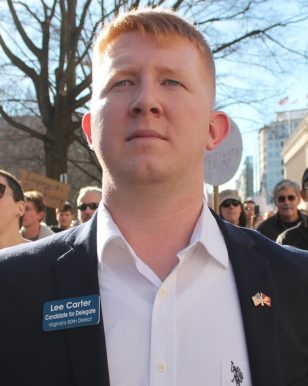
Del. Lee Carter
Del. Lee J. Carter
A Marine veteran and two-term state delegate who represents most of Manassas and part of Prince William County, Carter is the only self-described Democratic Socialist seeking Virginia’s Democratic nomination for governor. “It’s no secret that Virginia is divided, but it’s not red vs. blue. It’s the haves and the have-nots. One side has the lawyers and the lobbyists, but Virginia needs a governor that’ll fight for the rest of us,” Carter wrote in a Jan. 1 tweet announcing his candidacy. Carter was the state co-chair for U.S. Sen. Bernie Sanders’ presidential campaign and co-sponsored a successful bill that caps monthly insulin medical copayments at $50.
Justin Fairfax
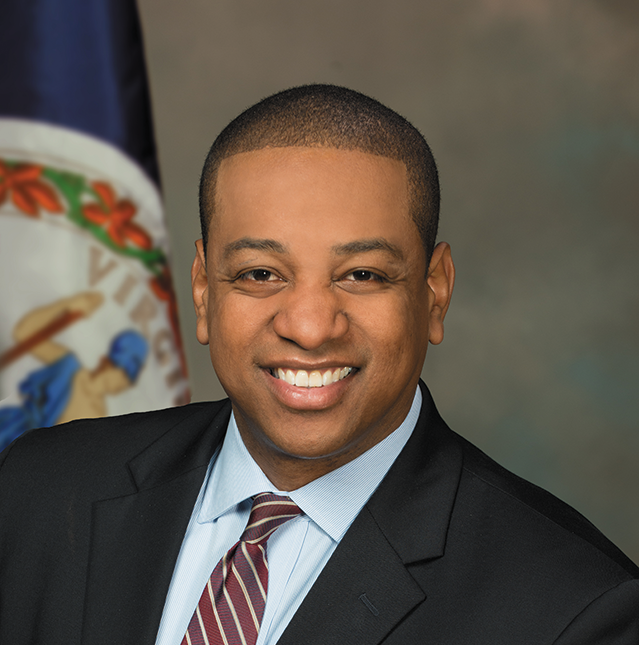
Lt. Gov. Justin Fairfax
Normally, a lieutenant governor would be sitting in the catbird seat when making a bid for the governorship. But Fairfax’s situation isn’t typical — not when the first paragraphs of news stories announcing his decision to run for the commonwealth’s top job inevitably cited two allegations of sexual assault that were made against him in 2019. No charges have been brought, and Fairfax has denied any misconduct, yet the situation has cast a pall over his campaign. The former federal prosecutor’s platform calls for “justice, fairness and opportunity” for all Virginians, with an emphasis on support for Medicaid expansion and police reform. If elected, Fairfax, 41, would be Virginia’s second Black governor. (Gov. L. Douglas Wilder was first, in 1990.) As of the second quarter of 2020, Fairfax’s campaign had raised less than $20,000, according to the Virginia Public Access Project (VPAP).
Jennifer Carroll Foy Contributed photos
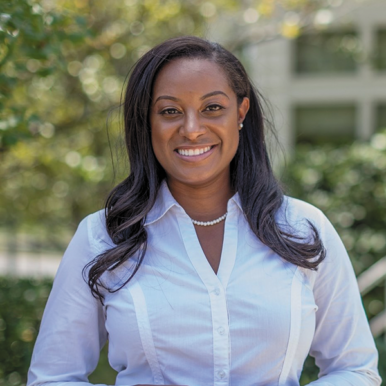
Jennifer Carroll Foy
Foy likes to tell voters about how her grandmother shaped the trajectory of her life. “If you have it, you have to give it,” her grandmother told her, and for Foy, “it” has entailed being a groundbreaker from the get-go. The former state delegate who represented Prince William and Stafford counties was one of the first African American women to graduate from Virginia Military Institute, which is now the subject of a state probe into an alleged culture of racism. Foy, 39, went on to become a magistrate judge and then a public defender. Now, she wants to become the nation’s first Black female governor and she’s serious about landing her party’s nomination. In December, she resigned from the House seat she had held since 2017 in order to focus on her gubernatorial bid. As a delegate, Foy helped get the Equal Rights Amendment ratified and supported the successful effort to expand Medicaid to 400,000 Virginians. She believes in gun safety laws, better pay for teachers and protecting the environment. As of the second quarter of 2020, Foy’s campaign had raised more than $800,000.
Gov. Terry McAuliffe
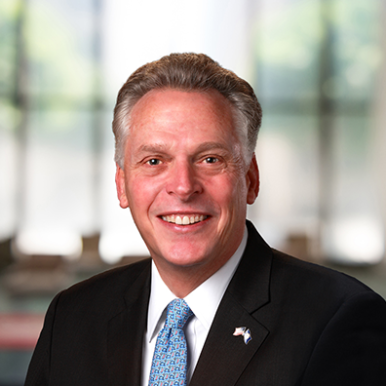
Gov. Terry McAuliffe
Virginia voters scarcely need to be introduced to McAuliffe. The 63-year-old former governor has been a ubiquitous force in national and state politics for 40 years. On the campaign trail in early 2020, President-elect Joe Biden called McAuliffe “the once and future governor.” McAuliffe has built a reputation as a stalwart of his party and a strong advocate of Democratic values, but as an older, white, establishment male, some in the party think it’s time for him to step aside in favor of a new generation of politicians personified by his declared rivals for the Democratic nomination. Still, the multimillionaire’s ability to raise money is legendary, starting with his decision at age 22 to wrestle an 8-foot alligator in exchange for a $15,000 contribution to then-President Jimmy Carter’s reelection campaign. (McAuliffe beat the beast, but Carter lost anyway.) The Washington Post reported McAuliffe had more than $2 million in his campaign war chest when he announced his run in early December 2020.
Jennifer McClellan
Sen. Jennifer McClellan
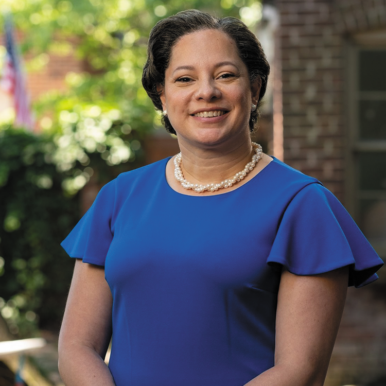
McClellan, 48, is a familiar face in Richmond, having spent 14 years in the state legislature, first in the House of Delegates for 11 years and then since 2017 as a state senator for the 9th District, which includes Richmond, Charles City County and portions of Henrico and Hanover counties. A corporate lawyer for Verizon, she has built a reputation as a pragmatist. She was a key player in the ratification of the Equal Rights Amendment, a rollback of abortion restrictions and passing the Virginia Clean Economy Act, which commits the commonwealth to generating its electrical power from carbon-free sources by 2050. Criminal justice reform, health care and education rank high on her agenda. McClellan is partly an establishment figure — her mentor is U.S. Sen. Tim Kaine — but she also can lay claim to being a member of the increasingly diverse left-of-center faction of her party. If elected, she would be the first African American female governor in the country. According to VPAP, her campaign raised close to $500,000 during the first half of 2020.
REPUBLICANS Declared
Sen. Amanda F. Chase
Sen. Amanda Chase
The first candidate of either party to throw a hat in the gubernatorial ring, the highly controversial Chase, 52, spent much of 2020 as the only formally announced GOP candidate. The far-right state senator from Chesterfield County briefly flirted with running as an independent in December, after the state GOP decided to hold a gubernatorial convention instead of a primary, a move some saw as intended to prevent her from gaining the nomination. But she quickly reversed course, affirming her intention to run as a Republican. A fervent Trump supporter, she called on the president to declare martial law and stay in office after his defeat. The pugnacious senator was kicked out of the Chesterfield Republican Party and refuses to caucus with Senate Republicans. Her opponent, Del. Kirk Cox, has said Chase’s “antics have long grown more than tiresome,” and a GOP senator’s aide formed an anti-Chase political action committee, the Unfit Virginia PAC. Chase is a passionate Second Amendment defender and champion of family values and religious liberties. She opposes COVID-19 restrictions, mask-wearing and mandatory coronavirus vaccinations, tweeting: “I will fight this with everything that is in me — so help me God.” She’s also known for making inflammatory and racially charged statements, such as claiming in a November 2020 Facebook post that the Democratic Party of Virginia “hates white people.” Two of her supporters made headlines after being arrested in November for carrying firearms outside a Philadelphia polling place. As of mid-July 2020, Chase had raised more than $225,000.
Del. Kirk Cox
Del. Kirk Cox
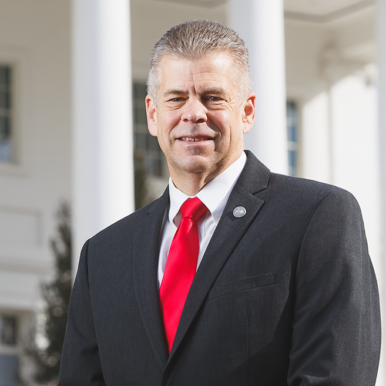
Former Speaker of the House Cox has been a force in state politics for more than 30 years. Before the blue tsunami of the 2019 election stripped Republicans of their leadership roles in the state legislature, the representative of the 66th District had served as house speaker and majority leader. “During my leadership tenure, you can point to a Virginia that was very, very well run,” he told a conservative news site, The Virginia Star. Cox, 63, is a traditional conservative: strongly pro-business, pro-law enforcement and anti-abortion. The retired high school government teacher did tread on some GOP toes in 2018, though, when, as speaker, he oversaw the expansion of Medicaid. Still, Cox showed his staying power in 2019 by being reelected in a radically redrawn district that could have turned blue. As governor, Cox has said he would seek to spend $50 million to raise law enforcement salaries. Cox is well-liked among the party stalwarts, and his mild-mannered demeanor could appeal to mainstream voters. In December, former state Sen. Bill Carrico of Grayson County set aside his own 2021 gubernatorial ambitions to endorse Cox, telling The Roanoke Times, “I believe Kirk’s the right man, and I believe he’s the one who can put Virginia forward economically for everyone and bring forth a more safe and secure state.”
Sergio de la Peña (U.S. Army photo by Monica King/Released)
Sergio de la Peña
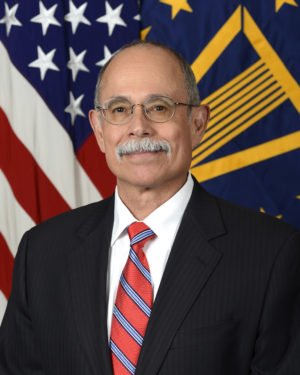
A Fairfax County resident who served in the Trump administration as deputy assistant secretary of defense, de la Peña is a Mexican native who immigrated to the United States and served 30 years in the U.S. Army, retiring as a colonel. He said in his announcement that he supports President Donald Trump and claims the American dream “is under assault.” In the Department of Defense, he oversaw Western Hemisphere affairs and oversaw the funding of defense cooperation for the U.S. Northern Command and U.S. Southern Command. According to his DOD bio, he was the chief of the international affairs division of the U.S. Northern Command J59, responsible for military to military guidance of training, sales and other activity with Canada and Mexico. He also served in Chile and Venezuela and was an air defense officer, and is an ROTC graduate of the University of Iowa.
Snyder
Pete Snyder
Following a year of buzz over whether he would enter the race, Charlottesville-area venture capitalist Pete Snyder formally announced on Jan. 27 that he would seek the GOP nomination for Virginia governor. A former Fox News contributor, Snyder made an unsuccessful bid for the GOP nomination for lieutenant governor in 2013 and chaired Ed Gillespie’s unsuccessful 2017 gubernatorial campaign. The William & Mary graduate founded Arlington-based social media marketing firm New Media Strategies and sold it in 2007 to Meredith Corp. for $30 million. He’s now chief executive of Disruptor Capital, a venture capital firm focused on innovative technologies and entrepreneurs. In response to the pandemic, Snyder and his wife, Burson, co-founded the Virginia 30 Day Fund, a nonprofit which provides small, forgivable loans to help small businesses weather the pandemic. The endeavor is separate from political considerations, Snyder says: “This is a time for us to be helping each other.”
Glenn A. Youngkin
Glenn A. Youngkin
Youngkin, 54, resigned his longtime position as co-CEO of Washington, D.C.-based investment firm The Carlyle Group in September 2020 in order to focus on “community and public service efforts.” In early January, the political newcomer declared he was running for the Republican nomination. With an estimated net worth of about $254 million, Youngkin could decide to self-fund his campaign. In an interview with The Washington Post, Youngkin’s campaign manager, Garrison Coward, said, “The political insiders have been smothering Virginians’ best interests with their special interests. Glenn is a breath of fresh air that will bring conservative solutions to everyday problems.”
In summer 2020, Youngkin and his wife launched the nonprofit Virginia Ready Institute to retrain workers idled by COVID-19. Youngkin is a longtime Republican donor, and he attended middle school in Chesterfield County before receiving degrees from Rice University and Harvard Business School. He also is part of the Virginia Tech Innovation Campus Advisory Board, among other nonprofit governing boards. Before joining Carlyle in 1995, he was a management consultant with McKinsey & Co.
Undecided
Sen. Emmett Hanger
Sen. Emmett Hanger
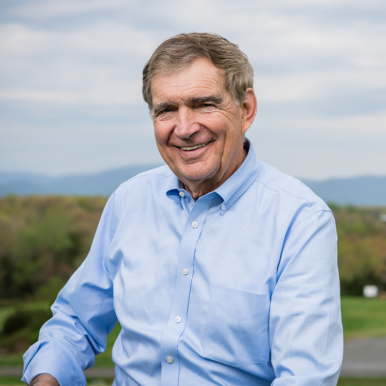
In September, Hanger created a political action committee, Virginians for a Better Tomorrow, to push for a constitutional amendment on nonpartisan political redistricting. Voters approved the amendment in November. The 72-year-old Hanger, who represents Staunton, Augusta County and other areas of the Shenandoah Valley, has said he will announce whether he will run for governor before the General Assembly session opens on Jan. 13. He has been a member of the legislature since 1982, first as a delegate, then as a senator. “When I started, I considered myself to be one of the most conservative members, and I don’t think my views have changed,” he says. Since then, however, more members of his party have moved “considerably to the right of me,” he says. Being labeled “moderate” used to bother him, but Hanger now considers “moderate” a synonym for “reasonable.” A believer in limited government and fiscal restraint, Hanger has been known to reach across the aisle to get things done. To the dismay of many in his party, he supported the expansion of Medicaid under the Affordable Care Act.
Also considering a run
Princess Blanding, the sister of an Essex County high school biology teacher who was killed by a Richmond police officer during a mental health crisis in 2018, announced in December a third-party bid for governor. An advocate for criminal justice reform, Blanding is running as a candidate for the Liberation Party, a party created following the killing of her brother, Marcus-David Peters. She is a science teacher from Middlesex County.
Mike L. Chapman, a three-term Republican Loudoun County sheriff, is openly considering a run to push back against what he calls “a false narrative” about law enforcement. He adamantly opposes citizen oversight bodies like those greenlighted in 2020 by the General Assembly to investigate police misconduct complaints.
Neil Chatterjee was chairman of the Federal Energy Regulatory Commission before being demoted from the post in November 2020 by President Donald Trump. In May, Chatterjee, a Republican, created a Facebook group pitching a “hypothetical” run for governor. He told Politico he was “just playing around,” but the former aide to Senate Majority Leader Mitch McConnell has not formally ruled out a run.
Pete Doran is a free-market stalwart who chairs the pro-GOP political organization Let’s Win, Virginia! He is the former CEO of the nonprofit Center for European Policy Analysis (CEPA), which advocates for public policy to encourage an economically vibrant, strategically secure and politically free Europe.
Republican U.S. Rep. Denver Riggleman, whose term ended Jan. 3, has formed an exploratory committee to examine a run as an independent after the GOP did not renominate him for his House seat representing the Fifth District, Virginia’s largest geographic congressional district. The one-term congressman was censured by his party for not supporting its positions on spending and immigration, as well as officiating a same-sex wedding and not backing Trump’s voter fraud claims. He’s been a vocal critic of Trump and congressional Republicans.
Meat, coffee creamer, frozen fruits and chocolate.
These commodities represent some of the bread and butter business lines, literally, of Devon Anders’ mega storage and supply chain logistics company, which is based in Mount Crawford and has other state locations.
Interstate 81 is the backbone for distribution in the valley and has helped the manufacturing sector there remain strong, says Jay Langston, executive director of the Shenandoah Valley Partnership. Photo by Norm Shafer
The success of InterChange Group Inc.rises and falls on the health of the Shenandoah Valley’s manufacturing industry, and that’s due in large part to the performance of the local food and beverage sector, which includes companies such as Cargill Meat Solutions, Perdue and Hershey Co.
In 2019, InterChange opened a 250,000-square-foot cold storage facility, housing multiple spaces ranging in temperatures from minus 10 degrees to 34 degrees Fahrenheit. It’s planning a third-phase expansion of the facility that will include blast freezing capability (a rapid freezing process), mostly for meat storage.
“Our business has grown based on the growth of manufacturing in the valley,” says Anders, president of InterChange and a Pennsylvania native who moved to the Shenandoah Valley to attend Eastern Mennonite University in Harrisonburg. After graduation, he worked as a certified professional auditor before shifting to the packaging and logistics businesses.
InterChange’s story is a microcosm of the business environment in this agriculture-rich and mountainous western part of Virginia, where a population of approximately 370,000 relies on a mix of food manufacturing, agriculture and agribusiness — industries that build on one another to keep the economy moving forward. More than 5% of the Shenandoah Valley’s labor force comprises manufacturing, and it’s also the top region in Virginia for agriculture products sold, according to the Virginia Economic Development Partnership.
One reason for the valley’s manufacturing success is its location, says Jay Langston, executive director of the Shenandoah Valley Partnership. The Shenandoah Valley is situated along Interstate 81, serving as sort of a gateway to areas north, south, east and west. This proximity to many markets has “allowed the manufacturing to stay strong over time,” Langston says.
But a significant challenge is attracting people to fill the region’s many manufacturing jobs. That effort has been a major focus for economic development offices throughout the Shenandoah Valley — and it is ramping up.
The food chain
Manufacturing is the largest private sector employer in the Shenandoah Valley, and that’s unusual, compared with other regions, Langston says. Shenandoah Valley Partnership works to attract new businesses to the valley, expand existing business and increase workforce development opportunities.
Much of the region’s manufacturing growth in recent years has been in the food and beverage industry.
Take Hershey Co., which announced in July that it planned to expand its Stuarts Draft plant by about 90,000 square feet and add 110 jobs. It is the company’s second expansion in Augusta County in two years. The facility, which employs more than 1,000 people, is considered Hershey’s second largest in the country. Hershey Chocolate of Virginia has operated in Stuarts Draft for 38 years.
“We are proud to continue to invest and grow in an area that gives our employees a great place to live and work,” said Jason Reiman, senior vice president and chief supply chain officer at The Hershey Co., in a news release issued by Gov. Ralph Northam’s office. “Increasingly, Augusta County and Virginia are critical to our company’s growth and ability to deliver iconic and beloved products to consumers around the world.”
The region also is known for poultry manufacturing. In Rockingham County, Cargill Meat Solutions, Perdue, Pilgrim’s Pride Corp. and Virginia Poultry Growers Cooperative are among the top employers, with more than 500 workers each.
French
Slightly further north, in Mount Jackson, Bowman Andros Products LLC, a French company that processes applesauce, is expanding its production facility. It’s one of the county’s largest employers, with more than 500 employees, says Jenna French, director of tourism and economic development for Shenandoah County.
“We’ve actually seen a lot of our manufacturers, [despite] the pandemic, still going strong,” she says.
Food and beverage companies typically perform well, regardless of the state of the economy, Langston says.
“That’s an advantage for us,” he says. “People like their sweets, they like their beer, they like chicken and poultry.”
But it’s not only about food manufacturing in the Shenandoah Valley. Other manufacturers in the valley are growing and expanding.
They include Merck & Co., a global pharmaceutical company with a manufacturing operation in Elkton. Last year, it announced a $1 billion investment to expand its manufacturing operation to increase production of the human papillomavirus (HPV) vaccine. It employs about 900 people in Elkton, where it has been located for 75 years.
Agricultural innovation
From chickens to cows, the Shenandoah Valley houses four of the five top agriculture-producing counties in the state. Specifically, Rockingham County and Harrisonburg are the state’s agribusiness powerhouses, producing about 13,122 jobs, according to the Shenandoah Valley Partnership.
Rockingham, Augusta, Page and Shenandoah counties were among the top 10 farm income-producing counties in the state, based on the U.S. Department of Agriculture’s 2017 Census of Agriculture. The state’s poultry industry has long been concentrated in the Shenandoah Valley.
Within this thriving industry, there have been some innovative ideas in the Shenandoah Valley. In 2014, Corwin Heatwole, a sixth-generation farmer, launched Shenandoah Valley Organic, a network of privately owned poultry farms mostly housed in the valley. The idea was to work with family farms that did not want to sell poultry through larger corporations such as Perdue and Cargill. The Harrisonburg-based company sells its products under the Farmer Focus brand.
Corwin Heatwole runs Shenandoah Valley Organic, a poultry network that is building its second facility in Harrisonburg, creating 110 jobs. Heatwole photo courtesy Shenandoah Valley Organic
In November 2020, Shenandoah Valley Organic announced plans to establish a second, 75,000-square-foot facility in Harrisonburg, creating 110 jobs. The expansion will increase the company’s production capacity and retail packaging abilities.
The organic poultry company is a significant success story and employer for Rockingham County, says Josh Gooden, economic development and tourism coordinator for the county. Gooden did not know the company’s total employee count, and Heatwole could not be reached for comment.
“Farmers have always been sort of the unsung heroes, but they have evolved based upon the marketplace,” Langston says. “They are addressing the needs that people want in the marketplace.”
Attracting the right workforce
One of the Shenandoah Valley’s primary challenges in recent years has been finding the workforce to fill a rising number of manufacturing jobs.
“We are trying to educate,” says Langston. “Our manufacturing has grown throughout this pandemic. [Companies] are screaming for workers.”
The valley’s population is projected to grow by 2.5% during the next five years, and Langston says the growth rate might be closer to the 3.6% the region has seen since 2015. But, he adds, that still probably won’t be enough to meet employers’ labor demands.
“Business needs in general are growing at a higher level from a workforce perspective than we have workforce to fill it,” Langston says. “Part of that is we need to do a better job of selling the opportunities in the valley.”
Also, some manufacturing companies struggle to fill jobs because of a negative perception of those careers. Many people don’t know about the different kinds of jobs that are available through manufacturing nowadays, compared with what may have been available years ago, Langston says.
The partnership and other economic development offices across the region are working on new efforts to market the Shenandoah Valley as an attractive area to live and work. The partnership is in the process of creating a website to advertise the valley’s livability.
Gooden
Similarly, Shenandoah County officials have worked with neighboring counties to study perceptions of the region, French says. The county also plans to launch a website to highlight its jobs, amenities and quality of life.
“It’s a struggle to find adequate workforce for a lot of our companies,” French says. “They often are competing against one another.”
In order to provide more training for manufacturing jobs, particularly those at Merck, Blue Ridge Community College and James Madison University in 2019 announced a partnership to offer curriculum and training programs in biotechnology, engineering and computer science. Also, Blue Ridge opened a new bioscience building in 2019 at its Weyers Cave campus, housing nursing, paramedic and bioscience-related programs.
“The whole partnership just shows that everyone in the valley wants to see everyone in the valley succeed,” says Gooden of Rockingham County.
For the first time, James Madison University‘s College of Business offered spring 2020 students in its MBA program an elective course focused specifically on diversity.
By the end of the semester, JMU had hired the course’s instructor, visiting professor Demetria Henderson, as the business school’s director of diversity, equity and inclusion.
The appointment was a sign of how the national conversation on race that followed the police killings of George Floyd and Breonna Taylor prompted Virginia business schools to examine the role they should play in forging future business leaders able to foster inclusive workplaces.
Many schools are updating case studies to make sure they reflect diverse protagonists and examining the campus experience they offer to students and faculty from diverse backgrounds. Others are employing new technologies and increasing community interaction in order to build practical skills they believe students need in today’s workforce.
‘We can’t wait any longer’
At JMU, College of Business Dean Michael Busing saw a need to turn what had been a scattershot approach to matters of diversity, equity and inclusion into a more intentional effort.
“We have known that we need this for a long time, but it really does take a moment like this to get people to say, ‘We can’t wait any longer,’” Busing says.
Henderson, who was already teaching at the school as a visiting professor, seemed a perfect fit for the task.
She worked for more than 15 years in consulting and banking before earning her doctorate in management from the University of Texas at Arlington. Her research on how social class affects hiring was inspired by the experiences she had as a Black woman working in corporate America.
With her MBA students this spring, Henderson focused on creating an environment where students felt safe discussing the many aspects of diversity. Instead of hearing lectures, students discussed a variety of readings that caused them to question previous assumptions, and in some cases to change how they were interacting in their full-time jobs.
“It is about sharing information and experiences,” says Henderson, who is planning an undergraduate elective business course on diversity for the spring 2021 semester.
Both Henderson and Busing say JMU needs to focus on hiring a more diverse business faculty — a goal shared by many other business schools, and one that won’t come easily as JMU faces a hiring freeze due to the financial challenges brought on by the COVID-19 pandemic.
Henderson stresses that just as the school must broaden its recruiting efforts to bring in more diverse faculty, it also needs to create an environment where faculty from different backgrounds feel welcome once they arrive.
Busing agrees. “You can’t just say, ‘We will hire for diversity.’ You have to create a culture where everybody feels included,” he says.
This means supporting minority faculty with mentoring, looking at quality of life for various groups in the surrounding Harrisonburg community and being sensitive to the fact that loading an individual with committee appointments because they are a member of an underrepresented group can leave them with less time to pursue their own professional goals, Henderson says.
At Virginia Tech‘s Pamplin College of Business, Director of Diversity and Inclusion Janice Branch Hall has made recruitment and retention of a more diverse faculty a priority since she was hired in February 2019.
“A big part of that is understanding their needs and unique challenges, making sure we are providing research support [and]making sure promotion and tenure expectations are clear,” she says. “We want to make sure they are positioned well for success.”
Changing the classroom conversation
Hall and senior leaders at Virginia Tech have developed a web-based training site to equip faculty with the skills to lead classroom discussions that don’t shy away from potentially sensitive matters related to diversity and inclusion.
“If we are in the business of developing future business leaders, we have to have these conversations in the classroom,” Hall says.
At the University of Virginia‘s Darden School of Business, Martin Davidson, senior associate dean and global chief diversity officer, agrees.
“What is happening for students in the classroom is so powerfully affected by how skillful our faculty are in facilitating conversations about diversity,” Davidson says. “That skillset for our faculty is one critical element we are focusing on.”
Darden does this through regular seminars and teaching development forums — many of which have gone virtual in the COVID-19 era — that discuss what it means to lead an “inclusive classroom.” Examples are equitably calling on students to give responses and being aware of the unconscious biases that may affect teaching and other interactions with students.
This is also a goal at William & Mary’s Raymond A. Mason School of Business. The school recently began using a virtual reality platform that simulates role-playing scenarios with avatars, giving students a chance to practice broaching potentially polarizing topics with virtual managers and colleagues, and offering them a venue to assess and improve their skills.
“Students need to not only know in an abstract way what diversity and inclusion mean, but we also want to help students change behaviors to interact with each other in a different way and recognize biases as they are happening,” says Inga Carboni, an associate business professor at William & Mary.
Carboni uses the technology in a diversity course that is required for all undergraduate business students at the school. She has used it with online MBA students and will be training senior administrators at the school with it this fall.
Constant vigilance is key
Darden first established its chief diversity officer position in 2007, before many other top business schools. But Davidson says work on diversity, equity and inclusion isn’t something that can be checked off a list as a single accomplishment. Efforts to recruit more diverse students and faculty can take years to bear fruit and fostering a culture where diverse individuals feel welcome requires ongoing effort.
“It’s like working out — if you stop doing it, then you stop getting the benefits,” he says. “Our objective is to change our DNA, to change the way we operate so it becomes natural to pay attention to and practice inclusion.”
Jeff Tanner, dean of the Strome College of Business at Old Dominion University, was attracted to ODU specifically because of its commitment to diversity and inclusivity.
ODU’s student body has a higher proportion of Black and Hispanic students than the state average for four-year public institutions, according to 2019-20 data from the State Council of Higher Education for Virginia.
One in four students at the school are first-generation college students, and one in four have military affiliation, giving the school a wide diversity of age and life experiences.
“Inclusivity is such a pillar of who we are, it is such a basic part of our organizational DNA, that it attracts you or it repels you,” Tanner says. “Therefore, we attract people who seek this kind of place.”
But that doesn’t mean there isn’t work to be done. When a student in a January 2020 focus group remarked that speakers at school events didn’t reflect the student body, Tanner was surprised. He was proud of the school’s recent signature speaker series, which featured four speakers, three of whom were Black.
But when a committee looked more deeply at speakers across the business school, they found that most people who were invited to speak to classes and student organizations were white.
“I realized that while I might see one thing, students are seeing another, because they are exposed to a different set of experiences, and we really needed to do the deeper dive,” Tanner says.
He is adamant that inclusivity needs to be pursued with a bigger purpose, and at ODU he has tried to steer that purpose toward fostering better conditions for minorities to thrive in the Hampton Roads business community.
Strome’s chapter of the National Association of Black Accountants, for example, works with Future Business Leaders of America clubs in local high schools to recruit a more diverse group of future students.
The school’s Transitional Entrepreneurship Lab is devoted to promoting economic well-being among disadvantaged communities, and in fall 2020 it put on a small business academy for vendors that meet Virginia state government’s Small, Women-owned and Minority (SWaM) business certification standard.
“One of the things I have really tried to do as dean is give this idea of inclusivity a purpose beyond, ‘It’s a nice, good thing to do,’” Tanner says.
At Virginia Tech, Hall sees a similar dynamic in the impact that faculty research can have on the business world. She points to research Tech professors are conducting on the importance of diversity on corporate boards, Black entrepreneurship, social justice branding and other topics that are driving new conversations within business schools and out in the business world.
“We are focused on ways that our faculty can conduct research that really impacts the human condition, and how we engage in society, and what that means in a global economy,” she says.
Although it’s hard to think way back to January 2020, a time before a year of social unrest, pandemic and economic peril, that’s when Virginia’s legislature and executive branch became majority-Democrat for the first time since 1993. However, even if some Virginians forgot about this significant shift, Republican lawmakers have not.
Just before Thanksgiving, Virginia Business spoke to the House of Delegates’ minority leader, Del. Todd Gilbert, R-Shenandoah. A Texas-born attorney with a bachelor’s degree from the University of Virginia, the 50-year-old Gilbert has held his seat since 2006, representing sections of Rockingham and Warren counties, as well as the counties of Page and Shenandoah. He serves on the House’s agriculture, rules and finance committees and was majority leader from 2018 to 2020. Democratic control of the House and Senate now makes it difficult for the GOP to pass legislation and set priorities in Virginia, but Gilbert says Republicans aim to “try and be a voice of reason for the business community.”
This year’s General Assembly session comes on the heels of the longest special session in memory, an 84-day session held from August to mid-October that was mainly focused on policing reforms and COVID-19-related economic relief measures. Gilbert and his fellow Republican legislators say they will not join Democrats in approving a 15-day extension of the 2021 regular session to 45 days, as is customary, but nonetheless requires a two-thirds majority vote. Gilbert says there’s no need for more than 30 days since much of the budget work was accomplished in the fall. On that front, Republicans retain some power.
Virginia Business: What legislation will be top of the agenda this session?
Del. Todd Gilbert: Well, I certainly think that the agenda in the General Assembly is obviously being driven by the one-party rule that we currently face in Richmond. We just had what I believe to be the worst legislation [passed] for business in the history of the commonwealth if you look at it as a whole. Virginia is, at least at the moment, still in the position of being the No. 1 state in which to do business, according to [2019] CNBC rankings.
I think it’s very much a collective effort [by Democrats] to undermine the business environment. I mean, there are any number of ways that businesses are going to be able to be sued now, untold new liabilities in that regard, any number of additional costs of doing business — from increasing minimum wage to having to pay prevailing wages in public-works contracts — [to] being able to be sued for nonpayment of wages, for discriminatory behavior, for misidentifying employees as independent contractors and on and on.
VB:The state Senate tempered some of the stronger measures with support in the House, such as killing a measure that would have repealed the right-to-work law last year.
Gilbert: That’s correct, but I think that’s only a temporary reprieve. The Democrats as a whole have made it extremely clear that Virginia’s almost sacred right-to-work law is in their sights, and they intend to get rid of that. The unions to which they are beholden expect them to do that. I think the only reason that we did not see it happen in the last session is because the House and the Senate differed on how they chose to eliminate right-to-work. I don’t think the goal of the House and Senate is ultimately different; it’s just how they intend to get there.
… One of the top reasons we are an attractive place to do business nationally, that people choose to come here, is because we don’t have the system where you have to belong to a particular union in order to work in a particular business or factory or industry.
VB:Where do you stand on marijuana legalization, and where does your party stand on it?
Gilbert: I don’t know if there’s a collective opinion of our party. We’re made up of … diverse individuals, and the members of my caucus probably have varying opinions on it. I continue to oppose legalization without any guidance as to where this is all headed.
My contention through the years has been that before Virginia even contemplates going down that road, we should let all these other states that have done so make all the mistakes first. I’m not saying I would never support it, but I certainly think it’s prudent for those who do support it to let other states make all those mistakes and try to learn from them. If you look at California, there’s still an enormous black market for marijuana. They legalized it out there, but their regulatory scheme, their tax scheme, is so onerous that there’s still a tremendous black market and all the crime that goes along with it. You’re not going to eliminate that unless you’re thoughtful about it. Colorado has had any number of public health impacts in terms of usage and driving under the influence and you name it.
Nobody has yet presented a real plan or vision of the structure that that would take. [Editor’s note: This interview took place before Gov. Ralph Northam’s administration released a 400-page report on the impact of legalizing marijuana.] How would it be regulated? How would it be taxed? How would it be implemented? Are they going to sell it at 7-Eleven? Are we going to have dispensaries? Anyway, I just think it’s moving awfully fast for it to be done right.
“I’m concerned that there are no real opportunities for bipartisanship anymore, at least in this current environment,” Gilbert says. Photo by Caroline Martin
VB:Broadband access has come up a lot this year. What does the state needs to do to expand access, especially in rural areas?
Gilbert: I think there was some legislation recently where broadband was going to be able to tag along on existing easements that utilities have. I think I had some concerns about some of the constitutional aspects of that as … basically running these [fibers] across somebody’s private property. I love the goal of it, especially when you’re using existing infrastructure and existing easements, but there were some constitutional concerns.
At the same time, you look at what the private sector is doing. I think Elon Musk and company are currently deploying satellites all around the atmosphere that will bring high-speed internet access everywhere without the need for that physical wire or broadband in terms of the way we think of it now. I think in the future, we’re going to see … innovation, and the efforts that we’re making in state government provide those additional opportunities.
VB:HouseSpeaker Eileen Filler-Corn has said the session will be held remotely due to the pandemic. You’ve said it’s not the best way to go because constituents and lawmakers won’t have the same level of access. What would you do instead?
Gilbert: The Maryland legislature is also run by a robust Democratic majority. They rolled out a plan recently to meet in person, and I think they intend to meet in person. It is doable with just a little less timidity and a little more creativity. I loved what [Filler-Corn] did initially last special session when we met in person at the VCU Siegel Center.
The question is, to what degree do we intend to be willing to limit public participation and hinder the legislative process in such a dramatic way simply to try to stay shuttered in our homes and not having any interaction with anybody? Believe me, I don’t want to get [the coronavirus] and I don’t want to bring it home to my family. I’ve got two small children.
I guarantee you, if [Republicans] were in charge, we would try to find a way to safely conduct this session in person and allow for maximum safety and participation simultaneously, and do it very thoughtfully. None of us are suggesting that this is some hoax or that it isn’t real, or it doesn’t have negative health consequences for lots of people. That doesn’t mean, I think, we just close up shop and do this over the computer until it all passes. I think we have to get on with our jobs and our lives and just be thoughtful and safety-conscious as we do it.
VB: You’ve said you won’t vote to extend the 30-day session to 45 days. Why?
Gilbert: The Constitution of Virginia [says] that in the off year — and by off year, I mean a nonbudget year — that the legislature was always intended to meet for 30 days. By tradition and custom and practice, it has typically extended to 45 days. The reason for that is that we usually need that time to work on the budget.
[However], we just spent 2½ months in special session, and we came out of that with those very adjustments to the budget. I don’t see why we need to extend the session past the constitutional mandate when we’ve already made those adjustments.
Nobody currently serving intended that this would be a full-time professional legislature, even though I’m seeing a growing number of Democrat members suggest that’s the direction we should head.
Certainly, the days in session can wear on citizen legislators who need to be paying their own mortgages. I don’t want to minimize it. There are good reasons. We’re all ready to step up and do our job at a moment’s notice when it’s necessary. I don’t know how necessary 2½ months of special session was when, frankly, all Democrats did was make life a lot harder on police and a lot easier on criminals in that special session.
VB:In a time of so much division, do you think that bipartisan cooperation still exists here?
Gilbert: It is far more rare than when I began 15 years ago. I think, at least [in 2020], there were bills … where [Republicans] raised concerns or made suggestions, and those were dismissed out of hand. They were ignored. Debate was cut off.
Then, lo and behold, the Senate in many instances ended up requiring the same suggestions that we had suggested or making the same changes that we had said would be beneficial to have a common-sense bill instead of something very extreme. I’m concerned that there are no real opportunities for bipartisanship anymore, at least in this current environment.
Right now, I think [Virginia Democrats are] feeling very much like they can do whatever they want, and they don’t need to worry about what Republicans think. That’s unfortunate because we represent millions of Virginians ourselves.
VB: We are seeing a lot of rural counties in Virginia consider measures to endorse the assembly and training of militias. How does the GOP feel about this on a state level?
Gilbert: I think what you’re seeing is some level of angst that is well-deserved by people who value very much their right to protect themselves and their families as they see fit. They’ve seen this very extreme attack on their rights and their personal property coming out of Richmond from Democrats, where [Democrats] made it very clear that they intend to sharply limit the ability of law-abiding people to protect themselves and their families as they see fit. [Constituents have] recoiled at that.
I don’t think people should attribute revolutionary motivations to anybody. I know that locally we have a militia that formed in one of my counties, and their primary purpose, they will tell you, is just to supplement the sheriff’s office if they ever need assistance in an emergency. I don’t mean like a riot, but like if there’s ever a natural disaster or some need for search and rescue.
VB: What do you think it would take for Republicans to regain control of the House, and possibly the Senate and the governorship?
Gilbert: I think 2021 is going to be a very interesting political year in Virginia because of the natural swings that may exist when the White House changes hands. If Joe Biden is president of the United States, you’re going to see a very interesting political climate emerge in Virginia that may present some opportunities at the state level both for governor and for the House of Delegates.
VB: What do you think about the change in Virginia’s redistricting process, which relies on a bipartisan commission redrawing legislative district lines instead of legislators?
Gilbert: It’s going to be a much different thing than we’re used to, which is that the party in power chooses — it draws the lines essentially. Having this bipartisan commission to do it is certainly new and exciting, and it’s obviously going to have an effect on the politics and the districts.
None of us know really what districts we’re going to be running in or even if there will be a district that we’re recognized to run in, but I still think it’s a vast improvement over what we had previously, and we’re all excited to see how it comes out.
VB:What agenda items do Republicans need to accomplish this session?
Gilbert: If we can accomplish anything, even in the minority … I would hope that [Democrats] would help us provide some protections for businesses in terms of liability related to the COVID-19 outbreak, so that in addition to trying to keep the lights on, [businesses] wouldn’t also have to worry about being sued for a violation of a technical aspect of the health department regulations.
I will say that one of the things I’m concerned about just in terms of quality of life in Virginia and how that impacts families, businesses, etc., is the very extreme direction in which our Democratic colleagues appear to be headed in terms of crime and punishment. You’ve seen for years now they keep doing things like increasing the larceny threshold. All that means is that Democrats are incentivizing people to shoplift, and I mean that. We are just going to give you a pass on your stealing. They very clearly signal to the criminal element that there will no longer be serious consequences for your thievery, and that obviously impacts the people who they’re stealing from, which in many cases is a business.
It’s going to make it much more dangerous to live here, much more expensive to live here, to run a business here. Criminal justice policy has an impact on … the business community and the desire of people to even live in Virginia if it changes dramatically.
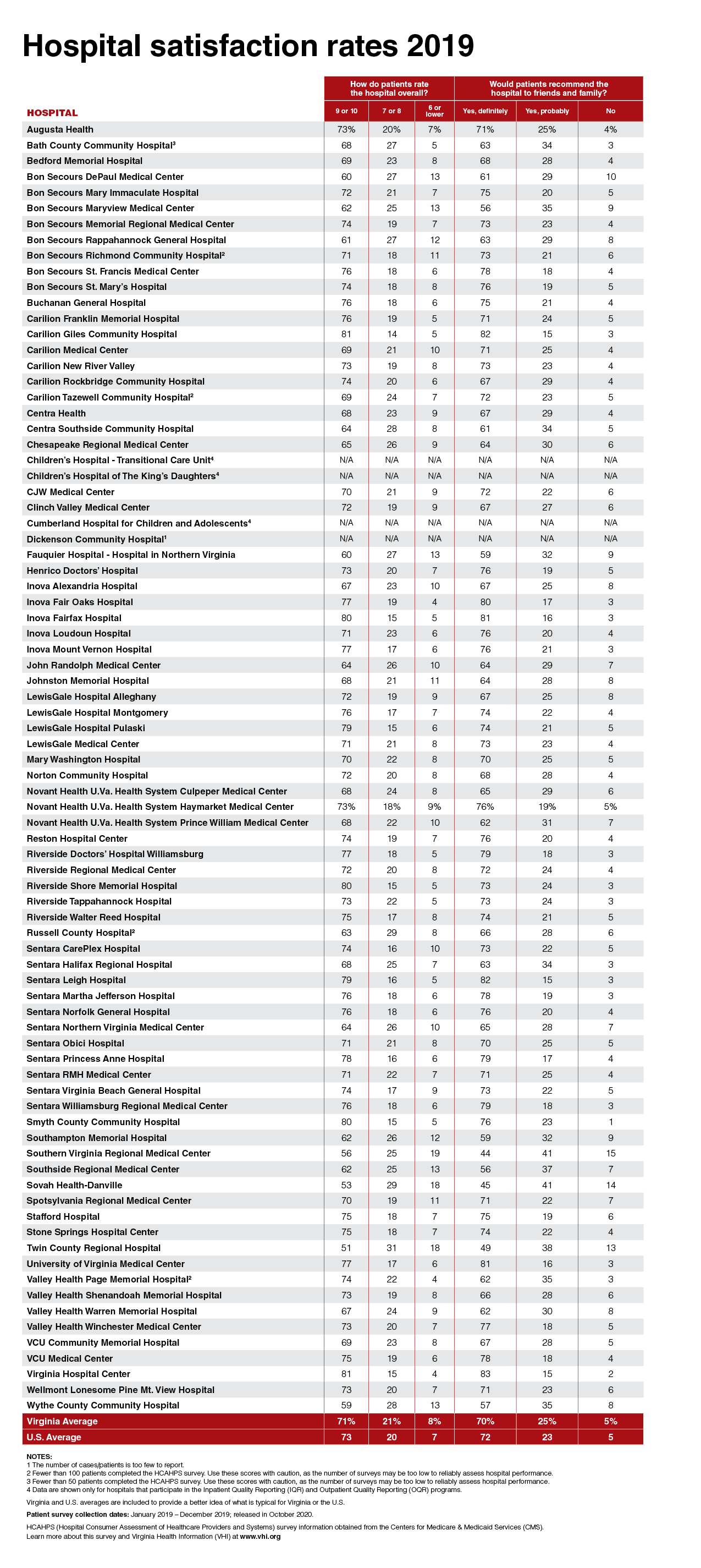
Virginia’s patient satisfaction rate held steady in a recently released nationwide survey, but just three hospitals in the commonwealth received the highest marks. Overall, Virginia patient satisfaction trails the national average by just 2%.
The patient satisfaction scores come from the annual Hospital Consumer Assessment of Healthcare Providers and Systems conducted by the Centers for Medicare & Medicaid Services (CMS).
The Virginia results of the latest survey are shown on Pages 42-43. It’s important to note that the survey was conducted in 2019, assessing patient satisfaction prior to the coronavirus pandemic. The results are provided by Virginia Health Information, a Richmond-based nonprofit organization offering an array of data on hospitals, nursing facilities, physicians and health insurers in the commonwealth.
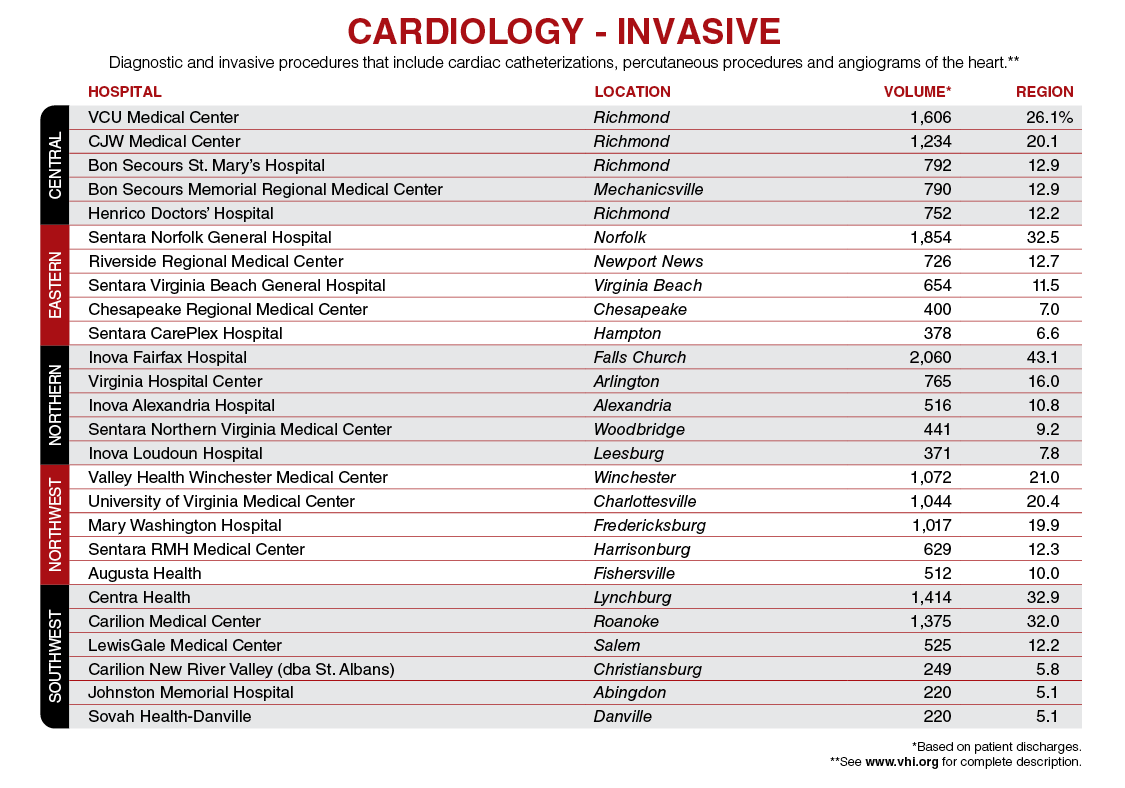
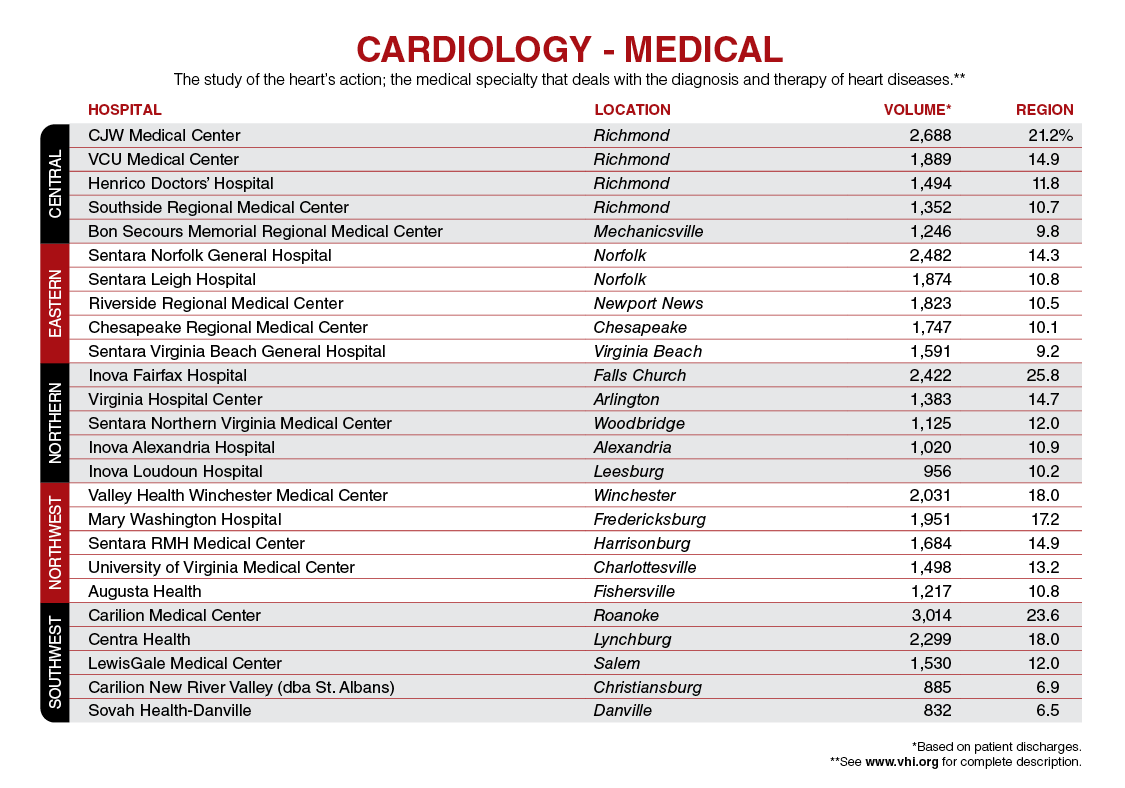
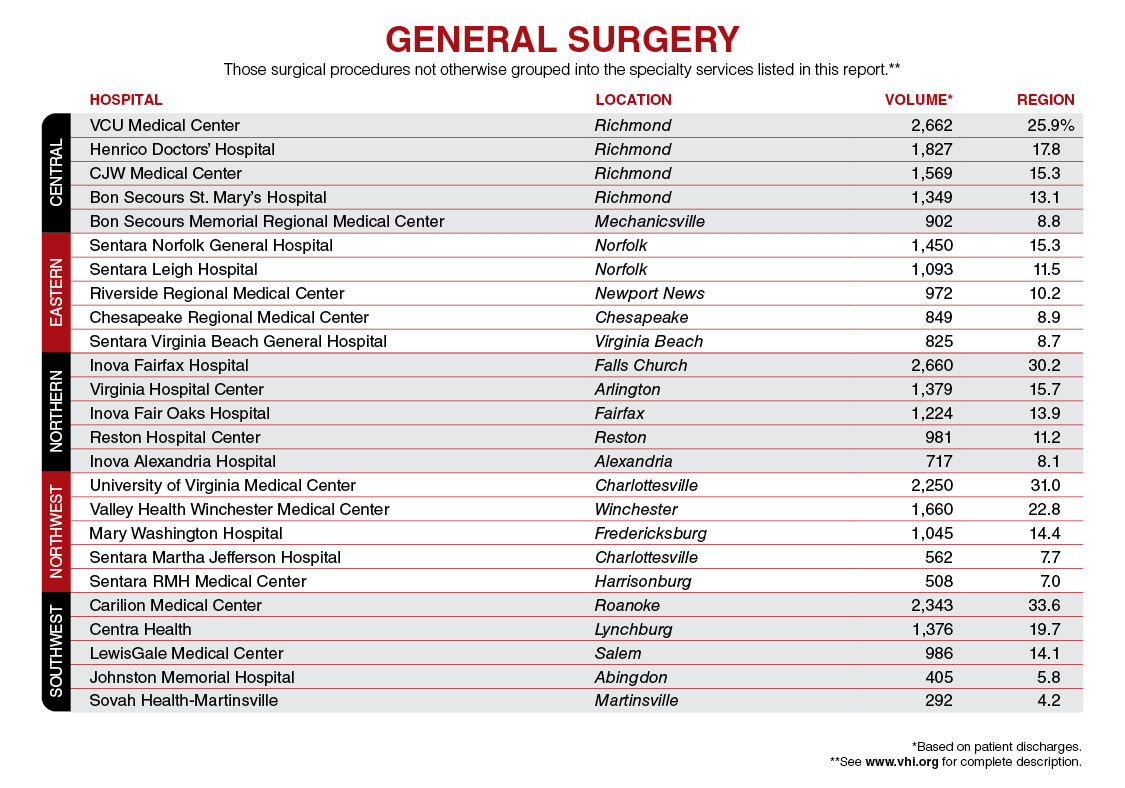
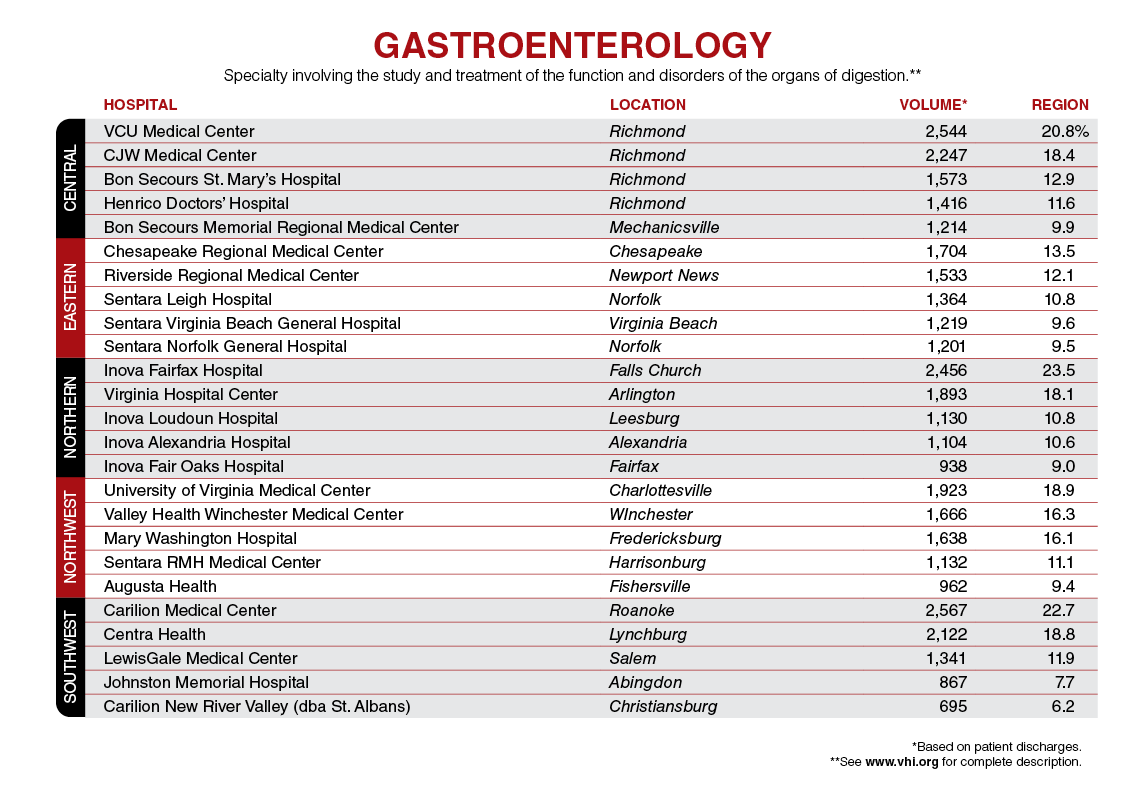
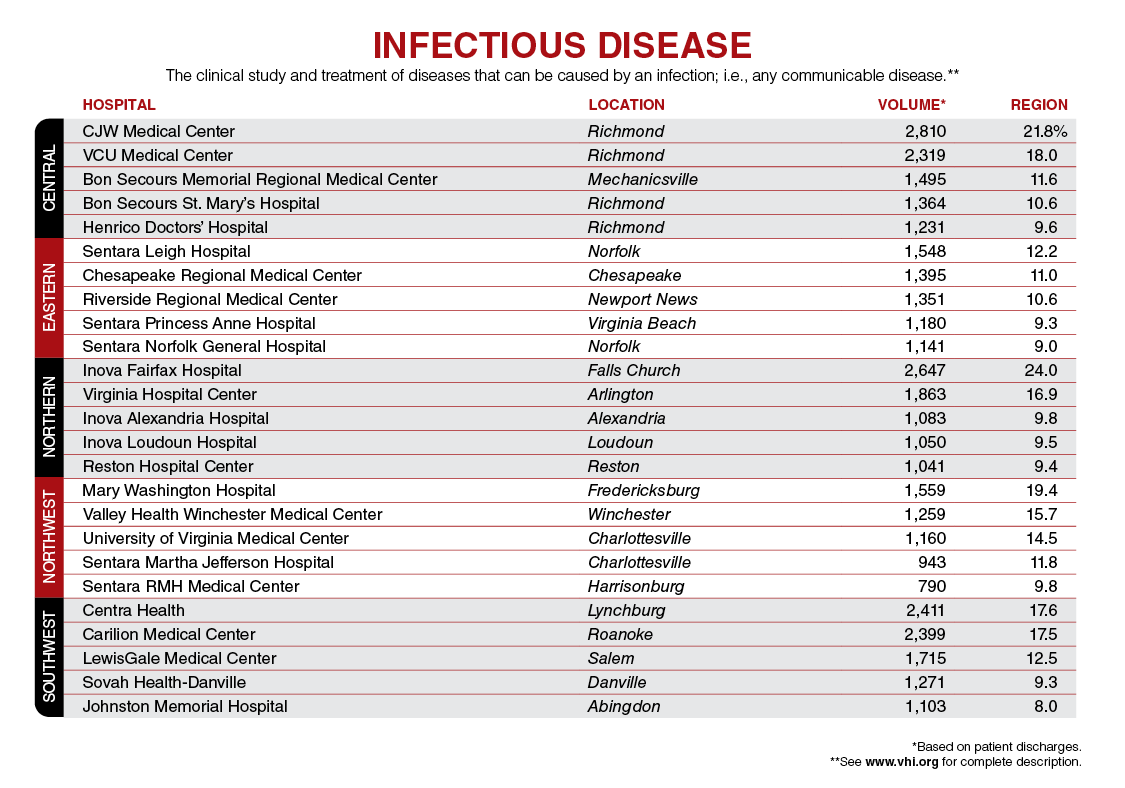
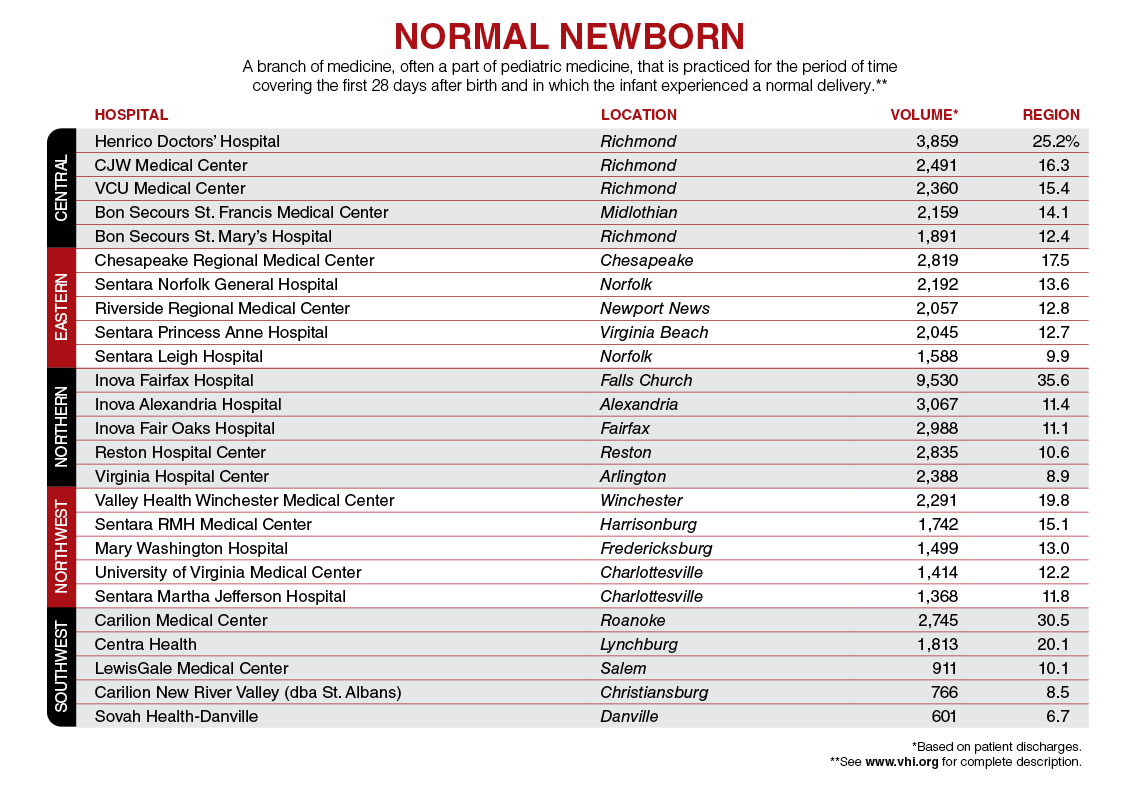
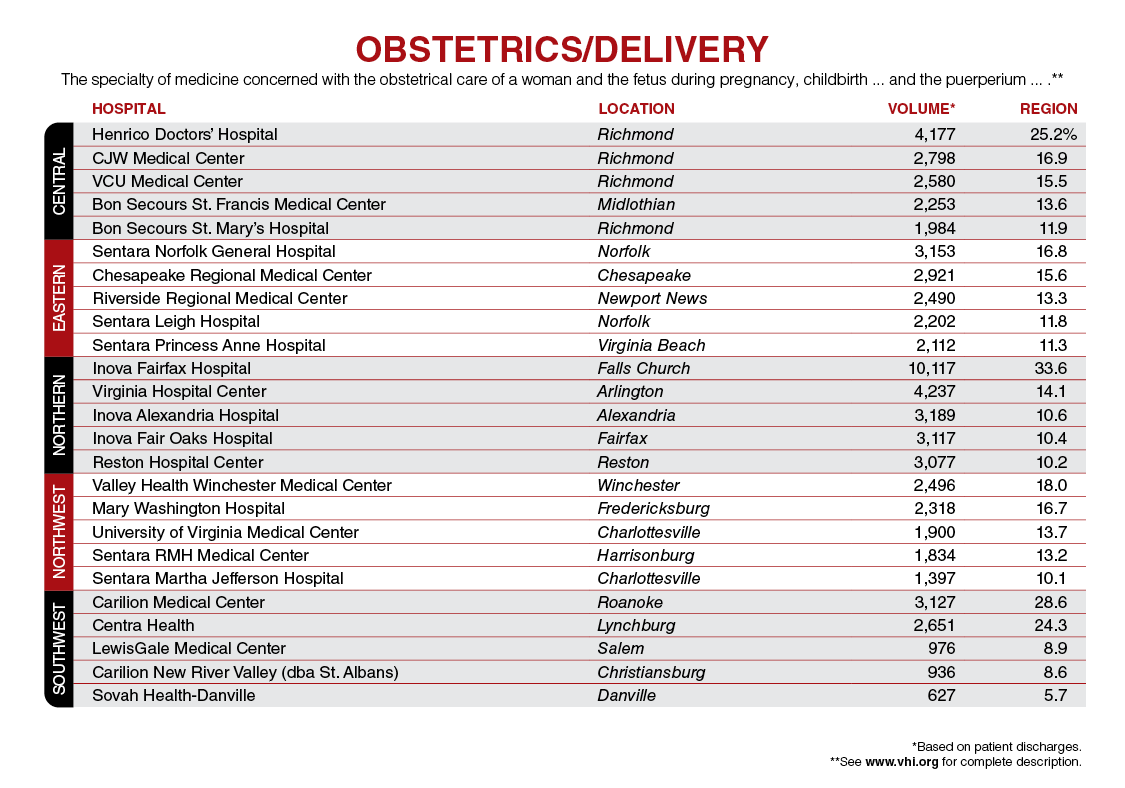
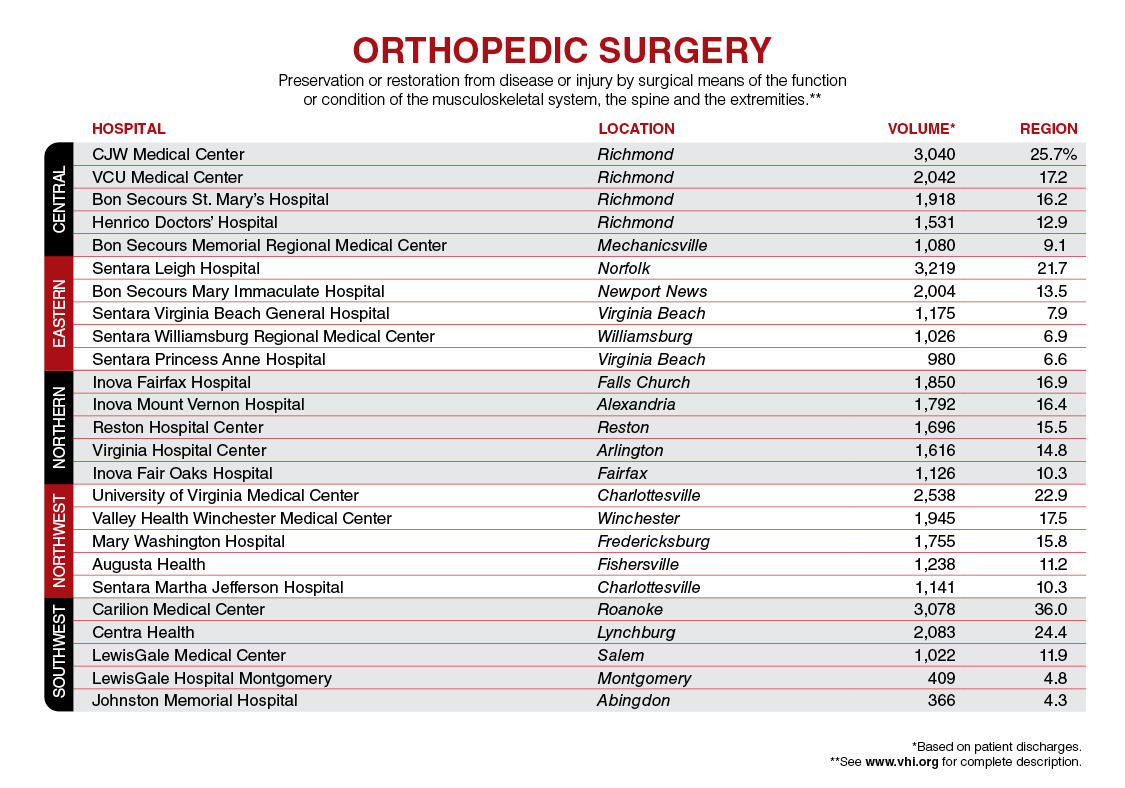
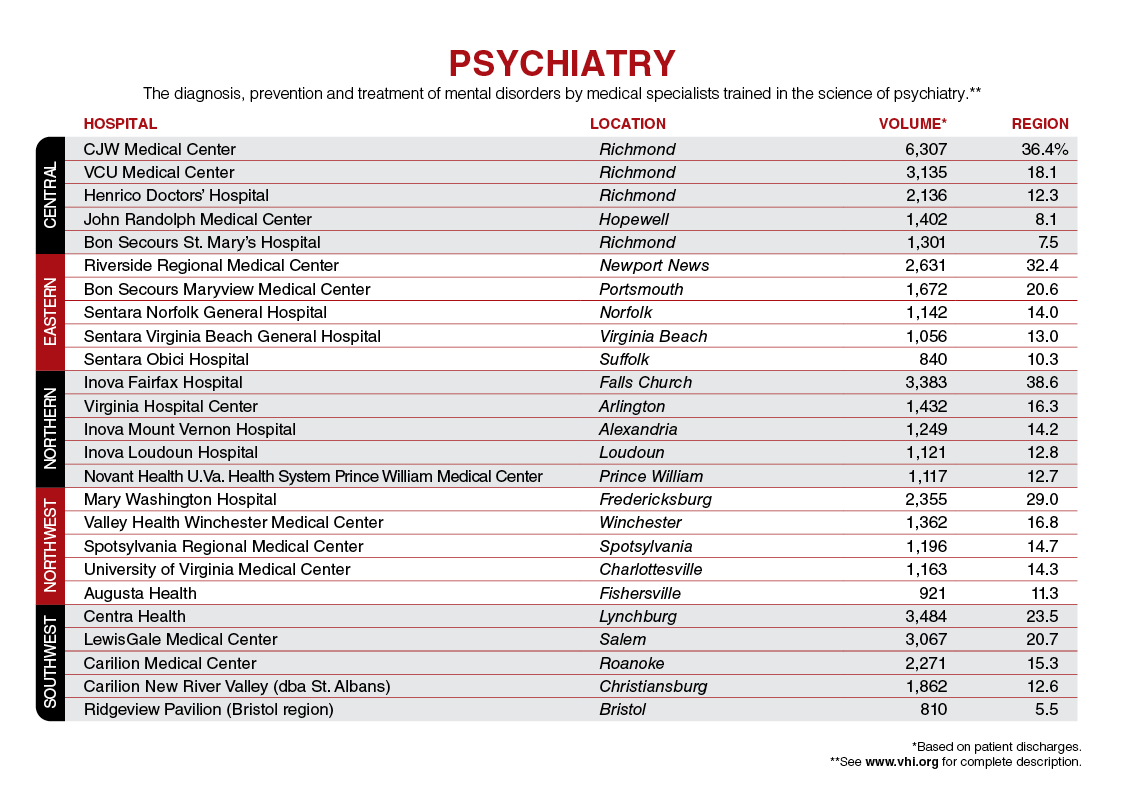
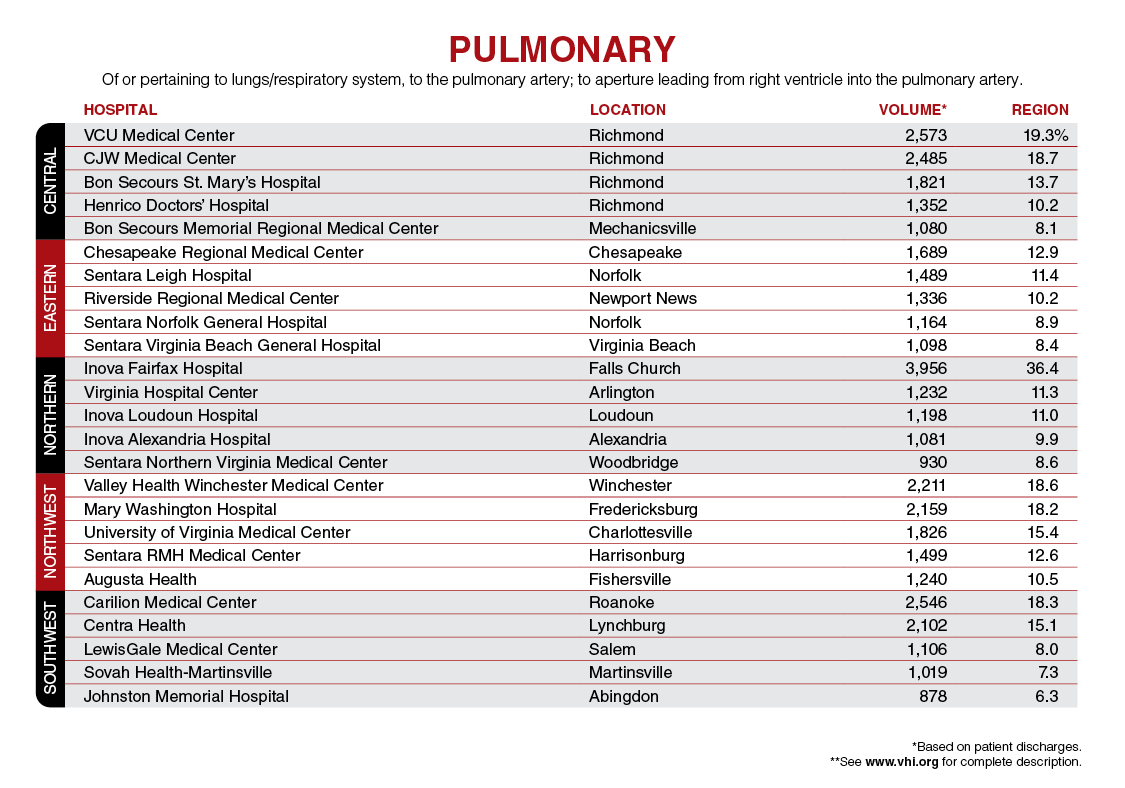
In addition to the patient satisfaction survey, VHI annually provides Virginia Business with service line reports showing patient discharge volume by region for a wide variety of hospital procedures.
The national satisfaction survey asks patients two questions:
How do they rate their hospitals overall?
And would they recommend the hospital to friends and family?
The highest ratings in answer to the first question are 9 or 10 on a 10-point scale. The highest recommendation in response to the second question is: “Yes, definitely.”
In answering both questions in 2019, 80% or more of respondents gave top ratings to three of 82 Virginia acute-care hospitals: Carilion Giles Community Hospital in Pearisburg, Inova Fairfax Hospital in Falls Church and Virginia Hospital Center in Arlington. Carilion Giles Community Hospital and Virginia Hospital Center also received top marks in the 2016, 2017 and 2018 surveys.
Additionally, another five hospitals scored 80% or better on one of the two questions in the 2019 survey: Inova Fair Oaks Hospital in Fairfax, Riverside Shore Memorial Hospital in Onancock, Sentara Leigh Hospital in Norfolk, Smyth Community Hospital in Marion and University of Virginia Medical Center in Charlottesville.
The Virginia average percentages for top ratings in the latest survey were 71% for the first question (unchanged from the 2018 survey) and 70% for the second question (also unchanged from the previous year). The national averages for the 2019 survey were 73% for the first question and 72% percent for the second.
In the 2019 survey, data was unavailable from four hospitals, and an insufficient number of patients took the survey at four other facilities.
The service line reports on Pages 44-50 show consumers which hospitals are the market leaders in their regions in terms of patient discharges for a variety of procedures. VHI suggests that patients seek additional information about their options and needs from health care providers. Not all hospitals provide the same types of care.
VHI also publishes regional and statewide costs for dozens of services to help consumers compare expected costs. These and other details about Virginia hospitals.
Abingdon’s Moonlite Theatre is on the National Register of Historic Places and in the lyrics of at least two country western songs, but the drive-in movie theater was closed for most of the last decade.
When Katy Brown visited it last spring, “it was a wreck,” she recalls, “but I thought all we’d have to do is put a stage up here. This could happen.”
Barter Theatre’s producing artistic director, Brown decided that the Moonlite was the place to produce plays during a pandemic. COVID-19 forced Barter to shut down its spring schedule and furlough 93 of its 104 employees. But with help and support from Abingdon-area businesses, Barter staged performances that projected on Moonlite’s 65-foot-tall screen and broadcast on car radios.
Shows ran through the summer, with two productions around Halloween and two for Christmas. Barter increased its staff for the productions to 53 workers, not all of them full-time. Ten actors and a stage manager lived at the Barter Inn from June until the night before Christmas Eve.
“You can truly be absolutely distant and together,” Brown says. “I’m so proud that we’re doing something that can give people some kind of connection and is actually honest-to-God fun.”
Terrance Jackson, a creative content specialist with Barter’s marketing team, played nine roles in two Christmas plays. With all that togetherness, the cast learned “how to navigate the good days, the bad days and what each other needs to function, to make the best possible art that we can make,” he says.
Making art requires money, and the Moonlite’s one show per evening couldn’t replace the revenue generated by Barter, its Smith Theatre and traveling shows. Ticket sales usually provide 60% to 70% of the theater’s budget, which was $6.4 million pre-COVID, so Barter is depending on fundraising more than usual. Brown won’t reveal the target. “We’re just trying to be understanding that people can give what they can give right now,” she says.
According to Brown, Barter has received $100,000 in federal CARES Act funding from the National Endowment for the Arts and local governments, and she expected another $50,000 by the end of 2020.
“The community’s response to this, the region’s response to this, has been great,” Brown says, “and we couldn’t have done it without that.”
In August 2020, Old Dominion University won a $775,000 grant from the Department of Defense that will help create a “wind energy siting solution,” enabling offshore and onshore wind-energy developers to avoid potential conflicts with military operations and trainings.
The ODU grant followed Dominion Energy Inc.’s June 2020 installation of two monster wind turbines some 27 miles off Cape Henry during the summer — the first wind turbines in the nation in federal waters.
The two turbines — each standing more than 600 feet above the ocean surface — eventually will be joined by more than 180 even larger turbines in an adjacent 112,800-acre expanse of the Atlantic Ocean leased by Dominion Energy from the U.S. Bureau of Ocean Energy Management. Plans call for construction to begin in 2024 on the largest single offshore wind project in the country. Known as Coastal Virginia Offshore Wind and scheduled for completion in 2026, it will provide 2.6 gigawatts of power, enough for more than 650,000 customers.
As big as it’ll be, though, the project will get Virginia only halfway to its goal of generating 5.2 gigawatts from wind energy by 2034, says George Hagerman, senior project scientist at ODU’s Center for Coastal Physical Oceanography.
That means more offshore wind lease areas will have to be identified, though exactly where those will be located is, well, up in the air. Part of this is due to all the stakeholders that have to be considered. Dominion Energy’s project had to take into account the military, ports and commercial shippers.
That’s where ODU’s new siting solution tool comes in.
ODU’s tool, once rolled out, will help in the development of future wind-energy sites by providing a “web-based map portal,” weaving together unclassified military GIS (Geographic Information Systems) data layers and visualizing offshore and onshore features such as training routes, restricted airspace and radar coverage, says Tom Allen, professor of geography and political science at ODU, who will serve as principal investigator.
The tool will cover the state and extend 200 miles out into the ocean, across the “Exclusive Economic Zone,” he says.
“Not long ago, the ocean was considered open space,” Hagerman explains. “Nobody had to worry about where they fished; and once outside designated shipping lanes, nobody had to worry about where they sailed their ships.”
The top trending stories on VirginiaBusiness.com from Nov. 16 to Dec. 15 included the news that Gov. Ralph Northam was ordering new restrictions based
on post-Thanksgiving surges in coronavirus cases.
These 16 Va. companies received $10M PPP loans Sixteen companies received the maximum $10 million from the federal relief program intended to assist small businesses due to the economic crisis caused by the pandemic. (Dec. 2)
This website uses cookies, web beacons, pixels, tags, software development kits, and related tracking technologies, as described in our Privacy Policy and Cookie Policy, for purposes that may include website operation, analytics, analyzing site usage, enhancing site navigation optimizing a user's experience, and third-party advertising or marketing purposes. Through these technologies, we and certain third parties may automatically collect information about your interactions with our website, such as your browsing behavior and page views. We also may share this information about your activity on our website with our social media, advertising, analytics, and other business partners. By clicking “Accept All”, you consent to the use of these technologies and that we can share information about your activity on our website with third parties in accordance with our Privacy Policy and Cookie Policy. If you do not agree with our use of non-essential tracking technologies, please click “Reject All.” You may opt out of certain non-essential technologies by clicking “Cookie Settings.”
Functional
Always active
The technical storage or access is strictly necessary for the legitimate purpose of enabling the use of a specific service explicitly requested by the subscriber or user, or for the sole purpose of carrying out the transmission of a communication over an electronic communications network.
Preferences
The technical storage or access is necessary for the legitimate purpose of storing preferences that are not requested by the subscriber or user.
Statistics
The technical storage or access that is used exclusively for statistical purposes.The technical storage or access that is used exclusively for anonymous statistical purposes. Without a subpoena, voluntary compliance on the part of your Internet Service Provider, or additional records from a third party, information stored or retrieved for this purpose alone cannot usually be used to identify you.
Advertisement
The technical storage or access is required to create user profiles to send advertising, or to track the user on a website or across several websites for similar marketing purposes.

 Sign In
 Free Newsletter