Back in my high school days, I recall longing to be one of the “cool kids.” Guys with names like Matt or Jim. This was a time of jocks and cheerleaders. I wasn’t great at sports, but I liked cheerleaders. I tried following in my older brother’s footsteps by being a yearbook photographer. Maybe I wasn’t nerdy enough, but I wasn’t great at taking pictures either.
In 1964, Ford Motor Co. introduced a new concept car, the Mustang. Stewarded through the development process by then-General Manager Lee Iacocca, the Mustang was the epitome of cool. Iacocca’s roots were in sales and marketing. Imagine that — a top executive who didn’t come from accounting! Iacocca later went on to head the Chrysler Corp., turning the near-bankrupt company around with government-backed loans in 1979. By the way, Iacocca also made a blue shirt with white collar and cuffs a ubiquitous ’80s business fashion cornerstone.
These were the days when big business was all about making and selling products that Americans wanted to buy during the post-World War II economic boom. Working for a big company offered career development and it largely meant employment for life. It also paid off with the promise of a comfortable, pension-funded retirement.
Around this same time, a small but significant shift began — a rise in lobbying efforts to create a more friendly legislative environment for big business. Pension obligations, safety and environmental regulations, tax policy and numerous other legislative issues were ripe for change.
Thus began a transformation of the American economy from industrial production to professional services. Labor and production were offshored to low-cost countries. Business became a global affair. Professional services such as law, accounting, financial management, investing and consulting grew into some of the largest segments of the U.S. economy. Sectors such as agriculture became increasingly characterized by low-cost and often undocumented immigrant labor.
By the late 1980s, the “cool jobs” for U.S. college graduates were in global finance. First, get an MBA, then fall in line to interview for a post in consulting with McKinsey & Co. or Boston Consulting Group, or a spot in banking with Deutsche Bank or HSBC. The cool kids aspired to be like Michael Douglas in 1987’s “Wall Street” — remember walking on the beach and talking on a cell phone the size of a small shoebox? Financial engineering and hedge funds were in the initial stages of becoming the behemoths they are today.
Fast-forwarding to today, hindsight makes it easy to see some of the downsides to that economic transformation. Labor has been devalued in our economy. The stability of a company-guaranteed, defined contribution, pension-funded retirement has been traded off for the volatility of self-determined 401(k) plans. Overheated financial derivatives, namely mortgage-backed securities, crashed during the Great Recession. An entire generation saw the comfortable retirement hopes of their big company-employed parents crash onto the rocks of income disparity.
Today, cool jobs seem more like get-rich-quick schemes — develop an app and sell it to someone else and cash out quickly in the venture capital market. Is wealth all there is? Even big tech barons seem only passingly cool. Hoodies and T-shirts are more the products of basement-bred Xbox culture than anything close to the corporate cool of Lee Iacocca or Michael Douglas. Craft brewing, the celebrity culture of “Top Chef,” or being a social media influencer all pale in comparison with being a captain of industry.
It’s time for business to find its cool again. Just as 2020 offered an opportunity to slow down, retool and rethink, 2021 offers an opportunity to reboot and rebuild the kinds of businesses that serve everyone.
Hit hard by the economic effects of the coronavirus, the hotel industry isn’t expected to fully recover until 2023 or 2024. Meanwhile, several hotel properties, including two in Northern Virginia, are being redeveloped into more profitable residential units.
Sunburst Hospitality won approval in October 2020 to convert the 187-unit Arlington Court Suites Hotel into one- or two-bedroom apartments or condos. Also, a former Crowne Plaza Hotel in Alexandria is being converted into condos.
Built in Arlington in 1962, Arlington Court Suites saw occupancy drop to 20% in 2020, says Martin Walsh, an attorney with Walsh, Colucci, Lubeley & Walsh who represents the owner.
Expect to see more of the same, industry experts say. Not only are some hotels being repurposed, but projects in the development pipeline are being abandoned or slowed.
“It will be a very long, slow recovery,” says Eric Terry, president of the Virginia, Restaurant, Lodging and Travel Association. “A lot of companies have adapted to Zoom meetings as opposed to traveling.”
The hotel industry finished strong in 2019 but tanked in 2020, with occupancy falling nearly 40% nationwide, according to STR Inc., a division of CoStar Group. The industry is expected to regain only 66% occupancy in 2021.
Virginia is following a similar pattern, with the exception of Hampton Roads, where summer tourists kept hotels afloat, Terry says. Crystal City experienced the sharpest decline in hotel occupancy in Northern Virginia.
Hotel occupancy in Arlington has dropped 57% year to date. “We are expecting a fairly slow return to normal until the virus situation can be mitigated,” says Emily Cassell, director of Arlington Convention and Visitors Service. “Demand will return as soon as people feel safe to travel.”
In the meantime, Cassell’s department is shifting the focus of hotel marketing from group meetings to visitor travel, where more opportunity is seen.
Marc McCauley, director of Arlington Economic Development‘s real estate division, says three hotel projects were recently approved by the county board. But they were all pre-COVID-19.
Survival of existing hotels hinges primarily on the age of any given property, with older hotels being targeted for other uses, Terry adds. Debt service lenders are working with hotel property owners, providing financial relief — but only temporarily.
In November 2020, the American Hotel & Lodging Association forecast that 71% of hotels wouldn’t survive until May 2021 without federal assistance.
In Virginia this year, the lodging industry will see more hotel sales and possibly foreclosures, Terry predicts. However, “in 2023, we will get back to more normal levels, but maybe with less inventory.”
The pandemic brought record early voter turnout, stretching official election outcomes for days — but a panel of five statewide political experts resoundingly predicted the day after the election that now-President-elect Biden would be the 46th president of the United States.
On Nov. 4, 2020, Virginia Business held its 14th annual Political Roundtable event. Editor Richard Foster led a livestreamed virtual discussion, sponsored by Cox Communications, with H. Benson “Ben” Dendy III, president of Richmond-based lobbying group Vectre Corp.; James W. “Jim” Dyke Jr., senior state government relations adviser with Richmond-based McGuireWoods Consulting LLC; Stephen Farnsworth, professor and director of the University of Mary Washington’s Center for Leadership and Media Studies; Mark J. Rozell, dean of George Mason University’s Schar School of Policy and Government; and Amanda L. Wintersieck, an assistant professor with Virginia Commonwealth University’s Department of Political Science.
With election results still up in the air at the time, panel conversation focused on voter turnout, COVID-19 concerns, economic recovery and the nation’s extreme partisan divide.
Wintersieck broached the idea that states will need to begin considering what future elections may look like, saying Virginia is well-positioned to expand mail-in and early voting for upcoming elections. Dendy agreed that it would be difficult to return to primarily in-person voting after this year introduced a more convenient voting model.
What drove more Virginians to polls this year were concerns about how the Trump administration managed the COVID-19 crisis and its resulting economic fallout, the panelists said.
While Democrats were generally motivated by resistance to the Trump administration’s handling of the coronavirus, Rozell said, Republicans were willing to “pack together like sardines in a can” in support of President Donald Trump. Some panelists said Biden would provide more promise for economic recovery in Virginia, but Farnsworth said those outcomes would likely vary by industry.
Recovery lies, however, in the hands of both parties and their willingness to work across the aisle, panelists agreed.
“We need people to stand up and say, ‘Let’s live up to the principles of this country,’” Dyke said. “We’re all created equal. We all need to work together. We need to find out how we can coexist in a peaceful world where everyone is given the opportunity to develop to their full potential — and [then] we’ll do much better as a nation.”
“Dopesick,” an eight-episode limited Hulu series, will film in Central Virginia, the Shenandoah Valley and the Roanoke region through the spring, Gov. Ralph Northam announced in November 2020. Based on the bestselling nonfiction book “Dopesick: Dealers, Doctors, and the Drug Company that Addicted America,” by Roanoke journalist Beth Macy, the series will star Academy Award-nominated actor Michael Keaton and will be directed by Academy Award winner Barry Levinson. (VirginiaBusiness.com)
Two senior executives at Roanoke-Blacksburg Regional Airport were put on paid administrative leave in late November during an investigation into an undisclosed “serious allegation” involving them. On leave are Timothy Bradshaw, the executive director of the airport, and Richard Osborne, director of planning and engineering. The commission that owns and operates the airport “was made aware of a serious allegation of a procedural nature involving the executive director and director of planning and engineering.” (The Roanoke Times)
Rosie’s Gaming Emporium is planning an expansion in the town of Vinton that will almost double the facility’s size and add a parking garage, Rosie’s General Manager Ernie Dellaverson told Vinton Town Council in mid-November. The gaming company plans an investment “into the millions,” with the hiring of many additional employees, Dellaverson said. The project will add 18,000 square feet to the building and increase the number of gaming machines from 150 to 500. The proposed three-and-a-half story parking garage will include 276 parking spots. (The Vinton Messenger)
As of mid-November 2020, Virginia Tech had lost upward of $60 million since the onset of the coronavirus pandemic, mostly due to losses in dining and housing revenue. Tech’s board of visitors in November approved the university’s adjusted $1.6 billion operating budget for 2020-21. Board members also gave Tech the power to postpone debt bills and issue new debt to help boost cash flow. Hiring at Virginia Tech — the largest employer in the New River Valley — also slowed this summer to more than half the typical rate. (The Roanoke Times)
In early December 2020, Virginia Tech’s College of Agriculture and Life Sciences announced it has partnered with Richmond-based Hardywood Park Craft Brewery to produce a licensed Virginia Tech beer, Fightin’ Hokies Lager. Virginia Tech researched and developed the craft beer recipe that will be produced and marketed by Hardywood and be available in spring 2021. The golden beer with 5% alcohol by volume will be available at restaurants, grocery stores and convenience stores in Hardywood’s network of wholesalers across Virginia and Washington, D.C. (VirginiaBusiness.com)
Volvo Trucks North America‘s plant in Pulaski County will manufacture its new battery powered VNR Electric truck model starting early next year, the company announced in early December 2020. The largest Volvo truck plant in the world, the Dublin facility currently employs close to 3,000 people and builds heavy-duty trucks of multiple models. The Volvo Class 8 VNR Electric heavy-duty truck runs on battery electric power and produces zero tailpipe emissions. The truck will run on 264-kWh lithium-ion batteries, which charge up to 80% within 70 minutes and have an operating range of up to 150 miles, according to Volvo. (VirginiaBusiness.com)
People
Donald “Don” Graul, the former president of construction and connected communities with Centreville-based Parsons Corp., became CEO of The Branch Group Inc., following the resignation of former CEO Will Karbach in July 2020. (VirginiaBusiness.com)
The town of Vinton in early December announced that Richard W. Peters has been named as its next town manager, effective Jan. 1. He has more than 20 years of experience in local government, including working for the city of Roanoke and Botetourt County. (The Smith Mountain Eagle)
Central Virginia
Jerry Falwell Jr. dropped his defamation lawsuit against Liberty University, saying in a December 2020 statement that he has decided “to take a timeout” from the suit while keeping his options open. Falwell sued his former employer in October 2020 in Lynchburg Circuit Court, claiming that the university made defamatory statements about him in the wake of his resignation as president and chancellor of the private Christian institution in August 2020. He sought punitive damages and attorney’s fees from Liberty, as well as a trial by jury. However, at a Dec. 9 hearing, a Lynchburg judge ruled on Falwell’s motion to drop the suit. (VirginiaBusiness.com)
In early December 2020, Henrico County officials announced plans for a $2.3 billion development called GreenCity that will be a mixed-use “ecodistrict” with a 17,000-seat arena, 2.3 million square feet of office and retail space, 2,400 housing units and two hotels. The 204-acre project is being built on the site of the former Best Products Inc. headquarters campus. The arena would be in operation in 2025, with buildout complete in 2033. The project is being developed by Capital City Partners LLC, a joint venture that was to develop Richmond’s proposed $1.5 billion Navy Hill downtown redevelopment project, which was rejected by Richmond City Council in February 2020. (VirginiaBusiness.com)
In December 2020, Richmond-based advertising firm The Martin Agency was named Adweek’s 2020 U.S. agency of the year. In early 2020, the firm added the Old Navy ad account to a roster of clients that includes GEICO, UPS, Ritz, Oreo and Buffalo Wild Wings. Martin posted $22 million or 30% net growth in new and organic revenue in 2020, the only U.S.-based finalist to report double-digit growth in the pandemic year, according to AdWeek. The agency last won the honor in 2009. (VirginiaBusiness.com)
Richmond-based pharmaceutical manufacturing company Phlow Corp. raised $15 million from investors in an equity funding round, according to a November 2020 filing with the U.S. Securities and Exchange Commission. The company could seek
$5 million more for a total capital raise of $20 million. Last May, Phlow announced it had received a $354 million contract to build a strategic reserve of medications and to make the active ingredients for more than a dozen medicines used to treat COVID-19. (Richmond Times-Dispatch)
The city of Richmond intends to select a resort casino site and operator in summer 2021. In 2020, the Virginia General Assembly passed a law authorizing five economically challenged cities, including Richmond, to allow a single resort casino to operate in each locality. For the project to go forward, Richmond City Council must select a single preferred casino operator and location. Richmond has said it will use a request for proposals process to select an operator. Then city voters must grant approval for the proposal in a Nov. 2 referendum. The RFP process will remain open until February. (VirginiaBusiness.com)
In its largest fundraising campaign to date, Virginia Commonwealth University announced in November 2020 that it had raised $841.6 million through its Make It Real Campaign. Publicly launched in September 2016 following a silent period that began in 2012, the campaign had a goal of $750 million. Donors established 394 endowed scholarships and student funds, 138 endowed chairs, professorships, faculty support and research funds. Funding also went to the Institute for Contemporary Art at VCU, the Inger Rice Lodge at the Rice Rivers Center and the new College of Health Professions building. (VirginiaBusiness.com)
PEOPLE
Charles Samuel Luck III, former president of Goochland-based Luck Cos. — parent company of Luck Stone Corp. — died on Dec. 1, 2020, at the age of 87. Luck became president in 1965. By the time he retired in 1995, he had grown the business into a major producer of crushed stone for construction aggregates at quarries in the mid-Atlantic. Under his leadership, Luck Stone expanded its operations, innovated with its retail architectural stone stores and diversified into real estate and making clay tennis courts. (Richmond Times-Dispatch)
Southwest Virginia
A rate increase sought by Appalachian Power Co. was denied by the State Corporation Commission in November 2020. The company was seeking to increase rates by approximately $10 per month for a typical residential customer using 1,000 kilowatt hours of electricity. Appalachian Power earned profits that were within the range authorized by Virginia utility law for calendar years 2017, 2018 and 2019, as determined by the SCC’s triennial financial review of the utility, through which it was seeking the increase. Appalachian Power’s Virginia service area includes Southwest Virginia and the Roanoke and New River Valley regions. (VirginiaBusiness.com)
Bristol Virginia City Council in early December 2020 voted unanimously to certify HR Bristol LLC as the city’s preferred gaming operator. In November 2020, city voters overwhelmingly approved a plan for Hard Rock International to establish a $400 million casino, hotel and resort at the Bristol Mall. It is now up to the Virginia Lottery Board to finalize its casino regulations, so that Hard Rock can formally submit its request for a gaming license. That is expected by April. HR Bristol LLC will handle management for the project and includes Hard Rock, project founders Jim McGlothlin and Clyde Stacy and their representatives. (Bristol Herald Courier)
eHealth Technologies Inc., a provider of medical record and image retrieval and clinical intelligence services, is investing $375,000 to establish a customer support center in Scott County that will create 160 jobs, Gov. Ralph Northam announced in early December 2020. Based in New York, eHealth is a wholly owned subsidiary of Fairfax County-based private equity firm Aldrich Capital Partners and serves more than half of the nation’s top 100 hospitals. (VirginiaBusiness.com)
Organic meat snack brand Grayson Natural Farms LLC will expand its Grayson County operation by 35,000 square feet through a $1.5 million investment, creating 40 jobs, Gov. Ralph Northam announced in December 2020. Grayson Natural Farms produces Landcrafted Food, which are grass-fed, organic meat snacks. The company first opened its facility in 2017. (VirginiaBusiness.com)
Southwest Virginia officials in November 2020 announced plans for a large indoor fish-farming operation, Pure Salmon, to construct an aquaculture facility on the boundary of Tazewell and Russell counties. The facility is expected to employ more than 200 people and process up to 20,000 tons (18,000 metric tons) of salmon each year. The company will invest about $228 million in the equipment and facility, which would be the “world’s largest vertically integrated indoor aquaculture facility.” (Associated Press)
Since February 2020, InvestSWVA has been working with highway guardrail manufacturer SPIG Industry LLC on its expansion plans, and in December 2020 Gov. Ralph Northam announced the Washington County-based company’s plans to invest $7.9 million to expand its operations in the Bristol-Washington Industrial Park, creating 113 jobs. SPIG Industry plans to build three production plants and a welding shop, as well as a new rail spur line. The company, which currently has a 40,000-square-foot manufacturing facility in Washington County, manufactures highway guardrails and guardrail end terminals for federal and state highway contractors and installers. (VirginiaBusiness.com)
Wise County Public Schools announced in early December 2020 it is the first school district in Virginia to use SpaceX‘s Starlink satellite internet constellation for high-speed internet. Founded by Elon Musk, aerospace company SpaceX designs, manufactures and launches spacecraft and is working to deploy its Starlink system, a constellation of satellites in low Earth orbit that will delivers high-speed internet to “locations where access has been unreliable, expensive, or completely unavailable.” The project will provide free internet service to 45 Wise County families starting in early 2021, and will eventually expand to serve an additional 90 families in the county. (VirginiaBusiness.com)
Shenandoah Valley
In December 2020, automotive components and systems supplier International Automotive Components Group announced plans to invest $4.6 million to expand its Strasburg operations and add auto component lines and products to its existing facility, creating 47 jobs. Headquartered in Luxembourg, IAC Group is a supplier of instrument panels, console systems, door panels, headliners and overhead systems for automakers. It has more than 60 locations in 18 countries, employing more than 18,000 people globally. (VirginiaBusiness.com)
Winchester’s Shenandoah University entered into a partnership with the Washington Justice, a professional Overwatch League, for internships and learning opportunities for students. Announced in December 2020, the partnership is the first between a university and a professional Overwatch League. The Washington Justice represents Virginia, Maryland and Washington, D.C. The partnership will launch in early 2021 and end during the summer of 2022. In 2019, Shenandoah University became one of the first higher education institutions in the United States to offer multitrack bachelor’s degrees in esports management and communications. (VirginiaBusiness.com)
Shenandoah Valley Organic, a family-owned organic chicken company, announced in late November 2020 that it would establish a second, 75,000-square-foot facility in Harrisonburg, creating 110 jobs. The expansion will increase the company’s production capacity and retail packaging abilities. Founded by sixth-generation farmer Corwin Heatwole, Shenandoah Valley Organic’s mission is to partner with independent family farmers to raise organic chickens. Headquartered in Harrisonburg, the family-owned company sources its products from nearly 70 family farms. Virginia competed with West Virginia for the expansion. (VirginiaBusiness.com)
Silent Falcon UAS, an unmanned aircraft systems service provider and equipment manufacturer, announced in December 2020 that it will invest $6 million to locate its new East Coast headquarters for research development and manufacturing at the Front Royal-Warren County Airport, creating 249 jobs. Based in Albuquerque, New Mexico, Silent Falcon UAS manufactures patent-pending unmanned aircraft systems components and sensors for security, military and commercial customers. Its decision to move operations to Virginia coincides with an expansion of the company’s data collection business for runway inspections at airports. (VirginiaBusiness.com)
A December 2020 listing from Common-wealth Commercial stated that the Staunton Mall will be demolished and replaced with a mixed-use development that will include retail, multifamily, flex industrial and retail outparcels. According to the listing, there will be spaces for lease ranging from 6,000 square feet to more than 60,000 square feet. Manakin Cos. LLC, the mall’s management company, said in a release that the move was being taken due to declining revenues and is “part of a broader plan to revitalize and redevelop the shopping center.” Built in 1968, the mail was enclosed in 1986. With the partial demolition, the mall will revert to a strip mall with several new outparcel businesses. (The News Leader, news release)
In early December 2020, Virginia Military Institute removed a prominent statue of Confederate Gen. Thomas “Stonewall” Jackson, an effort initiated after allegations of systemic racism roiled the state-supported military college. VMI’s board voted to remove the statue in October 2020 after The Washington Post published a story that described an “atmosphere of hostility and cultural insensitivity” at VMI. The piece detailed incidents such as lynching threats and a white professor reminiscing in class about her father’s Ku Klux Klan membership. In November 2020, Virginia lawmakers approved budgeting $1 million for an independent investigation into allegations of systemic racism at VMI. (Associated Press, VirginiaBusiness.com)
Northern Virginia
DHL Supply Chain, a contract logistics company with its North American headquarters in Ohio, is investing $72 million to establish a mid-Atlantic distribution center in Stafford County’s Venture Business Park, creating 577 jobs, Gov. Ralph Northam announced in mid-November. The company will build a 500,000-square-foot high-bay facility for its Real Estate Solutions unit. A subsidiary of parent company Deutsche Post DHL Group, a German publicly traded company with more than $76 billion in revenue in 2019, DHL Supply Chain employs approximately 36,000 people in the United States. (VirginiaBusiness.com)
California-based digital infrastructure company Equinix Inc. opened a new $95 million data center on its existing Ashburn campus in late November 2020. The two-story facility is designed for large and small deployments. The first phase includes more than 41,000 square feet of colocation space, which will total more than 124,000 square feet when the expansion is complete. Equinix has more than 225 International Business Exchange data centers across 63 markets and 26 countries, providing service to more than 9,500 businesses. (VirginiaBusiness.com)
Reston-based Fortune 500 government contractor Leidos Holdings Inc. announced in December 2020 that it will acquire information technology services company 1901 Group for $215 million. Also based in Reston, 1901 Group was founded in 2009 and offers cloud, cybersecurity and enterprise scale-managed services. It has clients in the federal, state and local governments, as well as law enforcement and criminal justice agencies. With annual revenues of $11.09 billion last year and 37,000 employees, Leidos specializes in technology and engineering services for defense agencies. (VirginiaBusiness.com)
Metro prepared to lay off at least 1,100 employees, according to Worker Adjustment and Retraining Notifications filed in Washington, D.C., Maryland and Virginia in late 2020. Washington Metropolitan Area Transit Authority filed a Nov. 23 WARN notice with the Virginia Employment Commission listing total layoffs at 1,141. Affected employees work at facilities in Alexandria, Arlington and Fairfax counties, Falls Church and Vienna. The effective date for layoffs was listed as Jan. 23, the first Saturday after the inauguration of President-elect Joe Biden. The job losses coincide with a number of service cuts in an attempt to deal with a $200 million shortfall. (Washington Business Journal)
Tysons-based business software company MicroStrategy Inc. closed a convertible debt offering in December 2020, raising net proceeds of $634.9 million, which it planned to invest in bitcoin. In August and September 2020, MicroStrategy invested more than $675 million worth of bitcoin. The company announced in August it would keep its bitcoin holdings in its corporate treasury reserve — which MicroStrategy CEO Michael Saylor said in a statement would be the principal holding in its treasury reserve strategy. During December, bitcoin prices rose to more than $20,000 apiece, a new high. (VirginiaBusiness.com)
Falls Church-based Fortune 500 aerospace and defense contractor Northrop Grumman Corp. announced in early December that it will sell its federal IT and mission support services business for $3.4 billion in cash to Herndon-based national security contractor Peraton, a Veritas Capital affiliate. The Northrop Grumman business unit was projected to generate approximately $2.3 billion in revenue for 2020. The transaction is expected to close in the first half of 2021 and is subject to approvals and closing conditions. Sale proceeds are expected to be used for share repurchases and debt retirement. (VirginiaBusiness.com)
Eastern Virginia
Amazon.com Inc. will open two additional delivery stations in Hampton and Norfolk in 2021, creating more than 200 full- and part-time jobs. The delivery station in Norfolk will be located on Sewells Point Road and the Hampton facility will be located in the long-vacant Kmart on Mercury Boulevard. The ecommerce giant announced in March 2020 that it would build two operations facilities in Suffolk and Chesapeake, creating an expected 1,500 jobs. (VirginiaBusiness.com)
A portion of Virginia Beach’s Atlantic Avenue has closed permanently as part of the effort to create a campus for the Cavalier Hotel. Gold Key | PHR CEO Bruce Thompson, the developer of the historic hotel, says he wants to re-create the property’s iconic “grand lawn” and create a motor court for the new Marriott Virginia Beach Oceanfront Hotel. In late November 2020, workers installed a construction wall to block Atlantic Avenue where it meets Pacific Avenue in what is informally referred to as 42nd Street. Gold Key | PHR is paying $3.5 million for the road realignment. (The Virginian-Pilot)
Goodwill of Central and Coastal Virginia received a $10 million grant in December 2020 from MacKenzie Scott, the world’s third-wealthiest woman and the former wife of Amazon.com Inc. CEO Jeff Bezos. The gift will help Goodwill provide job-readiness training to people in Central Virginia and Coastal Virginia. A novelist, Scott donated about $6 billion to nonprofits during 2020, including more than $4.2 billion during the last four months of 2020. As of mid-December 2020, she had an estimated net worth of $60.7 billion, according to the Bloomberg Billionaires Index. (VirginiaBusiness.com)
In a boon to Huntington Ingalls Industries’ Newport News Shipbuilding division, congressional negotiators agreed to fund a second Virginia-class submarine and increased funding for the new Columbia-class submarines. The federal government will spend $4.6 billion in fiscal 2021 on Virginia-class submarines, $2.2 billion for purchases of material for Virginia-class submarines and $1.2 billion for advance procurement of material for the new Columbia-class submarines. The 2021 federal defense budget also includes $1.9 billion for refueling and overhaul of nuclear carriers, work done at Newport News, and $1.6 billion for work on the nuclear carrier USS Doris Miller, which Newport News is slated to deliver in 2030. Congressional negotiators also agreed to a multiyear procurement of three smaller amphibious ships and one large deck amphibious ship. (Daily Press)
Tidewater Community College confirmed in early December 2020 that the namesake donors behind a proposed destination culinary and visual arts center in downtown Norfolk’s NEON district withdrew their pledge. According to an email sent to TCC President Marcia Conston, Patricia and Douglas Perry’s family foundation pulled back their $2.5 million donation because they said they heard the city of Norfolk intended to pull out of the project. But Mayor Kenny Alexander said that wasn’t the case and that Norfolk’s City Council had not discussed pulling out of the TCC project or using the land for any other project. (The Virginian-Pilot)
PEOPLE
Harvey
After 42 years at the helm, Hampton University President William R. Harvey announced in mid-December 2020 that he will retire at the end of June 2022. Harvey is one of the nation’s longest-serving university presidents and will retire with 44 years at the 152-year-old historically Black private university. He is the eighth longest-serving university president currently serving a term. (VirginiaBusiness.com)
Southern Virginia
Caesars Entertainment has begun the process of selecting an architect for an in-depth design of its Caesars Virginia project slated to open in Danville in 2023. The company’s promised up-front payment of $15 million to the city was paid in December 2020 and Caesars’ $5 million purchase of the Schoolfield site was set to take place by Dec. 31 as pledged, said Steven Gould, a Danville attorney representing the casino giant. The City Council is not likely to appropriate the $15 million all at once but will hold votes on each expenditure. Councilors already voted to spend $5.9 million toward a new police station in the former Dan River Inc. executive building off Memorial Drive. (Danville Register & Bee)
Danville Community College saw a 15% decline in enrollment for fall 2020, compared with the same period in 2019 — the steepest decrease in the state. The school has 1,463 full-time students enrolled, a drop from 1,713 in fall 2019. DCC was on an upward trend before the COVID-19 pandemic, a spokesperson said, with a 5% increase in enrollment between the 2018-19 academic year and fall 2019. Tidewater Community College and Thomas Nelson Community College also were in double-digit decline during fall 2020, according to the Virginia Community College System.
(Danville Register & Bee)
Dominion Energy Inc., which hoped to invest about $200 million in a power plant at the Southern Virginia Megasite at Berry Hill, has canceled its plans at the site, the utility announced in early December 2020. The 500-megawatt, combustion turbine power plant was projected to be the first business at the mega site in Pittsylvania County. The industrial park is co-owned by the city of Danville and Pittsylvania. A Dominion spokesperson said the company intends to conduct a reliability study to determine how the utility can best provide power to the 125,000 customers the plant would have served during peak times. (Danville Register & Bee)
Within a few months, Microsoft TechSpark Southern Virginia will move into its South Boston home, the SOVA Innovation Hub, a two-story, 15,000-square-foot facility that is being built by Mid-Atlantic Broadband Communities. Microsoft set up shop in South Boston in November 2017. Over the past three years, it has started technology programs for area schools and 4-H groups, as well as deploying free public WiFi networks in Boydton and Clarksville. With the opening of the new Innovation Hub, Microsoft will be able to provide programming opportunities for Southern Virginia residents, said local TechSpark manager Jeremy Satterfield. (Mecklenburg Sun)
The Virginia Department of Conservation and Recreation is moving forward with plans to purchase Falkland Farms in Scottsburg and incorporate the sprawling property into neighboring Staunton River State Park. The acquisition, which will be done in phases, will make Staunton River the largest state park in Virginia, with almost 10,000 acres. In early December, the DCR submitted the first of two grant requests to raise between $2 million and $3 million for the purchase of the first 2,000 acres of the farm and hunting preserve, which spans 7,362 acres. North Carolina tech billionaire Tim Sweeney, who created the Fortnite video game, bought the property for $11.5 million in 2019 to protect it from future development. The DCR’s purchase will take about six years as funding becomes available. (News & Record)
Richmond, Virginia Beach, Newport News, Norfolk, Roanoke, Manassas
844-334-4466
ecpi.edu
SOUTH UNIVERSITY
College of Business
Richmond, Virginia Beach
804-727-6800
southuniversity.edu/college-of-business#cid-18
STRATFORD UNIVERSITY
School of Business Administration
Alexandria, Falls Church, Woodbridge
855-444-5018
stratford.edu/business-administration
STRAYER UNIVERSITY
Alexandria, Arlington, Chesapeake, Chesterfield County, Fredericksburg, Henrico County, Loudoun County, Manassas, Newport News, Virginia Beach, Woodbridge
Even before the pandemic and ensuing recession took hold in Virginia, 2020 already had the makings for a novel year in the General Assembly.
Having won majorities in both houses in the November 2019 elections, Democrats took back full control of the legislature for the first time in a generation. With Gov. Ralph Northam in the Executive Mansion, Democrats hit the ground running in the 2020 regular session, passing bills that decriminalized marijuana, allowed localities to remove Confederate statues, set in motion redistricting reforms, expanded early voting, raised the minimum wage, allowed casinos, implemented gun control measures, permitted collective bargaining in local governments and enacted the Virginia Clean Economy Act, a sweeping piece of legislation mandating that the state’s biggest utilities shift to 100% renewable energy in coming decades.
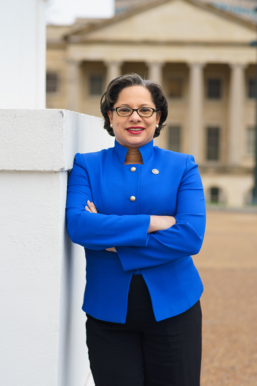
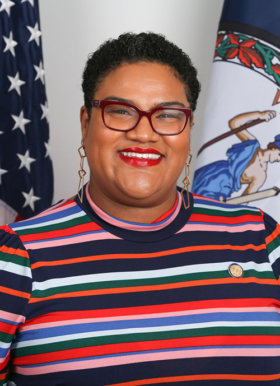
“We’re going to try to strike the right balance so that businesses and employees get what they need to manage through this crisis,” says state Sen. Jennifer McClellan, D-Richmond. Photo by Shandell Taylor
Just as COVID-19 began rearing its spiky proteins in mid-March 2020, the General Assembly adjourned and returned for an April 2020 veto session that saw the House of Delegates meet outdoors under a canopy on the Capitol lawn. Their Senate counterparts opted to meet at the Science Museum of Virginia, which allowed for greater social distancing than the Capitol, as well as the installation of Plexiglas partitions as needed.
Assembly members reconvened on Aug. 18, 2020, for the start of a marathon 84-day special session in which House members met virtually, while the Senate continued meeting at the Science Museum of Virginia. During the special session, Democrats revised the state’s budget to account for recession-related shortfalls, and also passed a full slate of policing and racial justice reforms in response to last summer’s Black Lives Matter protests.
Now, following what one legislator jokingly termed “a short break,” the House of Delegates plans to gavel in its 2021 regular session virtually on Jan. 13, with the state Senate again planning to meet at the Science Museum.
The pandemic is one of the few events to have disrupted the normal convening of the General Assembly since the legislature began meeting at the Thomas Jefferson-designed Virginia State Capitol in 1792. Aside from the Civil War period, there are only two other instances when the Assembly didn’t meet in its normal chambers for an entire session: in 1849, when a cholera epidemic caused legislators to convene at the Fauquier White Sulphur Springs Hotel near Warrenton; and from 2005 to 2007, when the legislature met in the adjacent Patrick Henry Building while the Capitol underwent an extensive renovation.
With the pandemic surging worse than ever and businesses and citizens continuing to feel the alligator chomp of economic distress, the legislators will likely have a busy session.
Farnsworth
Adding to the uncertainty, their time during the regular session will likely be limited. Republicans have vowed to not extend the 30-day session by 15 days, as is the norm. This would make it the briefest legislative regular session in at least half a century.
During the short session, will the legislature work to assist struggling businesses, or saddle them with additional regulatory and tax burdens? And, with the state grappling with revenue shortfalls from the recession — reported in August as $2.7 billion less than previously anticipated for the two-year state budget — could taxes generated from legalizing marijuana help stanch the bleeding?
The general outline of the upcoming session appears to be forming a giant question mark.
A joint resolution?
To Virginia budget hawks and recreational weed enthusiasts alike, Nov. 16 marked an important development.
Saxman
That’s when the Joint Legislative Audit & Review Commission — which evaluates programs and policies on behalf of the General Assembly — issued its assessment of what marijuana legalization might look like in Virginia. With the JLARC report estimating that pot cultivation and sales could generate up to $300 million in annual state tax revenue and create 11,000 jobs, Northam told The Associated Press, “Legalizing marijuana will happen in Virginia.”
Compared with the state government’s previous stance on legalization, Rich Meagher, an associate professor of political science at Randolph-Macon College, calls Northam’s statement an “‘Exorcist’-style head spin from where we were even two or three years ago.”
The sudden change is emblematic of how much Virginia politics have shifted since Democrats gained legislative power. But for every two steps the party took in 2020, it had to take one step back because of the pandemic-related recession.
Legislation that would have raised the hourly minimum wage from $7.25 to $9.50 on Jan. 1, 2021, was pushed back to May 1 to allow employers more time to recover from the recession; the wage will rise gradually to $15 by 2026.
“New spending initiatives really were hammered by the financial crisis,” says Stephen Farnsworth, political science professor at the University of Mary Washington and director of the Center for Leadership and Media Studies. “2020 was a year where some Democratic initiatives could proceed but others had to wait.”
Holsworth
Other goals Democrats may want to achieve — such as raising teacher pay — may prove daunting under current fiscal conditions.
“We’ve got shortfalls but not as bad we expected it to be,” says state Sen. Jennifer McClellan, D-Richmond. “It’s going to be tight.”
To Chris Saxman, executive director of the nonpartisan business advocacy group Virginia FREE, many of the changes undertaken and aspired to by Democrats are detrimental to business. A former Republican delegate who represented parts of Augusta and Nelson counties, Saxman says minimum wage increases and a threat to Virginia’s right-to-work status are “a horrible signal to send the business community.”
During last year’s regular session, efforts to repeal or scale back Virginia’s right-to-work law — which bans compulsory union membership — were killed in committee in both chambers. But businesspeople and Republicans are still nervous.
“At a time when the economy is recovering, they’re going to throw more stones in the packs of the business leaders,” Saxman says. “The business lobbyists are out of their minds, scared at what some of these people are coming up with.”
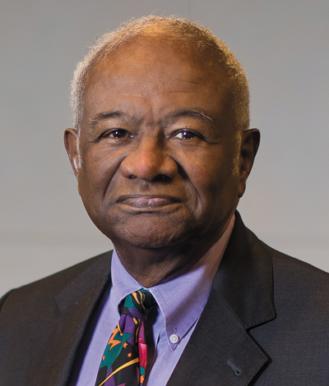
Bob Holsworth, a veteran political analyst based in Richmond, says that, until recently, Democratic and Republican legislators might have disagreed on social issues but generally came together around economic development. However, with Democrats gaining power and more progressives in the statehouse, business leaders “are seeing that consensus begin to fray a little bit,” Holsworth says.
Martin
Barry DuVal, president and CEO of the Virginia Chamber of Commerce, says he hopes that the General Assembly will recognize the trouble that businesses are going through right now and develop a business relief program.
“The General Assembly heard from the business community [in 2020] that it’s time to protect our business climate and begin to set the stage to rebuild the Virginia economy,” says DuVal, who served as state secretary of commerce under Gov. Jim Gilmore.
In the upcoming session, DuVal wants Virginia to continue its status as the northernmost right-to-work state on the East Coast. He also wants the General Assembly to fund education and workforce initiatives that would help businesses, including child care assistance. As some states have done, DuVal also wants the legislature to protect employers from what he deems “frivolous lawsuits” related to employees and customers contracting the coronavirus.
Keith Martin, the Virginia Chamber’s executive vice president of public policy, warned in early November that with the Virginia Employment Commission was anticipating a $750 million deficit in its jobless benefits fund because of unemployment claims, and that unemployment insurance taxes may climb as high as roughly $250 per employee, up from a pre-pandemic average of $67. Those concerns have since been addressed with a Dec. 22 executive order by Northam that froze potential increases, temporarily shielding Virginia’s businesses from having to pay an additional $200 million to replenish the fund. The special session budget that Northam signed included $210 million to help backfill the fund.
John March, spokesperson for the Republican Party of Virginia, says that between the minimum wage raise and additional regulations and permits that he believes the Democrats will enact, it will endanger Virginia’s status as CNBC’s No. 1 state for business in America, a distinction the commonwealth received most recently in 2019. “Virginia is not going to be the most friendly place for business much longer.
Price
But McClellan stresses that worker protections are good for businesses too, reflecting “a symbiotic relationship. … A lot of businesses have recognized — particularly over the past year — how health and safety and child care impact their employees and their ability to be productive,” she says. “We’re going to try to strike the right balance so that businesses and employees get what they need to manage through this crisis.”
A 30-day challenge
In accordance with the state constitution, the General Assembly is supposed to convene for 30-day sessions in odd-numbered years. Traditionally, though, that’s been extended to 45 days.
That 15-day extension, however, requires approval from two-thirds of the legislature, and Republicans aren’t playing ball this session. House Minority Leader Del. C. Todd Gilbert, R-Shenandoah, says the extensions are intended for budget adjustments, which aren’t necessary this time because the legislature already did that during the fall 2020 special session.
But, Holsworth says,“given the impact of COVID, it makes no sense to say, ‘We’re going to artificially limit this to 30 days.’ They have a responsibility to address some very significant issues.” He notes that planning and oversight of the state’s COVID-19 vaccination program will have to occur this year.
Last fall’s 84-day special session put a strain on legislators, most of whom hold full-time jobs on top of serving in the General Assembly. As a mother of two and an administrator at Richard Bland College, Del. Lashrecse D. Aird, D-Petersburg, says the special session had her playing“work-life Jenga, as in, whatever I can keep from falling for the day.”
Though Northam can call another special session at any time, legislators would more or less have to restart the legislative process. Because of this, the legislature will limit the number of bills that can be submitted during the 2021 regular session.
Del. Marcia “Cia” Price, D-Newport News, says that she’s had to scale back the legislation she’s filing at a time when “the pandemic has uncovered or exacerbated [the] issues the community is facing. The need for legislative solutions increased, but now there’s a fight to decrease the amount of work that we’ll be able to accomplish, so I think people really are starting to scramble.
Led by House Minority Leader Del. Todd Gilbert, R-Shenandoah, Republican delegates plan this year to oppose the legislature’s traditional 15-day session extension. Photo by Norm Shafer
Greg Habeeb, a partner with public affairs, communications and marketing firm Gentry Locke Consulting, says that clients are planning to lobby less than usual because of the short session. The budget, he says, will loom large.
“This past year, a lot of short-term funding issues brought on by the pandemic and recession were plugged with one-time money,” largely from the federal CARES Act, says Habeeb, a former Republican delegate who represented Roanoke, Salem and Montgomery and Craig counties from 2011 to 2018. “We’ll have to see if and how President-elect Joe Biden and Congress allocate additional federal funding.”
And while Habeeb understands the need to conduct the 2021 session virtually, he says that the lack of personal interactions will make it difficult for legislators and advocates to have the discussions necessary to advance major initiatives such as last session’s Virginia Clean Economy Act.
For lobbyists and other stakeholders, day-to-day informal interactions with lawmakers and aides in the hallways and elevators of the Pocahontas Building are essential to passing legislation. But the Pocahontas Building, which houses legislators’ Richmond offices as well as committee and subcommittee meeting rooms, will be closed to the public during the 2021 session due to the pandemic.
As if this session needed another wrinkle, it’s also taking place in a gubernatorial election year when all House of Delegates candidates will be up for reelection. Amid this, several state legislators will be jockeying to land their parties’ nominations for governor, lieutenant governor and attorney general.
“It’s going to be a noisy lead-up to a really quick session, so my guess is that Northam’s voice is going to be the strongest one, but there could be a lot of other voices out there muddying the waters,” Meagher says.
The blue horizon
Habeeb
Democratic lawmakers will likely try to address many of the issues they care about, including additional social justice and law enforcement reforms, housing equity, broadband expansion, sick leave and paid family medical leave, expanding collective bargaining and repealing or diminishing Virginia’s right-to-work status.
“That’s just a discussion that we’re going to continue to have,” says McClellan of right-to-work. “If you benefit from a collective bargaining agreement or from a union representing you through grievances, you should have to contribute to getting that collective bargaining agreement or having that representation.”
McClellan says Democrats are undaunted by the brevity of a 30-day session and will call a special session if needed.
“This is a time where we need to address the needs of all Virginians,” says McClellan, who is seeking the Democratic nomination for governor. “People elected us to solve problems.”
Dyke Jr
Regarding Richmond-based utility Dominion Energy Inc. — which Democrats and especially progressives have taken aim at in the past — McClellan says the legislature may take a look at the Virginia Clean Energy Act and make sure Dominion is implementing it the way they intended.
James W.“Jim” Dyke Jr., a consulting senior adviser for state government relations at McGuireWoods, hopes that some of the revenues from recently approved casinos will help fund child care and early childhood education. And considering how vital the internet is for those who are currently working or attending school from home, broadband expansion will likely be taken up as well, he says.
“If you didn’t know broadband was an issue before COVID, you clearly know it now,” says Dyke, who served as secretary of education under Democratic Gov. L. Douglas Wilder in the early 1990s.
Looking past 2021, Meagher says the General Assembly likely will remain under Democratic control for the foreseeable future. Once ruled by rural areas, the state’s political base has shifted as populous suburbs have become less conservative and more diverse. Unless the recently approved bipartisan redistricting commission radically redraws the state’s political maps, it looks like there’s blue on the horizon.
“Demographics are destiny. This is a Democratic state now,” says Rich Meagher, an associate professor of political science at Randolph-Macon College. Photo by Caroline Martin
“Demographics are destiny. This is a Democratic state now. This is a state defined by the urban corridor that runs from Northern Virginia out to the coast,” Meagher says. “It’s Democratic, and it’s more oriented towards urban and suburban districts, and that’s going to drive our politics.”
Roanoke developer Lucas Thornton hopes to break ground this summer on a multimillion-dollar renovation project that will transform what is now Campbell Court Transportation Center, the city’s rundown bus station, into an office tower and another building with apartments and retail space.
Thornton’s $35 million development, tentatively named Randolph Street, inched closer to becoming reality in mid-November 2020, when members of Roanoke’s City Council voted unanimously to amend the city’s zoning ordinance so public transit centers are allowed downtown by right.
The city’s plan to build a $9.8 million Valley Metro bus station on what is now a parking lot on the corner of Salem Avenue and Third Street met with opposition earlier in the year. Citizens spoke out against the location, saying it sits too close to a section of downtown that is enjoying success from several revitalization projects. Popular restaurants, residences and a microbrewery now punctuate a street previously lined by light industrial and warehouses.
Richmond-based developer Bill Chapman, who is responsible for many of the successful Salem Avenue projects, was an especially vocal critic of the bus station site and offered to build an apartment complex on the proposed site in exchange for moving the station four blocks west — a plan rejected by council because the site was considered too far from the center of downtown. Chapman declined to comment for this article.
Hearing the concerns, the city Board of Zoning Appeals voted in August 2020 against granting a special-use exception for the bus station to be built at the parking lot. The city could have appealed the decision in court, but instead councilors amended the zoning ordinance to allow for the new station.
Thornton, managing partner of Hist:Re Partners, is optimistic he may see construction on the mixed-use Randolph Street project begin in June, with an opening date planned for fall 2022. The project will include a 60,000-square-foot office tower, about 12,000 square feet of retail space, 90 apartments, 15 homes and a pedestrian courtyard, Thornton says. The majority of the commercial and retail spaces have tenants lined up, he said.
City Manager Bob Cowell calls the Randolph Street development “an exciting chapter in downtown’s continued renewal.” Lucas also is developing a four-story apartment building in Roanoke across from Norfolk Southern Corp’s former locomotive shops, which closed in May 2020.
Weaving through the sea of students walking to class and working on the floor in groups, the business faculty at James Madison University‘s Zane Showker Hall had a running joke: Getting to their offices each day was akin to an Indiana Jones adventure.
It wasn’t that Showker Hall wasn’t a nice place; it was just that with the rapid expansion of JMU’s College of Business in recent years, a building that was intended for 2,400 students was straining to accommodate 5,000.
Langridge
“We were bursting at the seams, basically,” says Elias J. Semaan, professor of finance and business law. “The hallways were always crowded.”
But with the help of a $3.7 million donation — the largest cash gift in the school’s history — change has come to JMU’s College of Business. In fall 2020, the university opened the doors of Hartman Hall, its new 115,000-square-foot academic building, to students and faculty. The $66.5 million facility is the first step toward what will eventually become the College of Business Learning Complex, comprised of Hartman Hall and Showker Hall, which is undergoing a $19.9 million renovation of its own.
JMU plans to reopen Showker in May, with a grand reopening celebration planned for the fall. Altogether, the price tag for the complex will total $99.2 million, including funding for equipment and the $66.5 million for Hartman Hall.
For students, faculty, officials and alums of the Harrisonburg university, the new business school complex is symbolic of the recognition JMU has received from Bloomberg Businessweek for having one of the best public business schools in the country.
JMU unleashed
From his time as a JMU student in the 1960s through his time running a large company of truck dealerships, James Hartman says the lessons he learned at the university proved invaluable in life and business.
After transferring to the school as a junior in 1968, Hartman attended class by day and drove a truck for his father’s company at night. Upon graduating in 1970 with a bachelor’s in business administration, Hartman helped grow his family’s company, Harrisonburg-based Truck Enterprises Inc., from a single truck to eight full-service commercial truck dealerships. Hartman sold the company to Transport Equipment Co. of Salt Lake City on Sept. 1, 2020.
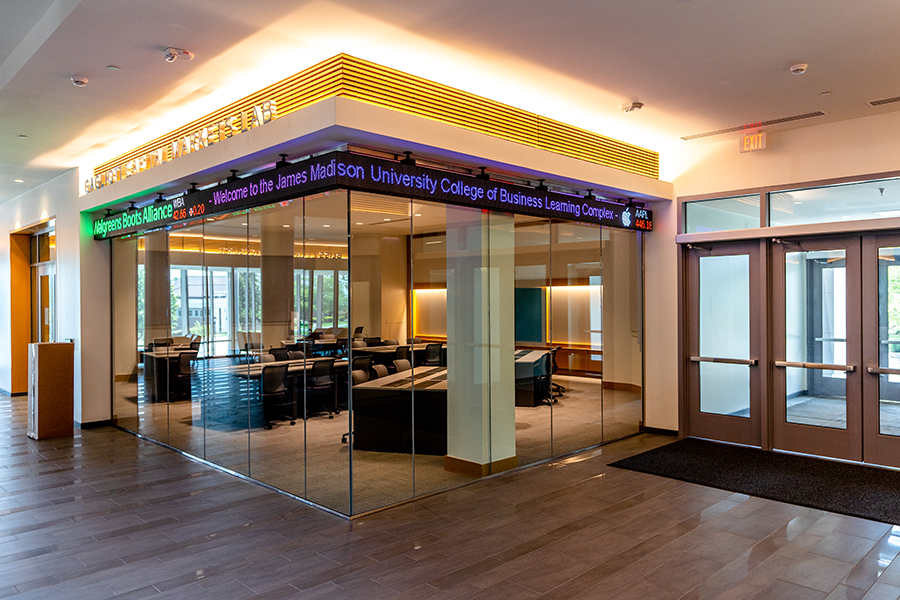
JMU’s Gaglioti Capital Markets Lab in Hartman Hall offers Bloomberg terminals with real-time financial data. Photo by JMU Creative Media
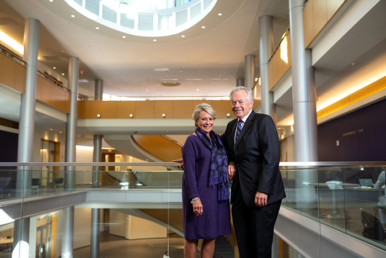
Hartman has stayed connected with JMU over the years, serving on its board of visitors and then as rector from 2010 to 2012. Through his connections at the university, Hartman knew of the need for a new business school building. The building’s name recognizes Hartman; his wife, Carolyn; their son, Scott; and their daughter, Jennifer Risser, a 2000 graduate who now works in the university’s Center for International Stabilization and Recovery.
The road to a new business complex started in the 2000s under then-JMU President Linwood H. Rose. After Jonathan R. Alger became president in 2012, the university put together a six-year strategic plan. It included overarching principles and goals, as well as key initiatives the university hoped to achieve, including increasing graduation rates, lowering student-faculty ratios, and expanding and renovating buildings such as Showker Hall.
With fundraising needed to achieve those initiatives — including a new business school complex — JMU launched its “Unleashed” capital campaign in October 2018. The campaign had an initial goal of raising $150 million but upped the ante to $200 million after fundraising began exceeding expectations.
“The appetite was there to go for it. It was a little daring. It was the single largest capital project in JMU’s history,” Nick Langridge, vice president for university advancement, says of the fundraising campaign.
For the business complex, JMU needed to secure $16.5 million in private funding. Including the Hartmans’ $3.7 million gift, the university raised a total of more than $19 million in private commitments from more than 2,500 donors. The General Assembly allocated an additional $75.9 million toward the project.
Michael Busing, dean of the JMU College of Business, says that Hartman Hall offers better technology and more flexible learning spaces. Photo by Norm Shafer
Michael Busing, dean of the College of Business, says that the classrooms at Hartman Hall are “state-of-the-art,” including desktop cameras, 4K projection screens and confidence monitors. For guest speakers both virtual and in-person, the rooms offer array and wireless microphones.
Compared with traditional Harvard-style lecture rooms, Busing says, these classrooms also are more flexible. “What that allows is for students to quickly get into small group conversations … to discuss a topic,” he explains, adding that the classrooms of Showker will be similar after the renovation. “They can convert that classroom from lecture-style to small breakout in about 10 seconds, then [return] to a lecture.”
One fan of Hartman Hall is Maryhelen Storey. Currently in her first year of grad school for accounting, Storey also earned her undergraduate degree in accounting at JMU. She says Hartman compares favorably to the old Showker Hall.
“There’s a much bigger lobby when you walk in that allows for many more seating areas, and then there’s a whole area of study rooms,” Storey says, adding that with greater ease of access, students get more face time with professors. “You see them walking around more, and you also have a new café here that has a full-service eatery, so you’re able to get food here instead of having to leave.”
Gems and crystal Ball
If there’s a gem in the crown of Hartman Hall, it’s the Gaglioti Capital Markets Lab.
Semaan
Bounded by glass and a stock ticker displaying share prices, the lab features Bloomberg terminals that feed up-to-the-minute financial data, giving students access to real-world tools to support their learning.
Originally established at Showker Hall in 2011, the lab has been expanded through a comprehensive makeover in its move to Hartman Hall. Even though the previous lab featured financial industry software applications such as SAS, Analytic Solver and Crystal Ball Software, it was crowded.
The lab “was very nice, but at the same time, very limited, so the class could only fit 20 students at the most,” says Semaan, who teaches all of his courses in the lab.
With its new digs, the lab has doubled its seating capacity, and includes an attached board room that can also function as a multiuse area. The lab features 40 computer stations, eight 55-inch flat-panel displays and a 96-inch smart board.
Even with occupancy limitations put in place during the pandemic to help enforce social distancing, Semaan says, the lab is very popular with students.
“You could tell that the students were very excited about it,” Semaan says. “It’s such a pleasant space.”
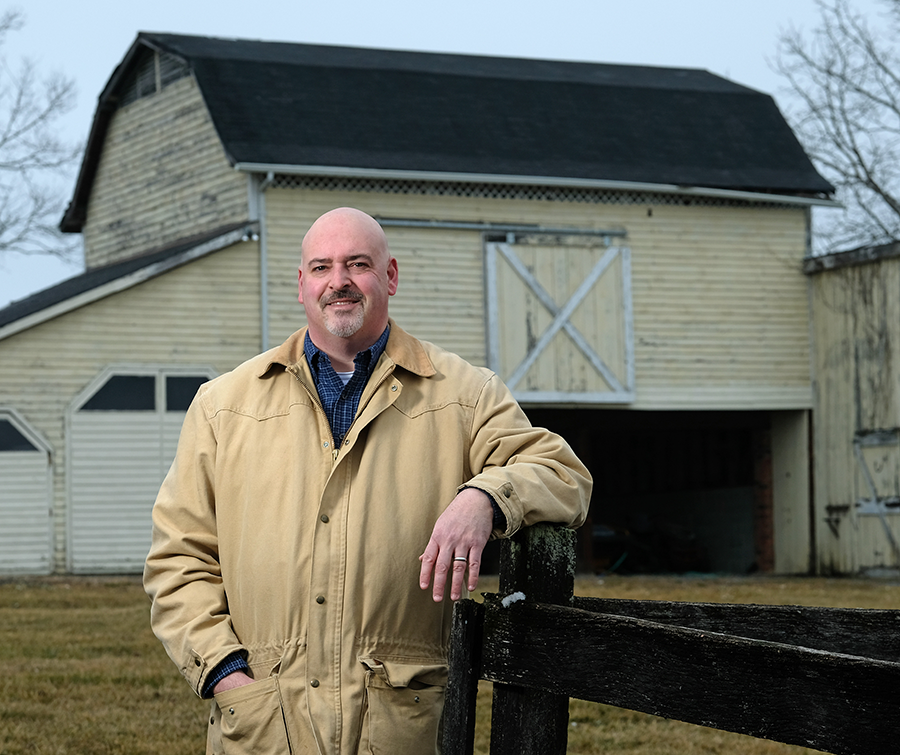
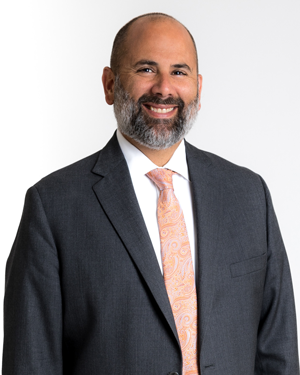
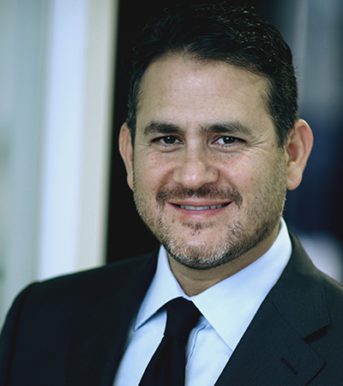
Enrico Gaglioti, a 1994 graduate, says he donated the lab to give students a better understanding of the tools used in the financial services industry. A former partner at Goldman Sachs & Co., Gaglioti co-founded and served as CEO of New York City-based Chiron Investment Management before it was acquired by Philadelphia-based FS Investments, where he now serves as co-president.
Alger
When Gaglioti entered the financial world, he says, many large, New York City-headquartered financial institutions recruited more substantially from top-tier Ivies with big business schools.
“As financial services has grown over the last two decades, these big institutions started broadening out their reach,” says Gaglioti.
Since he entered the workforce, Gaglioti says, JMU has made “a bit of a name for itself” in financial services, with alums reflecting the school’s culture of being collaborative, hard-working, curious and intellectually capable.
“Those are all qualities that are really important in financial services,” he says.
Hard work and humility
Talk to Alger, JMU’s president, and you’ll hear that the workforce of today and tomorrow needs to be made up of people with the breadth of experience and originality that’s fostered by the school.
“The answers are not in the back of the textbook for the problems employers are trying to solve” today, says Alger. “You’ve got to have students that have a creative and innovative mindset.”
As such, Alger says, JMU graduates are well-suited for the workforce because of their collaborative spirit and the fact that they don’t usually have everything handed to them. It’s a work ethos, he says, that’s reflected by the Hartmans.
“JMU grads are known for rolling up their sleeves, for not being entitled, and the Hartmans are known very much for that attitude,” Alger says.
Philanthropists Carolyn and James Hartman donated $3.7 million toward Hartman Hall’s construction. Photo by JMU Creative Media
With the new Hartman Hall and a renovated Showker Hall in the works, Langridge says the business school’s physical infrastructure is beginning to meet the caliber of its programming.
“We’ve got the facility to match the model, and I think that’s one of the wonderful things about the new learning complex.”
At a glance
Founded
Established in 1908, James Madison University was originally known as the State Normal and Industrial School for Women. It was renamed Madison College in 1938 in honor of President James Madison and became James Madison University in 1977.
Campus
Located in Harrisonburg in the heart of the Shenandoah Valley, JMU’s 728-acre campus is divided by Interstate 81. It’s known for its distinctive bluestone buildings on the campus’ west side, as well as Newman Lake near Greek Row and the university’s 125-acre Edith J. Carrier Arboretum, which has numerous gardens and wooded areas with 100-plus-year-old oak and hickory trees.
Enrollment (fall 2020)
Undergraduate students: 19,727
Graduate students: 1,867
Student profile
Male/female ratio: 42% / 58%
International students: 1.4%
Minority students: 22.3%
Academic programs
JMU has nearly 140 undergraduate and graduate degree programs, ranging from accounting and computer science to international business, psychology and nursing.
Faculty*
Full-time instructional faculty: 1,070
Part-time instructional faculty: 447
Tuition, fees, housing
and dining
$23,918 approximate annual in-state undergraduate residential cost, including tuition, mandatory fees, housing and meal plan for incoming freshmen.
The novel coronavirus that causes COVID-19 has upended life across the globe, but it also has spurred innovation and invention.
At Virginia Commonwealth University, two researchers have been working on projects that, if successful, might have far-reaching applications for preventing and detecting COVID-19.
A vaccine patch the size of a fingernail has the attention of Guizhi “Julian” Zhu, an assistant professor in the Department of Pharmaceutics at the VCU School of Pharmacy.
His research is focused on finding a way to embed tiny needles in a patch that could be self-applied to deliver a successful COVID-19 vaccine, once it has been developed and approved.
As of mid-December, Virginia was beginning to dole out the initial tens of thousands of doses of Pfizer Inc.’s COVID-19 vaccine to health care workers.
“Our effort,” Zhu says, “is to make [COVID-19 vaccines] more accessible for the general public for mass vaccination” via a patch that can be mailed in an envelope. “Instead of injecting this vaccine with needles in the hospital or clinic or a physician’s office, we can inject ourselves at home.”
Zhu says more than 100 polymer needles, each thinner than a human hair and virtually painless, would deliver the vaccine through the skin. Tests of the patch on animals are currently underway, and human tests await if sufficient funding is available.
VCU provides some funding, but Zhu says grants are needed to advance the project to human studies. In November 2020, Zhu filmed a TED Talk about the vaccine patch, which likely will raise the profile of the project.
Over at the VCU College of Engineering, another researcher, assistant professor Christina Tang, is working with the U.S. Army on another coronavirus-focused project to spin liquid crystals into nanofibers — each 1/1,000 the width of a human hair— that change colors at different temperatures.
Applications might range from being used in camouflage clothing or adapted to detect viruses such as the coronavirus.
“The liquid crystals act like special mirrors that can reflect one color at a time. The color that the fabric appears to be depends on the size of the liquid crystal, which changes with temperature,” Tang says.
For example, if a face mask contained nanofibers that could detect COVID-19 and changed colors, Tang says, you would immediately know that you needed to change your mask.
The Halifax CountyIndustrialDevelopment Authority has seen some upheaval recently, but officials say there are several projects in the pipeline as well as a new shell building ready to be occupied.
In October 2020, IDA executive director Brian Brown was fired after being hired a little more than a year ago, a move that appeared to surprise Brown himself, who could not be reached for comment.
Rick Harrell, former owner of R.O. Harrell Inc. trucking company and an IDA board member, says, “We made that change because we saw an operational weakness. It wasn’t any … malfeasance of any kind.” Unlike many IDAs in Virginia, Halifax’s authority is self-funded and focuses on all economic development in the county, not just industrial sectors.
With recent expenses — including $1.7 million spent on constructing the 50,000-square-foot shell building at the Southern Virginia Technology Park and $3.2 million for a building that is to house the hemp processing plant for Golden Piedmont Labs — there was a $359,000 deficit in the authority’s 2020 fiscal year budget.
“It’s such a wide gap between those that have a lot and those that have a little bit and those that have nothing,” Harrell says of the state’s IDAs. “The economy’s put strains on our self-generated income,” which primarily comes from leasing buildings to businesses recruited to the area. And successes like Golden Piedmont Labs, run by two Halifax natives — “favorite sons” who found success in Richmond — are fairly rare, he adds.
However, Halifax has some things working in its favor: Microsoft Corp.’s presence in South Boston, broadband access through Mid-Atlantic Broadband Communities Corp., multiple workforce training programs and marketing assistance from Virginia Economic Development Partnership and the Southern Virginia Regional Alliance.
With Brown’s departure, Mike Davidson, who recently retired as Campbell County’s economic development director, is serving as Halifax’s part-time interim executive director. He says he doesn’t expect his tenure to last more than a few months as the board hires a search firm to find a full-time replacement. But he feels positive about conditions in the county.
“The economy is improving. There are some things going on,” Davidson says. The shell building has “an active prospect that is considering us and four other states,” he adds, and there are a few other projects that aren’t quite ready to be announced.
Manage Consent
This website uses cookies, web beacons, pixels, tags, software development kits, and related tracking technologies, as described in our Privacy Policy and Cookie Policy, for purposes that may include website operation, analytics, analyzing site usage, enhancing site navigation optimizing a user's experience, and third-party advertising or marketing purposes. Through these technologies, we and certain third parties may automatically collect information about your interactions with our website, such as your browsing behavior and page views. We also may share this information about your activity on our website with our social media, advertising, analytics, and other business partners. By clicking “Accept All”, you consent to the use of these technologies and that we can share information about your activity on our website with third parties in accordance with our Privacy Policy and Cookie Policy. If you do not agree with our use of non-essential tracking technologies, please click “Reject All.” You may opt out of certain non-essential technologies by clicking “Cookie Settings.”
Functional
Always active
The technical storage or access is strictly necessary for the legitimate purpose of enabling the use of a specific service explicitly requested by the subscriber or user, or for the sole purpose of carrying out the transmission of a communication over an electronic communications network.
Preferences
The technical storage or access is necessary for the legitimate purpose of storing preferences that are not requested by the subscriber or user.
Statistics
The technical storage or access that is used exclusively for statistical purposes.The technical storage or access that is used exclusively for anonymous statistical purposes. Without a subpoena, voluntary compliance on the part of your Internet Service Provider, or additional records from a third party, information stored or retrieved for this purpose alone cannot usually be used to identify you.
Advertisement
The technical storage or access is required to create user profiles to send advertising, or to track the user on a website or across several websites for similar marketing purposes.

 Sign In
 Free Newsletter




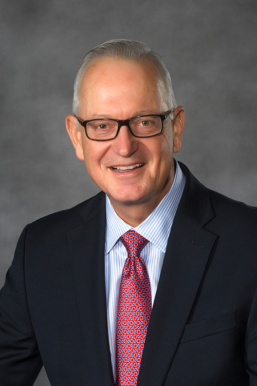


 Enrico Gaglioti, a 1994 graduate, says he donated the lab to give students a better understanding of the tools used in the financial services industry. A former partner at Goldman Sachs & Co., Gaglioti co-founded and served as CEO of New York City-based Chiron Investment Management before it was acquired by Philadelphia-based FS Investments, where he now serves as co-president.