Plans for constructing a $1.9 billion, two-track railroad bridge connecting Virginia to Washington, D.C. — doubling the number of tracks going across the Potomac River from the U.S. capital to the commonwealth — are chugging right along.
“We’re now moving forward to advance the engineering design and that should be completed by 2023,” says Jennifer Mitchell, director of the Virginia Department of Rail and Public Transportation (DRPT).
Massachusetts-based civil engineering firm Vanasse Hangen Brustlin Inc. won the $21 million contract to complete preliminary engineering on the Long Bridge project. Construction is expected to begin in 2024 with completion expected by 2030, according to DRPT spokesperson Haley Glynn.
That day can’t come soon enough for riders on commuter and regional passenger rail.
The current Long Bridge, which is 117 years old, is the sole rail connection between Virginia and D.C. Owned and operated by CSX Transportation, the bridge often functions at 98% capacity. When more than two trains need to use the bridge, any additional trains must wait until the tracks are clear, according to Glynn.
The new two-track bridge will be owned by DRPT and will run parallel to the existing bridge, which will be used solely for freight trains. “Separating passenger and freight traffic will help alleviate the rail congestion,” Glynn said in a statement.
Mitchell estimates that with the addition of the new tracks, the corridor will serve 18,000 new freight and passenger train crossings annually — which could take 1 million trucks and 5 million cars off highways each year.
The project will be funded via a mix of state and federal funds as well as through partnerships with Virginia Railway Express (VRE) and Amtrak, according to DRPT spokesperson Haley Glynn.
Amtrak has pledged $944 million to the Transforming Rail in Virginia plan, a $3.9 billion initiative designed to expand passenger, commuter and freight rail in Virginia through agreements between the state government, CSX, VRE and Amtrak. Completion of the Long Bridge Project is a cornerstone of the plan, which also includes goals such as doubling Amtrak service in the state.
The federal Bipartisan Infrastructure Investment and Jobs Act, which passed the U.S. Senate in August but had an uncertain future in the House as of mid-September, included $66 billion for passenger rail — money that could help fund the Long Bridge project, according to U.S. Sen. Tim Kaine’s office. “Federal funding is still critically needed for this project to move forward,” Kaine says.
As he completed his senior project last spring at Old Dominion University’s Batten College of Engineering & Technology, Kristal Sunuwar researched the development of the global offshore wind industry.
Learning how China, South Korea, Japan and European nations had developed their offshore wind programs, Sunuwar reached an unexpected conclusion: “I was surprised that the USA wasn’t farther ahead” in offshore wind development, he says. He was also struck by how much more cumbersome the governmental approval process for offshore wind projects appeared to be in the U.S. versus other countries.
Now holding a part-time position at ODU in developing offshore wind courses for future workers, Sunuwar says, “If we could make the federal process more streamlined, I think we could get it done a little bit faster.”
Questions such as these are driving work at ODU, in partnership with other educational, government and business entities, to establish a supply chain hub centered in Virginia for the burgeoning offshore wind industry along the East Coast.
In April 2020, Virginia Gov. Ralph Northamsigned the Virginia Clean Economy Act, which requires Dominion Energy Virginia and Appalachian Power to generate all electricity for Virginia from carbon-free sources by 2045 and 2050 respectively. Meanwhile, Richmond-based Dominion Energy Inc. is working through the approval process for its 2.64-gigawatt, $7.8 billion Coastal Virginia Offshore Wind (CVOW) project 27 miles off the coast of Virginia Beach. It will include about 180 wind turbines and produce enough power for up to 660,000 homes when completed by 2026.
Also, in 2019, officials with ODU and the state Department of Mines, Minerals and Energy —rebranded as of Oct. 1 as the Virginia Department of Energy (Virginia Energy)—signed a memorandum of understanding for the state’s offshore wind projects, including Dominion’s wind farm.
As part of that agreement, ODU has organized the Commonwealth Offshore Wind Task Force, which brings together more than 200 partners from across the state to examine all aspects of building a brand-new industry — from workforce pipeline needs to supply-chain capability, to how offshore wind would interact with Virginia’s existing maritime industries.
Paul Olsen, executive director of programs and partnerships for ODU’s office of research, co-leads the task force with Jennifer Palestrant of Virginia Energy. As a former commander of the U.S. Army Corps of Engineers’ Norfolk District, Olsen sees offshore wind as the next big “megaproject” that will demand the focus of the entire Hampton Roads region.
Matt Smith, who leads offshore wind business development for the Hampton Roads Alliance, says the task force is “probably the longest ongoing effort to focus on different areas that need work to be done to make Virginia one of the hubs of the industry.”
Olsen’s approach to building the task force mirrors work he did to organize university efforts to address sea level rise when he arrived at Old Dominion in 2015. But as he works to raise funds for ODU’s research efforts, Olsen notes that the business case for offshore wind is much clearer.
“Until we monetize the cost of a milli-meter of sea level rise,” he says, it’s harder to make the case for research funding. “With offshore wind, you can monetize your progress, because you can put a price tag on a kilowatt hour.”
A decade in the making
Making the case that offshore wind presents an economically viable piece of the commonwealth’s energy picture has been part of ODU’s role since 2006, when the General Assembly established the Virginia Coastal Energy Research Consortium (VCERC).
Headquartered at ODU, VCERC brought together researchers from Virginia Tech, James Madison University, William & Mary, Norfolk State University, Hampton University, the University of Virginia and Virginia Commonwealth University.
In its 2010 final report, VCERC researchers reported that with carbon reduction measures expected to increase the cost of coal-fired energy, new offshore wind farms could yield lower energy costs than new coal-fired power plants.
VCERC recommended that Virginia apply for a research lease to conduct a demonstration project on the potential for offshore wind off the Virginia coast to be an economically viable renewable energy source.
“Before that, nobody had even suggested that offshore wind should be in Virginia’s energy future,” says George Hagerman, senior project scientist at ODU’s Center for Coastal Physical Oceanography. “That really catalyzed everything that has happened since.”
At the time the report was released, Hagerman was a senior research associate at Virginia Tech’s Advanced Research Institute. He says ODU’s strengths in electrical engineering and oceanography were particularly valuable in the offshore wind research.
Hagerman joined the faculty at ODU in 2018.
He teamed with ODU chemistry and biochemistry professor Pat Hatcher — who chaired VCERC — and oceanographer Larry Atkinson, an esteemed member of the ODU faculty who died in January, to make presentations to the Virginia legislature and to Dominion Energy about offshore wind’s potential.
That work helped inform Dominion’s development of the CVOW project — the first offshore wind farm in U.S. federal waters.
Dominion installed a two-turbine, 12-megawatt pilot project off the coast of Virginia Beach in summer 2020. The utility plans to begin construction on the larger wind farm in 2024.
Supporting a new industry
As interest in offshore wind has increased, the capacity to review the construction and operation plans for these giant infrastructure projects has struggled to keep up. This created a backlog of plans at the federal Bureau of Ocean Energy Management (BOEM).
When U.S. Sen. Mark Warner held a meeting on the issue in February, Olsen suggested that BOEM make use of a federal authority that allows the Army Corps of Engineers to provide interagency help for critical infrastructure projects. The idea led to an agreement between BOEM and the Corps that has sped up federal reviews for offshore wind farms.
“This is an ODU contribution that is going to unlock the industry between Cape Cod and Cape Hatteras,” Hagerman says.
The university also is helping forge connections as the Hampton Roads business community strives to present itself as an attractive place for wind-energy-related businesses to locate — key to establishing a supply chain that can support offshore wind development along the East Coast.
In May, ODU’s OpenSeas Technology Innovation Hub partnered with the Hampton Roads Alliance and the then-Department of Mines, Minerals and Energy to open the Virginia Offshore Wind Landing. A coworking space located in Norfolk’s World Trade Center, Virginia Offshore Wind Landing is meant to be a collaborative space for offshore wind-related companies hoping to learn more about the region.
“It’s really a place where companies who are exploring the market in Hampton Roads have a place to get connected to resources, have meeting space [and] hold events,” says Smith.
He hopes to work with ODU’s Jerry Cronin, who heads the OpenSeas Technology Innovation Hub, to develop programming that can help connect smaller companies with federal agencies and larger players in the offshore wind industry.
“We see the relationship with ODU as a way to promote innovation and thought leadership,” he says.
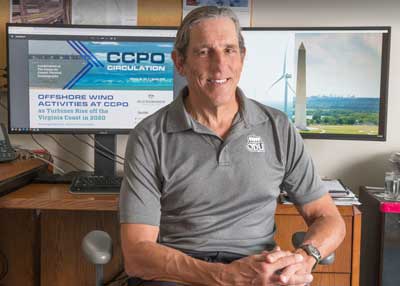
George Hagerman of ODU’s Center for Coastal Physical Oceanography says Dominion Energy’s twin-turbine pilot wind farm is a fertile ground for research.
Hagerman sees the twin pilot wind turbines Dominion installed last summer as a rich bed for research into all aspects of offshore wind in Virginia.
In summer 2020, ODU, in partnership with William & Mary and James Madison University, won a $775,000 Department of Defense grant that will support research to mitigate the effects of wind farm locations on military training, readiness and research.
Hagerman and Olsen both have a long list of research topics for which they’re seeking funding. Their aim is to find ways to help reduce the cost of energy generated from offshore wind farms, to reduce the safety risks to people working on offshore wind projects and to reduce risk to the marine environment.
Olsen is actively seeking funding for research on extending the life of wind turbines, using autonomous vehicles to reduce the risk to wind farm maintenance workers, and optimizing turbine design, placement and positioning to harvest more energy.
“We would love to partner with industry,” Olsen says. “We can solve problems for business that ultimately reduce the cost of the kilowatt hour.”
Momentum around offshore wind also poses a workforce challenge.
To that end, Centura College in Virginia Beach and Thomas Nelson and Tidewater community colleges have begun offering offshore wind technician training courses.
Rema McManus, offshore wind program specialist with ODU’s Center for Coastal Physical Oceanography, traveled to the New College Institute in Martinsville in January to earn the Basic Safety Training certification offered through the Global Wind Organisation.
“I wanted to know firsthand what technicians go through,” she says. The experience opened her eyes to the fact that many skills that already exist in the Hampton Roads workforce — such as those needed to operate cranes at the port — could translate to offshore wind.
Both Smith and Hampton Roads Workforce Council President and CEO Shawn Avery say that as community colleges and technical schools train workers for offshore wind industry construction and technician jobs, ODU can play a role in educating people who could become managers and engineers in the industry.
“We are developing a brand-new industry,” Avery says. “What about the management levels, the engineering levels, the human resources behind the companies? That is where ODU will shine.”
Orlando Ayala, an ODU associate professor of mechanical engineering, is working on a National Science Foundation grant proposal to develop a graduate-level program that could train engineers in all aspects of renewable energy — from the mechanics of offshore wind to the business and geopolitical forces that govern its development.
He worked with colleagues to adapt an existing undergraduate course on energy and the environment to include lecturers working on current renewable energy projects in Virginia, including solar, biomass and Dominion’s offshore wind project.
The course debuted this past summer. Ayala’s hope is for ODU to establish a clear pipeline for students who complete technical coursework that brings them into the industry to continue to build their skills with undergraduate and graduate work at the university.
“We have to create courses that adapt to the needs of the industry,” he says.
At a glance
Founded
Old Dominion University was founded in 1930 as an extension of William & Mary and Virginia Tech. The school gained independent status in 1962 as Old Dominion College. Old Dominion began offering master’s degrees in 1964 and doctoral degrees in 1971. It was renamed Old Dominion University in 1969.
Campus
Old Dominion’s 335-acre Norfolk campus is bordered on two sides by the Elizabeth and Lafayette rivers. The school also operates regional higher educational centers in Virginia Beach, Portsmouth and Hampton.
Enrollment1
Undergraduate: 19,372
Graduate: 4,804
In-state: 21,360 (88%)
International: 617 (2.5%)
Students of color: 11,620 (49%)
Employees
3,062
Faculty
901 full-time
Tuition and fees
In-state tuition and fees: $11,160
Tuition and fees (out of state):
$31,320
Room and board and other fees:
$11,523
Average financial aid awarded
to full-time freshmen seeking
assistance: $11,797
1 2020-21 enrollment statistics
This article has been clarified since publication.
Fortune 500 IT services company DXC Technology is leaving Tysons for a smaller headquarters in Ashburn in November, the company announced this week.
DXC’s new 10,000-square-foot building is located at One Loudoun in Ashburn.
The new corporate headquarters will reflect the shift to a virtual-first mentality. Employees can work from anywhere and use the office as more of a place to come together. It’s designed around collaboration, executives say.
DXC started thinking about being virtual-first before the pandemic, said Chris Drumgoole, DXC’s chief operating officer.
“As I joined just under two years ago…we were really stepping back and saying, ‘Hey, what do we want the future of the company to be and how do we want to attract talent, what do we think our footprint should be environmentally, kind of like the big picture. We’re a technology company at heart and can we act like one?'” Drumgoole said Wednesday in an interview with Virginia Business.
It’s almost entirely meeting and conference space, with offices for key executive officers.
“We are reimagining our new local corporate office in Ashburn to be a modern, open, and inspiring workplace to foster both in-office and remote collaboration among colleagues, and with customers, while providing multiple activity-based spaces and state-of-the-art technology and meeting rooms,” DXC spokesman Rich Adamonis said in a statement.
DXC has several hundred employees in the greater Washington, D.C., and Northern Virginia area; some will work on site and others will have access when needed. Fewer will work there on a permanent basis.
“Over the past two years, as we looked at ways to improve employee engagement and experience, we have moved to a virtual first environment locally and globally,” Adamonis said in a statement. “Today, approximately 99% of DXC’s global workforce is equipped to work virtual first. Ours is a now largely distributed, remote workplace where our people throughout the world are enabled to work remotely and flexibly and, when needed, to access purpose-built offices—whatever best fits their needs.”
DXC has more than 130,000 employees worldwide.
The company was founded in 2017 after the merger of Computer Science Corp. and the Enterprise Services business of Hewlett Packard Enterprise Corp. In October 2020, DXC finalized the sale of its health business to Veritas Capital for $5 billion, which the company planned to use to reduce its debt by about $3.5 billion. Last week, DXC completed its refinancing actions, according to a news release from the company.
In fiscal 2021, the company had $17.7 billion in revenue.
Herndon-based federal Peraton Inc. announced this week it has been awarded a contract worth up to $109 million by the U.S. Cyber Command, a project that will deliver full-spectrum cyberspace operations for the Department of Defense.
The indefinite-delivery, indefinite-quantity Cyberspace Operations Support Services task order could last four years, the company said in a news release Tuesday. Peraton, which employs about 22,000 people in more than 90 locations, would support the command’s directorate of operations, the Cyber National Mission Force and Joint Task Force ARES, strengthening the DoD’s information network. The company has worked with the command since 2016.
“Peraton is proud to continue our work partnering with the DoD to improve the nation’s ability to withstand and respond to cyberattacks,” Tom Afferton, president of Peraton’s cyber mission sector, said in a statement.
Earlier in the year, Peraton acquired Chantilly-based federal IT contractor Perspecta Inc. for $7.1 billion and Northrop Grumman Corp.’s federal IT and mission support services business for $3.4 billion. The company grew out of Veritas Capital’s 2017 acquisition of the former government services business Harris Corp.
Fluence Energy Inc., an Arlington-based energy storage and digital application company owned by Siemens and AES Corp., announced this week it has filed paperwork with the U.S. Securities and Exchange Commission for an initial public offering of its Class A common stock.
The number of shares and price range for the proposed offering have not yet been determined, according to a news release from the company Tuesday. J.P. Morgan Securities LLC, Morgan Stanley & Co. LLC, Barclays Capital Inc. and BofA Securities will act as lead book-running managers for the proposed offering, the company said, and IPO will be made through a prospectus.
Fluence, which was founded in 2018 as a joint venture of Arlington-based Fortune 500 energy company AES and industrial manufacturer Siemens, announced late last year that the Qatar Investment Authority will invest $125 million in the company, with AES and Siemens retaining approximately 44% shares each of the company. Fluence has more than 3.4 gigawatts of energy storage in 29 markets globally, and more than 4.5 gigawatts of wind, solar and storage assets in Australia and California.
Alpine-X LLC, a McLean-based indoor snow sports company, announced a crowdfunding campaign to open the stock to public investors.
The offering — started on crowdfunding site Republic — allows accredited and non-accredited investors to own a piece of the McLean-based company that is planning a national chain of indoor ski resorts. So far, more than 100 people — known as “snow moguls” — have signed up as investors, CEO John Emery said Wednesday afternoon, and the company has raised more than $170,000.
According to the fundraising page, the company is valued at $40 million, and its funding goal is up to $5 million, with a maximum investment per investor of $500,000. The deadline to sign up is Jan. 15, 2022.
In May, Alpine-X released details of Fairfax Peak, a $200 million indoor ski resort proposed to be built on parts of the I-95 Landfill Complex in Lorton. The 450,000-square-foot indoor snow sports facility will have a 1,700-foot ski slope and 100-plus room luxury hotel and is expected to open in 2025. Emery and Chief Financial Officer Jim Calder were previously the CEO and CFO of Great Wolf Resorts Inc.
Over the past two weeks, Alpine-X has held two community events — one in person, one on Zoom — drawing more than 450 people, Emery said. The project is still going through the zoning and approvals process with Fairfax County officials.
“The level of interest in the community is well beyond our expectation this early in the process,” Emery said. The response to the stock offering, or crowdfunding, has been good, he added. “It’s a chance for people to have an investment in something local.”
The company plans to use net proceeds from the stock offering to fund early development costs of the first resort and plans for new markets around North America.
Emery said the next two or three proposed sites across the U.S. and Canada are in the works, but did not specify where they are yet. He said each location will roll out 12-18 months after the one before it opens.
Investors will be offered perks to the resorts, such as discounts on merchandise and lift tickets, early access to events, meetings with the founders and limited-edition apparel.
A groundbreaking ceremony took place Wednesday in Patrick County to widen a 7.4-mile stretch of U.S. Route 58 in Patrick County, the first phase of a project to create a continuous four-lane highway between Virginia Beach and Interstate 77.
The project, part of the U.S. Route 58 Corridor Development Program enacted by state lawmakers in 1989, will cost approximately $300 million, according to the governor’s office. The two-lane section of the highway over Lovers Leap Mountain is currently restricted to tractor-trailers, but that will change once improvements are completed under a November 2020 agreement between the Virginia Department of Transportation and Roanoke-based Branch Civil Inc.
VDOT and Branch Civil signed their public-private partnership in 2003 to develop and widen the highway from Hillsville to Stuart, a 36-mile corridor through Carroll, Floyd and Patrick counties, as soon as state funding became available. Although earlier sections were widened before now, it took 18 years to reach this stretch of Route 58.
“Once the General Assembly prioritized funding for the project, the Virginia Department of Transportation and our partner Branch Civil used an innovative progressive design-build approach to refine the design and advance the project to construction,” state Commissioner of Highways Stephen Brich said in a statement. “This was the first time this contracting style was used in Virginia and supported a new level of engagement between the Virginia Department of Transportation and our contracting partner.”
The section set to be widened is between the Poor Farmers Farm Store in Vesta and the Route 58 Stuart Bypass, and there are two other parts of Route 58 that will be widened at a time to be determined, including a four-mile stretch in Vesta and a 7.2-mile section near Crooked Oak.
“Route 58 is a vital road for locals, tourists, and commercial traffic, connecting Southern Virginia from the beach to the mountains,” Northam said in a statement. “By widening this key section, the project will open up this part of Southwest Virginia to faster, safer travel and more economic investment.”
Virginia has launched an app to help connect state government agencies and other users with local, woman- and minority-owned businesses more efficiently, Gov. Ralph Northam announced Wednesday.
The Start Small app is available for free, and it allows users to conduct keyword searches to match with businesses that fit their needs, and can be narrowed to small, woman- and minority-owned (SWaM) businesses certified through the Department of Small Business and Supplier Diversity, as well as those owned by service-disabled veterans.
“Virginia is stronger because of our small businesses,” Northam said in a statement. “This app makes it easier than ever to support our local, women-owned, and minority-owned businesses. I encourage all Virginians to take advantage of Start Small to find vendors that fit their needs.”
In 2019, Northam appointed Janice Underwood as the state’s chief diversity, equity and inclusion officer and tasked her with leading the creation of the One Virginia Plan, which aimed in part to create more inclusive practices in state agencies, including hiring more minority- and woman-led vendors and contractors. Northam issued an executive order that year directing executive branch agencies and institutions to allocate more than 42% of discretionary spending to certified small businesses.
In 2020, more than $945 million was spent by agency charge cardholders, and there are 13,000 SWaM-certified vendors registered with the state. More than 191,000 purchase order worth more than $1.5 billion were issued through the state’s electronic procurement system known as eVA, and the app will use vendor data from that system. Virginia Department of Transportation created the Start Small app, according to Wednesday’s announcement.
Virginia Tech has launched a research institute focused on national security with presences in Blacksburg and the Washington, D.C., metro area, the university announced Tuesday.
The Virginia TechNational Security Institute aspires to become “the nation’s preeminent academic organization at the nexus of interdisciplinary research, technology, policy and talent development to advance national security,” according to a news release. Tech has long had ties to the Department of Defense, which contributed $50 million in federal funding to the university in fiscal year 2020,
The institute will bring together researchers, programs and resources from across the university and integrate student learning and research on national intelligence, defense, law enforcement, homeland security and cybersecurity, the university said. The Pamplin College of Business, the School of Public and International Affairs, the College of Liberal Arts and Human Sciences, and the Ted and Karyn Hume Center for National Security and Technology will be part of the institute’s programming, as will industry leaders Raytheon, Mitre, Lockheed Martin and Northrop Grumman, which will offer students internships.
Eric Paterson has been named the executive director of the institute. He previously served as the interim director for the Hume Center for more than two years and has led the Kevin T. Crofton Department of Aerospace and Ocean Engineering as department head for 10 years.
The Department of Defense is Virginia Tech’s largest source of federal funding, giving approximately $50 million in fiscal 2020. In January, the DOD awarded Virginia Tech a $1.5 million grant to prepare students for careers in cybersecurity through the Hume Center.
“As chairman of the Senate’s Select Committee on Intelligence, I am pleased that Virginia Tech is strategically organizing and prioritizing its national security research and workforce efforts,” U.S. Sen. Mark Warner said in a statement. “Given the university’s nearly $50 million Department of Defense research portfolio, and its strategic locations in Northern Virginia near key national intelligence agencies and the Pentagon, this purposeful focusing of Virginia Tech’s efforts in national security is welcome news. Virginia Tech’s new National Security Institute will help our nation develop new security-related technological advancements while helping train the future generations of intelligence leaders.”
The institute is the third thematic research institute at Virginia Tech. It joins Virginia Tech’s transportation institute and the Fralin Biomedical Research Institute at VTC.
Stoney Trent, previously the chief of missions for the Department of Defense’s Joint Artificial Intelligence Center and the principal adviser for the Office for Research and Innovation at Virginia Tech, led the effort to start the institute. A group of deans, institute directors and vice presidents reviewed the proposal, and the charter was approved in the spring.
Reston-based not-for-profit federal contractorNoblis has won a five-year, $263 million contract from the Department of Defense’s Defense Threat Reduction Agency to implement the Cooperative Threat Reduction program, the company announced Tuesday.
Under the contract, Noblis will deliver advisory services that will advance the CTR program’s mission to work cooperatively with partners and allies to reduce or eliminate weapons of mass destruction or threats and related materials, technologies, facilities and expertise.
“Noblis has built a strong and diverse team, including large businesses Sawdey Solutions Services, Amyx and Merrick & Co., as well as small businesses Red Gate, RMantra Solutions Inc., BB&E, TechInt Solutions, The PMC Group, Lunatek, Seventh Sense Consulting and Quantitative Scientific Solutions to help drive this priority,” Glenn Hickok, vice president of Noblis’ Defense Mission Area, said in a statement. “We look forward to working together alongside the CTR team to help advance their critical mission and protect our nation.”
DTRA, founded in 1998, enables the Department of Defense, the U.S. government and international partners to counter and deter weapons of mass destruction and emerging threats. Noblis purchased McKean Defense Group in April for an undisclosed amount and rebranded the subsidiary as Noblis MSD (mission solutions for defense) in July.
Manage Consent
This website uses cookies, web beacons, pixels, tags, software development kits, and related tracking technologies, as described in our Privacy Policy and Cookie Policy, for purposes that may include website operation, analytics, analyzing site usage, enhancing site navigation optimizing a user's experience, and third-party advertising or marketing purposes. Through these technologies, we and certain third parties may automatically collect information about your interactions with our website, such as your browsing behavior and page views. We also may share this information about your activity on our website with our social media, advertising, analytics, and other business partners. By clicking “Accept All”, you consent to the use of these technologies and that we can share information about your activity on our website with third parties in accordance with our Privacy Policy and Cookie Policy. If you do not agree with our use of non-essential tracking technologies, please click “Reject All.” You may opt out of certain non-essential technologies by clicking “Cookie Settings.”
Functional
Always active
The technical storage or access is strictly necessary for the legitimate purpose of enabling the use of a specific service explicitly requested by the subscriber or user, or for the sole purpose of carrying out the transmission of a communication over an electronic communications network.
Preferences
The technical storage or access is necessary for the legitimate purpose of storing preferences that are not requested by the subscriber or user.
Statistics
The technical storage or access that is used exclusively for statistical purposes.The technical storage or access that is used exclusively for anonymous statistical purposes. Without a subpoena, voluntary compliance on the part of your Internet Service Provider, or additional records from a third party, information stored or retrieved for this purpose alone cannot usually be used to identify you.
Advertisement
The technical storage or access is required to create user profiles to send advertising, or to track the user on a website or across several websites for similar marketing purposes.

 Sign In
 Free Newsletter