Sign In
Upcoming Event
 Free Newsletter

Universities adjust maritime programs for AI era
Educators recognize students must keep pace with tech developments
Paul Bibeau April 29, 2026//
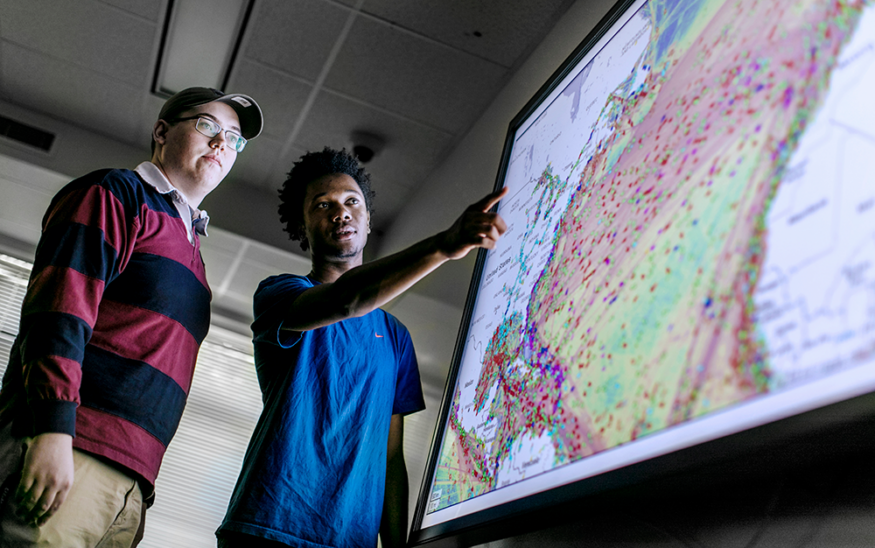
Old Dominion University’s School of Supply Chain, Logistics & Maritime Operations offers certificates in addition to traditional degrees. Photo courtesy Old Dominion University
Old Dominion University’s School of Supply Chain, Logistics & Maritime Operations offers certificates in addition to traditional degrees. Photo courtesy Old Dominion University
Universities adjust maritime programs for AI era
Educators recognize students must keep pace with tech developments
Paul Bibeau// April 29, 2026//



Summary:
- AI is impacting maritime sector jobs at significant pace
- However, industry is “conservative and somewhat risk-averse,” a VCU professor says
- Sales jobs are relatively secure, but entry-level supply chain jobs are declining
In a February column, Wall Street Journal writer Peggy Noonan described the artificial intelligence revolution as a tsunami approaching us from the horizon as we freeze, wondering what to do.
“We can’t stop it,” she wrote. “Should we run? Which way?”
Nonetheless, Virginia’s colleges and universities with maritime programs are not in fight-or-flight mode.
In the maritime sector, AI’s effect is sizable and growing, with a $4.13 billion global market and a projected five-year compound annual growth rate of 23%, according to a 2024 study commissioned by the London consulting group Lloyd’s Register.
Educators are responding by adding AI competency to classes. But in the long term, they expect even more profound changes and are also emphasizing hands-on training and certifications that a student can obtain quickly to help potential workers keep pace with industry developments.
What you won’t see, at least right away, is an army of maintenance robots roaming around ships, says Jason Merrick, a professor of supply chain analytics at Virginia Commonwealth University. The maritime industry is conservative and somewhat risk-averse, he adds. The short-term changes that will happen in shipbuilding and repair will be subtle.
“You’re going to have engineers on a ship with better systems, predictive maintenance systems,” he says. “But engineers are going to be needed.”
Brett Massimino, chair of VCU’s Department of Supply Chain Management and Analytics, points to the larger supply chain as a place where AI could have immediate effects, such as reducing the number of entry-level jobs.
“The accountants of the world just doing standard bookkeeping, some supply chain jobs — a lot of that manual stuff is now just abstracted and put into some sort of AI system, and we don’t need a team of entry-level people to oversee that,” Massimino says.
But sales jobs are still a good avenue to break into the industry, Merrick adds. “They’re working with a shipping company or a container company, and they’re making sure their ships are full for transportation. Sales jobs aren’t going away at this point.”
Old Dominion University has several classes in AI at the undergraduate and graduate level. According to Rafael Diaz, director of ODU’s maritime research cluster, premium skills needed in the industry include AI literacy, backed by the kind of critical thinking colleges have always taught. Employers need students who can evaluate the data an AI system is feeding back instead of taking it at face value.
“AI itself is not going to solve the problem,” Diaz says. “It’s not like a silver bullet.” He describes the relationship between the user and the AI as a process of asking questions, narrowing down the answers and then questioning the questions.
Adjusting expectations
Kuntal Bhattacharyya, director of ODU’s School of Supply Chain, Logistics & Maritime Operations, notes that people will have to constantly update their skills to stay competitive in the industry. His school has taken a three-pronged approach: upgrading its core requirements, helping students get practical experience and offering certificates in addition to traditional degrees, so students can gain knowledge more quickly.
Supply Chain 4.0, for example, is now a required core course in the school’s graduate-level curriculum, as well as all its certificates. Based on the concept of Industry 4.0, which refers to the roles AI, cloud computing and other cutting-edge tech play in manufacturing, the class teaches how AI, machine learning and analytics can be used to manage supply chains.
What’s more, certificates are important to allow students to stay competitive in a potentially volatile market, Bhattacharyya says. A typical master’s program, he explains, might take three years to complete, while a certificate could take a year.
Finally, Bhattacharyya notes practical experience is more important than ever to understand how maritime industries are currently employing AI. To achieve this goal, ODU has entered into an agreement with Splice, a Norfolk-based B2B software company that uses AI to automate logistics processes.
“So, this would allow students to dig deep into datasets focused on seaport and port terminal operations,” he says.
According to Chris Cartwright, dean of Tidewater Community College‘s maritime and skilled trades pathway, practical industrial experience is his school’s forte. TCC has partnered with the Norfolk Naval Shipyard since the 1970s, and it offers apprenticeships with a variety of other maritime and industrial employers.
“Technologies often associated with artificial intelligence are beginning to influence parts of the maritime industry,” Cartwright says, “primarily through increased automation, improved data use and advanced manufacturing processes.”
Ultimately, Bhattacharyya adds, it’s the job of a university to aid people to upskill and keep pace. “You have to ride that wave of change.”