Sign In
Upcoming Event
 Free Newsletter

Maritime workforce accelerator revs engines
New Virginia Works program addresses recruitment, retention in jobs
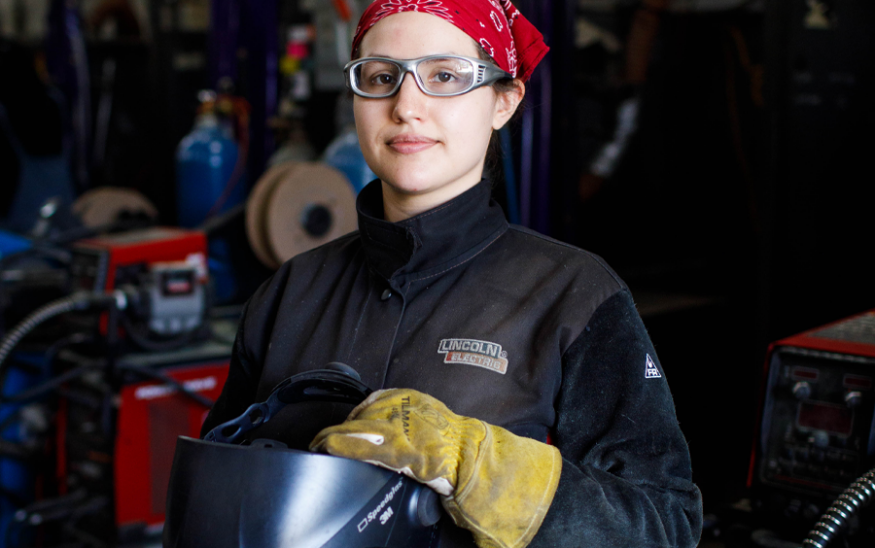
Rachel Pike is Virginia Peninsula Community College’s lead welding instructor, teaching Newport News Shipbuilding trainees. Photo by Kristen Zeis
Rachel Pike is Virginia Peninsula Community College’s lead welding instructor, teaching Newport News Shipbuilding trainees. Photo by Kristen Zeis
Maritime workforce accelerator revs engines
New Virginia Works program addresses recruitment, retention in jobs



Summary:
- State agency has started the Maritime & Nuclear Workforce Accelerator
- Program aids recruitment and retention for maritime and nuclear jobs in Hampton Roads
- State works closely with employers to address needs for skilled workers
A new Virginia Works accelerator aims to supply the commonwealth’s giant military and commercial shipbuilding industry with employees whose skills precisely fit company needs.
True to its name, the Maritime & Nuclear Workforce Accelerator aids recruitment and retention for maritime and nuclear energy jobs, as well as related manufacturing sectors.
Like other port regions around the country, Hampton Roads is contending with a shortage of skilled workers such as welders and pipefitters that companies need to assemble the large steel components that make up a ship’s bulkheads, decking and superstructure. The U.S. Department of Labor estimates that an additional 200,000 to 250,000 maritime workers will be required over the next decade.
To alleviate the skills shortage, “we’re leading with the needs of employers. As a workforce development agency, we get an up-close-and-personal view of employer needs,” says Virginia Works Commissioner Nicole Overley. “We want to help them understand what training is available and design a program that works.”
The new accelerator is using a phased approach that begins with a structured employer needs assessment, Overley says. About a dozen employers took part in this process, which began in January and concluded at the end of March.
Feedback shows a need for welders, electricians, machinists, industrial maintenance, inspectors and supervisors, Overley notes. “Some can be entry-level, but most require hands-on training and experience.”
The initiative gives eligible employers reimbursement of up to 80% of approved training costs for a maximum reimbursement of $100,000 per employer. Performance-based reimbursement will be tied to training completion and six-month job retention.
Approximately $1.2 million is provided by the governor’s set-aside Workforce Innovation Opportunity Act Title I funds.
With the needs assessment phase complete, Overley says work begins on designing and implementing training programs, such as short-term credential programs, customized or modular training, apprenticeship programs and on-the-job training. “There’s a broad range of models that we’ve seen work.”
The next step will be tracking how many participants complete training and how the program supports recruitment and retention.
Training is valuable as a retention tool, Overley adds. “Not only do more workers enter the industry but by helping employees continue improving their skills within their current roles, … they can see a future career path upward” within the company.
Virginia Works is the lead entity in the maritime skills project but has a wide array of partners, including the Central Virginia Workforce Development Board, Virginia Manufacturers’ Association and the Virginia Department of Energy. The agency also partners with the Virginia Community College System. In April, Virginia Works issued a request for applications from eligible employers, due May 20.
Leading-edge learning
Rachel Pike, lead welding instructor at Virginia Peninsula Community College, notes that Hampton Roads is the nucleus of high-tech shipbuilding, specializing in nuclear-powered aircraft carriers and submarines. Technological advances in the industry include advanced additive manufacturing (also known as 3D printing), robotics and unmanned systems engineering.
Pike currently teaches people who have been pre-hired by Newport News Shipbuilding. The three-week welding course “is eight hours a day, five days a week,” she notes. “It gets their feet wet so that when they go to Newport News Shipbuilding, they can more quickly go through training there.”
The shortage of skilled workers is due to several factors, according to Pike.
“Older workers are aging out of the workforce before they can turn over knowledge” to younger workers, she says. Although rising tuition costs and student loan debt have caused many people to reconsider pursuing four-year degrees, “college is being pushed more than trade,” Pike adds. “There haven’t been enough people gaining interest or realizing it is an option. We need to let people know that trade is an option, that it can be a well-paying option.”
Another partner in the maritime skills project is the Hampton Roads Workforce Council.
“We wear two hats,” says President and CEO Shawn Avery, working to increase both supply and demand of skilled employees. He collaborates with employers to identify their training needs and help them find resources such as the Maritime & Nuclear Workforce Accelerator, and the council directs potential workers to the best-fitting training programs for their situations.
There’s a special source of talent in Hampton Roads, according to Avery — exiting military service members and their spouses. “We try to transition them, especially if they have specific skills” that are valuable to the shipbuilding industry, he notes.
“People are making transitions. Some are from other industry sectors. There have been federal layoffs. Some people were in retail or had a part-time job and are looking to get back into the workforce.”