Sign In
Upcoming Event
 Free Newsletter

Maritime leaders on automation, tariffs and the industry’s future
Newport News Shipbuilding, LS GreenLink execs weigh in
Depositphotos
Depositphotos
Maritime leaders on automation, tariffs and the industry’s future
Newport News Shipbuilding, LS GreenLink execs weigh in



 ROB GIES
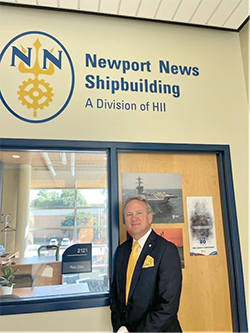 ROB GIES
Associate technical fellow, Newport News Shipbuilding; engineering professional in residence, Old Dominion University, Norfolk
Virginia Business: How have times changed since you were a student at ODU, and what have you learned in advising students, particularly for future maritime careers?
Gies: First, the evolution and advancement of technology and computing capabilities has grown exponentially. From punch cards and mainframe computers to incredible current-day computing power, the changes have made engineering assessments and analysis techniques more robust.
Second, there are many student resources available to support students through advising, counseling, academic success and career guidance. Elements of these resources were available when I was a student, but the depth and breadth are more comprehensive today. As a first-generation college student, I did not know these resources existed, so when able, I always try to communicate to students that if they need help, then they need to seek support.
Old Dominion University wants each student to be successful, and they are ready to proactively help.
I encourage students to explore their interests, to define what success means, and to ensure that their life includes a balanced approach that maximizes and stretches their potential, while broadening their perspectives.
VB: You’ve been a liaison between ODU and NNS for quite a while — how does the opening of the NNS office on campus impact your job?
Gies: NNS and ODU share many goals and efforts, so it makes perfect sense for the two organizations to collaborate. Through this office, on behalf of NNS, I am able to talk to students on a regular basis on a broad range of topics, ranging from career choices to engineering within the industry to professional development.
I am a strong advocate for mentoring, so I enjoy the opportunity to mentor students too. My on-campus involvement with ODU also includes interfacing with different professors to identify potential common research opportunities in shipbuilding and maritime operations.
I am honored to represent NNS at ODU through our office, and I look forward to the future as both NNS and ODU continue to forge our relationship.
 RACHEL SHAMES
 RACHEL SHAMES
Vice president of pricing and procurement, CV International, Norfolk
Virginia Business: Tariffs have had a big impact on shipping and other sectors. The Supreme Court struck down President Trump’s tariffs in February, but he has instituted new 10% levies under different authority. What is the current status for Virginia’s maritime industry?
Shames: In general, U.S. importers and exporters are cautious right now. Uncertainty continues, despite the Supreme Court ruling, as alternative methods of levying tariffs are still on the table. The war with Iran has cast even more uncertainty on the economy and consumer confidence for the year ahead.
Many companies have worked through inventories and are maintaining very low levels of stock for now. In global sourcing, many U.S. companies are exploring new origins and markets for their goods. We have seen a good number of importers shift at least some sourcing from China to alternative origins, including Southeast Asia and India. In some cases, the new manufacturer works well, and in other cases, the quality tradeoff is not worth the tariff savings. It’s very case by case.
VB: How are automation and AI changing things for companies in the maritime industry?
Shames: Our industry has been ripe for innovation for quite some time, and the last several years have brought new technologies to freight forwarding, customs brokerage and maritime in general. The best technologies are those that leverage automation and AI-powered solutions to complement the human aspect.
Processing documents and digesting standard shipment details are examples of practical areas where AI can support the business. Typically, the most time-consuming challenges in our business still require a personal intervention — picking up the phone to call customs or a transportation partner, for example.
This reflects the complex nature of international trade; automation and AI will certainly make some processes more efficient, but personal touch will remain critical.
 JOHN POLOWCZYK
 JOHN POLOWCZYK
President, Virginia Ship Repair Association, Norfolk
Virginia Business: How is workforce development in Virginia’s ship repair industry going currently, and what kinds of skilled workers does the industry need most?
Polowczyk: We have great foundational programs, training about 5,000 to 6,000 new entrants a year. What ship repair needs is a way to upskill workers faster to help bridge the gap between new and experienced workers getting ready to retire. While apprenticeship programs help, we need ways to go faster on upskilling workers.
VB: How is the geopolitical atmosphere impacting the industry?
Polowczyk: World events are going to put pressure on ship repair because the Navy will need to reset the force after the long deployments. We will need to get the work done quickly and return ships to full capabilities.
VB: What do you think the impact of greater automation will be on the industry and on workers?
Polowczyk: Automation has a place in ship repair. We should be using robots to inspect tanks. We should be using AI in our supply chain and schedule tools. Industry 4.0 has a real chance to help ship repair, and the government and industry need to get together and see how we can go faster.
VB: What do you think Virginia can or should do to support the ship repair industry?
Polowczyk: Virginia should stand up as a maritime leader and work to bring more investment, more ships and more work to Virginia.
 PATRICK SHIM
 PATRICK SHIM
Managing director, LS GreenLink USA, Chesapeake
Virginia Business: LS Cable & System announced recently it will double its capital investment in Hampton Roads. How did your company decide to build another major project in Chesapeake?
Shim: The new $689 million investment announced in December 2025 will consist of three businesses within a single manufacturing complex, separate from the previously announced LS GreenLink project and site.
It will include: (1) copper recycling and smelting, (2) magnet wire production, and (3) rare-earth magnet production. We chose Chesapeake again to reflect our strong partnership with Virginia, Chesapeake and the local community. As with the LS GreenLink project, this new investment was also drawn to the Hampton Roads region by its high-quality workforce and the strong leadership of local elected officials.
VB: How is your company planning to find qualified workers for the campus and the cable manufacturing facility?
Shim: As we approach completion of construction on both projects in the second half of 2027 and the first half of 2028, we plan to begin large-scale hiring efforts and work closely with the local community. We are a Virginia Values Veterans-certified employer and intend to actively engage with the veteran community.
VB: How are tariffs impacting construction costs and/or the company’s manufacturing plans?
Shim: Tariffs are negatively impacting both our construction and manufacturing plans, and we are continuing to explore potential solutions.