Sign In
Upcoming Event
 Free Newsletter

HII robotics agreements could mean job changes
Shipbuilder signs MOUs with Path Robotics, GrayMatter Robotics
Chris Suarez //April 29, 2026//
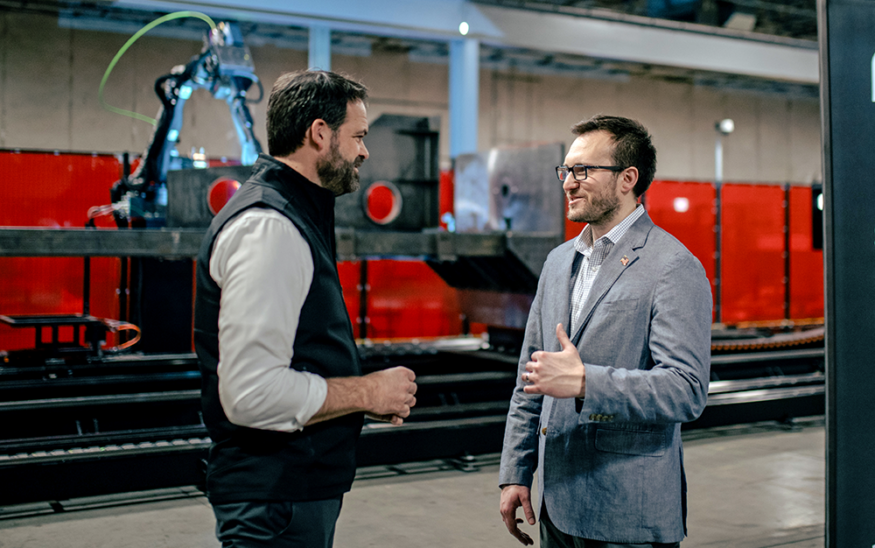
Huntington Ingalls Industries’ Eric Chewning (left) and Andy Lonsberry, Path Robotics’ CEO, announce their companies’ partnership.
Huntington Ingalls Industries’ Eric Chewning (left) and Andy Lonsberry, Path Robotics’ CEO, announce their companies’ partnership.
HII robotics agreements could mean job changes
Shipbuilder signs MOUs with Path Robotics, GrayMatter Robotics
Chris Suarez //April 29, 2026//



Summary:
- HII signed memorandum with Path Robotics for physical AI welding in February
- In March, shipbuilder signed agreement with California’s GrayMatter Robotics
- HII aims for 15% shipbuilding throughput growth in 2025
The new frontier of AI-driven welding and shipbuilding is on the horizon for Huntington Ingalls Industries in Newport News.
In February, HII announced the signing of a memorandum of understanding with Ohio-based Path Robotics to develop “physical artificial intelligence” that can autonomously handle welding for the naval warships it builds for the U.S. Navy.
Eric Chewning, HII’s executive vice president for maritime systems and corporate strategy, says the innovation is part of a fourth-wave industrial revolution that moves beyond contemporary robotics and digitalization.
“In the past, automation focused on applications where one task would be done numerous times. Think of one robot doing the same task 10,000 times. But in shipbuilding, you need 10,000 tasks done once,” Chewning said at a document-signing ceremony in Path’s Columbus, Ohio, headquarters. “This is why physical AI is a game changer. We finally have systems able to do a variety of tasks.”
In late March, HII announced a second memorandum of understanding with California’s GrayMatter Robotics, which also develops physical AI tech.
HII, the nation’s largest shipbuilder, assembles nuclear submarines and aircraft carriers at its Newport News Shipbuilding subsidiary. The company also operates a shipyard in Mississippi where it builds destroyers, cutters and other vessels for the U.S. Navy and the U.S. Coast Guard. Newport News is the larger of the two locations, with approximately 26,000 employees.
The company says it increased year-over-year shipbuilding throughput by 14% in 2025 and aims to hit 15% in growth this year.
Chewning says the partnership with Path is part of a five-point strategy, which includes outsourcing ship module construction to smaller shipyards and manufacturers, developing vocational apprenticeship programs and adding more than $600 million in planned capital investments.
Path Robotics markets its physical AI technology as a solution to a projected shortage of 600,000 welders by 2030. Andy Lonsberry, the CEO and co-founder of Path Robotics, says it’s a critical time for national defense and manufacturing.
“Welding is one of the hardest processes to automate in any industry, and shipbuilding is no exception. Path’s physical AI is purpose-built for that challenge — seeing, understanding and adapting to real-world conditions in real time,” Lonsberry says.
Details about HII’s implementation of the technology remain fuzzy. A spokesperson for the company declined Virginia Business’ request to arrange an interview for this story.
Ricardo Ungo, director of the Maritime & Logistics Institute at Old Dominion University, says he’s unaware of examples where autonomous-welding technology has been implemented so far.
“AI is new for most industries. Most industries are still learning how they can apply AI in their operations. Shipbuilding is no different from that,” he says. “I think they are looking for new avenues and new methods to improve the delivery time and the commissioning.”
United Steelworkers Local 8888 represents about 12,000 employees at the Newport News shipyard. Its president, Charles Spivey, says he’s heard nothing about how the new technology might change operations there.
After 45 years in the industry, he says, he’s seen how previous technological improvements changed jobs.
“We have robotic systems for the weldings, but some it is still manned by a person. You still need to have a person to set up all these things for them,” Spivey says. “He got to be there the whole time while this thing is operating. So that didn’t eliminate his job. It just perfected his job.”
While Spivey says he’s generally wary of automation eliminating existing jobs, he also says the industry has struggled to retain newly trained welders and ready-to-retire journeymen.
“They are constantly hiring,” he says. “We’re in high demand.”
P