Sign In
Upcoming Event
 Free Newsletter

Hampton Roads could anchor shipbuilding revival
Virginia officials say China's lead is growing
Josh Janney //April 29, 2026//
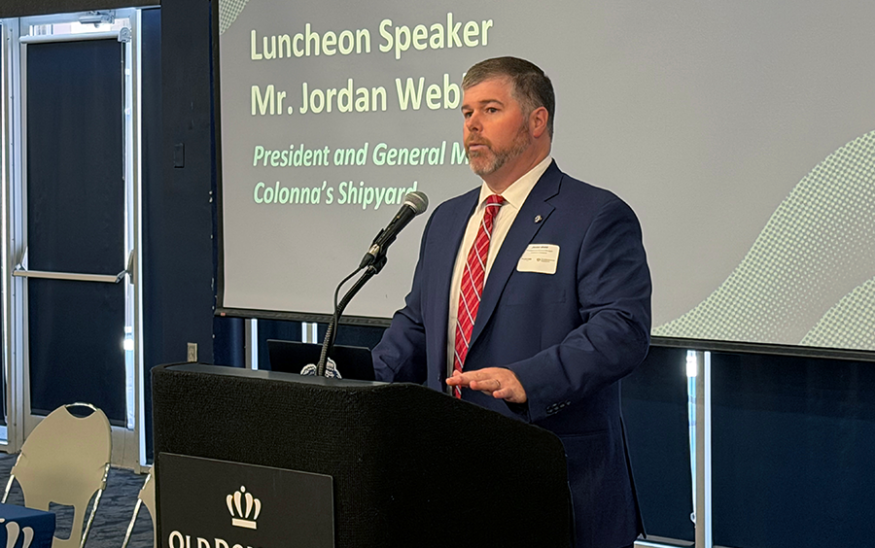
Colonna’s Shipyard President Jordan Webb says that the U.S. shipbuilding industry is under pressure from China. Photo by Josh Janney
Colonna’s Shipyard President Jordan Webb says that the U.S. shipbuilding industry is under pressure from China. Photo by Josh Janney
Hampton Roads could anchor shipbuilding revival
Virginia officials say China's lead is growing
Josh Janney //April 29, 2026//



Summary:
- Hampton Roads is considered critical to the nation’s maritime industry.
- Virginia maritime leaders, members of Congress say China’s hold on shipbuilding is growing
- U.S. builds less than 1% of global commercial ships, while China leads
The United States is under growing pressure to rebuild its shipbuilding capacity as global competition intensifies, particularly from China.
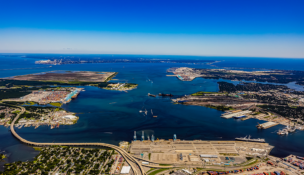
Virginia’s industry and government leaders say Hampton Roads will be critical to strengthening the nation’s maritime industrial base.
During the Old Dominion University Maritime Conference in March, Jordan Webb, president of Norfolk-based Colonna’s Shipyard, pointed to what defense analysts call the “Davidson window,” a timeframe through 2027 when China could have the military capability to seize Taiwan through conflict. Named for Navy Adm. Philip S. Davidson, the concept has significant impact on U.S. military policy.
“But to me, it symbolizes more, because it’s really the period of time when we see that China might have sufficient military power to challenge the U.S. dominance of the seas,” Webb says. “And when does that begin? 2027. Or, some would argue, we’re already there.”
He cited a Center for Strategic and International Studies report showing China built 39 warships between 2019 and 2023, totaling more than 550,000 tons, allowing it to surpass the Royal Navy. CSIS has also reported that in 2024, China State Shipbuilding Corporation built more commercial vessels by tonnage than the entire U.S. shipbuilding industry has built since World War II.
“We must think more regionally than individually, because if the statistics on Chinese shipbuilding don’t make you a little nervous, you might want to get checked out,” Webb says, stressing the need for the Hampton Roads region’s shipyards, suppliers, workforce programs and policymakers to operate as a coordinated system.
Hampton Roads is one of the nation’s largest maritime hubs, home to the world’s largest naval station and supporting tens of thousands of shipbuilding and repair jobs. Newport News Shipbuilding, a subsidiary of Huntington Ingalls Industries, employs roughly 26,000 workers, making it the state’s largest industrial employer.
At the conference, Virginia lawmakers emphasized the importance of strengthening the nation’s maritime capacity, with U.S. Rep. Jen Kiggans, R-Virginia Beach, pointing to what she described as growing recognition in Washington, D.C., that rebuilding the industry must be a priority.
Kiggans framed investing in shipbuilding as important not only for the economy but also for national security. Citing CSIS data, she notes the U.S. builds less than 1% of the world’s commercial ships, whereas “adversaries like China” produce more than half of the global shipbuilding output.
She highlighted a Maritime Action Plan released by the Trump administration outlining proposals to rebuild the U.S. maritime industrial base. The plan focuses on expanding shipyard capacity, strengthening the maritime workforce and modernizing infrastructure, though many of its initiatives will require congressional approval and future funding.
Matthew Sermon, who leads the Navy’s maritime industrial base program, says the industry will need to rely more heavily on advanced manufacturing and new production methods to meet future demand.
“We’re not going to re-stand up the 70% to 80% … of our infrastructure that we lost at the end of the Cold War over a long period of time,” he says. “It’s not cost-effective. It’s not efficient. We don’t have the workforce.”
Webb says another challenge facing the maritime industry is inconsistent demand signals from the Navy and instability in scheduled shipbuilding and repair workloads. He adds that government shutdowns “cripple this industry” and that continuing resolutions “don’t work,” arguing that short-term budgeting practices and fluctuating workloads make it difficult for companies to make investments.
“Companies can only justify investments in tools, equipment and infrastructure if they know what they’re working on next week, next month, next year,” Webb says. “We are hyper-focused on workforce, and that’s great. But we must get more cohesive on the idea of workload.”
Still, workforce development remains a challenge for the industry, according to U.S. Rep. Bobby Scott, D-Newport News, who is a member of the congressional shipbuilding caucus and co-chair of the congressional submarine caucus.
However, he pointed to changes included in the One Big Beautiful Bill Act that allow Pell grants to be used for programs that “lead to good jobs” rather than only traditional college degrees. The provision expands eligibility to short-term workforce training programs often tied to skilled trades and technical fields. While Scott opposed the Trump-led legislation overall, he supports this provision.
Efforts to strengthen the region’s maritime and defense industrial base are also part of a broader regional economic strategy outlined in the Hampton Roads Playbook, a plan led by the Hampton Roads Alliance to coordinate growth across the region’s key industries.
“This is our moment,” says Doug Smith, the alliance’s president and CEO.
The playbook focuses on sectors where Hampton Roads already has a competitive advantage — defense, energy, aerospace and logistics — and aims to secure jobs and investment.
Webb points to renewed national momentum around shipbuilding and maritime policy as a rare opportunity for Hampton Roads.
“There has never been a better time since the late 1970s to be a maritime community,” he says.