Sign In
Upcoming Event
 Free Newsletter

Virginia Tech opens $310M academic building in Alexandria
Virginia Tech’s Alexandria campus sees success
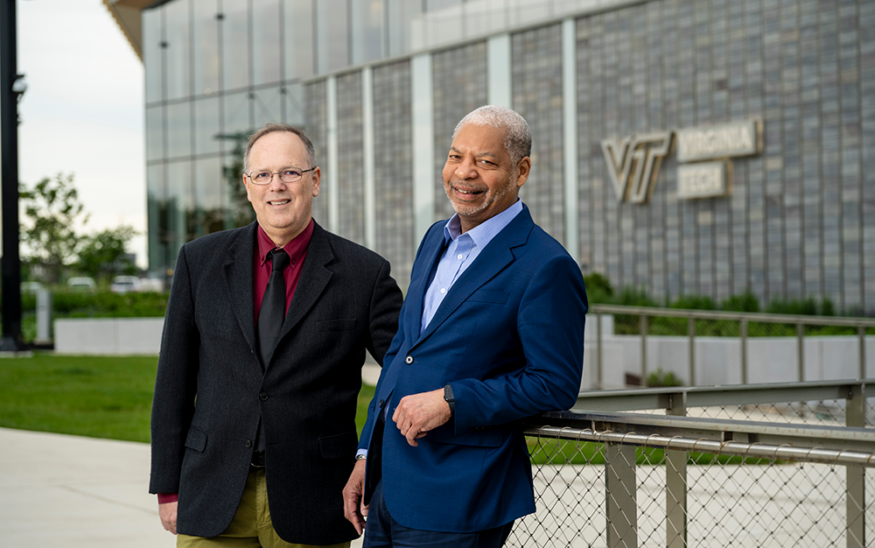
Kirk Cameron (left), faculty lead and managing director of Virginia Tech’s Institute for Advanced Computing, and Lance Collins, the university’s Washington, D.C., area vice president, have marked a year of growth in Alexandria. Photo by Will Schermerhorn
Kirk Cameron (left), faculty lead and managing director of Virginia Tech’s Institute for Advanced Computing, and Lance Collins, the university’s Washington, D.C., area vice president, have marked a year of growth in Alexandria. Photo by Will Schermerhorn
Virginia Tech opens $310M academic building in Alexandria
Virginia Tech’s Alexandria campus sees success



Summary:
- Virginia Tech opens $310 million Academic Building One
- Building houses AI, quantum computing and Flex MBA programs
- Northrop Grumman invests $12.5 million in quantum center
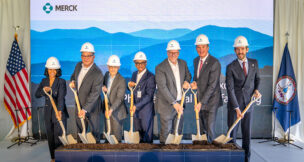
Virginia Tech took a big swing with its Academic Building One in Alexandria, which opened in January 2025.
Beyond the light-sensitive optics of its glass structure, which can appear cobalt blue or champagne gold depending on the sun’s position, the building’s walls are outfitted with the latest in photovoltaic windows and fins that soak up sun rays to provide electric power. That innovation won the $310 million, 11-story building praise in Interior Design magazine, which awarded it the 2025 Best of Year Award for Larger Higher Education projects.
However, the building’s initial return on investment is more about the collection of human energy inside its walls, which house graduate programs in computer science and computer engineering, as well as the Pamplin College of Business‘ Flex MBA program.
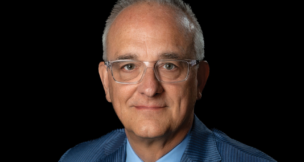
“There’s something quite powerful when you bring together engineering and business,” says Lance Collins, Tech’s vice president for the greater Washington, D.C., area and formerly the inaugural vice president and executive director of the Alexandria campus. “It opens the door for new company creation and for stronger interaction with existing companies in the technology space especially.”
Academic Building One houses Tech’s key areas of research, which include artificial intelligence, wireless, quantum computing and augmented reality. As of this spring, 320 of Tech’s 450 computing-focused engineering graduate students are based in the D.C. market, according to a spokesperson.
The building also represents the first phase of Virginia Tech’s $1 billion, 3.5-acre campus previously known as the university’s Innovation Campus. Collins notes that name was retired because it lacked specificity and, with Virginia Tech spread out across the state, “innovation is not in one location.”
There’s room for two more buildings of about 150,000 square feet apiece in Alexandria, but officials say the buildings’ construction will be dictated by campus growth, and at the moment, the first building is the focus. Virginia Tech’s campus is part of a 19-acre “mixed-use development and innovation district” being developed by JBG Smith and the City of Alexandria in North Potomac Yard.
Faculty, students and administrators, meanwhile, are taking advantage of their surroundings and connections to neighbors such as Amazon, which hosts grad students as Amazon Fellows and supports an Alexa project running in the Sanghani Center for Artificial Intelligence and Data Analytics based in the academic building.
And while “the Blacksburg campus, intellectually, is the centerpiece of the university,” Collins says, he is proud of its Northern Virginia outpost.
He says the building is a connector for all of Tech’s initiatives in Northern Virginia and serves as a “front door” to the historic campus in Blacksburg and its more than 150 years of know-how.
“There was a point in time, particularly closer to the pandemic, where it was almost this thinking that it doesn’t really matter where we are, because we can Zoom or call,” he says. “But I think there’s no question that proximity really does make a difference.”
Solving monumental problems
One of Tech’s neighbors, the Secret Service, recently came to the building seeking help to protect the nation’s monuments.
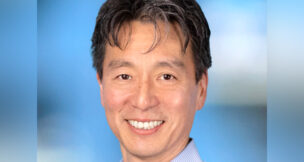
“The Secret Service said, ‘OK, here’s the problem we have: If a drone is broadcasting, we can see it pretty readily. But what if it’s not?’” explains Kirk Cameron, faculty lead and managing director of the Institute for Advanced Computing. “What if it’s coming at us in a stealth way? How do you detect these unmanned aerial systems and protect these locations from attack?”
Fortunately, students on multiple teams tackling the problem have access to a 465-square-foot indoor drone testing cage, one of many innovative features.
In addition to the institute, which has 20 core faculty members, the building houses the Center of Quantum Architecture and Software Development, backed with a $12.5 million investment from Northrop Grumman, and the Sanghani Center, supported with a $10 million gift by Octo founder and CEO Mehul Sanghani and his wife, Hema Sanghani, both of whom are Tech alums.
Cameron says about two dozen public and private industry partners have sought the institute’s student problem-solving over the last few years. Bloomberg, the Marines and the Alexandria Fire Department, among other businesses and organizations, regularly pitch logistical problems to Tech students at the start of each semester in the 3,000-square-foot Boeing Auditorium.
In the spring semester, about 150 students attended the event, which tasks them with individual projects that give them industry experience.
“It just gives you an indication of how popular the kind of stuff that we’re doing on the project side is,” Cameron says. “Looking ahead, we want to grow everything. It’s challenging to scale the kind of experiential learning experience that we’re giving the students because it’s a bit white glove. But it’s really key to our brand. It’s what separates us from all the other degree programs up here. So, we have a goal to get to about 1,000, maybe 1,200 students in the program at any one time.”
The institute is searching for an executive director to handle outward-facing business, such as fundraising, while Cameron manages the internal day-to-day, and with expansion, Cameron expects to hire a couple more faculty members.
As for the drone-spotting project for the Secret Service, Cameron says one promising approach involves projecting sound waves, sonar-style, to sense incoming movement. The students were set to present their proposals at an all-day showcase in mid-May.
Location, location, location
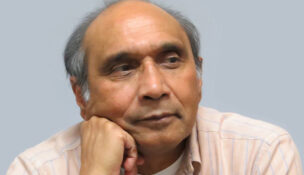
Place, of course, is one of the “4 Ps” of marketing, a subject matter Rajesh Bagchi has built his academic career on.
“We’re next to the power capital of the world,” reflects Bagchi, who serves as the Pamplin College of Business’ associate dean for research, graduate programs and centers. While the business school maintains its original Blacksburg location, its Flex MBA program is based in Alexandria, amid the Metro system, Reagan National Airport, the Pentagon and Amazon’s HQ2.
Academic Building One positions Tech for a robust set of new customers, although university officials had to ask themselves first whether MBAs are still considered valuable in today’s economy.
“We did quite a bit of market research, and one thing we learned is that MBAs are here to stay,” Bagchi says.
Corporations tell him that they seek professionals with both high-level wisdom and of-the-moment understanding to help lead their organizations, particularly those who can adapt to disparate cultures and guide their organizations through uncertain times.
“What is happening now is that the world has become very flat,” Bagchi says. “You have people who are graduating with a lot of knowledge but very little experience, and then you have some folks like me who’ve been around for a little while longer, maybe with a little more experience perhaps, but our knowledge is drying up because of all this infusion of new technology, new methodologies and new approaches to doing business.
“So, it is important for us to keep building on both fronts,” Bagchi says.
Enter the 10-course, 30-credit Flex MBA, which starts this fall. It’s actually the same rigorous MBA that’s always been offered but with new flexibility for completion. Students can attend class at Academic Building One, or virtually, on a course-by-course basis. They can start by taking just one or two courses as needed to fit their busy schedules. And every degree candidate pays the same price — currently a little over $50,000 to complete the degree — no matter where they live.
Whether prospective students are climbing the career ladder or seeking a fresh start in the wake of government job cuts and sweeping AI upheaval, Virginia Tech wants to be their go-to.
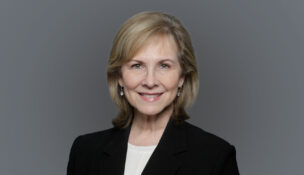
“The average student that we have has about 12 years of work experience,” says Linda Christie, who directs Tech’s MBA programs. “They’re in their late 30s. So, they’re well into their careers. For the most part, our students are coming to us thinking about the future and wanting to be well- prepared. They’re usually in positions they’re already successful at. We’re also attracting a lot of veterans right now, so people that have spent 20 years in the military, and now they’ve transitioned to a different phase of their work life.”
The Boeing Center for Veteran Transition and Military Families, also located at Academic Building One, is in a strong position to make many of the introductions.
Funded by Boeing’s $50 million donation in 2021, which also supports student scholarships, faculty recruitment and K-12 STEM pathway programs, the center is a partnership among the Fortune 500 aerospace and defense giant, Virginia Tech and the Virginia Department of Veteran Services to provide resources to ease veterans’ return to civilian life.
Christie expects about 20 military-affiliated students to start Flex MBA this fall, out of a total of 85 to 90 enrollees. In spring 2027, she anticipates 40 to 50 new students in Flex MBA, including about 10 with military backgrounds.
“And we also have a terrific veteran support service group in Blacksburg,” Christie says. “They help us with making sure that everything is coordinated correctly in terms of student benefits and also working with the registrar and their courses.”
This story has been updated since publication.

at a glance
- Undergraduate: 31,536
- Graduate and professional: 7,459
- In-state undergraduate: 20,474
- International: 4,047
- Student profile
- Male: 56.2%
- Female: 43.5%
- Students of color: 12,385
- Full-time employees: 9,160
- Research and teaching faculty: 2,934
- In-state undergraduate: $17,087
- Out-of-state
- undergraduate: $40,180
- Room and board: $15,032
- Average financial aid awarded to entering in-state undergraduates in 2025-26: $8,348