Sign In
Upcoming Event
 Free Newsletter


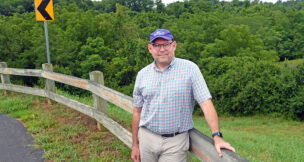
William Hollinsed, a chemistry lecturer, discusses his research for a program at JMU’s Research, Economic Development and Innovation department. Photo courtesy James Madison University
William Hollinsed, a chemistry lecturer, discusses his research for a program at JMU’s Research, Economic Development and Innovation department. Photo courtesy James Madison University
JMU’s innovation efforts gain national notice
Paul Bibeau August 2, 2026//



Summary:
- JMU named Innovation & Economic Prosperity university by APLU
- REDI department supports research and business partnerships
- X-Labs collaborates with local companies on workforce solutions
When it opened last year, the Harrisonburg Innovation Hub was a sizable development in the city’s downtown, with more than 30,000 square feet of space to bring people together to share work, ideas and unlimited coffee.
James Madison University was there right at the beginning as an anchor tenant.
“I give them a lot of credit for that,” says Brian Shull, Harrisonburg’s economic development director. The university, he added, is a longtime driver of business in this region and beyond. “JMU is such a powerful economic engine for Harrisonburg, for Shenandoah Valley and the entire commonwealth.”
The Association of Public and Land-grant Universities recognized this involvement; it named JMU one of six new Innovation & Economic Prosperity universities in 2025. The designation recognizes public universities that collaborate with companies and public agencies to support development. Virginia Tech is the only other IEP designee school in Virginia.
“This designation is a powerful affirmation of James Madison University’s commitment to economic engagement and thriving community partnerships,” JMU President Jim Schmidt said in a statement. “It places JMU among a national network of forward-thinking institutions and strengthens our resolve to be the commonwealth’s preferred partner.”
Gaining its IEP designation involved an effort by the entire institution. JMU went through a self-assessment, took feedback from stakeholders and put together a five-year plan for improvement and growth. Two prime examples of how the institution partners with local businesses are the Research, Economic Development and Innovation (REDI) department and its incubator of collaborative projects, X-Labs.
Platform for discovery
As the university’s research hub, REDI provides support for faculty and students working on projects. Associate Vice President for Research and Economic Development Keith Holland says this group identifies funding sources and helps researchers apply for the money and comply with the funding requirements.
Sometimes, he added, it’s a matter of spotting the broad trends that government agencies and private foundations are following, the kinds of research they want pursued. He says they try to equip scholars with whatever they need to get results.
“We’ve helped connect those brilliant business ideas with faculty members and students who can help build a prototype in the lab or figure out the methodology that they’re going to use to test whether this business concept has viability,” Holland says.
For example, JMU scholars have been developing a device that automatically performs a horizontal gaze nystagmus test, the technique police use to check a driver’s sobriety in the field. The researchers published work in 2023 and 2024, and now HGNsense, an AI-driven eye-tracking system to detect alcohol impairment, is a funded project at the Commonwealth Cyber Initiative.
Leigh Evans, JMU’s director of research to impact, says her job is like that of a trail guide. She comes to the aid of researchers wherever they are in the development process and guides them to the next step, whether that means connecting them to an expert on patents or someone who can help them create a business.
“When people ask me what I do,” she says, “I tell them I’m a professional networker.”
The result could impact entire industries. The HGNsense team won $75,000 from CCI for further market study, and they are beginning to do research on who could benefit from — or buy — their product. One possibility is installing it in vehicles to keep someone from driving while intoxicated, which could have implications for a variety of transport businesses, Evans says.
Shull calls REDI a “gateway” that allows companies and nonprofits to access JMU’s resources.
“Somebody who’s new to dealing with a university can often be intimidated by it,” he says. “‘Where do I go? Where do I go first?’ So, REDI can really solve that.” And if people have a particularly thorny conundrum, they might find their way to a REDI program called X-Labs.
Crew of troubleshooters
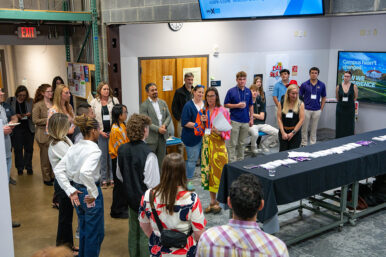
JMU X-Labs is a place where people from different academic disciplines come together to solve real-world problems brought to them by businesses and community partners. Every project at the lab begins with a big challenge or question. The X-Labs team then brainstorms ideas and begins a process of testing and improving its potential solutions until it finds the answer.
Emily Winter, who was director of programming at X-Labs from 2019 to 2021 and is now Harrisonburg Downtown Renaissance’s director of marketing, says the key to X-Labs’ success is its array of students of different disciplines who develop many skills while working on challenges. Winter often raised awareness of the then-new program by arranging pop-up workshops.
“We specifically made them so that not just STEM majors would be welcome, but like really any major at all,” she says.
“We’re constantly on the beat looking for partners,” says Patrice Ludwig, X-Labs’ acting executive director and co-founder. “Somebody will say, ‘I know X-Labs does this. You might want to go talk to them.’”
Along the way, X-Labs has partnered with Dynamic Aviation, a Bridgewater-based aerospace company, to find creative solutions to help people learn about the first Air Force One, the official plane of President Dwight Eisenhower. It also teamed with the management company Arc Aspicio to address human trafficking. And during the COVID-19 pandemic, the team worked with the Harrisonburg Farmers Market to use online ordering and drive-thru pickups to allow the organization to keep running.
But one specific X-Labs challenge shows how the team, and JMU itself, is tackling the issue of workforce development.
“Students aren’t great at mapping their skills that they learn in school to their career,” Ludwig explains. Reston-based higher education software company Ellucian and X-Labs worked together to crack this problem by creating what she called the “reimagined internship.”
They put out a listing for students who were studying for a variety of careers, including front-end designers, product managers and even an ethicist, and they assembled a class of interns who received regular training on Ellucian’s products and its corporate culture, to build a tool for the company to identify students’ skill gaps. Eventually Ellucian hired the entire class as a group for paid summer internships to see if they could function together. Ludwig says the project worked “beautifully” and noted that the company is continuing the program into a second year.
As a JMU undergraduate, Hamid Elias was one of 10 students working on the Ellucian project. His internship landed him a job there after he graduated in 2024.
Today, Elias is a product manager at Capital One and notes that his experience with X-Labs taught him the importance of flexibility in a college course and in his career. “It showed me that there is learning beyond a traditional classroom.”
Sharpening the saw
Part of the goal, according to Ludwig, is to help JMU students become the kind of workers who will continue to be an asset to the region long after they graduate. And that means building adaptability and social skills that Ludwig believes will be more important in years to come.
When working in X-Labs, she says, students and educators often trade roles. Nobody knows everything required to find a solution, so members in a cross-disciplinary team will absorb new information and become the team expert for the purpose of a single task. This also requires solid critical thinking skills; students in the group will find data and then argue over whether it’s reliable.
In the give and take of a meeting, the team then hashes out what they learned and pass on that knowledge to other teammates.
“How do you find and own information?” Ludwig asks. “How do you translate that to somebody who doesn’t know what you’re talking about or has never heard this concept before?”
She added that the X-Labs experience lets students model conflict in business situations without the high stakes. Participants often learn how to find common ground and be a leader one moment and a follower the next, as the team sifts through information, mimicking the flexibility that business leaders have to bring to dealing with problems in an increasingly complicated world.
Ludwig says she has heard praise from business clients about the creativity and professionalism the students bring to their tasks. But she’s proud of something else as well.
“We also hear that they’re good humans. … They’re good to work with. They understand how to work in the environment that they’re being placed in. And to me, like, ultimately, that’s what I want to hear.”
Winter says she gained skills at X-Labs that helped her find her current job at Harrisonburg Downtown Renaissance, a local nonprofit that supports that region’s business community. “It let me know that innovation really comes from everywhere.”
In 2022, JMU hit another benchmark for research when it received the R2 classification from the Carnegie Classification of Institutions of Higher Education. The organization issues R2 designation, its second-highest ranking, to universities that award at least 20 research doctorates annually and spend more than $5 million per year on research. Virginia has three R2 universities and five R1 institutions, the highest rating.
Holland noted that JMU is now spending $30 million or more on research, which is approaching the $50 million threshold to receive an R1 classification. He added that the university is working on strategies to get to that mark, but that it’s important to think through how to properly support the doctoral programs and balance these goals against the other work JMU is doing as a regional partner. He says that the IEP designation is not only an award for the university but a commitment to improvement.
“Yay, you did it, you’re doing a good job,” he says playfully. But reaching this marker means the school has to figure out how to continue being a resource for its neighbors — by answering questions, providing solutions and supporting economic development. “But really the ultimate goals that we have are making sure that the knowledge that’s generated at the university through research becomes impactful [in] some way.”