Sign In
Upcoming Event
 Free Newsletter

Virginia finalizes $200B+ 2026-28 budget
Budget includes data center energy consumption tax, retail marijuana sales framework
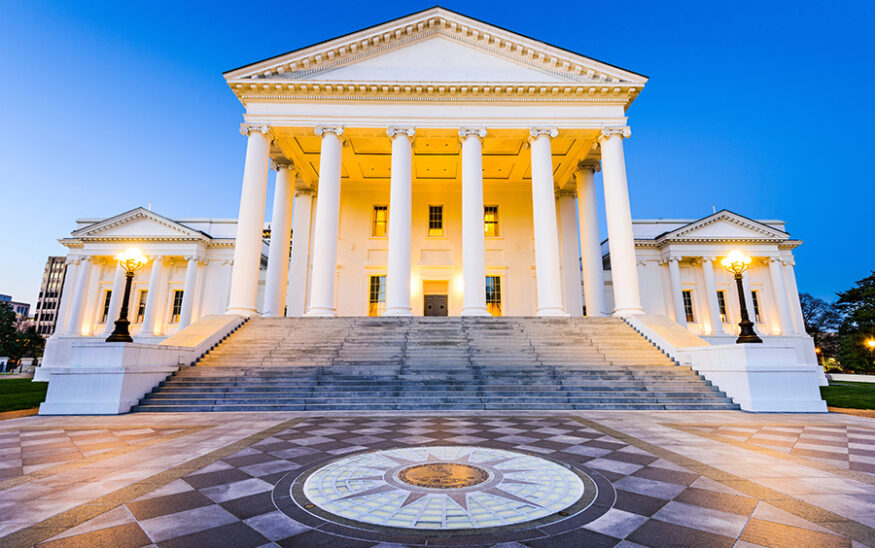
The Virginia State Capitol in Richmond. Photo by DepositPhotos
The Virginia State Capitol in Richmond. Photo by DepositPhotos
Virginia finalizes $200B+ 2026-28 budget
Budget includes data center energy consumption tax, retail marijuana sales framework



The Virginia General Assembly finalized the state budget Monday, accepting Gov. Abigail Spanberger‘s amendments two days before the start of the state’s next fiscal year.
Legislators sent a compromise budget to Spanberger on Monday, June 22, and she proposed a package of 14 amendments Friday evening. The legislators’ acceptance of the governor’s amendments to the roughly $207 billion, biennial budget averts a government shutdown, which would have been Virginia’s first.
In a statement Monday, Spanberger said, “This budget proves that no matter the challenges we face, Virginians always come together to find a responsible, bipartisan path forward to better our commonwealth.”
Speaking to reporters after the budget’s passage Monday, House Minority Leader Terry Kilgore, a Republican whose district spans several Southwest Virginia localities, said, “Well, we finally passed the budget, got it moving finally today, 100 days late … and we should have been able to do this sooner, quicker, so that our localities, our folks out there could count and be able to pass their budgets and move forward.”
The budget includes an electricity consumption tax on data centers — a compromise between the state Senate on one hand and Spanberger and the House of Delegates on the other — and a cannabis recreational retail framework, allowing legal sales to start in July 2027.
The electricity consumption tax on data centers is expected to bring in $1.2 billion in revenue over the next two years. It taxes $0.011 per kilowatt hour of power used by each data center per month, up to $600 million per fiscal year; any other tax revenue beyond $600 million will be returned to data center operators.
“I’m really excited about our budget. We went through a lot to get here, but at the end of the day, data centers are going to contribute about $1.1, $1.2 billion over the biennium to help fund our government, just like every other taxpayer in our state,” Senate Majority Leader Scott Surovell, D-Fairfax County, said to reporters Monday.
The idea of a data center tax assessment arose earlier in June as a potential compromise between the Virginia State Senate, which advocated for a repeal of the sales and use tax exemption for data centers that now costs the state more than $1 billion annually in tax revenue, and Spanberger and the House of Delegates, who did not want to repeal the incentive without a study to discuss impact on the state’s business interests.
“This budget also positions Virginia to be a national leader on data centers,” Spanberger said in her statement Monday. “I’m proud that we got a budget across the finish line that includes the first-of-its-kind statewide energy consumption tax on data centers I proposed this spring.”
On Monday, Surovell also said of data centers, “We’ve taken the first step this year in terms of generating some more revenue … but there’s other issues we have to continue looking at,” including the sales tax exemption, effects on the electricity grid and environmental concerns.
Cannabis retail framework
Spanberger and the General Assembly reached a deal on cannabis retail sales in mid-June, after the governor vetoed the proposed framework in May. Legislators had sought to start recreational sales at the start of 2027, but under the compromise, they will begin July 1, 2027. There will be 350 store licenses, as lawmakers wanted, instead of Spanberger’s preferred 200 licenses, although they will not all be released at once.
Speaking to reporters Monday, Kilgore said, “We shouldn’t be putting big bills like marijuana in the budget, I don’t think. … We need to make sure that we pass those bills during the session in front of committees where folks can have an opportunity to make amendments and to make the bills better.”
Standing beside him, Del. Scott Wyatt, R-Hanover County, said, “The impact on marijuana amongst our youth and public safety will be detrimental to Virginia like we see [in] other states like Colorado.”
The budget also allocates funding toward mitigating cuts in federal healthcare spending, according to Spanberger’s news release, including $150 million to lower costs for Virginians buying health insurance through the marketplace, $350 million to a Medicaid Reserve Fund to prepare for potential federal Medicaid cuts and $225 million to a new Federal Contingency Fund meant to help counteract federal funding reductions and prepare for possible additional cuts.
Virginia leadership “balanced the budget, protected our fiscal strength, invested in our people, and delivered real results without losing sight of our responsibility to future generations,” House of Delegates Speaker Don Scott, D-Portsmouth, said in a statement Monday. “This budget keeps Virginia the best place in the nation to do business while making sure working families share in that success.”
Also included in the budget are allocations meant to help lower housing and childcare costs, including $60 million for a mixed-income housing pilot and support for the Housing Trust Fund and $137.6 million more in funding for childcare assistance. Additionally, the budget includes 4% pay raises for teachers and school support staff and 3.5% raises for state employees.
T