Sign In
Upcoming Event
 Free Newsletter

Data center discord continues to block Virginia budget agreement
State senators hear from public at town hall meetings
Kate Andrews //June 17, 2026//
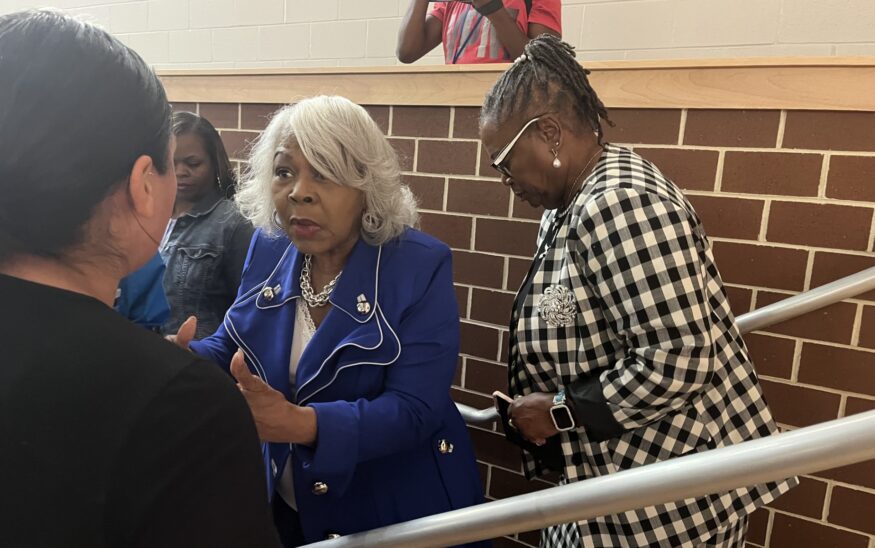
Virgnia Sen. Louise Lucas (left) speaks with an attendee of a Chesterfield County data center town hall she hosted June 16, 2026, with Sen. Mamie Locke (right). Photo by Kate Andrews/Virginia Business
Virgnia Sen. Louise Lucas (left) speaks with an attendee of a Chesterfield County data center town hall she hosted June 16, 2026, with Sen. Mamie Locke (right). Photo by Kate Andrews/Virginia Business
Data center discord continues to block Virginia budget agreement
State senators hear from public at town hall meetings
Kate Andrews //June 17, 2026//



SUMMARY:
In Manchester Middle School’s auditorium in Chesterfield County, three state senators showed up Tuesday night, ready to listen to people’s thoughts on data centers and the state’s tax exemption for data center developers.
Sen. L. Louise Lucas, the Virginia Senate’s president pro tempore and chair of the Senate Finance and Appropriations Committee, has been barnstorming around Northern Virginia, Hampton Roads and the Richmond area in a series of town halls to discuss the cost of data centers, an increasingly volatile topic in Virginia and elsewhere.
Her opinion is clear on the matter. Joined by fellow Democratic Sens. Mamie Locke and Michael Jones, Lucas told a couple hundred attendees on Tuesday that she wants data centers to “pay their fair share,” instead of continuing to receive tax breaks enacted years ago that are expected to sunset in 2035.
However, proponents of Virginia’s data center industry and related sectors, as well as union electrical workers in attendance at the town hall, say a repeal would harm Virginia’s business-friendly reputation and cost the state jobs.
Lucas and other senators’ stance is in sharp contrast with that of Gov. Abigail Spanberger and the House of Delegates, which have called instead for a study on data centers to be conducted before making any changes to the exemption.
The long-running dispute has held up approval of the state’s biennial budget, which must be passed by July 1 to avoid a government shutdown, something that has never happened in Virginia. House Speaker Don Scott called the situation “a civil war among Democrats” in an interview this week with the Richmond Times-Dispatch and laid the blame at Lucas’ feet.
Scott’s office and Del. Luke Torian, chair of the House Appropriations Committee, did not respond to requests for comment Wednesday.
Lucas, though, said she and Locke are continuing to work toward compromise on the state budget, even until “midnight” Tuesday, following the town hall event.
“We want to make sure the environmental protection that the community deserves will be in that budget,” Lucas told the crowd. “This is about big business paying their fair taxes, just like we all do.”
Locke said after the town hall that she expects the budget will be finalized in time for the June 30 deadline.
Possible ‘impact fee’
In a Senate finance committee meeting Tuesday morning, Sen. Scott Surovell asked about Senate budget conferees’ idea of assessing a two-year “impact fee” of $1.7 billion to data center developers, instead of repealing the Data Center Retail Sales and Use Tax exemption approved by the Virginia General Assembly in 2008.
According to state finance staff estimates, Virginia is expected to see a $1.3 billion cost associated with the data center tax exemption in fiscal 2027, $1.35 billion in fiscal 2028 and up to $1.79 billion by fiscal 2032.
According to a 2025 Joint Legislative Audit and Review Commission report, the state spent $5.2 billion on 97 economic development incentive programs from fiscal 2015 to fiscal 2024, including a total $1.3 billion in fiscal 2024. The same report said data centers were “by far the largest beneficiary of incentive spending, which reflects the sizable capital investment of the industry.” The sales and use tax exemption accounted for 53% of all incentive spending over the decade, $2.7 billion, the report said.

Lucas, along with Locke, Jones and other senators, have attempted to end the data center tax exemption by Jan. 1, 2027, a full eight years early, or enact the proposed impact fee over the next two years if a repeal cannot be accomplished.
Their push comes with growing public support, particularly in Virginia, which has more than 660 data centers in operation and nearly 600 more in the pipeline, more than any other state, according to the American Edge Project.
In Northern Virginia, Loudoun County is home to close to 200 operating data centers, plus 100 more that have been approved, and Prince William County has 44 active data centers and about 15 under construction. While economic development leaders have touted the tax benefits to their communities, local resistance has grown in recent years, and construction of the proposed Prince William Digital Gateway data center project has been blocked by neighbors’ lawsuits stemming from its 2023 county approval process.
In Central Virginia, eastern Henrico County is already home to multiple operating data centers and more in the pipeline, and Chesterfield County has three large properties that have been purchased by Google for its data center expansion.
In a Washington Post-George Mason University Schar School of Policy and Government poll of Virginians conducted in March, 59% of respondents said they would be “uncomfortable” if a new data center were built in their community, more than double the number of respondents who were asked the same question in 2023, when 24% answered the same way.
The turn in public opinion has coincided with extreme growth in data centers that tech giants like Meta Platforms and Google say they need to handle higher internet traffic associated with artificial intelligence use, which has grown exponentially since the introduction of ChatGPT in 2022.
While environmental impact remains a prominent issue among critics, Lucas has taken a pragmatic tack, focusing on how the tech giants and data center developers have received tax breaks that ordinary citizens and smaller businesses do not receive, despite the industry’s growing profit margins.
Michael Kelly, Hunton Andrews Kurth’s director of strategic communication and advocacy, who represents players in the industry, said data centers generated $5.3 billion in state and local taxes and invested more than $80 billion in Virginia in 2024 and 2025, citing the state Department of Taxation, and he noted that other businesses in Virginia receive sales tax exemptions.
Locke, who serves on the Senate finance committee with Lucas, said Tuesday that back in 2008, when the legislature passed the data center incentive, which took effect in 2010, the cost to the state’s tax coffers was anticipated at about $1.3 million a year. However, the annual cost now exceeds $1 billion, according to state data.
“So, what do you think will happen if I don’t pay my taxes?” Locke asked the town hall audience. “It’s called Leavenworth, Kansas,” referring to federal prison, she said to audience laughter.
“There is nothing wrong with asking billionaires and now a trillionaire to pay their fair share. … That’s only fair to us as citizens,” Locke added. “It’s only fair to us as taxpayers ourselves. It’s only fair to small businesses.”
Locke repeatedly cited $2.9 billion as the annual cost of the tax exemption at Tuesday’s event, but it was not clear where that number came from, as state finance staff cited the current estimate at around $1.3 billion for fiscal 2027 and up to $1.79 billion by fiscal 2032 during a Senate Finance meeting earlier in the day. Locke’s legislative office did not respond to an email and voicemail Wednesday seeking clarification.
Union, industry opposition
A few dozen members of the International Brotherhood of Electrical Workers, which represents electricians in Central Virginia and elsewhere, carried “Save Our Jobs” signs at the Manchester Middle town hall, and some spoke in favor of maintaining the tax exemption for data centers.
“What is most striking is that in all the commentary from anti-data center proponents in both parties, there is zero importance or consideration given to the fact that data centers have created tens of thousands of high-paying union jobs for blue collar workers in construction, upgrading, retrofitting and monitoring, as well as in the pre-fab factories that are opening around the state,” Don Slaiman, political coordinator for IBEW Local 26, said in a statement. “This blatant indifference to Virginians’ careers and well-being is a very sad testament to the political class’s indifference to the working class.”
Industry spokesperson Nicole Riley, director of Virginia government affairs for the Data Center Coalition and former deputy secretary of commerce and trade under former Gov. Glenn Youngkin, added in a statement that the Senate’s proposal is “just a new name for the same bad approach that will raise costs and prices, hurt Virginia’s business reputation, violate commitments the commonwealth has made, and stifle job creation and investment when Virginia needs both. Virginia’s data centers generated more than $5 billion in taxes in the last two years, but the Senate now insists on billions more that its own staff admits will be passed on to businesses and consumers.”
Also on Wednesday, the Virginia Chamber of Commerce’s interim president and CEO issued a statement backing the exemption and opposing the impact fee proposal. “Virginia’s economic growth depends on trust, stability and a consistent commitment to the business community,” Keith Martin said. “Changing long-standing agreements risks undermining billions of dollars in private investment, putting jobs in jeopardy and reducing critical local tax revenue that supports schools, infrastructure and public services.”
However, most speakers at the town hall, as well as other town halls held this week by state senators in Hampton Roads and Prince William County, voiced support for the tax exemption’s repeal and setting statewide limits on data center growth.
Melinda Lewis, a member of Friends of Chesterfield who opposed Dominion’s Chesterfield Energy Reliability Center, said that Google paid less for the 307 acres at 2700 Bermuda Hundred Road it recently bought from the county to expand its data center footprint than the county itself had.
In March 2020, Peanut LLC, an entity connected to Google, purchased the land for $18.1 million, nearly $3 million less than the county’s economic development authority paid to previous owners R.B. Lowe and R.J. King Jr. on the same day, according to Chesterfield County property records.
Meanwhile, other speakers said they were worried about the amount of water that hyperscale data centers could use and what happens after the water is used, including the possibility of polluted well water or other water sources like Chesterfield’s Swift Creek Reservoir used for local drinking water.
Sean Sublette, a Richmond-based independent meteorologist who was a broadcast meteorologist in Roanoke and Lynchburg, said he has read reports of well water in rural Georgia that “has turned brown” while a “huge data center” is being built nearby.
“Job creation is good,” Sublette said. “We all know that, but the tax credit is out of control.”
A couple of speakers at the town hall said they were unsure of the legislators’ willingness to fully regulate the data center industry in Virginia, and the Virginia League of Conservation Voters, an environmental group, said in a statement Wednesday that both the state House and Senate have not taken “serious, comprehensive action to hold this industry accountable.”
Michael Town, the Virginia LCV’s executive director, called for environmental standards and reforms to be put in place before any further projects are approved: “No more data center projects should be allowed to move forward until lawmakers pass the comprehensive solutions that Virginians deserve and demand.”