As global coronavirus cases surpassed the 3 million mark Tuesday, the Virginia Department of Health reported 13,794 confirmed COVID-19 cases in the commonwealth, an increase of 736 cases.
The largest 24-hour increase since the pandemic began, it breaks a previous record set three days earlier on April 25. The 13,794 cases do not include an additional 545 probable cases.
Statewide, 492 people have died from the coronavirus and 2,165 Virginians are hospitalized.
Across Virginia, there have been 203 outbreaks, referring to incidences of multiple cases occurring in one location. Long-term care facilities have experienced 114 outbreaks, accounting for 1,357 cases and 107 deaths from the disease. Nearly 83,000 people have been tested in Virginia and Gov. Ralph Northam noted on Monday that the state has almost doubled its testing capacity to about 4,000 tests per day.
These are the 10 localities with the most cases in the commonwealth:
Fairfax County: 3,278
Prince William County: 1,445
Arlington County: 865
Henrico County: 835
Loudoun County: 688
Alexandria: 653
Chesterfield County: 488
Harrisonburg: 406
Virginia Beach: 359
Richmond: 312
Worldwide, there are 3.06 million confirmed COVID-19 cases, with 212,056 deaths. The United States, which has the reported the most COVID-19 cases and deaths, had 988,469 confirmed cases as of April 28, and 56,253 deaths across the nation, the Centers for Disease Control and Prevention reported.
Approximately 10 million jobs have been lost in the United States since early April, according to a biweekly survey conducted by Virginia Commonwealth University and Arizona State University economists — bringing the total jobs lost since mid-March to approximately 34 million.
“The size of these changes are hard to fathom,” said Adam Blandin, the VCU School of Business assistant professor who conducted the survey, in a statement. “In the Great Recession, it took over a year for the employment rate to decline 5 percentage points. Our estimates suggest that the employment rate has fallen more than twice as much in the last month.”
When the last VCU-Arizona State survey was released on April 17, an estimated 24 million jobs had been lost, amounting to a 12% decline in the national employment rate. The survey released Monday indicates an employment rate of 55.8% among working-age adults during the week of April 12 through April 18.
A survey conducted by economists from VCU and Arizona State University finds an employment rate of 55.8% among working-age adults in the week of April 12-18. Data in the above chart from Jan. 12-March 8 is derived from the U.S. Bureau of Labor Statistics’ Current Population Survey, while more recent data derived from responses to the VCU/ASU survey. Chart courtesy Skye Shannon, VCU School of Business
This is the second Real Time Population Survey that Blandin and Alexander Bick, an associate professor of economics at Arizona State, conducted. The second survey indicates that many unemployed workers have also stopped seeking replacement jobs.
“Even many of those who still have jobs are earning less,” Blandin added. “We find that 42% of those who were working in February have experienced a loss in earnings.”
The U.S. Bureau of Labor Statistics conducts the Current Population Survey once per month and reports results with a three-week delay. The U.S. Bureau of Labor Statistics results for the same week, April 12 through April 18, won’t be released until May 8.
A major difference between the results of the first and second surveys show that declines in employment were initially concentrated among women, but have shifted toward men during the most recent reporting week. However, older and less-educated workers still remain hard-hit.
The next round of survey results will be released on May 8, covering the period from April 26 through May 2.
A team from the Centers for Disease Control and Prevention is arriving in Virginia today to assist with containing COVID-19 outbreaks among workers at two large poultry processing plants in Accomack County, Gov. Ralph Northam announced during a news briefing Monday.
The plants, operated by Arkansas-based Tysons Foods Inc. and Maryland-based Perdue Farms, employ more than 3,000 people, many of whom are from Haiti and English is not their first language, Northam said.
Virginia has 10 such poultry processing plants of varying sizes, mostly located on the Eastern Shore and in the Shenandoah Valley, the governor added, and the commonwealth has more than 120 federally inspected meat processing plants statewide.
“These poultry plants are a vital part of our food supply chain, providing food to millions of people on the East Coast. But the health of the people who work in these plants is also critically important,” Northam said. “While the companies here in Virginia are taking additional safety measures inside their facilities to protect their workers and keep the plants operational, I am very concerned about the continued rise in cases.”
Poultry plants in Virginia, Maryland and Delaware on the Delmarva Peninsula have been experiencing similar COVID-19 outbreaks, Northam said, and he and the governors of Maryland and Delaware wrote a joint letter to President Donald Trump requesting a “fully coordinated approach” from the federal government to deal with the rapidly developing outbreaks. In particular, Northam expressed concerns that medical facilities on the Eastern Shore could quickly become overwhelmed if the situation isn’t contained.
The CDC team arriving Monday will include epidemiologists, contact tracers and language specialists who speak Haitian Creole, the governor said. The team will assist the Virginia Department of Health and local health departments, Northam said, “with conducting wider-scale testing to “determine the actual scope of the problem” at the poultry plants and take steps to contain the outbreaks.
Virginia-based Smithfield Foods, Tysons Foods and JBS USA have closed 15 meat processing plants across the nation due to coronavirus infections, leading to a roughly 25% cut in national pork production. An April 25 report by The Washington Post found that the three major meat companies had failed to provide protective equipment to all workers in the crowded factories. An employee at a Smithfield Foods plant in Missouri and members of a workers’ rights group sued the company, charging that Smithfield Foods is operating the plant “in a manner that contributes to the spread of disease.” As of Friday, there were no confirmed cases at the Missouri plant, however more than 800 COVID-19 cases were linked to an outbreak earlier this month at a Sioux Falls, South Dakota, Smithfield Foods factory where more than 600 employees tested positive for COVID-19.
Glen Allen-based real estate investment company Capital Square announced Monday that it has named Marc Meunier as regional vice president. He will be responsible for sales in the company’s northeast territory.
Meunier was most recently the regional vice president for California-based SmartStop Asset Management LLC. In his new role, he will provide sales and marketing support to broker-dealers, registered representatives and registered investment advisers in New York, Rhode Island, Massachusetts, New Hampshire, Vermont, Connecticut and Maine.
Before his 22-year real estate career, Meunier earned his bachelor’s degree from Hartwick College.
Capital Square specializes in tax-advantaged real estate investments, including opportunity zones.
An office building in Suffolk sold for $8.5 million, Cushman & Wakefield | Thalhimer’s Capital Markets Group announced Monday.
Located at 7025 Harbour View Blvd. in Bridgeway Commerce Park, Bridgeway Technology Center I is a 123,407-square-foot, single-story office building sitting on 16.03 acres.
The office building was 69% leased at the time of the sale to the U.S. Army, Bon Secours Maryview Medical Center, Liberty Baptist Church and Western Tidewater Community Services Board.
Bridgeway 7025 LLC purchased the building from ML-CFC 2007-8 Harbour View Boulevard LLC in a transaction that closed on April 22. Eric Robison, Rob Wright and Christine M. Kaempfe of Thalhimer’s Capital Markets Group represented the seller.
In its Monday update, the Virginia Department of Health reported that 13,058 people have confirmed cases of COVID-19, not including 499 probable cases. There are 454 deaths among Virginians who have tested positive for the virus, as well as four probable fatalities, and 2,059 people who are hospitalized have tested positive. Nearly 80,200 people have been tested in the commonwealth.
Across Virginia, there have been 199 outbreaks, referring to incidences of multiple cases occurring in one location. Long-term care facilities have experienced 113 outbreaks, accounting for 1,320 cases and 106 deaths from the disease.
Worldwide, there are 2.99 million confirmed COVID-19 cases, with 207,446 deaths. The United States, which has the reported the most COVID-19 cases and deaths, had 965,951 confirmed cases as of April 27, and 54,877 deaths across the nation, the Centers for Disease Control and Prevention reported.
UPDATE SUNDAY, APRIL 26: The Virginia Department of Health reported 586 new confirmed COVID-19 cases Sunday, not including 482 probable cases, raising the states’s total confirmed cases to 12,488. There have been 448 deaths from COVID-19 in Virginia and 2,007 Virginians are hospitalized with the disease. Fairfax County, the locality with the highest number of people who have tested positive, now has 2,889 cases.
SATURDAY, APRIL 25: Virginia saw an increase of 733 new confirmed COVID-19 cases in the last 24 hours, the largest one-day rise since the pandemic began. As of Saturday, April 25, there are a total of 11,902 confirmed coronavirus cases in the commonwealth, not including 464 probable cases, according to the Virginia Department of Health.
There have been 436 deaths from COVID-19 in Virginia and 1,935 Virginians are hospitalized with the disease.
The record day for new cases comes two days after the University of Washington’s model predicted Virginia’s first wave of cases would have already peaked and start trending downward. Another model, from the University of Virginia Biocomplexity Institute, forecasts that if Virginia lifts Gov. Ralph Northam’s stay-at-home order as scheduled on June 10, cases will begin surging upward in July and peak in August. Northam held a news conference Friday in which he discussed the first phase for his “Forward Virginia” blueprint for gradually reopening Virginia businesses with restrictions in place.
Fairfax County has 2,745 cases, the most of any locality statewide. In other Northern Virginia localities, there are 1,184 reported cases in Prince William County, 764 in Arlington County, 564 in Loudoun County, 575 in Alexandria and 198 in Stafford County. In Central Virginia, there are 764 reported cases in Henrico County, 440 in Chesterfield County, 287 in Richmond and 103 in Hanover County. In Hampton Roads, there are 335 reported cases in Virginia Beach, 200 cases in Chesapeake, 151 in James City County, 169 in Norfolk, 109 in Newport News, 101 in Hampton, 141 in Suffolk and 103 in Portsmouth. In the Shenandoah Valley, Harrisonburg has 370 cases and Rockingham County has 184 cases.
Forty-nine of the state’s COVID-19 deaths have occurred at Canterbury Rehabilitation & Healthcare Center, a nursing home in Henrico County.
Statewide, 72,178 people have been tested for the coronavirus and there have been 188 outbreaks statewide, with 104 of those occurring in long-term care facilities and nursing homes, accounting for 1,095 cases and 86 deaths.
Globally, there are 2.82 million confirmed COVID-19 cases, with 197,871 deaths worldwide. The United States, which has the reported the most COVID-19 cases and deaths, had 905,333 confirmed cases as of April 24, and 51,949 deaths across the nation. Nearly 16,650 of those deaths have occurred in New York City.
Virginia Business virtually sat down with Larry “Boomer” Foster, president of Long & Foster Real Estate, to get the current pulse on the real estate market in Virginia. The most recent data published was reflective of March real estate transactions in Northern Virginia, but Foster shared insight from the most up-to-date real estate data available from the past two weeks in April. The data includes all residential real estate transactions in Long & Foster’s footprint, and is inclusive of all transactions.
Virginia Business: How has the housing market changed during the pandemic?
Foster: I would suggest that not just in Northern Virginia, but certainly in our entire footprint [which stretches from Central Virginia to New Jersey], that the impact of the coronavirus has certainly been significant, but the most recent trends show that people are really coming back into the market. In Northern Virginia, new listing inventory is down about 35%. But if you go back over the last four years, the trend with inventory decreasing has been significant as well. We think double-digit decreases almost monthly for 48 months in a row.
VB: Are houses still going on the market?
Foster: Certainly less are going on the market. There’s a number of homeowners that are taking a pause from being on the market. The number of homes off the market has gone up over the past three or four weeks. But what’s interesting is that there are huge opportunities out there right now for people who are going on the market. Demand way outpaced supply in Northern Virginia for a very long time because supply was so depleted and credit was so available and people were out looking. A large number of buyers got shut out of the marketplace because other stronger buyers were winning competing-offer situations.
VB: How have buyers been affected?
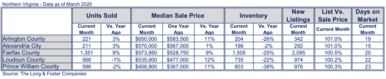
Foster: There’s still plenty of buyers. What was a seller’s market at most price points has turned into a more balanced market during this. If you look at what’s happening with average prices in Northern Virginia for April — if you compare April of 2020 to April of 2019 — the average price in Northern Virginia is up 9.2%. Even in the midst of the pandemic, the average price point in Northern Virginia right now is a little over $652,000, whereas at this time last year that was just a little over $597,000.
VB: How have sale prices changed?
Foster: They’re up dramatically. For Alexandria, the average sales price is up about 18%. Arlington County is up almost 8%. Fairfax is up 10%. Loudon County is up almost 9%. When you put all of those together, the average price point [in Northern Virginia] is up 9.2%.
Data as of March 2020. Foster discusses March data as well as the most recent data in April, which has not been officially published. Chart courtesy Long & Foster.
VB: Has the pandemic affected how long houses are on the market?
Foster: At this time last year, on average, it would take 19 days to sell a home in Northern Virginia. Right now it takes 14 days.
It’s counterintuitive to think about the fact that the volume that has sold this year in Northern Virginia compared to last year’s is down 11% of the units, and the number of homes that have sold are down about 18% right now. The only reason the rest of those numbers would look positive is because the amount of demand still exceeds the amount of supply out there. There’s still credit availability, albeit changed and more restrictive than it was before because of the CARES Act. There’s still credit availability for quality qualified buyers and qualified buyers are out still transacting and still buying homes right now.
It’s reflective of supply and demand. [A home is] going to go under contract quicker when you’ve got more people looking at it because there’s going to be a fear of loss. Buyers aren’t going to sit back and take their time to make decisions on homes when they know other buyers are looking for the home that they’re looking at.
What are you anticipating for the future?
Foster: The negativity and volatility that we’re seeing in the economy has caused a challenge with consumer confidence. What we understand with human nature is when there’s a crisis of confidence, people pause. They don’t stop, they just pause, and they wait until they’re more confident. As we projected what was going to happen the rest of this year, [we anticipated] that the hardest hit month was going to be April. You’ll see people gradually come out more in May and more in June. It’ll affect us the rest of this year, and certainly until there’s a vaccine for the virus.
But if you compare what’s happening in the real estate industry with what’s happening in the economy in general, the trends are way more positive in the real estate industry. People are parking money in real estate because they’re worried about volatility on Wall Street and they know that their returns on bond yields are not very good right now.
We dropped off a cliff three weeks ago, four weeks ago, and the trends since then have been very positive. I think what will affect us the most is in the mortgage side of things as the Fed figures out the liquidity challenges the banks are experiencing and the servicing challenges caused by the CARES Act that will free up even more credit to qualified buyers and it’ll reduce some of the qualifications that have become more stringent in recent weeks.
Hampden-Sydney College announced Friday that it received two anonymous gifts totaling $2.45 million to establish a biology laboratory and add to the college’s need-based scholarship funding.
A $1 million gift will establish the Hinton Baxter Overcash Immersive Biology Laboratory in the Pauley Science Center, which is expected to be completed by fall 2021. The lab is named in memory of Overcash, who was a biology professor at the college from 1922 to 1965.
The space will be used by students to prepare them for graduate programs at Eastern Virginia Medical School, the George Washington University School of Medicine, the University of Lynchburg and the Virginia Commonwealth University School of Medicine, with which the college has graduate school agreements.
“This new space recognizes and honors Professor Overcash’s legacy of effectively equipping his students with the knowledge and discipline necessary for careers in medicine,” President Larry Stimpert said in a statement. “This gift recognizes the contributions of one specific faculty member, but it also pays tribute to the central role faculty members have in preparing Hampden-Sydney graduates for a lifetime of service and accomplishment.”
Another $1.45 million gift will add to the college’s endowment and be used for scholarship funding. It will also be used toward the college’s four-year Carpenter Foundation challenge.
In 2017, the E. Rhodes and Leona B. Carpenter Foundation promised the university $4 million in funding for need-based financial aid to be donated in four annual $1 million installments. These installments are contingent on the college raising $4 million in cash for each $1 million portion of the Carpenter funds.
As of Dec. 31, the college had raised $8 million and received $2 million in Carpenter grants.
“Among our highest priorities is making the benefits of a Hampden-Sydney education accessible to any talented young man who wishes to attend,” Heather Krajewski, vice president for college advancement, said in a statement. “Thanks to the generosity of this alumnus, Hampden-Sydney is now more than a quarter of the way toward the current year goal of raising $4 million in scholarship endowment in order to receive an additional $1 million from the Carpenter Foundation.”
Virginia Beach-based real estate company Divaris Real Estate Inc. announced Thursday that Brian Devlin will serve as its senior vice president of office leasing and investment sales at its headquarters.
Devlin most recently was the senior vice president at Glen Allen-based Commonwealth Commercial Partners’ Norfolk office, but began his career at Divaris Real Estate in 1999 as an associate in the office leasing and sales division.
In his new role, he will manage leasing for 22 office and industrial properties in Hampton, Chesapeake and Virginia Beach. Before Commonwealth Commercial Partners, Devlin worked as the director of leasing for Richmond-based Lingerfelt CommonWealth Partners for its Hampton Roads market.
He earned his bachelor’s degree from Old Dominion University and is a member of the Hampton Roads Association for Commercial Real Estate.
This website uses cookies, web beacons, pixels, tags, software development kits, and related tracking technologies, as described in our Privacy Policy and Cookie Policy, for purposes that may include website operation, analytics, analyzing site usage, enhancing site navigation optimizing a user's experience, and third-party advertising or marketing purposes. Through these technologies, we and certain third parties may automatically collect information about your interactions with our website, such as your browsing behavior and page views. We also may share this information about your activity on our website with our social media, advertising, analytics, and other business partners. By clicking “Accept All”, you consent to the use of these technologies and that we can share information about your activity on our website with third parties in accordance with our Privacy Policy and Cookie Policy. If you do not agree with our use of non-essential tracking technologies, please click “Reject All.” You may opt out of certain non-essential technologies by clicking “Cookie Settings.”
Functional
Always active
The technical storage or access is strictly necessary for the legitimate purpose of enabling the use of a specific service explicitly requested by the subscriber or user, or for the sole purpose of carrying out the transmission of a communication over an electronic communications network.
Preferences
The technical storage or access is necessary for the legitimate purpose of storing preferences that are not requested by the subscriber or user.
Statistics
The technical storage or access that is used exclusively for statistical purposes.The technical storage or access that is used exclusively for anonymous statistical purposes. Without a subpoena, voluntary compliance on the part of your Internet Service Provider, or additional records from a third party, information stored or retrieved for this purpose alone cannot usually be used to identify you.
Advertisement
The technical storage or access is required to create user profiles to send advertising, or to track the user on a website or across several websites for similar marketing purposes.

 Sign In
 Free Newsletter