With service limited and thousands of federal employees teleworking during the coronavirus pandemic, Metro stations are ghost towns these days. Nevertheless, that isn’t slowing down construction on the new Potomac Yard Metrorail station in Alexandria, according to city officials.
In March, the city and Metro completed pricing discussions for improved access to the station that will serve riders near Amazon.com Inc.’s HQ2 East Coast headquarters and the Virginia Tech Innovation Campus. It’s expected to be in service by 2022.
As of April 8, Metro rail ridership was down to 36,000, a 95% decrease from the same date last year, and 110,000 people rode Metrobuses that day, down 74% from 2019. And as of April 21, 33 Metro employees, including several bus drivers, had confirmed cases of the coronavirus.
Washington Metropolitan Area Transit Authority, which runs the transportation system, began reducing service hours and routes in mid-March in response to the COVID-19 pandemic. By early April, trains were running 5 to 9 a.m. weekdays, operating every 15 to 20 minutes, and from 8 a.m. to 9 p.m. on weekends, with trains operating every 20-30 minutes.
Jenny Jusell, a professional bra fitter who lives in Vienna, last rode the Metro home from her job in D.C.’s Northwest area in mid-March. “There were not a ton of riders,” she says, “and I was starting to see masks being worn by some people.” Jusell told the owner of the lingerie shop where she works that she needed to stop commuting because she was worried about potentially exposing her 93-year-old mother, with whom she lives, to the coronavirus. “There’s so much at stake.”
Also in April, the WMATA Board of Directors passed Metro’s $3.9 billion FY2021 budget, including $2.1 billion in operating expenses and $1.8 billion in capital investments. Plans include building phase 2 of the Silver Line, an 11-mile extension expected to cost $78.4 million, which will bring in funding from Loudoun County once it’s operational.
However, the Metro system has lost approximately $2.5 million per weekday since ridership began plummeting in March — a total of about $67 million as of April 2, according to a WMATA spokesperson. The WMATA’s 2021 budget notes that the pandemic has had a “significant” negative impact on the transit system’s revenues and expenses in FY2020, and that may extend into its next fiscal year, which begins July 1.
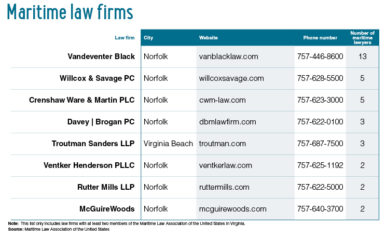
Note: This list only includes law firms with at least two members of the Maritime Law Association of the United States in Virginia. Source: Maritime Law Association of the United States
As businesses reacted to the coronavirus outbreak in Virginia, many employees found themselves
teleworking, wearing special protective gear or even sewing masks for health care workers.
Here is a sampling of contributed photos representing the “new normal.”
Click on the photos to expand.
Yolanda Hernandez, lead sewer and production manager at Shockoe Atelier in Richmond, started making masks for VCU Health employees.
LaTonya Snow, owner of Crystal Clean, a residential and commercial cleaning company in Hampton Roads, is still on the job.
Sailor, a “very good” employee of Armada Hoffler Properties in Virginia Beach, lives with graphic designer Collette Yoder.
Dr. Liz Bigelow (left) and nurse Heather Fitchett perform COVID-19 tests at PartnerMD’s Richmond office.
River Colton Cherry, a technician at Fredericksburg’s Spartan Emergency Water Removal, does a demolition job.
Cox Communications employees held a Zoom meeting with Virginia Peninsula Foodbank, presenting a $10,000 donation from Cox Charities Virginia.
Joshua Weinstein, founder of Norfolk Tour Co., gives online tours.
The corporate leadership team at SimVentions Inc., a defense contractor in Fredericksburg, meet via WebEx.
Tysons Cleaning LLC owner Charlene Johnson (left) and Shaelyn Bragg at work in a Northern Virginia home.
Jessica Jones, owner of New River Art & Fiber in Blacksburg, now has two young colleagues, her children.
Katherine O’Donnell, executive vice president at Richmond Region Tourism, at her home office.
Bella Weinstein, founder of Richmond clothing manufacturer Handyma’am Goods, has found a new use for her company’s bandannas.
Chris Stuart, vice president of Hampton-based security company Top Guard Security,
at his home office.
Mo Choumil, founder and CEO of Fairfax-based ATG Title Inc., takes paperwork to the curb for a drive-thru closing.
A customer and her dog use the drive-thru at Bank of Botetourt.
Virginia Beach-based Designer Workshop Resource Manager Monica Douglas has shifted from interior design to making face masks.
Only a few months ago, the economies of the historic port city of Norfolk and the greater Hampton Roads region, with which it is inextricably intertwined, were continuing to rebound after emerging from what Old Dominion University’s 2019 State of the Region report has called “the lost decade.”
During the period from 2007 to 2016, Hampton Roads added only one job for every three added in Virginia and every four in the United States.
The region’s economy was constrained by the twin blows of the Great Recession and a severe cutback in defense spending beginning in 2011, commonly known as sequestration.
Then things began turning around.
Economic activity in Hampton Roads grew 2% from 2017 to 2018, more than doubling the previous year’s growth, and growth was expected to jump to 2.4% in 2019, the ODU report says.
More good news came in February when Standard & Poor’s Global Ratings raised Norfolk’s credit rating to AAA on its general obligation bonds, the first time in history that the city — the second-most populous in the state, with approximately 244,000 residents — had earned the highest possible credit rating.
But just when the days ahead seemed brighter, the coronavirus struck, once again threatening Norfolk and the region’s economic growth.
It has caused those in charge of economic development in Norfolk to rethink their mission, at least for the time being, with a hope that the city’s fortunes will quickly resume their upward climb.
Jared Chalk, Norfolk’s director of economic development, was blunt in describing what lies ahead, as long as the effects of the coronavirus linger.
“I’ve told my staff that we’re going to be moving over probably the next several weeks to months into business retention mode and business survival mode,” he says.
“We’re really kind of retooling everything that we’ve done, so that small businesses, restaurants, retail, companies that import [and/or] export goods that have had supply chain issues, all of those things I think will now really be at the forefront of what we’re doing.”
Previously, Chalk says, the city was in a war for talent, a war that he expects will resume once the pandemic runs its course.
New approaches
To better compete regionally and nationally, Chalk says that prior to the COVID-19 upheaval, he took a different approach in Norfolk’s economic development department.
“I’ve really made a shift in the office to focus on companies that export goods and services and bring back money to the region, leveraging the port, leveraging offshore wind,” Chalk says. “The offshore wind industry is new to the state, so we’re all taking a look to see how we can participate.”
Last September, Richmond-based Dominion Energy Inc. revealed its plans for the largest offshore wind development in the country, 27 miles off the coast of nearby Virginia Beach. If approved, 220 wind turbines would provide power for 650,000 homes by generating 2,650 megawatts of zero-carbon electricity.
Chalk also is hoping that Norfolk will benefit from the Navy’s $21 billion effort to upgrade its three public shipyards. A $200 million renovation currently underway at Dry Dock 4 at the Norfolk Navy Naval Shipyard, located in nearby Portsmouth, is part of that upgrade.
When defense spending is strong, Norfolk thrives and is a job creator for the region.
It hosts the world’s largest naval base, Naval Station Norfolk, headquarters of the Navy’s Atlantic Fleet, along with one of NATO’s two Strategic Command headquarters.
Defense spending also drives shipbuilding, and Huntington Ingalls Industries, headquartered in nearby Newport News, is the world’s largest military shipbuilding company, drawing workers from Norfolk and other parts of Hampton Roads and the state.
The Port of Virginia, an economic engine for the region and state, has enjoyed a renaissance over the past several years and Norfolk International Terminals is the port’s largest terminal, lying on 567 acres along the Elizabeth and Lafayette rivers. It has become a magnet for international commerce.
The Pamunkey Indian Tribe plans to build a $700 million casino and resort on the Elizabeth River. Rendering courtesy Pamunkey Indian Tribe
Perhaps the biggest attention-grabber in Norfolk in recent years has been the $700 million resort-style casino being planned by the Pamunkey Indian Tribe.
The General Assembly recently passed legislation allowing commercial casino gambling in Virginia. Aside from Norfolk, the legislation would permit casinos in four other cities: Portsmouth, Richmond, Danville and Bristol.
Before it can proceed, the Pamunkey casino also would require public approval through a local referendum planned for the November ballot.
As initially outlined by the tribe, which is partnering with Tennessee investor Jon Yarbrough, the casino complex would be built on 13 acres east of the Norfolk Tides Harbor Park Stadium and would include a 500-room hotel and five to seven onsite restaurants.
The annual direct economic impact for Norfolk was projected to be $787 million, with about 6.7 million visitors annually.
But Jay Smith, a spokesman for the Pamunkey Tribe, says those projections and the scale of the project might be affected if a proposed casino is built in neighboring Portsmouth.
In any event, Smith says the Pamunkey casino-resort would be a “high-end destination facility” like similar operations in Las Vegas and would be an important piece of Norfolk’s efforts to boost tourism.
Chalk says that although a casino would not be “a silver bullet” for any economic development strategy, it fits in with Norfolk’s efforts to push for an economy that imports dollars.
“So, how do we bring more people to Norfolk?” Chalk asks rhetorically. “Carnival Cruise Line just did a five-year commitment to Norfolk, to do cruises out of Norfolk. We’ve been doing airlines upgrades. We want to change Norfolk into a place people really want to come spend a few days, and I think the casino really complements that.” (Carnival canceled sailings through June 26, cutting nine Norfolk embarkations.)
Another economic initiative Norfolk is undertaking focuses on an effort to become a laboratory for dealing with sea-level rise, Chalk says. According to the National Oceanic and Atmospheric Administration, Hampton Roads is second only to New Orleans in terms of the largest U.S. population centers at risk of flooding from climate change.
“Look at what the Dutch have done,” Chalk says. “They have created an industry around how to live with water, how to live with seawater rise. That’s what we’re looking to do here. What technologies can help? What kinds of tools are out there for not only seawater rise, but large downfalls of rain?”
He says Norfolk is inviting companies to test new technologies in the city, which also has created an Office of Resiliency and was one of the first cities in the country to name a chief resiliency officer.
Kurt Krause, president and CEO of VisitNorfolk, a nonprofit booster organization, is bullish on Norfolk’s future, especially its ability to attract young people to the city and build a talent pool.
Norfolk is home to the Virginia Symphony Orchestra, Ballet Virginia, the Virginia Opera and the Chrysler Museum of Art. Photo courtesy Virginia Symphony
“We’ve been recognized as one of the top five cities for millennials to move to, we’re not expensive, the weather is typically pretty good and there’s a lot of water,” Krause says.
VisitNorfolk and the five higher-ed institutions in the city — Old Dominion, Norfolk State, Hampton and Virginia Wesleyan universities and Tidewater Community College — also are bonding in an effort called Campus 757 to brand Norfolk as a college town.
“So, it’s the intent of collaborating with the five education institutions within Norfolk to attract high school students to come to our universities, get jobs, get internships, become engaged in the community and get a job,” Krause says.
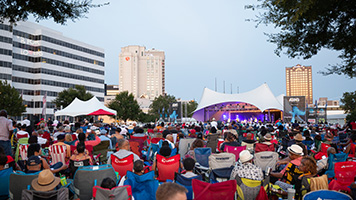
He adds that Norfolk has a lot to offer young people and those young of heart with an abundance of festivals: two wine festivals, Harborfest and the Norfolk Waterfront Jazz Festival, to name a few.
“Arguably, we’re also the capital of the arts,” Krause adds. “The Virginia Symphony is here, Ballet Virginia is headquartered here, the Virginia Opera is here, the Virginia Arts Festival is here.”
Scheduled for Aug. 21 and 22, the 38th annual Norfolk Waterside Jazz Festival is slated to feature performers such as guitarist George Benson and saxophonist David Sanborn. Photo courtesy Norfolk Festevents Ltd.
Norfolk is the only city in Virginia with a Triple-A baseball team, the Norfolk Tides, and it also has a professional hockey team, the Norfolk Admirals.
Changing course
Today, Norfolk’s poverty rate is 22% for individuals and 16% for families. Virginia’s overall poverty rate was 10.7% for 2018, the latest year for which figures have been released.
In an ambitious effort to break the pattern of intergenerational poverty in public housing, Norfolk is working to redevelop the St. Paul’s neighborhood, a 200-acre swath with 1,700 units in three public housing communities, representing the highest concentration of public housing in the region. The goal is to transform the area from low-income housing to mixed-income housing.
Ronald Jackson, recently named executive director of the Norfolk Redevelopment and Housing Authority, says the transformation also involves helping residents to become more self-sufficient through training and education and helping them make the best housing decision for their families.
Norfolk’s efforts in the St. Paul’s neighborhood are supported by a $30 million grant from the U.S. Department of Housing and Urban Development (HUD), along with investments and pledges from the city and its partners for $158 million.
While cautioning that COVID-19 makes any forecast uncertain, ODU economist Robert M. McNab, director of the Dragas Center for Economic Analysis and Policy, says Norfolk’s prospects for the future “are better than they have been in a decade.”
The Port of Virginia’s aim to become the deepest port on the East Coast continues apace, even during the COVID-19 outbreak. The $350 million project to dredge the Norfolk Harbor started more than two years early in December 2019. Meanwhile, the Virginia International Gateway (VIG) in Portsmouth and the Norfolk International Terminals (NIT) are both undergoing expansions, as are inland port projects, to accommodate more imports and exports. Here are more details about the projects:
Norfolk International Terminals
Following the VIG phase, it’s now the NIT’s turn in phase two of the $700 million terminal expansion project.
The project includes 18 more container stacks and 36 rail-mounted gantry cranes, which arrived earlier this year.
Annual container capacity to expand 46%, or 400,000 units, when complete.
The port has purchased 25 hybrid shuttle carriers in a $23 million contract with Kalmar, part of Cargotec Corp., with delivery set
for July 2020.
In spring 2020, the port was in the engineering phase to modernize the central rail yard.
Virginia Inland Port
VIP received $15.5 million from the U.S. Department of Transportation in December 2018 to increase terminal capacity in Front Royal.
The projects include the addition of three long loading tracks, two hybrid straddle carriers and a new highway bridge grade separation.
Final design of the project took place in early 2020, with construction scheduled to start later in the year.
Technology (at both terminals)
The Truck Reservation System, started in 2018, manages trucks moving to and from NIT and VIG.
Earlier in 2020, 92% of all trucks had turn times of less than an hour, and 55% were under 40%.
NIT averages 567 reservations per day, and VIG averages 765.
Richmond Marine Terminal
In March 2019, the Virginia Express, a second river barge, was put into service.
U.S. Department of Transportation’s Maritime Administration (MARAD) has granted the port $1.8 million to expand transportation between Richmond Marine Terminal and the Norfolk Harbor.
The project is also expected to reduce congestion on Interstate 64.
Virginia International Gateway
Started in February 2017, a $320 million project to expand capacity at the VIG container terminal was completed in July 2019.
The project includes four, 170-foot-tall ship-to-shore cranes and 26 rail-mounted gantry cranes.
Terminal’s annual throughput capacity expanded to 1.2 million container lifts.
Maritime shipping accounts for 90% of global trade, supplying us with many of our personal needs. The Port of Virginia is a major driver of the Virginia economy, generating 7.5%, or $39 billion, of Virginia’s gross product, $23 billion in labor income, about 400,000 jobs and $2.1 billion in state and local taxes and fees in 2018.
With the arrival of COVID-19 in America, ports are national news. On March 9, the head of the Port Authority of New York and New Jersey contracted the virus, while 21 passengers tested positive on a cruise ship berthed at the port of Oakland, California. By the end of March, more than 1,000 Virginians had confirmed cases.
Many wonder about the ability of the Port of Virginia to handle this challenge.
Preparations
Priority No. 1 is containing and mitigating coronavirus on ships calling on Virginia ports.
So-called “black swan” events are difficult, says port spokesman Joe Harris, but “the port has a working group that meets twice a week. They simulate major health events (e.g., ebola), practice removing sick [people] from vessels and track where ships have been in previous port calls.”
The port works in close coordination with local hospitals, military facilities, the Centers for Disease Control and Prevention, Norfolk police, the U.S. Navy, the U.S. Coast Guard (which makes initial contact with vessels) and the Virginia Department of Health.
Some restrictions the port has implemented:
The Coast Guard considers it a hazardous condition if anyone, regardless of where they have traveled or who they have interacted with, shows symptoms of COVID-19 or other flu-like illness. This requires immediate notification to the nearest Coast Guard captain.
Vessels destined for a U.S. port are required to report to the CDC any sick or deceased crew/passengers during the 15 days prior to arrival at the U.S. port. U.S. flagged-commercial vessels are also advised to report ill crewmembers in accordance with the requirements of each foreign port called upon.
The Port of Virginia has isolated berths available for emergency use where testing and safe transport to hospitals and facilities are possible. They are tracking and in communication with vessels to identify problems and ask specific questions, such as, “Do any of your crew or passengers have symptoms consistent with COVID-19?”
Cargo impact
An article in the February 2020 issue of the Journal of Hospital Infection reported that“human coronaviruses … can persist on inanimate surfaces like metal, glass or plastic for up to nine days,” according to studies.
“On copper and steel … it’s pretty much about two hours,” CDC Director Dr. Robert Redfield told the U.S. House of Representatives in February. “But I will say, on other surfaces — cardboard or plastic — it’s longer.”
The U.S. Food and Drug Administration said in late February it has no evidence that COVID-19 has been transmitted from imported goods. Containers shipped from Shanghai, China, to Hampton Roads are in transit for about 30 days, and even goods from Naples, Italy, are in transit at least 17 days, so the probability is near zero that the COVID-19 virus has survived the journey on cargo containers or the goods inside.
It is also virtually certain that the COVID-19 virus can be efficiently inactivated by common surface disinfectants within one minute. For maritime cargo, the issue for Virginians is not risk of infection. It is the current production and shipping shortfalls from contaminated areas that will affect the availability, variety and cost of goods we desire.
Also, the demand for goods on all sides will decline because of sickness, inability to work and cost of goods. The virus and trade tariffs have served a potent, but hopefully short-term, trade punch.
K. Scott Swan, a professor of international business, design and marketing at William & Mary’s Mason School of Business, and Roy Pearson, W&M chancellor professor of business emeritus, wrote a November 2019 report on the Port of Virginia’s economic impact.
Sea-level rise is happening faster than ever in Hampton Roads, experts say, up to an inch every four years. And if that doesn’t sound like a big deal, the Virginia Institute of Marine Science said in a February 2020 report that coastal waters could rise by more than a foot and a half by 2050.
Second only to New Orleans in flooding risk due to sea-level rise, according to the National Oceanic and Atmospheric Administration’s Office for Coastal Management, the Hampton Roads region is making strides toward safeguarding its land, although some larger localities are confronting the problem with bolder and more expensive solutions than smaller, rural localities can afford.
Buildings, roads and railways in areas already prone toward flooding will be increasingly impacted in coming decades — including the movement of freight into and out of the Port of Virginia — said retired U.S. Navy Rear Admiral Ann C. Phillips in a January speech to the Virginia Bar Association in Williamsburg.
In a region with a water-based economy, critical transportation infrastructure will be compromised by this environmental shift, she said, including recurring flooding, high winds, intense rainfalls and other factors.
NOAA predicts that three feet of sea-level rise could inundate 162 to 877 miles of the region’s roads, impacting up to 176,000 residents. It would also deliver a blow to military bases and the maritime industry.
“Much like the region’s federal facilities,” said Phillips, a special assistant to Gov. Ralph Northam for coastal adaptation and protection, the Port of Virginia’s “future resilience is inextricably linked to that of the surrounding cities and other localities that support and provide its critical utilities, transportation, logistics and supply chain infrastructure.”
This comes as no surprise to John Reinhart, CEO and executive director of the Virginia Port Authority, which oversees the port’s Hampton Roads terminals.
“When we started all of our implementation of our infrastructure, we looked at the sea-level rise effects, and we did raise our substations at [Norfolk International Terminals] to take into account some sea-level rise,” Reinhart says.
In December 2019, Virginia Beach made waves by issuing a policy report on sea-level rise that acknowledges it currently has no system or review process for retrofitting or maintaining roads to protect them against flooding. The city has devoted $3.8 million since 2015 — including an $844,000 grant from NOAA — to study flooding and identifying measures to reduce risk.
In January, the city’s public works engineering department, with consulting firm Dewberry, presented an extensive study to protect its watersheds and flood-prone property. The city’s even considering buying out or elevating properties that often flood — spending previously covered by the Federal Emergency Management Agency (FEMA) — but using $1.5 million in city funds initially and then $500,000 annually. The question is whether the city can still afford to do this following the economic devastation from COVID-19.
A regional approach has long been the argument of many experts. The Hampton Roads Planning District Commission recommended in October 2018 that localities need to work together to best prepare for sea-level rise.
“Large regional solutions, like floodgates, pump stations and seawalls, will likely be deployed to protect economically important and defense-related infrastructure,” Mark W. Luckenbach, associate dean of research at William & Mary’s Virginia Institute of Marine Science, said during the VBA conference.
Organizations like the Norfolk-based nonprofit RISE are working to fund development projects to address flood management, reestablishing critical utilities, and urban mobility as it relates to sea-level rise in Hampton Roads, awarding up to $250,000 per proposal. It’s seeking applications through June 1.
Kyle Spencer, the city of Norfolk’s deputy resilience officer, says “creative, smaller-scale, affordable solutions” are welcome, even while the region considers larger programs. “Big infrastructure projects take years and billions of dollars to implement.”
While health care workers scrambled to keep up with the growing number of COVID-19 cases in Virginia, researchers in Charlottesville and Richmond were working to solve the pandemic.
In March, VCU Health liver specialist and cancer researcher Dr. Arun Sanyal began testing remdesivir, an antiviral medication that is showing promise as a treatment for COVID-19.
Along with researchers at several institutions in the United States and in other countries, Sanyal is testing remdesivir on people with moderate to severe virus symptoms. These patients are sick enough to be in the hospital, he says, with documented fever and pneumonia. The worst cases are people who are on ventilators.
As of April 8, there were 22 patients enrolled at VCU Health, a number that changes daily, and the trials, Sanyal says, are “progressing well. Several have already been discharged, and the rest are stable or recovering. We have no deaths in enrolled patients.”
The medication, developed by California-based Gilead Sciences Inc., is given intravenously to patients for five or 10 days in the clinical trials, and Sanyal is tracking the patients’ symptoms. Some moderate patients are given a placebo as a control group.
Once he has results from the trial, Sanyal will send his data to Gilead, which will provide a full analysis of remdesivir to the U.S. Food & Drug Administration for fast-track approval — with the aim of full approval by May or June.
In early April, U.Va. Health joined the national clinical trial for remdesivir sponsored by the National Institutes for Health. In early April, the hospital had enrolled two patients.
Also in Charlottesville, two researchers are working on a COVID-19 vaccine. In late March, Peter Kasson, an infectious disease specialist and associate professor of molecular physiology and biomedical engineering, and Dr. William Petri, a professor and vice chair for research at the U.Va. School of Medicine, were close to testing their vaccine on mice.
Other researchers are slightly ahead in testing COVID-19 vaccines, Kasson notes, but his team and Sanyal are also an important part of a larger effort to lower the number of sick and dead. “I’m hopeful that we can, as a society, leverage some of the technology to slow the spread.”
Communities across the state are hurting from coronavirus-related layoffs and closures, but in Bath County, “it’s devastating,” says state Sen. Creigh Deeds, whose law practice is located on Hot Springs’ Main Street.
“Two major employers are closed,” he says, referring to The Omni Homestead Resort and The Greenbrier resort just over the West Virginia line. “Employees are furloughed. People’s lives are upset.”
In March, The Omni Homestead, which opened more than a century ago and is now owned by Omni Hotels & Resorts, announced it was closing until at least May 15. This was after all of its spring conferences and bookings were canceled in the days after the coronavirus spread to Virginia — which forced the resort to furlough 700 of its 800 employees. The Greenbrier announced it was closed until it’s safe to reopen.
According to the Virginia Employment Commission, 524 Bath County residents filed for unemployment benefits between March 14 and April 11, representing a 20.7% unemployment rate, up from 2.7% in February. Some locals were employed by other businesses, of course, Deeds notes, just as The Omni Homestead and Greenbrier employ many people who hail from other counties.
Omni was preparing to make significant renovations to the resort, and its famous Jefferson Pools, which were closed for repairs, were set to reopen this summer.
John Hess, Homestead’s director of sales and marketing, said in April that the furloughed employees, who would be brought back gradually after the resort reopens, received wages for any earned time off, as well as any disability pay. They also have been given the option of remaining on the resort’s benefits program.
The reopening of the Jefferson Pools and the resort’s renovation plans are still moving ahead, “however, the impact of the coronavirus could impact dates,” Hess notes.
March 25 was Amanda Gwin’s last day at the Omni Homestead before being furloughed. These days, the reservations manager spends time at home in Covington with her 19-year-old son, hiking, gardening and talking to friends via teleconference.
Her team had received dozens of calls earlier in March canceling reservations, including business groups, some of whom have rebooked for later in the year. “Then, of course, as COVID-19 got bigger, I saw a decline in the bookings,” she says, but many regular guests assured her they will return. “I do truly believe we have that loyalty.”
Between the payout of her remaining time off, state unemployment benefits and the federal stimulus check, Gwin will be OK financially, she says, “as long as this is a short-term world shutdown.”
In early March, 18 women gathered for the first week of a pre-apprenticeship program designed to catapult them into in-demand careers in the ship repair industry.
Run by the Hampton Roads Workforce Council, the 12-week, intensive Women in Skilled Careers (WISC) program offers training tracks in welding, marine coating, marine electrical, outside machinist, sheet metal fabrication and pipefitting.
Then the COVID-19 outbreak intervened, forcing the program to postpone classes until it’s safe to gather again.
In the meantime, says Virginia Career Works Deputy Director Latonya English, her team is fine-tuning the program and taking applications for future courses. They’re also staying in touch with the eight women who were part of the first class, seven of whom are currently employed in the ship repair industry in Hampton Roads. Most came from the restaurant and hospitality industries, which have laid off tens of thousands of local workers. “One of the things that made us sit back and think is how important this is for women,” especially in terms of job security, English says.
The workforce council prioritizes admissions for veterans, women living in poverty and women who’ve experienced homelessness, domestic violence or human trafficking. Organizers provide child care, transportation and a weekly stipend.
“What we’re doing is total wraparound services,” says Karen Miller, program coordinator of the Apprenticeship Institute at Tidewater Community College, where the program is based.
Last June, Miller attended a seminar about labor shortages in Hampton Roads, where the topic du jour was the lack of skilled workers to fill jobs in the ship repair industry.
“I’m sitting there, looking around the room, thinking, ‘How come nobody’s talking about women?’” says Miller, who soon applied for a grant from the U.S. Department of Labor. WISC received a $500,000 grant, allowing the group to launch the program in January.
Bill Crow, president of the Virginia Ship Repair Association, met with executives in the industry to see whether they’d help with training and later consider the program’s graduates for jobs. “They were all champing at the bit to do that,” he says.
Women who learn a skilled trade, Crow stresses, will have little trouble finding employment in the ship repair industry. “It’s a very rewarding industry,” he says. “It’s something that they will be able to take enormous pride in and, in the process, make darn good wages.”
The first cohort of eight students included Nikki Ruffin, a 33-year-old mother of four daughters. In the early weeks of WISC, Ruffin learned about topics such as financial literacy, while brushing up on her writing and math skills. She earned a certification in Emergency First Response and took Occupational Safety and Health Administration training. Later, classes moved to TCC, where Ruffin learned to weld.
The stipends allowed Ruffin to quit her job as a medical assistant and certified nursing assistant, since her work conflicted with the classes.
For Ruffin — who spent years trying to evade her abuser, now behind bars — the emotional support she received from WISC’s organizers and her fellow students was every bit as essential as the financial assistance. “We all helped each other out,” she says.
Since finishing WISC, Ruffin has received multiple job offers and she will likely start as a welder’s helper until welding apprenticeship classes start. Her dream is to be an underwater welder. First, though, Ruffin needs to learn how to swim. “Hopefully when the Y opens up, I can work on it,” she says, laughing.
Her daughters, like the women in her class, have been supportive of her career change and are rooting for her and her fellow WISC students, Ruffin says. “We all pitch in together and give each other encouraging words. … They’re really good women.”
This website uses cookies, web beacons, pixels, tags, software development kits, and related tracking technologies, as described in our Privacy Policy and Cookie Policy, for purposes that may include website operation, analytics, analyzing site usage, enhancing site navigation optimizing a user's experience, and third-party advertising or marketing purposes. Through these technologies, we and certain third parties may automatically collect information about your interactions with our website, such as your browsing behavior and page views. We also may share this information about your activity on our website with our social media, advertising, analytics, and other business partners. By clicking “Accept All”, you consent to the use of these technologies and that we can share information about your activity on our website with third parties in accordance with our Privacy Policy and Cookie Policy. If you do not agree with our use of non-essential tracking technologies, please click “Reject All.” You may opt out of certain non-essential technologies by clicking “Cookie Settings.”
Functional
Always active
The technical storage or access is strictly necessary for the legitimate purpose of enabling the use of a specific service explicitly requested by the subscriber or user, or for the sole purpose of carrying out the transmission of a communication over an electronic communications network.
Preferences
The technical storage or access is necessary for the legitimate purpose of storing preferences that are not requested by the subscriber or user.
Statistics
The technical storage or access that is used exclusively for statistical purposes.The technical storage or access that is used exclusively for anonymous statistical purposes. Without a subpoena, voluntary compliance on the part of your Internet Service Provider, or additional records from a third party, information stored or retrieved for this purpose alone cannot usually be used to identify you.
Advertisement
The technical storage or access is required to create user profiles to send advertising, or to track the user on a website or across several websites for similar marketing purposes.

 Sign In
 Free Newsletter