Under normal circumstances, event planners put together conferences by assessing the needs of their clients and then figuring out the logistics: the venue’s size, the agenda and, of course, the expected turnout of attendees.
As with everything else, this normal routine has been upended by the coronavirus. The new normal is digital conferences and in-person events with limited capacity and social distancing. This initially threw many organizations and planners for a loop, but in a field where flexibility is fundamental, event planning professionals are adjusting.
Jessie States, director of Dallas-based Meeting Professionals International’s MPI Academy, which offers continuing education and certificate programs for meeting and event planners, says that before COVID-19 she would work with clients to discuss whether they wanted to weave virtual aspects into in-person conferences. Now, the question isn’t if events are going to be virtual but how to keep remote conference attendees engaged.
“We try to find the right platform for what we’re trying to accomplish, so that means not all of our digital agencies are going to be used the same way,” States says. “Sometimes that is hosting weekly webinars, or we host digital summits that can be half a day or a whole day long.”
MPI is using avatar-based platforms such as VirBELA (which looks a bit like the video game “The Sims”) to increase engagement. Attendees create a personalized avatar to interact with others in an immersive 3-D space, with the hope of creating a more connective experience.
The team behind Henrico County-based Convention Connections Inc. (CCI) can attest to the sudden ubiquity of remote and hybrid-style conferences, as they’ve had to quickly incorporate more technology into conferences and figure out how to safely comply with various in-person regulations throughout the country. CCI is run by husband-wife duo Marty and Diane Malloy. Diane was named the 2019 Virginia Meeting Professional of the Year, a collaboration between Virginia Business magazine and the Virginia Restaurant, Lodging & Travel Association. CCI is responsible for planning many large conferences, from the VA-1 Tourism Summit to the annual CrimeCon, a national gathering of true crime fans.
“The tough thing about the virus is that everyone is looking at it from their own visor,” Marty Malloy says. “We organize conferences across the country, so we have to change up the extent of the digital model based on state and local regulations.”
Some of CCI’s clients have never incorporated digital technology into their conferences before this year, which has meant building new working relationships with clients’ IT teams. While event cancellations due to the coronavirus are no longer shocking — and shifting to digital is now anticipated — most CCI clients are hoping to return to business as usual.
“It’s a combination of cancellations with moves to next year, and then if you can’t put the conference on [in-person], then you go the virtual route,” he says. “But the one thing I am hearing from most clients is that they can’t wait to get back to in-person events.”
It’s a sentiment echoed by many clients and event planners alike.
“Nothing can replace in-person networking, and there is going to be a huge surge” of traditional conferences after the pandemic, States predicts. “When that happens, we will have a huge opportunity to stay better connected.”
However, the current shift to digital is proving a teachable moment on how to expand the reach and impact of conferences.
Ariel Cole is the special events manager at the Reynolds Community College Educational Foundation Inc. in Richmond and the former president of the MPI Virginia Chapter. This spring, she created a virtual commencement ceremony.
“It was a challenge of translating a personal and pivotal experience to a meaningful virtual experience,” Cole says. “One way we were able to do that was by working with different vendors to create personal slides for our students as their names were called.”
Congratulations on the Virginia 500 Power List issue. It is thorough
and very well-researched. It will be on lots of people’s desks. You in my opinion picked the appropriate person to lead off the living legends section. Bill Goodwin has been incredibly successful and generous.
I have had the pleasure of representing him, watching him lead and marveling at his incredible intellect and foresight. Although his title
says retired, don’t bet on it.
Clifford A. Cutchins IV
Richmond
Establishing (anti)trust
I just finished reading Bernie Niemeier’s column, “Antitrust Matters,” in the September issue. I spent over 20 years as a communications lawyer in D.C. before entering the world of statewide Virginia politics. Not only did I know a young Mark Warner, who preached the benefits of cell phones before most people had ever heard of them, but more importantly, I saw the rise of innovative, competitive companies that — as you point out — would not have occurred if we had left the AT&T monopoly in place. Thanks for sharing your thoughts on the need to update our antitrust laws.
Lawrence Roberts
Director, Sorensen Institute for Political Leadership
To submit a letter to the editor, please send your email of no more than 250 words to Richard Foster at [email protected]. Letters chosen for publication may be edited for clarity, word count and grammar.
CORRECTIONS
Hancock Daniel was inadvertently omitted from the September issue’s list of the state’s largest law firms. It is the 16th-largest firm.
Tracy Fitzsimmons became president of Shenandoah University in 2008. Her entry in the Virginia 500 listed the incorrect year.
The Virginia Credit Union has $3.7 billion in assets. The Virginia 500 entry about the credit union’s president and CEO, Chris Shockley, misstated the amount.
The Virginia 500 entry about Robert M. Tata, Norfolk managing officer partner with Hunton Andrews Kurth LLP, misidentified him as a former state legislator. His father, also named Robert Tata, was the legislator.
HCA Healthcare has not laid off employees during the pandemic. The Virginia 500 entry about HCA Capital Division President Tim McManus had incorrect information.
Apple Hospitality REIT Inc. owns 235 hotels in 34 states. The Virginia 500 entry about Apple Hospitality CEO Justin Knight misstated the number of hotels the company owns.
Editor’s note: These Virginia 500 entries, and others requiring clarifications, have been updated online.
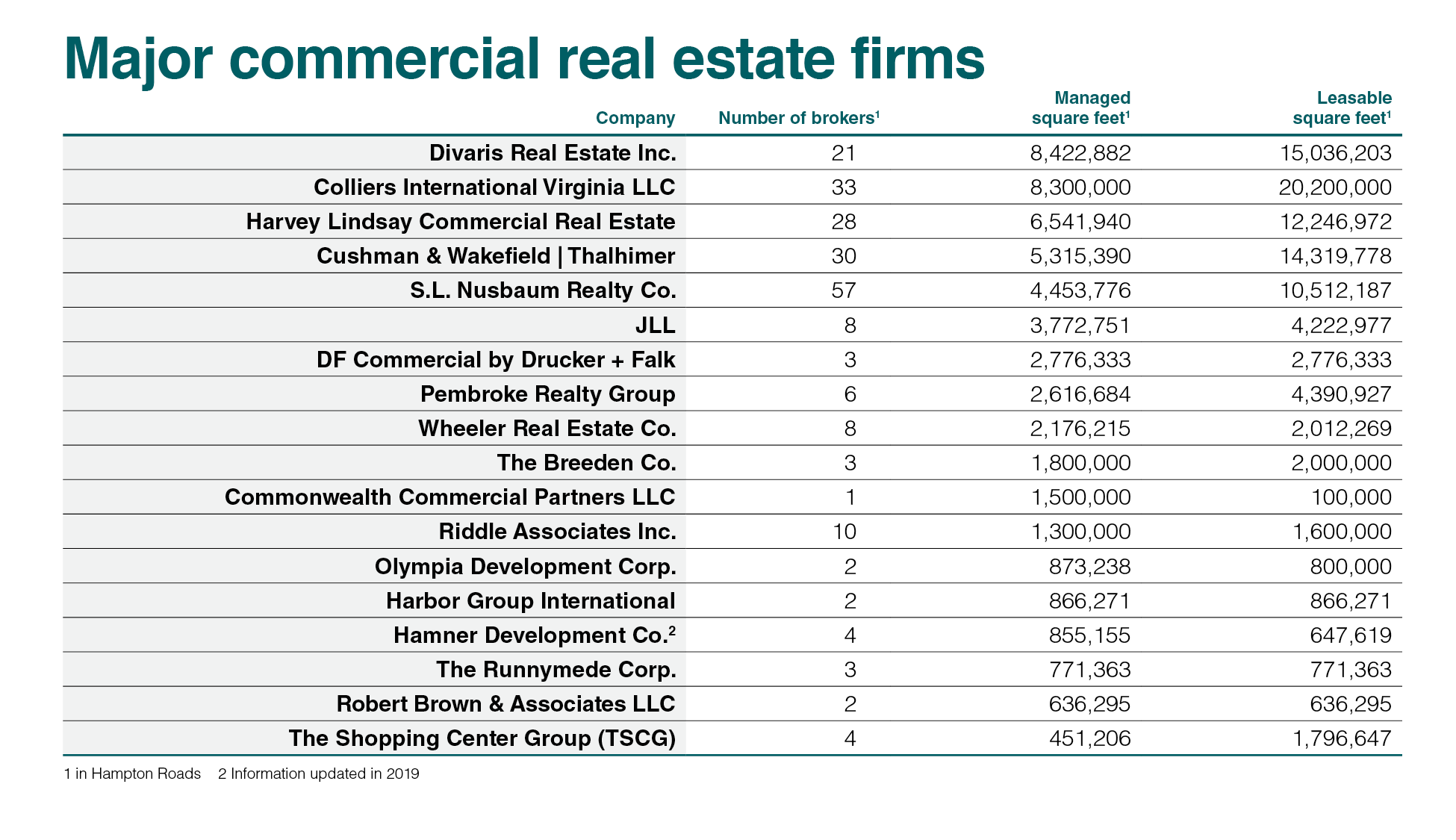
The pandemic hasn’t seemingly slowed down commercial real estate development and transactions in Hampton Roads.
Despite significant financial hits to the hospitality industry, the $125 million, 305-room Marriott Virginia Beach Oceanfront opened in June, the second phase of Gold Key | PHR’s three-phase, $350 million renovation and expansion of The Cavalier Resort.
Also in June, Suffolk-based TowneBank and Children’s Hospital of the King’s Daughters (CHKD) jointly purchased for $30 million the 22-story Norfolk Southern Tower in downtown Norfolk from the Fortune 500 railroad corporation, which is in the process of migrating its corporate headquarters to Atlanta.
In the health care industry, Norfolk-based Sentara Healthcare opened the $93.5 million, 253,000-square-foot Sentara Brock Cancer Center, a patient treatment and care facility in Norfolk, in June.
In Suffolk, Bon Secours is planning a $115.7 million, 67,000-square-foot expansion of the Bon Secours Health Center at Harbour View, for which it filed a certificate of public need in July.
On the horizon are two proposed casinos: the $300 million, 400,000-square-foot Rivers Casino Portsmouth and the Pamunkey Indian Tribe’s $500 million resort in Norfolk, both of which must be approved by local voters in November to move forward.
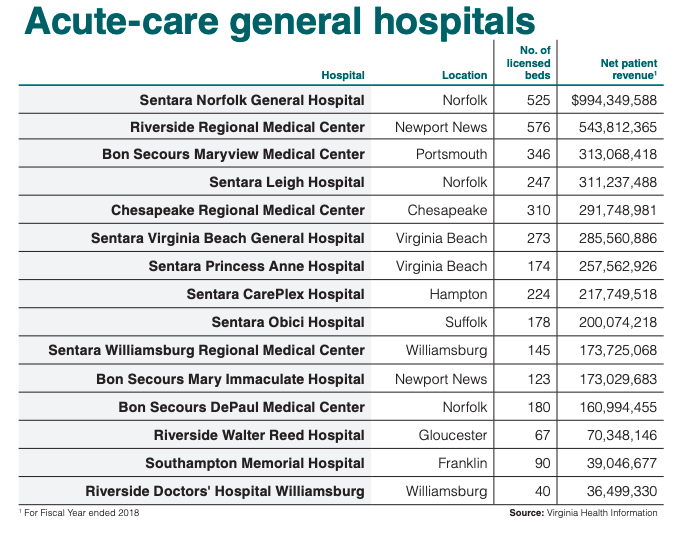
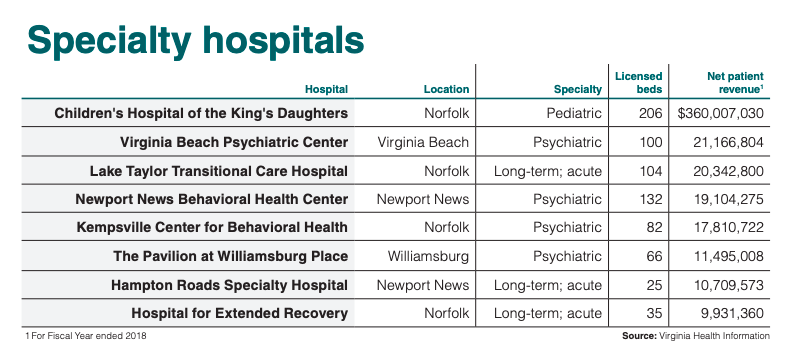
Even as the COVID-19 pandemic stresses Virginia hospitals, Hampton Roads’ health care sector continues to grow.
Richmond-based VCU Health System is making inroads in the region through partnerships with Riverside Health System and Sentara Healthcare.
In March, VCU Health System announced a formal affiliation with Newport News-based Riverside. The two organizations have identified areas “of mutual commitment and interest,” likely to spawn clinical, research and education projects, including a plan to increase existing medical education programs to address the growing shortage of physicians within the region.
One sign of the strengthened relationship: VCU Health System announced in March its plans to buy the 67-bed Riverside Tappahannock Hospital and related services, as well as physicians’ practices located in the region. The two health systems say the move will give patients access to a broader range of medical specialists, clinical trials and state-of-the-art technology. Financial terms of the deal were not released.
In April, VCU Health System announced that it had finalized the sale of a majority stake in the Virginia Premier health plan to Norfolk-based Sentara Healthcare. VCU has retained a 20% owner-ship in Virginia Premier, which it founded in 1995. Virginia Premier offers Medicare, Medicaid and health insurance exchange plans to more than 280,000 members.
Virginia Premier and Optima Health Plan, a wholly owned subsidiary of Sentara Healthcare, will operate as separate companies with different administrators and separate boards of directors. The Optima Health Plan provides coverage to more than 550,000 people, and according to a statement from Sentara, members shouldn’t see changes to their benefits or approved doctors.
On June 1, the $93.5 million, 253,000-square-foot Sentara Brock Cancer Center opened in Norfolk after two years of construction. The center will allow expert care teams, community organizations and holistic treatment providers to operate under one roof on the Sentara Leigh Hospital campus. Eastern Virginia Medical School and Virginia Oncology Associates also are partners in the facility.
In August, Sentara announced that it had signed a letter of intent to combine organizations with Greensboro, North Carolina-based Cone Health. Financial details were not disclosed, but the two health systems have combined revenues of $11.5 billion. Their headquarters will remain separate, according to Sentara, and the merger is subject to state and federal regulatory review. Sentara President and CEO Howard Kern will lead the combined organization from Norfolk.
The deal is set to close in mid-2021, and it will take up to two years for the systems to fully integrate.
Bon Secours also has plans to grow in the region, where it operates five hospitals and medical centers. The Cincinnati-based health system announced in July it had filed a certificate of public need (COPN) to expand the Bon Secours Health Center at Harbour View in Suffolk by 67,000 square feet and add up to 36 beds in a $115.7 million project. The state will need to approve the expansion.
“This expansion would help us meet the growing demand for inpatient services and allow for more flexibility in patient placement, bring much-needed obstetrical services to the area and ensure that we are prepared to handle any potential surge in patient volume well into the future,” said Kate Brinn, president of Bon Secours Maryview Medical Center and Bon Secours Harbour View Medical Campus.
Several candidates have already jumped into the 2021 Virginia gubernatorial race, and several more likely entrants are waiting to declare their candidacies until the 2020 election concludes.
Virginia’s constitution limits governors to nonconsecutive four-year terms, so incumbent Gov. Ralph Northam can’t run for reelection. Republicans haven’t won a statewide election in Virginia since 2009, and the Democratic field is more crowded than the Republican side so far.
Among the Democrats, Lt. Gov. Justin Fairfax, state Sen. Jennifer McClellan, D-Richmond, and Del. Jennifer Carroll Foy, D-Prince William, have declared their candidacies.
Former Gov. Terry McAuliffe, who served as governor from 2014 to 2018, filed paperwork to create a gubernatorial campaign committee but says he won’t announce whether he’ll run until after the 2020 election. McAuliffe is serving as a surrogate for Democratic presidential candidate Joe Biden.
The only declared Republican candidate for governor so far is state Sen. Amanda Chase, R-Chesterfield. Others, including former state Sen. Bill Carrico, R-Grayson, longtime delegate and former Speaker of the House Kirk Cox, R-Colonial Heights, and Charlottesville entrepreneur Pete Snyder, who lost the GOP primary for lieutenant governor in 2013, are considering runs as well.
Fairfax and Foy were part of a Democratic statewide sweep with Gov. Ralph Northam in 2017. Fairfax and Northam were caught up in 2019 scandals. Northam came under heavy criticism for a blackface photo that appeared on his 1984 Eastern Virginia Medical School yearbook page. (The governor has denied he was in the photo, which also depicted a person in a Ku Klux Klan costume.) Two women have alleged that Fairfax sexually assaulted them in the early 2000s, but Fairfax has said the incidents were consensual.
McClellan won election to the House of Delegates in 2005 and served there until 2017, when she won a special election to fill Donald McEachin’s state Senate seat after he was elected to Congress.
Foy was a public defender until she was elected to the Virginia House of Delegates in 2017.
Either McClellan or Foy would be the first woman governor in Virginia, as well as the first Black woman governor in the United States.
On the Republican side, Chase is running as a renegade Republican who refused to caucus with her fellow party senators in 2020. She was elected to the Virginia Senate in 2015 after defeating two primary opponents, including a 22-year incumbent, and winning the general election. She’s drawn attention for open carrying a .38 caliber firearm during the General Assembly session and for reportedly cursing at a Capitol Police officer during a parking dispute.
Other Republicans appear to be waiting to announce until after the 2020 election.
“My goal has been not to interfere with the 2020 race,” says Carrico, who served in the House of Delegates from 2002 to 2012 and the Virginia Senate from 2012 to 2020. “I don’t want to confuse the electorate. One of the things I felt about Amanda coming out [for governor] in February is that she takes focus off of what people need to be looking at.”
Chase has no apologies.
“I tell people I can chew gum and walk at the same time,” Chase says. “Some people want to criticize me for starting early. I’m going to win. People can criticize me, but at the end they’ll be calling me governor.”
Six Hampton Roads-based companies, including two newcomers, landed on the Virginia Chamber’s 2020 Fantastic 50 list of the state’s fastest-growing privately owned businesses. Due to the coronavirus pandemic, the winners were recognized during a virtual event held in May. To qualify for the Fantastic 50, nominees’ fiscal revenues had to exceed $200,000 and be less than $200 million in fiscal year 2018. They also had to demonstrate a positive net income in 2018, and businesses were ranked by their growth rate from 2015 to 2018.
Here are the winners, which represent multiple industries: construction, maritime, language services, water quality management, support services and commercial franchises.
The Language Group LLC
Virginia Beach
Fantastic 50 rank: #6
Year established: 1999
No. of employees: 24
2018 revenue: Would not disclose
’15-’18 revenue growth: 1,378.55%
With interpreters and translators fluent in more than 200 languages, The Language Group provides services for the health care and manufacturing industries as well as human resources departments and city and state governments. TLG was founded by married couple Chrysta and Giovanni Donatelli, who serve as executive partner and managing partner respectively. The company appeared in the Inc. 5000 rankings of the nation’s fastest-growing businesses in 2017, 2018 and 2019. In last year’s Fantastic 50, TLG was ranked sixth, and it won best small business in Virginia Beach from the Hampton Roads Chamber in 2019.
SOLitude Lake Management
Virginia Beach
Fantastic 50 rank: #10
Year established: 1998
No. of employees: 279
2018 revenue: Would not disclose
’15-’18 revenue growth: 629.14%
Founded by former landscaper Kevin Tucker, SOLitude is a water quality management company and part of U.K.-based pest control company Rentokil Steritech’s North American holdings. The company keeps lakes, ponds, wetlands and fisheries clean by controlling algae, weeds and invasive species for clients nationwide, from golf courses to apartment complexes. In August, SOLitude named Mychal Manolatos as its new vice president; he joined the company in 2016. In 2019, SOLitude was ranked 12th in the Fantastic 50.
ITA International LLC
Newport News
Fantastic 50 rank: #19
Year established: 2005
No. of employees: 373
2018 revenue: Would not disclose
’15-’18 revenue growth: 376.19%
ITA was started as a marine business, but it is now an international provider of integrated support services — including research, analysis, planning, training, engineering, logistics and maritime support — for government agencies, nongovernmental organizations and commercial clients. CEO Mike Melo is a retired naval officer and founded the company with his wife, Kathy, who is chief governance officer. Last year, ITA was ranked No. 17 in the Fantastic 50. In August, the company was awarded a five-year, $50 million contract to consolidate and modernize the U.S. Air Force’s electro-magnetic spectrum operations at Eglin Air Force Base in Florida, and it was on the 2020 Inc. 5000 list of the nation’s fastest-growing private companies, with a growth rate of 92%.
T. Parker Host
Norfolk
Fantastic 50 rank: #35
Year established: 1923
No. of employees: 529
2018 revenue: Would not disclose
’15-’18 revenue growth: 245.49%
T. Parker Host is once again the oldest company on the Fantastic 50 list as a maritime solutions provider that specializes in agency services, terminal operations, stevedoring and marine assets. A family-owned company named for its founder, Host was known primarily as a ship-handling agency in the Hampton Roads area for much of its history. Its chairman and CEO is Adam Anderson, who has been with the company since 1998. In 1986, the company expanded operations to the rest of the East Coast, the Gulf Coast and Colombia. This year, the company has remained open and working during the coronavirus pandemic, although some employees are working remotely, including those at the agency office. Last year, Host hired nearly 300 people, and the company rose from No. 46 on the 2019 Fantastic 50 to No. 35 this year.
Buzz Franchise Brands
Virginia Beach
Fantastic 50 rank: #39
Year established: 2012
No. of employees: 26
2018 revenue: Would not disclose
’15-’18 revenue growth: 224.18%
Buzz Franchise Brands was started in 2012 with Mosquito Joe, a mosquito-control company with five employees that later grew to 280 locations in 34 states. Today, Buzz owns three franchise brands, including pool cleaning and maintenance provider Pool Scouts, residential cleaning brand Home Clean Heroes and swimming lessons provider British Swim School. Mosquito Joe was sold in 2018 to Dwyer Group, a Texas-based company that buys franchisors, for an undisclosed amount. Buzz is on the Fantastic 50 list for the first time in 2020, which has been a tough year for many businesses. Its swim school locations have been temporarily closed, but the home cleaning and pool maintenance franchises have remained active this year. CEO and President Kevin Wilson announced in July that the company signed a deal with Atlanta private equity firm FranBridge Capital for 10 franchise units of Pool Scouts and Home Clean Heroes at $100,000 each.
Leebcor Services LLC
Williamsburg
Fantastic 50 rank: #48
Year established: 2008
No. of employees: 54
2018 revenue: Would not disclose
’15-’18 revenue growth: 163.68%
Another newcomer to the Fantastic 50, Leebcor Services is a general contractor and design-build firm that specializes in construction of federal facilities, with an emphasis on fast-track and turn-key services. Among its projects are buildings at Fort Lee, Fort A.P. Hill, Fort Eustis and Fort Story in Virginia, as well as facilities at military bases in Florida, Georgia and North Carolina. Led by President and CEO John Karafa, Leebcor is a service-disabled, veteran-owned business; Karafa is a Virginia Military Institute graduate who served in the U.S. Air Force as a civil engineering officer for 12 years. This summer, the company was awarded a $7.7 million contract to renovate a building at the Defense Logistics Agency and Defense Supply Center in Richmond, and it received an $8.4 million task order for work at Naval Air Station Jacksonville in Florida.
Startup resources
The entrepreneurial spirit is growing in Hampton Roads, and there are several organizations, incubators and private companies that exist to help startup businesses thrive. Following is a sample of some of the many resources available:
504 Capital Corp. 504capital.com
757 Accelerate 757accelerate.org
757 Angels 757angelsgroup.com
757 Makerspace 757makerspace.com
Black BRAND blackbrand.biz
Ernest M. Hodge Institute for Entrepreneurship nsu.edu
Franklin Business Center franklinsouthamptonva.com/
business-center
Welcome to the second issue of Virginia Meetings. Below you’ll find content about how hotels have reopened with caution during the pandemic and how virtual conferences have become the new norm for meeting planners. Also included is a list of Virginia’s largest conference hotels.
Checking in: Hotels reopen with caution following economic downfall
Three-term incumbent Fredericksburg Mayor Mary Katherine Greenlaw recalls when her city moved at a slower pace, as did surrounding Spotsylvania and Stafford counties.
All that has changed, profoundly.
Fredericksburg’s population has jumped by more than 50% during the past 20 years, from 19,279 in 2000 to an estimated 29,036 in 2019, according to the U.S. Census Bureau.
Spotsylvania’s population has increased at a similar pace, rising from 90,395 in 2000 to an estimated 137,110 today. Meanwhile, Stafford ‘s population has skyrocketed by nearly 70% over the last 20 years, shooting up from 92,446 to an estimated 156,300.
Altogether, the past two decades have been a period of growth and transition for the Fredericksburg region.
Greenlaw, who grew up in the city, has been part of that change.
For 27 years, she and her husband ran a cattle farm and butcher shop in Stafford County before Greenlaw turned to a timelier career in real estate. She retired in 2015 after working 15 years as a commercial real estate broker for Cushman & Wakefield | Thalhimer.
Fredericksburg’s real estate market is sizzling, Greenlaw says. “Everything is selling as soon as it’s put on the market.”
Over the past several years, the private sector has funneled $250 million into the city, the mayor adds, and an additional $250 million of economic development investment is in the pipeline.
Ties to Washington
A historic community, the Fredericksburg region is home to four major Civil War battlefields, including Chancellorsville and The Battle of the Wilderness site, and tourism is an important part of its economy.
For most of his childhood, George Washington lived in Stafford at Ferry Farm, where today visitors can see a replica of his boyhood home. His mother, Mary Ball Washington, spent much of her life in Fredericksburg, and Preservation Virginia maintains her final home on Charles Street as a period museum. Washington often visited his mother in Fredericksburg, as did luminaries such as John Marshall, Thomas Jefferson and Lafayette.
With its 4,400 students, the University of Mary Washington is named for her and infuses the city with a youthful vibe.
The nation’s capital, named for Mary Ball Washington’s son, is only about 50 miles away. And locals say Fredericksburg has always benefited from that proximity.
It’s well within commuting distance by car or train. Amtrak and the Virginia Railway Express (VRE) provide daily commuter rail service from Fredericksburg to Northern Virginia and downtown Washington, D.C.
“The number of people who moved to Fredericksburg to get affordable housing over the last 40 years has been tremendous,” says Jud Honaker, president of the Silver Cos.’ commercial development division. Photo by Will Schermerhorn
Jud Honaker is president of the commercial development division of Silver Cos., a Florida-based real estate investment and development firm with a regional office in Fredericksburg. A lifelong Fredericksburg resident, he’s had a ringside seat to the city’s growth and transformation, which he says has been driven by its status as a D.C. bedroom community.
“The number of people who moved to Fredericksburg to get affordable housing over the last 40 years has been tremendous,” Honaker says. “Basically, what people have been doing is moving further south to get the house they wanted for the price they could afford. Houses in Fairfax and Prince William (counties) kept going through the roof.”
Silver Cos. has been a principal developer in the Fredericksburg region for decades. “We’ve been a tremendous tax revenue generator for the three jurisdictions,” he says, pointing to one of the big turning points in the area’s economy.
“The city of Fredericksburg in the ’90s was financially strapped. They were considering reverting to a town and they had annexed this property called Central Park and they asked us to develop it.”
Development of Central Park began in 1995, and over the next 10 years, Silver Cos. built it into a huge shopping venue near the intersection of Interstate 95 and state Route 3. In its heyday, Central Park was ranked as the largest unenclosed mall (and second-largest mall) on the East Coast, and as the seventh-largest mall in the United States.
“At one time, it was generating over 20% of the city’s entire budget,” Honaker says. “If you take all of the projects the Silver Cos. have developed here in Fredericksburg, those developments are probably generating 30% of the city’s annual budget.”
Silver Cos. has since sold part of Central Park to a shopping center management company, but the firm is still actively developing properties in the community.
Carl Silver, the company’s founder, made his home in Fredericksburg, and the city is dotted with housing projects, shopping venues and scores of other properties that the company either owns or has developed.
Batter up
One of the company’s latest projects is Celebrate Virginia South, a 540-acre, mixed-use development just north of Central Park. It’s anchored by a Wegmans grocery store, three hotels and the Fredericksburg Expo Center, which attracts more than 250 events.
It also contains the 5,000-seat baseball stadium that is the new home of the Fredericksburg Nationals — FredNats, for short.
The FredNats are a Minor League Baseball team in the Carolina League and a Class A-Advanced affiliate of the Washington Nationals, which last year won the World Series.
Seth Silber, the team’s treasurer and the son of the team’s chairman/CEO, Art Silber, says his father and other investors bought the team in 1990, but eventually the Silber family took full ownership. His sister, Lani Weiss, is team president and lives in Fredericksburg.
Seth Silber’s family chose to locate their Fredericksburg Nationals Minor League Baseball team in the city partly because the Fredericksburg area is well-populated, economically strong and has its own identity. Photo by Will Schermerhorn
The Silber family had been trying to build a new stadium in Prince William County, where the team had been located since 1984, for more than a decade but the effort was unsuccessful. Fredericksburg officials reached out to the family two and a half years ago and invited them down for a visit.
Silber says they were “blown away” by the strong sense of community expressed during the visit, the strong interest in baseball and the immediate support from the business community.
“Minor League Baseball kind of thrives in smaller communities that have their own identity and Fredericksburg has its own identity. It’s in a fairly populous and economically strong area between Washington and Richmond,” says Silber, who also works as an attorney in Washington. “It’s kind of the perfect match for Minor League Baseball and that’s kind of what we hoped would happen when we came in and reached an agreement with the city on how to proceed and we got financing in place.”
Under a special financing arrangement, the stadium’s cost is being privately funded and Fredericksburg pays $1.05 million a year for 30 years to help service the debt on the stadium.
The city expects to recoup the money through tax revenue and other revenue-sharing opportunities with the owners of the FredNats.
“We think this might be a model for cities and counties wanting to do this in the future,” Silber says.
The pandemic washed out this baseball season for the FredNats, but Silber says the team is looking forward to a 140-game schedule beginning in April 2021, with 70 home games scheduled.
The team’s owners also are hoping to stage 10 to 15 concerts each year, and the city government also will be scheduling events at the new ballpark.
Relax, it’s Fred Ex
The FredNats are just one example of businesses that have recently moved into the area.
Bill Freehling, Fredericksburg’s economic development director, says that while a lot of workers live in Fredericksburg and commute to work elsewhere, more companies are locating in the city and creating jobs. Some of those companies are servicing the region’s growing population, while others, such as defense contractors, are relocating from Washington and from Northern Virginia in search of talent and lower business costs.
In February, the Virginia Economic Development Corp. released a study showing that the Fredericksburg region was adding jobs at a faster pace than anywhere else in Virginia.
One company that’s been particularly active is IST Research Corp., an engineering and technology firm that in January was awarded a $99.7 million contract to support the U.S. Department of State. In July, it received a five-year, $66 million contract from the General Services Administration (GSA).
Fredericksburg also is a center for health care in the region, with Mary Washington Healthcare employing more than 4,000 workers across a not-for-profit regional system with two hospitals and three emergency departments.
The city is also a bustling center of commerce for the region, with Central Park and other surrounding destination venues for shopping and dining. Spotsylvania Towne Center, directly across from Central Park, offers more than 150 specialty stores and restaurants.
Freehling also points out that the former downtown headquarters of the Free Lance-Star newspaper is undergoing a $90 million redevelopment into offices, restaurants, apartments and a hotel. The project is being handled by companies affiliated withlocal developers Tom and Cathy Wack and Vakos Cos.
While Fredericksburg has prospered through its proximity to Northern Virginia, that bond will likely grow stronger in the years to come, thanks to about $1 billion in public and private transportation projects in the Fredericksburg region that will unfold over the next several years.
But one of the most anticipated projects in the area will take on one of its greatest struggles — high traffic volumes.
The I-95 commuter corridor between Washington, D.C., and U.S. 17 in Stafford was dubbed the “worst single traffic hotspot” in the country a few years ago by INRIX Roadway Analytics, a global transportation data company.
“It was nothing new to us,” says Fredericksburg District Engineer Marcie Parker. “We already knew that.”
Expected to open in 2022, the Fredericksburg Extension (Fred Ex) will offer traffic relief via a $565 million, 10-mile extension of area Interstate 95 express lanes south to Exit 133. The lengthened lanes will connect with the I-395 Express Lanes to create a connected corridor spanning nearly 50 miles from Fredericksburg to the D.C. line.
Transurban, an Australia-based toll-road operation company with its U.S. headquarters in Alexandria, is funding the construction through a public private partnership with state government. Transurban will operate and maintain the express lanes and charge variable toll rates for using the lane in a contract that extends until 2087.
Developers say the extension will provide 66% more capacity on Interstate 95 during peak periods and move 30% more people and 23% more vehicles compared with existing conditions.
Other major area highway projects include two new bridges, each costing an estimated $132 million: the I-95 Northbound and Southbound Rappahannock River Crossings. The two new bridges will be built between existing I-95 bridges over the Rappahannock, providing for improved traffic movement through the region. The northbound crossing is being funded through a $277 million payment from Transurban to the state government to advance transportation projects along the I-95 corridor.
Parker says the new express lanes, bridges and other transportation work in the Fredericksburg region represent the largest body of highway improvements since I-95 was built and later widened.
“I feel these projects are going to be transformational for the area. It’s going to help the traffic move better than it has in the last 20 to 30 years,” Parker says.
The projects almost surely will bring new growth to the Fredericksburg region: more people, more jobs, more tourists, more change.
“It’s become so urban,” Greenlaw says, “but it pleases me that, despite the fact the city is twice the size it was when I finished high school, it’s still managed to maintain its character. I walk down the street and open my eyes and close my eyes, and it looks like my hometown. It feels like my hometown.”
On Election Day, Norfolk and Portsmouth voters will decide whether to hold ’em or fold ’em.
The two Hampton Roads cities will consider separate Nov. 3 ballot referendums on large casino projects that promise jobs, tax revenue, increased area tourism and funds for school construction.
“It’s new for Virginia, for sure,” says Jay Smith, spokesman for the Pamunkey Indian Tribe, which is proposing a 13.4-acre, $500 million waterfront casino resort next to Norfolk’s Harbor Park, with investor Jon Yarbrough, a Tennessee billionaire with close ties to the Indian gaming industry. “For years, people have been driving from Virginia across the Potomac to Maryland or Delaware or Atlantic City to spend their dollars. This is an opportunity to keep that money in Virginia and bring outside visitors here.”
Smith says the casino’s benefits are many and stresses that there is no public investment. “There’s not a dime of public money or tax incentives to do this. But what it means for education dollars is an estimated $50 million every year for public school construction and more than $30 million a year just for the city of Norfolk through gaming and sales taxes.”
Due to new legislation, the state will allow casinos in five economically challenged Virginia cities, including Norfolk and Portsmouth, but citizens have to vote “yes” to get in the game. To be added to the ballot, both the Pamunkey Tribe and Rush Street Gaming, the Chicago-based company behind the $300 million Rivers Casino project in Portsmouth, had to get the backing of their respective city councils and win preliminary certification from the state Lottery Board.
“The state legislature made sure that the minimum investment would be $300 million, to encourage the building of higher-end resorts and destination places rather than just places to gamble,” says Jared Chalk, executive director of the Norfolk Economic Development Authority. He points out that the Pamunkey casino would offer an adjoining hotel, restaurants, entertainment venue and spa.
About a 15-minute drive away across the Elizabeth River, the proposed 400,000-square-foot Rivers Casino Portsmouth is projected to generate $16.3 million in annual city tax revenue for the city, says Robert Moore, director of Portsmouth Economic Development, which estimates that the complex would produce 1,400 construction jobs and 1,200 permanent jobs.
Rivers Casino would also be one part of a larger entertainment district, Moore says. “It won’t just be a gaming facility but restaurants, a hotel, shops, an outdoor entertainment venue and convention meeting space.” Planned for 50 acres at the intersection of Victory Boulevard and I-264, the district would also be near Bide-A-Wee Golf Course.
“From the first time we saw the Victory Boulevard site, we knew it was the perfect place to build a casino,” says Jacob Oberman, senior vice president of development for Rush Street Gaming, which owns and operates resort casinos in Philadelphia, Pittsburgh, Illinois and New York. “We’re going to apply the best practices we’ve learned from operating our other casinos, which have been economic catalysts for their cities.”
The two Hampton Roads projects join similar local casino referendums up for voter consideration in Danville and Bristol on Nov. 3.Caesars Entertainment Corp. and Hard Rock International, respectively, would front those potential projects. Richmond voters will consider a gambling resort on the November 2021 ballot, and Smith says that the Pamunkey Tribe, which recently purchased 270,000 square feet of warehouse space in Richmond’s Manchester district for $4 million, will be among the bidders for that casino, which will require Richmond City Council’s approval.
But can the coastal region sustain two large casino projects within about six miles of each other?
Oberman is sure it can, citing Rush Street’s research on Portsmouth. “We’re ready to move forward,” he says. Chalk cites the General Assembly, which commissioned a 2019 Joint Legislative Audit and Review Commission (JLARC) report that reviewed the potential benefits of gaming in Virginia. “They found that two mega-casinos could coexist profitably in the region,” he says. “And now it’s up to the voters.”
This website uses cookies, web beacons, pixels, tags, software development kits, and related tracking technologies, as described in our Privacy Policy and Cookie Policy, for purposes that may include website operation, analytics, analyzing site usage, enhancing site navigation optimizing a user's experience, and third-party advertising or marketing purposes. Through these technologies, we and certain third parties may automatically collect information about your interactions with our website, such as your browsing behavior and page views. We also may share this information about your activity on our website with our social media, advertising, analytics, and other business partners. By clicking “Accept All”, you consent to the use of these technologies and that we can share information about your activity on our website with third parties in accordance with our Privacy Policy and Cookie Policy. If you do not agree with our use of non-essential tracking technologies, please click “Reject All.” You may opt out of certain non-essential technologies by clicking “Cookie Settings.”
Functional
Always active
The technical storage or access is strictly necessary for the legitimate purpose of enabling the use of a specific service explicitly requested by the subscriber or user, or for the sole purpose of carrying out the transmission of a communication over an electronic communications network.
Preferences
The technical storage or access is necessary for the legitimate purpose of storing preferences that are not requested by the subscriber or user.
Statistics
The technical storage or access that is used exclusively for statistical purposes.The technical storage or access that is used exclusively for anonymous statistical purposes. Without a subpoena, voluntary compliance on the part of your Internet Service Provider, or additional records from a third party, information stored or retrieved for this purpose alone cannot usually be used to identify you.
Advertisement
The technical storage or access is required to create user profiles to send advertising, or to track the user on a website or across several websites for similar marketing purposes.

 Sign In
 Free Newsletter