Sign In
 Free Newsletter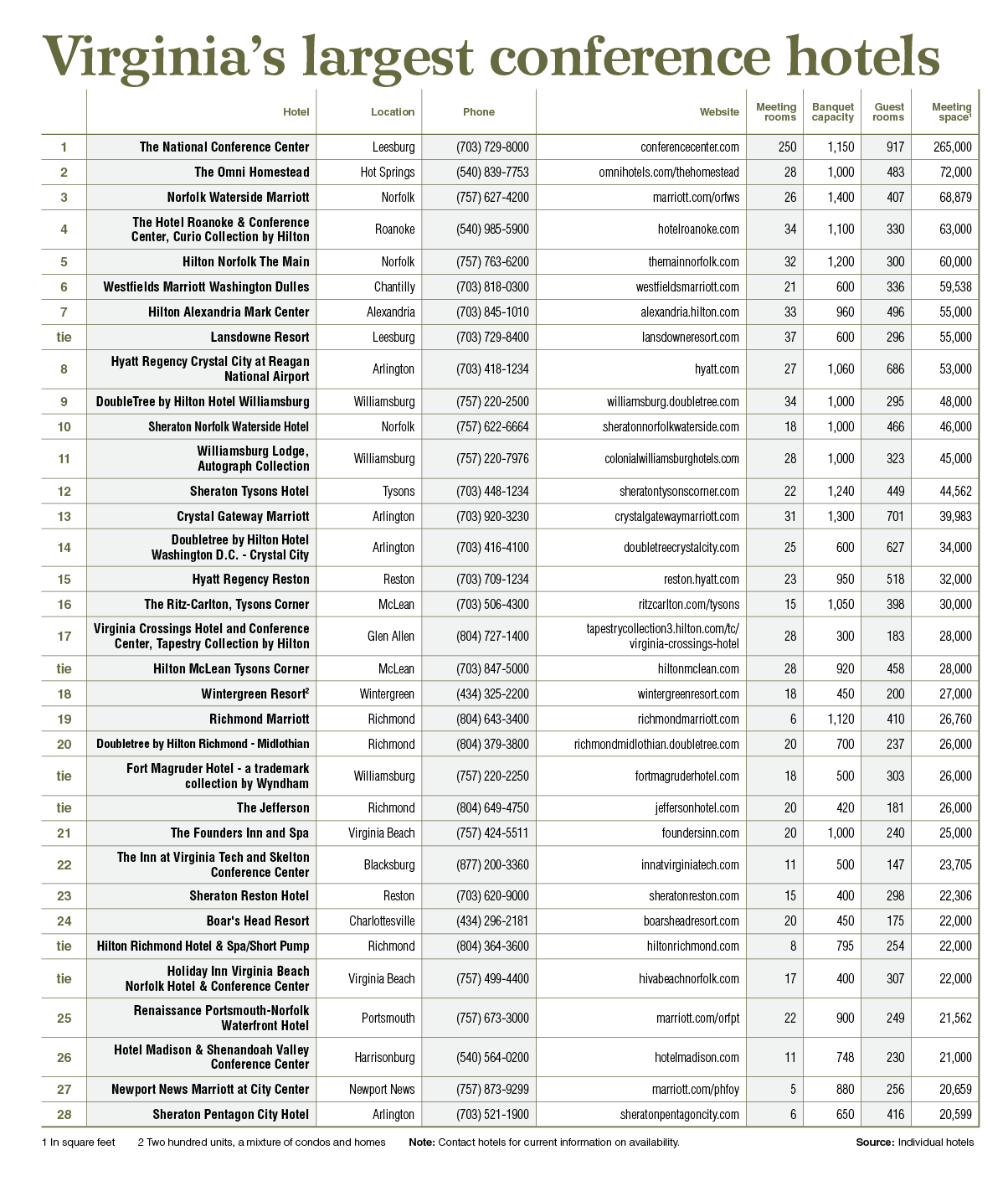


Upcoming Event


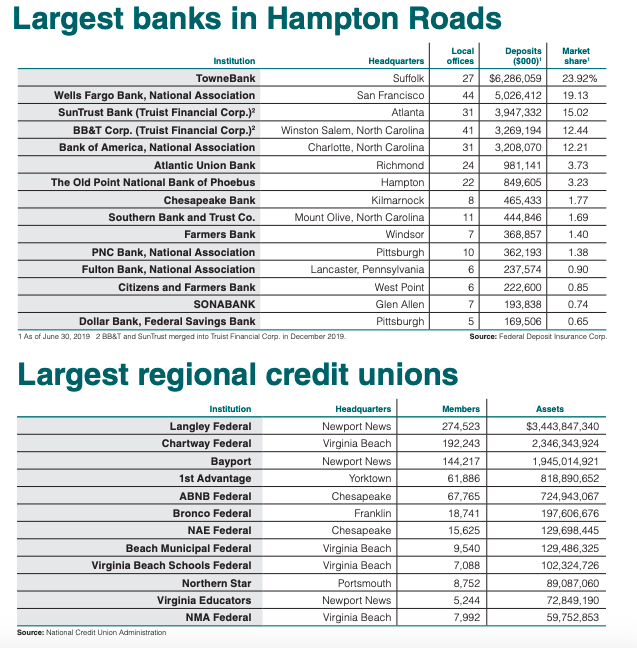
Suffolk-based TowneBank maintains its dominance among Hampton Roads financial institutions, holding nearly a quarter of the market share. In late June, TowneBank and Children’s Hospital of the King’s Daughters jointly purchased the 22-story Norfolk Southern tower in downtown Norfolk for $30 million. TowneBank’s market share increased slightly from last year, when it had 22.29% of deposits. Wells Fargo Bank, National Association, takes a close second with a 19.13% market share. Among credit unions, Langley Federal surpassed the $3 billion asset mark this year, compared to $2.9 billion last year.

The impact of COVID-19 on hospitality was felt almost immediately in Virginia. According to the U.S. Travel Association, in the first week of March, travel spending was at $521 million across the state, but by the last week of the month, it had fallen to less than $120 million. Most conventions statewide have moved online or been rescheduled.
Hotel revenues across the state were still down by 42% during the week of Aug. 16-22, compared with the same week in 2019, according to STR Inc., a CoStar Group division that provides weekly market data on the U.S. hospitality industry.
Although the pandemic has forced many hotels to rearrange their grand openings and renovation projects, hotels and conference centers are opening — and applying precautionary measures to ensure guests have as safe a stay as possible.
Here’s a sampling of what’s new around the state.
The Quirk Hotel Charlottesville made its debut in early March and is now open. The property is owned by Ted and Katie Ukrop, who started the first Quirk Hotel in downtown Richmond, and the art-focused boutique hotel has 80 rooms, a rooftop bar, art gallery, meeting space, a restaurant, The Pink Grouse. And coming soon will be a whiskey and cigar bar called Bobboo.
In an interview this summer, General Manager Matthew Brink said the grand opening party, held right before the pandemic struck Virginia, “was reminiscent of Hollywood. We saw great growth over the [first] weekend,” but within a week, “the world turned upside down.”
He notes that Quirk Charlottesville, which involved renovation of some older buildings on Main Street, still had some work to do on about a quarter of the guest rooms and landscaping in its courtyard, so the closing between March 23 and June 1 allowed that work to be finished. In Lynchburg, the Kirkley Hotel started on a multiyear, $1 million renovation last September. The upgrade will impact its 163 rooms, restaurant, ballrooms and façade. The hotel is still taking reservations, but the restaurant is open only for grab & go breakfast until Dec. 31.
Near the Richmond International Airport is the 160-room Sheraton Richmond Airport Hotel, one of Richmond-based Shamin Hotels’ 61 properties in six states. The hotel reopened in January after extensive renovations, including the addition of 8,000 square feet in event space.

The Delta Hotels by Marriott Virginia Beach Bayfront Suites, the only hotel facing the Chesapeake Bay, is set to reopen in November after new ownership and a two-year, $27 million renovation, with 295 suites and 12,257 square feet of indoor and outdoor event space. Formerly known as the Virginia Beach Resort Hotel & Conference Center, the property was bought by the Lingerfelt CommonWealth Partners LLC of Richmond in 2018 for $19 million.
On the Atlantic, the 24-story Marriott Virginia Beach Oceanfront opened its doors in June. The $125 million hotel, with 305 guest rooms and 20,000 square feet of event space, is the second phase of owner Gold Key | PHR’s three-phase plan to renovate and expand the Historic Cavalier Hotel & Beach Club, after the 2018 reopening of the historic beach resort after a four-year, $85 million renovation.
In Norfolk, another Marriott property, Glass Light Hotel & Gallery, is now open, with 117 boutique hotel rooms and suites, a gallery and a restaurant serving French-inspired New American dishes by a Michelin-starred chef. One of its most unique features is the collection of glass artwork by Dale Chihuly and Peter Bremers, including two large glass rabbits.
The Hyatt Regency Dulles in Herndon reopened in early 2020 after a top-down, multimillion-dollar renovation on its 316 rooms, restaurant and 29,000-square-foot meeting center, and it remained open through the early days of the pandemic.
The Hyatt Centric Old Town Alexandria opened in January, with 124 guest rooms, a restaurant inspired by French and Southern cuisines, and a lobby that also can be reserved for event space.
Some previously announced Northern Virginia projects — including The Dittmar Co.’s Holiday Inn redevelopment in Rosslyn and a planned hotel in Tysons to be constructed by Capital One — are on hold or are being redesigned to reflect different needs in the current environment.
The Georges, a recently restored 200-year-old boutique inn in Lexington, has 18 guest rooms and several event spaces, including the new Patton Room, which can accommodate up to 250 people for cocktails or 160 for a seated meal, as well as the Garden Terrace, just off the Patton Room. Owned by NewMarket Corp. President, Chairman and CEO Thomas E. “Teddy” Gottwald and his wife, Ann Parker Gottwald, the inn has a restaurant, courtyard and lobby lounge. In July, it was named the second-best city hotel in the United States by Travel + Leisure magazine.
The Omni Homestead Resort, Bath County’s largest employer, reopened in late June after closing for three months due to the pandemic. As one of the premier locations in the state for large conventions, the Homestead was heavily impacted by coronavirus shutdowns, forcing it to furlough 700 to 800 of its employees. But now, with safeguards in place, the resort has reopened for the most part, although its iconic dining room was still closed as of early September, and the Jefferson Pools, which are undergoing renovations, will reopen in 2022.
In Winchester, the new SpringHill Suites by Marriott property opened this summer. With 96 suites, free WiFi and a small meeting room, it’s located near the intersection of Interstate 81 and U.S. Route 11.
The Sessions Hotel in downtown Bristol, which opened on State Street in June 29, is named for the city’s status as the birthplace of recorded country music.
Kimberly Christner, president and CEO of Cornerstone Hospitality, which owns and operates the Sessions, said in June that the 70-room Marriott Tribute Portfolio hotel was seeing an uptick in bookings this summer and early fall. Amenities include a barbecue restaurant, rooftop bar, 2,300-square-foot meeting space and an outdoor performance stage.
Meanwhile, The Hotel Roanoke & Conference Center, Curio Collection by Hilton, is undergoing a $3.9 million renovation of The Pine Room Pub and The Palm Court Lobby, with completion slated for September. The facility, which has 330 rooms, also boasts a 63,000-square-foot conference center. In July, the hotel’s management said small meeting rentals had begun to pick up again since the early months of the pandemic.
Hampton Roads is Virginia’s second most populated region, with nearly 1.8 million residents in 17 localities, including Virginia Beach — the state’s largest city by population with about 450,000 residents. More than 120,000 active-duty and reserve members of the military, as well as civilian personnel, work at nine installations representing five branches. The Port of Virginia is the third-largest container port on the East Coast, with 14.1% of its market share. The region also has 11 community colleges and four-year colleges and universities, as well as a major tourism industry in recovery from the coronavirus pandemic.
Median household income: $64,648
Unemployment rate: 3.1%
Labor force participation rate: 64.4%
Average commute time: 24.4 minutes
Civilian labor force: 860,106
Population: 77 million
Population 20-24: 23%
Male vs. female ratio: 49% to 51%
Median age: 37.1
Population with a bachelor’s degree or higher: 32.8%
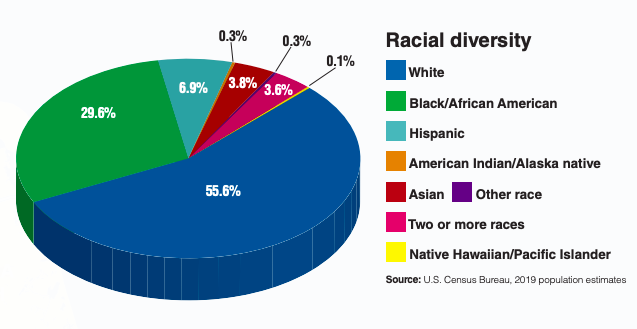
Sources:
1. U.S. Census Bureau, 2019 estimate of the resident population
2. U.S. Bureau of Labor Statistics, 2019 annual average, seasonally adjusted
3. Esri Business Analyst Online
Note: Population figure includes Hampton Roads MSA, including Currituck and Gates counties in North Carolina.
Subscribe to Virginia Business.
Faced with challenges associated with the COVID-19 pandemic, many Hampton Roads businesses and universities are looking to drones for help. Unmanned flight systems also are likely to drive economic development in the future.
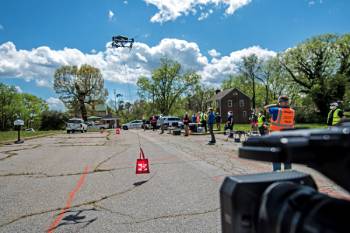
In May, when the fear of dwindling personal protective equipment was still fresh, the Herndon-based Center for Innovative Technology (CIT) partnered with Virginia Beach-based DroneUp to test how drones could assist medical professionals in delivering test samples and PPE with no contact between humans.
With 103 test launches at the former Saint Paul’s College site in Lawrenceville, DroneUp was able to successfully deliver 100 packages to partner organizations at stations set up around the 55-acre campus.
The company then started working in the spring on a white paper to be sent to the White House with recommendations for best practices and a blueprint for how other organizations and agencies can deploy drones. And although DroneUp couldn’t share specifics of where the project may be headed, company spokesperson Amy Wiegand says that this is an area the company will continue to work on.
DroneUp also has continued to expand its flight services through its April acquisition of Glenview, Illinois-based AeroVista Innovations LLC, which provides drone training for private and public sectors now as the DroneUp Training Academy. The company also added Low Altitude Authorization and Notification Capability to its app, which allows drone pilots to get airspace authorization with the Federal Aviation Administration, Wiegand says.
“That continues to develop because technology grows and changes and evolves,” she says.
While DroneUp flexes its new capabilities, Old Dominion University’s Virginia Institute for Spaceflight & Autonomy (VISA) is hard at work to develop the Autonomy Research Institute for Societal Enhancement, or ARISE.
VISA, along with Hampton University and William & Mary, as well as REaKTOR, the National Institute of Aerospace and Longbow Group, plans to develop a center at Fort Monroe to look at integration of autonomous systems into public use across air, sea and land.
The group’s goals are economic development, workforce development and research, says VISA Executive Director Dave Bowles, and the organization has applied for funding through GO Virginia, the state-funded initiative to foster regional private-sector growth. Bowles says he expects to hear about the funding decision in late September.
“Hampton Roads is well-positioned to be a big player in [autonomous systems],” Bowles says. “We’ve got the port, the naval footprint and … I think autonomous systems can play a tremendous role in offshore wind for maintenance, inspection and supply. This center is a good complement to other assets the commonwealth has, and I think it could be a big [source] for bringing in new businesses into the area.”
Training professionals to use unmanned systems and bringing drone capabilities to the public will be key in the next phase of growth in the industry, he says.
The Virginia Open Data Cube, a collab-orative project involving NASA, VISA and ODU’s Virginia Modeling, Analysis & Simulation Center (VMASC), combines data from satellites, drones and other sources and makes it available in an open-source format. It is already in use at higher education institutions and businesses in Hampton Roads to prepare for flooding associated with sea-level rise.
Having the information in one place will inform businesses and higher education institutions on how to better safeguard coastal resiliency, Bowles says.
Karen Jackson, chairman of the Unmanned Systems Association of Virginia, says that the industry is set to grow as a result of the pandemic, which has broadened the possibilities for deliveries.
“We’ve seen an acceptance level that is headed in the right direction, and it’s headed in a way that will only grow,” says Jackson, who served as state secretary of technology under Gov. Terry McAuliffe and is the New College Institute’s interim executive director.
Unmanned systems can speed up delivery times for companies and organizations, she says. “Part of that is it does take away proximity. Geography becomes much more simple when you can fly [instead of] drive. … As people get more comfortable with [drones], and people learn how to use them responsibly … the use cases are becoming more and more compelling.”
That unintended consequences come with innovation should be no surprise. Today, technology and social media are global cultural obsessions with a tremendous impact on business.
Not that long ago, who would have thought a wallet-sized object like a smart phone would replace nearly every piece of office equipment — telephones, typewriters, copiers, cameras and, to some degree, even desktop computers?
Furthermore, many jobs that were once quite common have largely disappeared. Administrative support, travel departments, interoffice mail delivery: all gone. Think about the woes of the U.S. Postal Service: First, UPS and FedEx gobble up their lucrative package deliveries. Then, e-mail makes stamps and letters into artifacts of a bygone era.
At the same time, technology has spawned new global business behemoths. Apple, Amazon, Alphabet, Facebook, Microsoft and Tesla saw an all-time high combined market value of $8.2 trillion in early September. That’s almost 40% of the gross domestic product (GDP) of the U.S., nearly 60% of the GDP of China and $2.5 trillion more than Japan’s GDP. Those are the world’s three largest economies.
And what’s the business model for most of these tech companies? Largely, it is built on your personal information. What you buy, what you read, who your friends are, even where you travel is being packaged and resold to advertisers and others for targeted communications. Sometimes your data is anonymous and sometimes it’s not. This isn’t a business model that relies on products or even content. It’s a business model based on information that you give up willingly and mostly for free.
Privacy matters.
In the European Union, the protection of personal data is considered a fundamental human right. The General Data Protection Regulation (GDPR), implemented in 2018, gives EU residents control over their personal data. Even when collected with an individual’s consent, that consent may be revoked at any time. Another purpose of the GDPR is to simplify the regulatory framework by having a single rule for all businesses operating in the 27 countries comprising the EU.
At the federal level, the U.S. has no similar legislation. In 2018, the California Consumer Privacy Act was signed into law; it is largely modeled on the GDPR. Maine and Nevada have also passed online consumer privacy regulations. A Virginia Privacy Act was introduced in this year’s General Assembly session. It has been referred to committee and will be revisited during the 2021 session. At least 20 other states are in some stage of considering consumer data privacy protections.
This morass of pending legislation amounts to a regulatory nightmare for companies doing business in the U.S. Some things, especially those affecting interstate commerce, are best not left to 50 individual states. The U.S. Chamber of Commerce, often reluctant to encourage regulation, has gone so far as to propose model legislation to create a federal data privacy law.
In an age when global companies have become larger than many nation’s economies, the penalties for failing to comply with regulations may seem significant but often are less impactful on corporations than one might think.
In 2012, the Federal Trade Commission charged Facebook with consumer privacy violations related to how the social media giant handled user data. In July 2019, after seven years of negotiation, the FTC announced a record-breaking $5 billion settlement with Facebook. That sounds like a lot of money, but Facebook’s 2019 revenue was $70.7 billion and its net income for the year was $18.5 billion.
Regardless of size, businesses should not be burdened with a multiplicity of regulations varying from state to state. Instead of drafting their own regulations, Virginia and the other states should be seeking a single national data privacy standard. It’s just good business.
With construction beginning this fall to expand the Hampton Roads Bridge-Tunnel (HRBT), relief is on the way for travelers weary of sitting in traffic jams along one of south-eastern Virginia’s most congested corridors.
The $3.8 billion expansion is the largest project in the history of the Virginia Department of Transportation and one of the largest infrastructure projects in the nation. It will also employ new tunnel-excavation technology that has just begun to be used for major roadway projects.
Twin two-lane tunnels, about 50 feet deeper than the current tunnels, will be constructed just west of the existing eastbound tunnel, while more than two dozen marine bridges will be replaced.
Additionally, the four-lane sections of the Interstate 64 corridor between Settlers Landing Road in Hampton and the Phoebus shoreline and the four-lane section of I-64 in Norfolk between the Willoughby shoreline and the I-564 interchange will be widened to six lanes, with the addition of a third lane and a drivable shoulder in each direction. When the project is completed in late 2025, there will be a total of eight lanes of capacity across the water.
The Hampton Roads Transportation Accountability Commission is the main funding agent for the project, using local revenue from sales and gasoline taxes in the Hampton Transportation Fund. State and federal funds will also support the expansion.
Along with increasing capacity and safety and enhancing the region’s emergency evacuation readiness, the multifaceted project is expected to improve travel time reliability. On a daily basis, commuters face an average six-mile backup to cross the Hampton Roads harbor. “You just never know if it will be 15 minutes or 50 minutes to get through the HRBT,” says James S. Utterback, VDOT’s director for the HRBT expansion project. “The value of the new facility is that drivers will have a much more predictable time to get through this corridor.”
When it opened in November 1957, the original 3.5-mile bridge-tunnel joining the Peninsula and Southside Hampton Roads was the world’s longest immersed tube tunnel and the first crossing constructed between two manmade islands. As the region’s population and traffic grew, construction began on an eastbound tunnel in 1972. The parallel tunnel opened in November 1976.
Four decades later, capacity has long been maxed out. Approximately 32.5 million motorists traveled across the HRBT in 2019. During the summer alone, an average of 100,000 vehicles cross the span daily. Maintaining traffic flow during construction is a major concern, says Utterback. “That’s going to be a big challenge related to the construction of the trestle bridges and the number of switches that will be occurring over the water.” To reduce long-term travel disruption, construction work on the tunnel, bridges and interstate will occur simultaneously. All lanes will remain open as construction along I-64 starts this fall.
Right-of-way along the corridor represents another challenge.

“There are so many historical properties that we can’t impact,” Utterback says. “That limits the corridor we can build on.” VDOT has committed to ensuring that the construction does not impact Naval Station Norfolk, the Willoughby Boat Ramp, Hampton University, Fort Monroe, the Hampton National Cemetery, Phoebus Historic District, Fort Monroe and Fort Wool.
Hampton Roads Connector Partners (HRCP), a joint venture led by New York-based Dragados USA Inc. and including Vinci Construction, Flatiron Construction Corp. and Vinci subsidiary Dodin Campenon Bernard, was chosen as the design-build contractor for the project. The project’s designers are Arlington-based HDR Inc. and Mott MacDonald, a British firm with a global presence. During the spring and summer, workers relocated utilities on South Island and shifted lanes on the south-approach trestle, with North Island expansion slated to begin in October. Widening is scheduled to begin on the Willoughby Bridge in January 2021, followed by replacement of the north and south trestles in February and widening of the Oastes Creek Bridge. The Mason Creek Bridge is slated to be widened and the Mallory Street Bridge replaced in March and April 2021.
The tunnel construction will mark only the fourth time that a tunnel boring machine (TBM) will be used on a tunnel roadway project in the United States. Other bored tunnels are in Seattle and Miami, as well as the Parallel Thimble Shoal Tunnel currently under construction at the Chesapeake Bay Bridge-Tunnel. Measuring the length of a football field, the TBM will excavate the tunnels, creating an approximately 45-foot-wide opening, the second largest in North America. The machine’s front end consists of a 46-foot-diameter rotating cutterhead that bores through soil and rock strata. HRCP has contracted with German firm Herrenknecht AG to design and build the machine for $101 million.
“We have a team of professionals who are used to this technology,” says Jose Martin Alos, HRCP’s project executive for the tunnel expansion. “That was key to our decision to use a tunnel boring machine.”

Technological advancements in the last decade have made the TBM a feasible option for cutting through the sandy soil found on the bottom of Hampton Roads Harbor. “It’s a hard-rock boring machine, but its ability to get through soft ground, like what’s found on the bottom of the sea, is a little more difficult,” Utterback explains.
The shaft at the tunnel’s entrance is deep enough to reduce the likelihood of encountering boulders on the way down, allowing the TBM to move under rock instead of through it, Alos adds. “The depth of where the tunnel starts is a little deeper on this project, and there are no expectations we will find any complications.”
Unlike the immersed tube method for tunnel construction, the TBM ensures less exposure to weather and wave action and is less disruptive to the environment. Additionally, since it works underwater, the machine will not encounter delays due to commercial and military use of the shipping lanes, the primary reason HRCP decided to bore the new HRBT tunnels. “You don’t have to worry about getting into the federal channel,” Utterback notes. “Basically, the tunnel boring machine will be going underneath it. It can work 24 hours a day under the bay, and you won’t see anything.”

Following an approximately four-month overseas journey from Germany, the TBM is scheduled to arrive in Hampton Roads during fall 2021, along with workers who will reassemble it in a 75-foot-deep pit on South Island and train HRCP’s crew to use it. “It will take four to six months to assemble it,” Utterback says, adding that the TBM could be launched from South Island as early as February 2022. Once the machine gets underway, a hydraulic cylinder will move it about 50 feet per day down to the stratum of sand and clay known as the Yorktown layer while the cutterhead bores a two-lane tunnel to North Island.
Upon reemerging at North Island, the machine will be rotated on a specially built turntable for its return trip, boring the parallel twin two-lane tunnel to South Island. “We estimate that it will take 10 to 12 months for the tunnel boring machine to go from South Island to North Island and about four months to turn the machine around and almost one year to return to South Island,” Utterback says. “A lot of that depends on the geotechnical samples to understand soil properties. We really won’t know until we actually get into it.”
HRCP is hiring approximately 300 staff members to manage the project, as well as 1,200 skilled craft employees working as crane operators, carpenters and other labor positions. “There will be all kinds of opportunities for apprenticeships and on-the-job training as the project grows,” Alos adds.
The new tunnels will carry all eastbound traffic, with one tube earmarked for general purposes and the other having a full-time HOT (high-occupancy toll) lane and a part-time shoulder lane. Tolls will be set toward the end of construction. Meanwhile, the existing eastbound tunnel will be modified to carry westbound traffic. “We’ll have eight lanes over the water — four lanes in each direction,” Utterback says. “That will be a tremendous help to the traffic situation.”

Fairfax County-based engineering consulting firm Dewberry will provide quality assurance services for the project, working alongside VDOT and HRCP to ensure equipment is calibrated and tested and materials installed to meet project specifications. “Dewberry’s role is one element in a multilayered quality assurance program,” says Doug Frost, a senior vice president with the firm. “Everything that goes into this project will be checked and double checked to make sure the proper materials are used and installed correctly.”
A different type of quality assurance is already playing out on South Island, where 20 trained border collies have been redirecting thousands of migratory seabirds, including royal terns and gulls, away from their longtime nesting grounds, which HRCP is paving to use as a staging area for the tunnel boring machine and other equipment. Earlier in the year, VDOT brought in the dogs and their handlers from Charlotte, North Carolina-based wildlife control company Flyaway Geese to patrol the island and coax the birds to move to new, safe nesting grounds prepared for them on floating barges and at Fort Wool, a 200-year-old nationally registered historic site off South Island.
“The contractor has a bird management plan to protect the island and the birds,” Utterback says. “The border collies are a key component of that plan.”
The dogs arrived in February and will remain until early October. They are outfitted with reflective vests and goggles and boots to protect them against sun, sand, asphalt and weather. Because it takes up to three nonviable nesting seasons for birds to change their migratory habits, the dogs will return each season for the next several years. While the birds consider the dogs predators, the border collies have a no-kill instinct and do not pose a threat.
“They won’t touch the birds,” Utterback says. “Their presence will keep the birds at bay.”
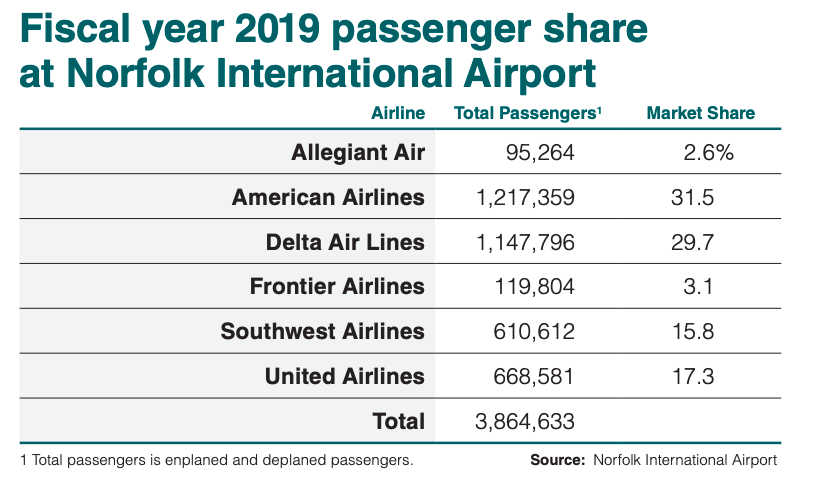
Allegiant Air
Cincinnati (CVG), Cleveland (CLE), Fort Lauderdale (FLL), Fort Myers-Punta Gorda (PGD), Jacksonville (JAX), Orlando-Sanford (SFB), Tampa-St. Pete (PIE)
American Airlines
Charlotte (CLT), Chicago-O’Hare (ORD), Dallas-Fort Worth (DFW), Miami (MIA), New York-JFK (JFK), New York-LaGuardia (LGA), Philadelphia (PHL), Washington-Reagan National (DCA)
Delta Air Lines
Atlanta (ATL), Boston (BOS), Detroit (DTW), Minneapolis-St. Paul (MSP), New York-JFK (JFK), New York-LaGuardia (LGA)
Frontier Airlines
Denver (DEN), Orlando (MCO)
Southwest Airlines
Atlanta (ATL), Baltimore (BWI), Denver (DEN), Chicago-Midway (MDW), Nashville (BNA), Orlando (MCO), San Diego (SAN)
United Airlines
Chicago-O’Hare (ORD), Denver (DEN), Houston (IAH), Newark (EWR), Washington-Dulles (IAD)
American Airlines
Charlotte (CLT), Philadelphia (PHL)
Delta Air Lines
Flights suspended as of September 2020

Fairfax County and Dominion Energy Inc. began testing a 13-foot autonomous, electric shuttle this summer, a first step toward driverless public transit between Metro stations.
The EZ10 shuttle nicknamed “Relay,” built by French manufacturer EasyMile and owned by Dominion, is expected to hit the road this fall between the Dunn Loring Metrorail station and the county’s bustling Mosaic District, in a pilot program. The aim is to make public transit easier and more convenient by adding shuttle service between bus stops and Metro stations, as well as nearby businesses, says Rachel O’Dwyer Flynn, Fairfax County’s deputy county executive.
“One of the reasons the location was selected [is] how far people will walk to viable transit,” Flynn says. “If it’s farther than a mile, then they tend to get into their cars rather than make that walk.”
County staff and supervisors are currently gauging interest in other EZ10 routes that could serve high-population areas. Fairfax received a $250,000 grant from the Virginia Department of Rail & Public Transportation for the shuttle’s first year of operation, and the county has contributed $50,000. This is the first time Virginia state funds have been used to test autonomous technology in public transportation.
The shuttle is operated by Transdev North America, which also operates the county’s bus system and has overseen similar autonomous shuttles in three other states. The pilot route would ideally be served by three or four shuttles, limiting wait times to five to eight minutes, Flynn says. The shuttles run 12 miles an hour, and they’re active in 16 cities across the country.
There have been safety concerns about driverless vehicles, and in February, the National Highway Traffic Safety Administration suspended shuttle use for nearly three months after a passenger in Columbus, Ohio, fell during an emergency stop. Now, the shuttles are required to have seatbelts, as well as signs and announcements about sudden stops.
Still, the EZ10 and other autonomous vehicles are typically safer than humans behind the wheel, says Julie Manzari, innovation strategist for Dominion. The shuttles use GPS and sensors to spot hazards and respond by slowing or stopping. An attendant will be on board to monitor safety and stop the vehicle manually if necessary, and the state will conduct a safety audit.
“[It] never gets distracted by … a text message or a nice building, or a friend it sees on the sidewalk,” Manzari says.
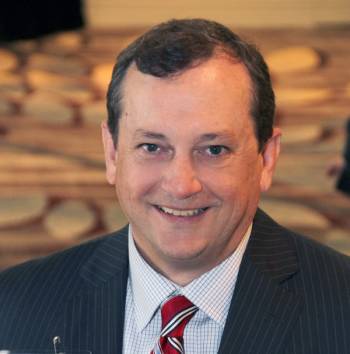
Executive vice president, Virginia Maritime Association
What do you consider the most pressing issue facing the Hampton Roads region?
The maritime industry is in the best position to drive the economic growth and job creation for the region. Capacity at the container terminals has been increased to move an additional 1 million containers annually, and dredging is ongoing to make our shipping channels the deepest on the East Coast. These improvements attract businesses involved in international trade and logistics, as evidenced by Amazon’s recent announcement it will build new facilities in Suffolk and Chesapeake, creating 1,500 new well-paying jobs. The U.S. Navy plans to increase and modernize its fleet, and Newport News Shipbuilding has a 10-year backlog of work requiring thousands of new employees. That larger, more modern fleet will require the maintenance capabilities of the companies and workers in our already robust and vital ship repair industry.
Offshore wind development is beginning off the coast of Virginia Beach, Kitty Hawk and elsewhere on the East Coast. Hampton Roads is well-positioned to become the epicenter of these construction and subsequent operations and maintenance activities, resulting in thousands of well-paying new jobs in the 757. The need is for regionwide prioritization and alignment of efforts to develop the supply chains and talent necessary to fully leverage these opportunities.
What changes did you see among VMA member companies due to the COVID-19 pandemic, and how are they doing now?
Our members are largely essential service providers that incurred additional costs to adjust operations and put new safety measures in place to protect employees while they continued to operate, while also experiencing declining volumes and revenues. Fortunately, business for many is bouncing back faster than expected, and forecasts are improving.

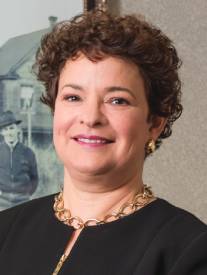
President, William & Mary
What is William & Mary doing to prepare students for the workforce, and how does a liberal arts curriculum fit into a world increasingly focused on STEM?
Beyond the health and safety of our community, this is the question that keeps me up at night since prior economic downturns have been so hard on rising college graduates. Early in the summer we gathered all staff and administrators doing anything related to career services across the university into a unified Career Pathways Team. They designed an entirely virtual program for the year focused on resilience, adaptability and innovation — calling in alumni, parents and employer partners to support career readiness in this new landscape.
Big picture: A liberal arts and sciences degree is the best preparation for today’s workforce, precisely because we are seeing such rapid change in all industries. The capacities every job requires now are adaptability and range. David Epstein details this in his book “Range”: People who have the capacity to apply their skills flexibly across multiple domains will be most in demand.
The current challenges to create a COVID-19 vaccine offer an example. We need scientists developing the vaccine and, beyond that, we need generalists who can tackle the ethical, economic, logistical and demographic issues that arise once a vaccine is validated and ready for distribution. How do we produce enough [vaccine doses] fast enough and get vaccines to people? Who needs them first? Who is most vulnerable? How do we educate communities to build trust in how vaccines work? With a W&M graduate, you get someone prepared to tackle such complex, multidimensional challenges.
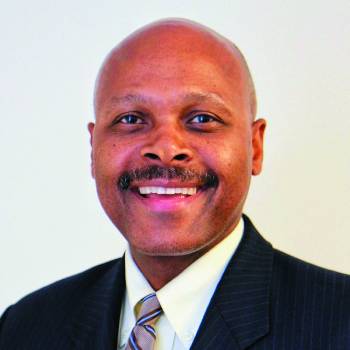
President, Newport News Shipbuilding
What do you consider the most pressing issue facing the Hampton Roads region?
Businesses, education institutions and the community must share in the responsibility of developing a skilled workforce. That’s why Newport News Shipbuilding has made significant investments in workforce development, education and training initiatives, from our Apprentice School to STEM programs in elementary, middle and high schools.
For the maritime shipbuilding and repair industry, this starts with efforts like the Maritime Industrial Base Ecosystem coalition, which is bringing together industry partners from Hampton Roads and across the commonwealth to examine how we can best prepare to support increasing maritime demands.
What developments are best paving the way for the region’s future?
Looking forward, it’s clear that we can no longer go on with business as usual. The future of Hampton Roads depends on our ability to work together to succeed. I am pleased with continued efforts to promote regional cooperation, and we must continue to break down barriers to find collective solutions to the challenges we all face. This ultimately brings me back to my previous point on workforce development. Our company has a strong track record of partnership with public school systems and community colleges.
On the Peninsula, New Horizons is an asset in providing centralized career and technical education programs for students in seven localities. As we look to increase our collaboration with schools in South Hampton Roads, a similar type of regional cooperation around CTE would benefit students, communities and businesses alike. We owe it to each other to work together to address these pressing regional challenges.
President and CEO, Local Initiatives Support Corp. (LISC)
How has the pandemic affected LISC’s priorities in terms of supporting underinvested communities?
Between grants and forgivable loans, we will have spent more than $200 million on that kind of assistance. That’s since March! There’s no looking back.
We’ve received about 570,000 applications for small business grants across the country since March. By the end of the year, we will have received a million requests for grants from small businesses.
Our focus has been on businesses that don’t have ongoing relationships with mainstream financial institutions. Over 90% of our grant recipients are businesses led by people of color; 44% of those were African American. Over 85% of businesses we’ve served have been businesses led by women; about 85% have been businesses serving low-wealth communities. Those are the ones most threatened right now.
What developments in Hampton Roads do you consider the most important for the region’s future?
The most promising development I was seeing [before the pandemic] was this budding entrepreneurial ecosystem: incubators, accelerators and angel funders. And the question is, what do COVID and the recession do to that ecosystem? Does it bounce back? Does COVID kill it?
The talent is here, but what [Hampton Roads] needs is more opportunities for that talent to flourish right here. Otherwise, the talent will go to D.C., will go to Richmond, will go to Raleigh. It’s going to take concerted effort from the public and the private sector to help people with small businesses come back. It’s all about resilience.
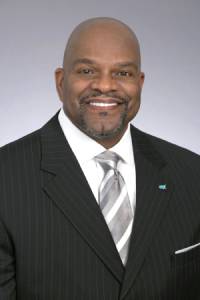
Senior vice president and region manager of Virginia operations, Cox Communications
What do you consider the most pressing issue facing the Hampton Roads region?
Hampton Roads is one of the most diverse regions in the nation, so let’s move the conversation from “diversity and inclusion” and focus on “equity.” Equity means every employee, regardless of their background, has equal access to growth opportunities. Our C-suites must reflect the communities we serve. And for that to happen, equity must be ingrained in our business cultures.
How has business changed at Cox during the pandemic?
At our core, we’re still the same — innovative and dedicated to doing what’s right. But how we accomplish our work has changed due to COVID-19. For example, we expedited virtual assist and augmented reality tools to support our customers when we couldn’t enter their homes. Additionally, we’re encouraging all our employees who can work from home to continue doing so until January 2021.
Are there any special challenges the Hampton Roads area faces in making sure businesses, schools and households are all able to access reliable internet?
Connectivity is important at any time but during this unprecedented time, it’s everything. Our low-cost internet program, Connect2Compete, is a tremendous resource for families receiving government assistance. For less than $10 a month, students can get internet at home for distance learning. And through June 30, 2021, we’re suspending late fees and extending payment relief options for Connect2Compete customers who express an inability to pay due to pandemic hardships.
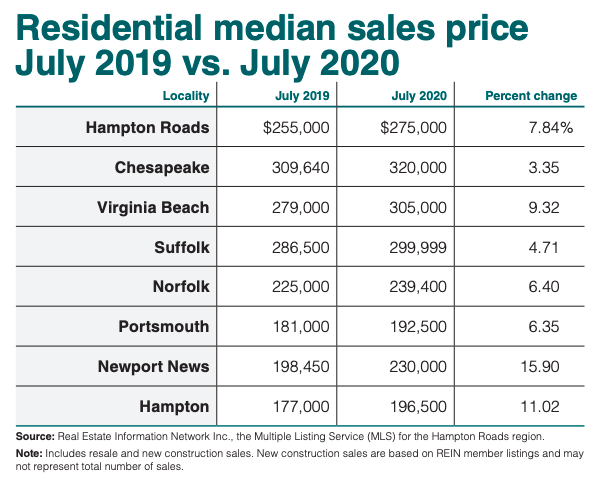
Hampton Roads home values continued trending upward from July 2019 through July 2020.
According to the latest available data from the Real Estate Information Network Inc., the Multiple Listing Service for the region, the median price of buying a home in Hampton Roads this July was $275,000 — a 7.84% increase from July 2019.
When looking at the region’s seven major cities — Chesapeake, Hampton, Newport News, Norfolk, Portsmouth, Suffolk and Virginia Beach — the median sales price of homes in Newport News increased by the highest percentage, from $198,450 to $230,000 in the 12-month period between July 2019 and July 2020, an increase of 15.9%.
Sales values increased the least in Chesapeake. The median sales price in the city rose from $309,640 in July 2019 to $320,000 this July, an increase of 3.35%. But the city does have the highest median sales price across the region.
Portsmouth had the lowest median sales price in Hampton Roads, with $192,500 in July, a 6.35% increase from July 2019, when the median sales price was $181,000.
“Seeing these types of numbers is fantastic, but we do have low inventory,” says Barry Nachman, president of REIN’s board of directors. “Anything that hits the market sells quickly. The market is great. It’s a good time to buy and sell.”