Dominion Energy Inc. has reached an agreement with two companies to charter its offshore wind turbine installation vessel to assist with construction of two offshore wind farms in the Northeastern U.S.
It will be the nation’s first offshore wind vessel in compliance with the Jones Act, which requires goods shipped between U.S. ports to be carried on U.S.-flagged, U.S.-built ships. Charybdis will be 472 feet long, 184 feet wide, 38 feet deep and will be made of 14,000 tons of steel, with nearly 10,000 tons sourced from the U.S. The vessel can hold up to 119 people, including somewhere between 20 and 30 maritime crew and 30 to 100 wind turbine workers, depending on the vessel’s mission at the time.
“A Jones Act-qualified installation vessel is a game changer for the development of the U.S. offshore wind industry,” said David Hardy, CEO of Ørsted Offshore North America, in a statement. “This investment will enable us to unlock the economic benefits of offshore wind, not just for the Northeast, but for the Southern states as well. We’re proud to partner with Dominion Energy and Eversource on this historic milestone.”
The $500 million watercraft, Charybdis, is expected to be sea-ready by late 2023, and will be responsible for carrying materials and assisting in the construction of offshore wind farms.
It will first be deployed out of New London harbor in Connecticut to support the construction of Revolution Wind and Sunrise Wind, both under joint development by Ørsted and Eversource, according to Dominion’s release.
The projects are set to serve nearly one million homes in Rhode Island, Connecticut and New York. Once complete, the two farms will generate more than 1.6 gigawatts of energy.
The Coastal Virginia Offshore Wind project will support roughly 900 jobs, with about 60% in Hampton Roads, leading to more than $143 million in economic output. Once construction is completed in 2027, more than 1,100 workers in Hampton Roads would operate and maintain the wind farm. That could translate into $210 million in economic output for the region, generating nearly $6 million in local tax revenue, according to Dominion.
Sentara Healthcare is allocating $40 million to expand its Healthier Communities Fund across Virginia and northeast North Carolina, with an aim to address health disparities that have been magnified by the impact of COVID-19 among underserved populations.
Today’s announcement follows an initial $10 million the Norfolk-based health care system pledged in January to address health disparities and bolster regional health sciences programs, according to a Sentara news release.
The $10 million will be disbursed during a two-year period among Sentara’s partner universities, including Old Dominion University and Norfolk State University; as well as Eastern Virginia Medical School and organizations in Hampton, Newport News, Williamsburg and Suffolk. The funding will go to community-based health efforts such as mobile clinics, community clinics, health screening, testing, behavioral health services and access to nutritious foods as well as academic scholarships for underrepresented students, according to a Sentara spokesperson.
The fund will allow for more engagement of community members, including faith-based leaders, in the distribution of the funds and will include an employee-led fund that allows Sentara team members to directly influence the distribution of funds.
“As we continue to face the impact of a pandemic of unprecedented magnitude, never has our community commitment been more vital,” Sentara President and CEO Howard Kern said. “In order to drive lasting change, we must forge new partnerships, strengthen longstanding relationships and marshal resources to build stronger, healthier, more equitable communities together. Based on the overwhelming response to the Sentara Healthier Communities Fund, Sentara is proud to be able to provide additional support to tackle these pressing issues.”
In 2020, Sentara invested nearly $256 million to support communities through health and prevention programs, teaching and training opportunities for health care professionals, philanthropic giving and uncompensated patient care.
In a statement Tuesday, Virginia Gov. Ralph Northam, a 1981 VMI alumnus, said, “The investigation found that institutional racism and sexism are present, tolerated and too often left unaddressed. While VMI has taken incremental steps forward since this review began, much more is needed. The question is whether VMI is willing to acknowledge this reality. The commonwealth will study this report carefully and then take appropriate action. VMI would be wise to do so as well. VMI is an agency of state government, and we will hold it accountable.”
The Washington, D.C.-based law firm Barnes & Thornburg LLP conducted the state-funded equity investigation into VMI beginning in January, interviewing cadets, alumni, faculty and staff. The firm’s final equity audit report describes the culture at VMI as “one of silence, fear and intimidation,” based on statements by current cadets, alumni and faculty — including during the investigation. “Interviewees reported that, in some sexual assault cases, members of the VMI administration have actively dissuaded victims from making reports. Interview respondents also explained that they perceived or experienced that VMI leadership puts a high priority on suppressing information and avoiding difficult situations, and less of a priority on addressing underlying problems. The [investigative team] had the same experience. VMI has taken affirmative steps to prevent negative information from making it into this report.”
VMI posted a new page Tuesday on its website titled “VMI Promise” that acknowledges the accusations and adds that the school is “a microcosm of society and not immune to the challenges of racism of sexual misconduct which occur on college campuses across the nation.” The statement notes, though, that “There are some who have made allegations that institutional racism is prevalent at VMI, but the facts simply do not support that position. Like many college campuses, we too have had incidences where racial slurs and racist acts have been perpetrated. That is not an experience that any of our cadets should have to endure, and we have taken action to address that concern. According to a 2017 report from the U.S. Department of Education Office of Civil Rights, VMI has implemented systems and training programs to properly address those issues.”
The institute also promotes its initiatives to “strengthen diversity, equity and inclusion efforts” on the page, including the hiring of its first chief diversity officer in late May. However, the investigative team found that VMI lags significantly behind other military colleges in DEI programs and that it “does not have a DEI plan, just a statement of diversity.”
In March, the firm released an interim report in which alumni and current cadets said they heard racial slurs “on a regular basis” at the school. A Black alumnus said he was called the n-word “many times” between 2018 and 2021, and in the mid-1990s, an Asian graduate said he “routinely” was called “sand n-word” by an upperclassman.
The final report also notes that sexual assault, especially against female cadets, is “prevalent,” yet has been “inadequately addressed by the Institute.” Fourteen percent of current female cadets reported being sexually assaulted at VMI, while 63% said that a fellow cadet — both men and women — had told them they had been a victim of sexual assault during their time at the institute. The report says that 27% of current female cadets reported being sexually harassed at VMI, and female faculty members and staff also reported sexual harassment at the institute.
A current female cadet told investigators that a staff member told one of her female friends, “If you cannot handle sexual assaults, you should not be at VMI,” the report says.
Despite “extensive” sexual assault training, “female cadets report that male cadets treat it as a joke and an opportunity for misogynistic humor, without consequence.” Many women said they reported their assaults but that they went “unaddressed” by VMI administration, and that at times administrators “intimidated female cadets to reconsider assault reports.”
The report determines that “issues of gender inequity and sexual assault may not be unique to VMI. But the character, quantity and severity of the issues described … do not exist everywhere. These issues are worse at VMI and they need to be addressed immediately.”
VMI’s statement on its website, though, said, “It cannot be overstated — sexual harassment or sexual assault is not and will never be tolerated at this institution. Perhaps what pains us most is hearing some cadets and alumni say that they were apprehensive to bring issues forward out of fear of reprisal. No cadet should ever feel the administration, faculty, or staff at VMI are not here for them. Addressing these issues is of paramount importance.”
In its recommendations, the five-person investigation team writes in the report that VMI should be required to submit regular written reports to the governor, the General Assembly and other stakeholders, but it stops short of recommending that “any of VMI’s core policies, practices and traditions, including the Honor Code and Rat Line, be abolished.” The report also recommends “that VMI leadership examine how it can create an environment that does not disadvantage or impose disparate effects on minorities.”
In the introductory summary of the report, the investigative team wrote that the school “has sustained systems that disadvantage minority and female cadets and faculty, and has left VMI trailing behind its peer institutions. If VMI refuses to think critically about its past and present, and to confront how racial and ethnic minorities and women experience VMI, it will remain a school for white men.” Although the installation of retired U.S. Army Maj. Gen. Cedric T. Wins — VMI’s first Black superintendent — as interim superintendent in November has led to some positive change, the report says that “many in the VMI community, including senior leaders, perceive no issues or reasons to change.”
Specifically, the report says that 42% of current Black cadets responded that they are discriminated against “a lot” at VMI, and half say they “strongly or somewhat agree that there is a culture of racial intolerance at VMI,” while the number of white cadets who agree with these statements are much lower.
“Racial slurs and jokes are not uncommon on post,” the report adds, and VMI’s response is “insufficient,” with administrators sometimes excusing such offenses, although the school provides “education and training” to cadets who say racially or ethnically offensive statements.
The report also says that a common opinion among white participants is “that there is not a race problem, but a problem with a divide between athletes and nonathletes,” with nonathlete cadets feeling that NCAA athletes receive preferential treatment at the school. As for allegations that Honor Court and Honor Code cases are conducted unfairly, the report says that they are fair “when examined in isolation” although of 91 cases involving convictions over the past 10 years, 41% of dismissed cadets were nonwhite, despite making up only 23% of the corps.
“Elimination of the fundamental elements of the Honor Code or Honor Court is not recommended,” the report says, but the institute “should include a root cause analysis of these statistics, revisions to training and procedures to implement more equitable processes.”
The report also says VMI has an “outdated, idealized reverence for the Civil War and the Confederacy,” including traditions related to the era “given disproportionate attention.”
VMI’s Board of Visitors has scheduled a special meeting Wednesday afternoon that the school described as primarily a closed meeting “to receive consultation regarding specific legal matters … regarding to the ongoing equity audit of VMI.”
The State Council of Higher Education for Virginia (SCHEV) released the 150-page report Tuesday. “SCHEV will not reach any conclusions or make any recommendations on the … study until after we have had ample time to review it,” SCHEV Director Peter Blake said in a statement. “We look forward to engaging VMI as well as the broader higher education community to consider issues raised by the report and recommendations.”
According to the school’s VMI Promise webpage, there will be a cadet-led Cultural Awareness Training program that is in development, with a goal of enhancing cadets’ “understanding of cultural differences amongst members of the Corps and to promote civility and respect.”
Last year, The Roanoke Times and The Washington Post reported recent cadets’ allegations of racist behavior and words by fellow students and faculty, including a Black student who said he was threatened with lynching by another cadet in 2018. The public airing of cadets’ complaints led to the October resignation of VMI Superintendent J.H. Binford Peay III, a retired U.S. Army general who served as the school’s leader for 17 years, and the removal of the school’s Stonewall Jackson statue, which honored the former Confederate general and VMI educator. Until recent years, cadets were required to salute the monument as they passed.
In May, VMI hired Jamica N. Love as chief diversity officer. She will report to Wins beginning July 9.
With high-speed subsea internet cables landing on Virginia Beach‘s shores and massive wind turbines propelling off its coast, the state’s largest city is primed to welcome new businesses and industries generating high-end jobs.
“Virginia Beach is going to be the epicenter of economic development on the East Coast,” says Mayor Bobby Dyer. “I am convinced of that. That’s my personal mission.”
Focusing on technology and renewable energy, Virginia Beach seeks to attract more high-tech industries, including those that would use the trio of the world’s fastest subsea cables that come ashore at Telxius’ 24,000-square-foot landing station in the Virginia Beach Development Authority’s Corporate Landing Business Park. MAREA, owned by Microsoft, Facebook and Telxius, connects the city to Spain, while Telxius’ BRUSA cable links Brazil to Puerto Rico and Virginia Beach. Google’s Dunant submarine cable, which became operational earlier this year, connects Virginia Beach with Spain, Brazil and France. A fourth cable traveling from New York City to near Miami and branching off to Virginia Beach, Myrtle Beach, South Carolina, and Jacksonville Beach, Florida, also is in the works, and city officials have discussed bringing in 14 additional cables in the near future.
Located between General Booth Boulevard and Dam Neck Road, Corporate Landing Business Park is on track to become a mid-Atlantic hub for intercontinental subsea cables. Taking advantage of the park’s direct connection to the subsea cables, Globalinx and PointOne are developing data centers designed to attract large cloud computing companies along the lines of Amazon.com Inc., Netflix and Facebook, as well as military and government tenants. “Our facility is designed to accommodate customers who use subsea cables, but it’s also designed for local businesses that need data enterprises,” says Colin Clish, chief operating officer of Alberta, Canada-based PointOne.
Virginia Beach City Council member Ben Davenport is focused on attracting more high-tech jobs for local college graduates. Photo by Mark Rhodes
Virginia Beach also wants to attract industries supplying components for East Coast offshore wind farms, including Richmond-based Dominion Energy Inc.’s Coastal Virginia Offshore Wind Project. In a pilot phase designed to generate energy for 3,000 homes, Dominion installed two massive, 600-foot-high wind turbines
27 miles off the Virginia Beach coastline last summer. By 2026, Dominion plans to build a major offshore wind farm there, erecting 188 turbines in adjacent waters — enough to power more than 650,000 homes. Achieving that ambitious goal will require establishing a wind energy construction supply chain that economic development officials foresee as becoming an East Coast hub as future offshore wind operations come online.
“With that plethora of technology, there will be potential job opportunities as we attract companies,” Dyer adds. “This is a really desirous location for a lot of businesses, and we’re going to roll out the red carpet for them.”
Cable ready
A technology and innovation task force, chaired by former Virginia Beach City Council member Ben Davenport, is examining the city’s ability to attract high-end tech jobs and increase workforce-training opportunities. “One of the problems we have in Virginia Beach is a lack of job opportunities for recent college graduates,” Dyer says. “We want to create situations where people’s children can find jobs here and keep families intact. That’s the ultimate economic development objective.”
Davenport, vice president of strategic development at Global Technical Systems, adds that the city is a prime location for technology enterprises. “We want to continue the momentum in building the technology ecosystem in Virginia Beach and ultimately in all of Hampton Roads,” he says. “If we continue down the road we’re on and make this an attractive place economically for internet ventures, we will have tremendous success. There are a lot of opportunities we are going to be chasing.”
Along with the subsea cables, Virginia Beach has one of the state’s lowest tax rates for data center equipment and one of the lowest municipal tax rates in the country, and officials worked with the U.S. Navy to establish the nation’s first cable landing protection area. “We’ve created a business environment that incentivizes the location of these activities,” says Virginia Beach Economic Development Director Taylor Adams.
Site work has been completed and the foundation poured for the first phase of NAP (Network Access Point) of Virginia Beach, a spec data center under development across from the cable landing station. The project was announced in late 2018, but work was suspended because of the pandemic. Now, PointOne is negotiating with potential tenants as it prepares to resume construction on the first of two 39,530-square-foot buildings on the 10.7-acre site. “We’re in the leasing stage with potential customers, but we don’t plan to start construction on the building until we secure a major tenant,” Clish says.
Additionally, the center will be able to accommodate growth from the existing cables, as well as new cables landing in Virginia Beach. “Virginia Beach is absolutely going to see two to five new cables in the next three to five years,” Clish adds.
Although there is room for more subsea cables, the city does not have available land to house massive data centers like Facebook’s 500-acre Henrico facility. “Virginia Beach doesn’t have that possibility,” Davenport acknowledges. “But we can work with other regional localities with more available landmass. As the region succeeds, our city succeeds.”
Wind energy
Virginia Beach also is spearheading efforts to boost Hampton Roads’ role in constructing a supply chain for the offshore wind industry. “Virginia Beach is a leader, but it’s too big of an initiative for any one city to act alone,” Adams says, noting that Dominion Energy’s offshore wind farm is one of eight to 10 similar projects on the East Coast. “There certainly is enough volume to see some of the suppliers locally here. I don’t think anybody fully knows the ultimate opportunities of companies coming here.”
Dominion Energy’s offshore wind farm also could help Hampton Roads attract data centers, adds Davenport. “Data centers are huge consumers of power,” he notes. “Dominion’s project paints the perfect picture of why Virginia Beach and Hampton Roads are one of the best places in the country for data centers. There will be an abundance of clean, renewable energy off the coast. Most in the data center industry see that as a big-time plus.”
To ensure local labor is prepared to support these emerging industries, the city has allocated $1 million for a Tidewater Community College program to teach skills to support offshore wind and is engaging with TCC and Old Dominion University to address high-tech workforce issues. Virginia Beach also is working with the military to ensure the more than 13,000 officers and enlisted personnel leaving the Navy each year can transfer their experience into local jobs.
“Many of those individuals come out with skill sets that are perfect for the technology industry,” Davenport says. “We have to create a technology economy here in Hampton Roads and ensure that we place them in opportunities where they will stay in Virginia Beach.”
Meanwhile, the city is partnering with Naval Air Station Oceana to explore economic development opportunities around the massive installation. Freeing up land around Oceana would help reduce the base’s overall costs and bring additional tax revenues to the city, says Dyer. “It’s still early in the process, but there is a plethora of potential there that the Navy is embracing with us.”
Overall, Virginia Beach’s economy remains strong despite the COVID-19 pandemic. Last year, more than 1,700 jobs were created in the city, representing a nearly $228 million investment and projected tax revenues of $55.8 million over the next two decades. “We’re really an economic engine for the entire region,” says Adams, noting that manufacturing, defense, logistics, office and tourism sectors continue to perform well, while the city’s unemployment rate is recovering from the pandemic. “We’re confident we’re on the road back to where we were.”
Engine trouble?
Dyer attributes Virginia Beach’s economic growth to business owners’ tenacity and resilience. “A lot of credit goes to the strength of Virginia Beach and the people of Virginia Beach who live, work and have businesses here,” he says. “Our strengths are our people, [who] make Virginia Beach a true, desirable destination where people are welcomed.”
One of the state’s top tourism destinations, Virginia Beach recorded the country’s highest hotel occupancy for 18 consecutive weeks last year amid the pandemic. “Once the beaches opened, that certainly helped,” Dyer says. “People could come to the beach for a healthy weekend.”
Virginia Beach’s status as a landing point for intercontinental high-speed internet cables makes it an attractive environment for data centers, says city Economic Development Director Taylor Adams. Photo by Mark Rhodes
Many visitors attend events at the $70 million Virginia Beach Sports Center that opened last fall at the oceanfront. Featuring 12 basketball courts, 24 volleyball courts, a 200-meter track and seating for 5,000 spectators, the 285,000-square-foot facility has already welcomed several NCAA tournaments. “It hit the market during the pandemic and has been fully booked,” says Adams.
Expectations are high that Atlantic Park will enjoy similar success. A $325 million public-private partnership between the city, Venture Realty Group and music superstar Pharrell Williams, the project will include a surf park, apartments, retail offices and an entertainment venue on 10 acres between 18th and 19th streets. Construction is expected to begin late this year.
“Atlantic Park is a very big part of the oceanfront’s future,” says Dyer. “If you give people things to do that are fun and entertaining, it makes for a better situation.”
Tourism is one of Virginia Beach’s major economic engines, but the luster has faded in some areas of the oceanfront. In response, the city revived its Resort Management Office to enhance the 40-block commercial district. The office will interact with visitors, promote safety, address homelessness issues and encourage property owners to update signage, awnings and other infrastructure.
Safety at the oceanfront has come under increased scrutiny after two people died (including a cousin of Williams who was shot by a police officer) and eight others were injured during a chaotic night of gunfire in late March. In response, City Council approved a $1.87 million public safety plan, including adding security cameras and lighting and a gunshot
detection system.
Still, local officials stress that the violence was an isolated event, and they tout rankings in recent years listing Virginia Beach as one of the country’s safest large cities. “The city is being proactive, and we’re confident we will have a safe season going forward,” Dyer says. “We want people to come to the oceanfront, but we expect them to respect the law and each other.”
Big plans are in place for a 103-acre plot on the Loudoun-Fairfax county line, property originally pitched by the two counties as a potential location for Amazon.com Inc.’s HQ2 East Coast headquarters.
Rivana at Innovation Station, the first phase of the 4.4 million-square-foot Innovation Station mixed-use development project announced in March, is ideally positioned for a changed business world, says Loudoun Economic Development Executive Director Buddy Rizer.
“This is coming online at a time when we can react to post-pandemic demand. We can respond to what office users of the future want,” in terms of safe building design such as smaller elevators and wider hallways, he says. “We can compete for large Class A office users. I think it’s a game-changer.”
Innovation Station will be connected to the planned Innovation Center Metro station, expected to open in Herndon this summer on the Silver Line.
In addition to more than 1,950 apartments and 1.8 million square feet of office space, Rivana’s plans call for an 11-acre park that will allow for the kind of open-air activities that have become popular since the start of the pandemic, Rizer says. “We’ll be able to capture that new dynamic. You can do all kinds of things. There can be corporate meetings on the lawn, yoga in the park.”
There also will be a 3,000-seat performing arts venue. “There can be concerts or TED Talks, community use. It will be a great location for corporate meetings,” he says.
The goal of the project is “to create a sense of place,” says Jeffrey D. Young, managing partner of Origami Capital Partners LLC, based in Chicago. Origami is one of four real estate and investment firms, most based in Texas, that co-own Novais Partners, the master developer of Innovation Station and co-developer of Rivana with Houston-based The Hanover Co.
“We want to draw people in, so they want to come and spend the day,” Young says. The developers plan to do that by “curating local culture into the retail, having farm-to-table restaurants, celebrating the Loudoun winemaker who sells wine, so that people have something they’re not getting at any other place.
“I envision people wanting to get married there,” he adds. “There’s the park setting and the entertainment venue and a hotel nearby.” (Rivana plans also call for a 265-room hotel.)
Groundbreaking for Rivana is set for early 2022. Fairfax County will be more involved in the development’s second phase, Young says.
In late April, Salem-based LewisGale Regional Health System broke ground for a new freestanding emergency room in Roanoke. Located on West Ruritan Road, the nearly 10,000-square-foot facility will be named LewisGale Medical Center Blue Hills ER and staffed with board-certified emergency room physicians and nurses. It is expected to open in 2022. (VirginiaBusiness.com)
In May, Roanoke’s Mill Mountain Theatre had its first in-person performance since 2019, staging Shakespeare’s “A Midsummer Night’s Dream” on the front lawn of Heights Community Church in Roanoke’s Grandin Village. The theater’s COVID-19 compliance officers put in their share of work. While seven members of the cast and MMT’s full staff already were vaccinated, actors who hadn’t yet been vaccinated were tested before performances. MMT plans to return to indoor performances at its theater in mid-June, including a production of “Legally Blonde” opening in late September. (WVTF)
Passenger train service will return to the New River Valley for the first time since 1979, Gov. Ralph Northam announced in early May. The $257.2 million deal with Norfolk Southern Railway is in addition to the $3.7 billion rail expansion Northam announced in March as part of the Transforming Rail in Virginia program. The agreement, called the Western Rail Initiative, extends service to the city of Radford and the counties of Floyd, Giles, Montgomery and Pulaski. It also increases intercity passenger rail service between Roanoke and the Northeast Corridor, and the initiative includes $219 million in infrastructure investments. The completion date is set for 2025. (VirginiaBusiness.com)
A new government website and interactive map was launched in late April for citizens to monitor progress on a variety of broadband expansion projects dotting Roanoke County. After a final vote in April to approve a $3 million project with Cox Communications that will expand internet access to more than 300 homes in Windsor Hills, Cave Spring and Catawba, the county has amassed close to $4 million in private, local, state and federal funds for rural broadband in the past year. (The Roanoke Times)
In May, unionized workers at the Volvo Trucks North America plant in Pulaski County soundly rejected a five-year contract, negotiated after a strike that ran from April 17 to April 30. According to a notice posted on the United Auto Workers Local 2069 website, workers voted “no” on aspects of pay, benefits and work schedules by margins ranging from 83% to 91%. It was not clear whether production at the Dublin plant proceeded normally after the vote, with the expected level of UAW-represented staffing, or how or when negotiations would resume. The plant employs more than 3,300 people, about 2,900 of whom are UAW members. (The Roanoke Times)
Wing, a subsidiary of Google corporate parent Alphabet, started using drones to deliver Girl Scout cookies in April to residents of Christiansburg. The town has been a testing ground for commercial delivery drones since 2019, with packages ranging from drugstore offerings, FedEx packages and cold brew coffees, but this is the first time Girl Scout cookies have been delivered by drone. Wing said it began talking to local troops because they’ve had a harder time selling cookies during the pandemic when fewer people were out and about. Federal officials started rolling out new rules in April that will allow operators to fly small drones over people and at night, potentially giving a boost to commercial use of the machines. (The Associated Press)
Eastern Virginia
People in Hampton Roads reported in early May that gas stations were sold out of fuel and station owners saw a spike in demand for gasoline in the days following a cyberattack on the Colonial Pipeline, which was shut down for several days. The fuel frenzy hit several states but was particularly hard on Hampton Roads and Northern Virginia, due in part to a shortage of tanker truck drivers. Gov. Ralph Northam declared a state of emergency that loosened the state’s regulations to make it easier to get gas in tanks and also punished suppliers for price gouging. (The Virginian-Pilot)
Integrity Bank for Business opened for business in Virginia Beach in early May. The first new community bank established in Hampton Roads
since 1998, Integrity received regulatory approval in April and is led by former Heritage Bank President and CEO Michael S. Ives. In January it announced that it had raised more than $20 million in stock purchase commitments. The bank plans to focus on serving business customers in Virginia Beach, Norfolk and Chesapeake. (VirginiaBusiness.com)
A modular housing manufacturer plans to establish its first East Coast facility in Newport News, investing $2 million and producing 220 jobs, Gov. Ralph Northam announced in mid-May. A public-benefit corporation and Certified B Corporation founded in 2018, indieDwell turns recycled shipping containers into small homes with one to four bedrooms to help solve the affordable housing crisis. The company currently has facilities in Idaho and Colorado, with plans to expand to other states, building factories in areas with low to moderate income and a need for affordable housing. (VirginiaBusiness.com)
Signs are pointing to the Hampton Roads region’s COVID recovery picking up steam if workers return to fill thousands of jobs that are coming open again, according to Bob McNab, director of Old Dominion University‘s Dragas Center for Economic Analysis and Policy. Before the pandemic, the region had a tight labor market with low unemployment — 2.9% in February 2020. Wages and income began to rise then, and now broad-based growth is returning on rising consumer confidence, increased vaccination and an increase in demand from deferred consumption and travel. Businesses, particularly in hospitality, have reported they’re having trouble finding workers, with many advertising sign-on bonuses. (The Virginian-Pilot)
Norfolk-based Sentara Healthcare was named one of the top five large U.S. health systems in an annual ranking by Fortune and IBM Watson Health released in late April. Sentara landed in fifth place, receiving five stars for clinical outcomes and operation efficiency and three stars for patient experience. This is the second year Sentara was ranked among the nation’s top 15 health care systems. Also, Sentara Leigh Hospital in Norfolk was named the No. 2 teaching hospital in the U.S. (VirginiaBusiness.com)
Agriculture startup Sunny Farms LLC plans to build a $59.6 million, 32-acre hydroponic operation in Virginia Beach, creating 155 jobs and one of the East Coast’s largest greenhouses, the governor’s office announced in April. The facility, which will cover 1.2 million square feet when completed in three years, will be at Taylor Farms off Dam Neck Road. The company’s co-founders, Jim Arnhold and Wayne Zinn, worked with the School of Plant and Environmental Science at Virginia Tech and other industry experts to develop the greenhouse. The development will be the site of a new workforce training nonprofit, One Matters Inc. (VirginiaBusiness.com)
Shenandoah Valley
The Frederick County Board of Supervisors has been sued for denying a conditional-use permit for a utility-scale solar power-generating facility in Gore. The lawsuit from Hollow Road Solar LLC, National Fruit Orchards Inc. and Diane Holmes, filed in April in the county’s Circuit Court, seeks a court order for supervisors to approve the permit. The suit also states the plaintiffs are entitled to a redress of $7.5 million. Supervisors voted 6-1 in March to reject the permit, which was part of the parties’ request to approve the county’s third solar facility within the past year. (The Winchester Star)
The Front Royal Warren County Economic Development Authority reached an agreement with its former executive director that requires her to pay the EDA $9 million to settle claims she used its money for her benefit. The EDA board voted in May to adopt a resolution that directs the Sands Anderson law firm to move forward with the judgment against Jennifer McDonald for no less than $9 million. The settlement cannot be discharged through her Chapter 7 bankruptcy case currently in federal court. (The Winchester Star)
Mary Baldwin University announced in late April it will require students 16 and older as well as faculty and staff to have a COVID-19 vaccination before returning to the Staunton and Fishersville campuses this fall. Earlier in the month, Attorney General Mark Herring said that Virginia colleges and universities have the right to require proof that anyone attending class in person has been vaccinated, although he left individual decisions up to schools. MBU, like most other schools with a vaccine requirement, is making an allowance for medical and religious exemptions. (News Leader)
Modine Manufacturing Co. will invest $7 million to convert its Rockbridge County warehouse into a manufacturing plant that will produce data center cooling solutions, creating 60 jobs, Gov. Ralph Northam announced in late April. Modine has had a manufacturing facility since 1963 in Buena Vista, where it employs more than 260 people. The new operation will be at Modine’s former warehouse at 360 Collierstown Road.(VirginiaBusiness.com)
Virginia Military Institute, which was pressured last year to remove a prominent statue of Confederate
Gen. Stonewall Jackson, took more steps to reduce its lingering tributes to the Civil War leader, a former professor at the college who owned six enslaved people. In its most notable decision made in early May, the college’s board of visitors voted to erase Jackson’s name as the author of a quotation mounted in bronze in the student barracks — a mantra that cadets and alumni memorize and has been engraved in class rings: “You may be whatever you resolve to be.” The maxim will remain, but the words “Stonewall Jackson” will be scrubbed. (The Washington Post)
The Washington and Lee University board will announce its name change decision in June, almost a year after the formation of a special committee to reconsider the university’s relationship to Robert E. Lee. The deliberation over dropping Lee’s name from the university has been lengthy. It began in July 2020, when the board formed a committee to gather input from all campus constituencies, analyze data and consult relevant experts. Mike McAlevey, rector of the board, announced the June deadline in a May email to the university community. (The Roanoke Times)
Southwest Virginia
Without naming Bristol, the executive director of the Virginia Lottery in April all but ruled out the possibility that a temporary casino could open this year. Officials of the Hard Rock Bristol Hotel and Casino Resort have on multiple occasions voiced plans to host temporary gaming while the casino project is being developed at the former Bristol Mall. The enabling legislation allows for a temporary location for up to one year before the permanent site opens but only after the gaming license is approved and several other steps occur. Lottery officials are currently developing regulations to govern the operation of five casinos in the state. (Bristol Herald Courier)
The federal Interagency Working Group on Coal and Power Plant Communities identified Southwest Virginia as the fourth most coal-dependent area in the United States in a report in late April. The finding, which is based on the percentage of total direct coal jobs relative to all employees within a region, designates the region as a priority community for “initial federal investments.” Roughly $38 billion in federal funding could be available for communities likely to be hard-hit by coal mine and power plant closures. The working group, which was created in January, consists of 11 federal agencies and the Appalachian Regional Commission. (Virginia Mercury)
Faulkner
Traeger Grills, manufacturer of the world’s top-selling wood pellet grill and signature hardwood pellets product, plans to build a $3 million manufacturing operation in Wythe County, Gov. Ralph Northam announced in late April. The company plans to purchase wood products exclusively sourced from
Virginia and create 15 jobs in Wythe. The Utah-based company will partner with Musser Lumber Co. Inc., which produces materials for wood pellet producers, decking manufacturers and plastic extrusion companies. Last August, Musser announced its own $2.4 million expansion in Wythe. (VirginiaBusiness.com)
In May, a Bristol, Tennessee, woman pleaded guilty in federal court in Abingdon for her part in a scheme to defraud the Virginia Employment Commission. The scheme involved dozens of co-conspirators, federal prosecutors said. Melissa Hayes conspired with others, including several people previously convicted in the case, to file claims for pandemic unemployment benefits through the VEC website, the U.S. Attorney’s Office said. The scheme involved submitting claims for several individuals who weren’t eligible to receive unemployment benefits, including inmates incarcerated in Southwest Virginia, prosecutors said. At least $499,000 in false claims were made. (Washington County News)
PEOPLE
Clark
Appalachian School of Law named its next president and dean, B. Keith Faulkner, in late April. He will begin his new role July 1, succeeding former Virginia Supreme Court Justice Elizabeth A. McClanahan, who will become president of the Virginia Tech Foundation in Blacksburg. Faulkner, previously dean of the Liberty University School of Law, was a litigator and served as the interim dean of North Carolina-based Campbell University’s law school. (Bristol Herald Courier)
Ballad Health named a new CEO of Smyth County Community Hospital in Marion. Dale Clark will succeed James Tyler, who is retiring, in early June, the health care system announced in May. Clark, a Bland County native who previously served as interim vice president and CEO of Ballad’s Wise County hospitals, will lead operations and services for the 44-bed acute care hospital and 109-bed nursing care facility. (SWVA Today)
Northern Virginia
Engineers working for the Metropolitan Washington Airports Authority determined in May thatAmazon.com Inc.‘s Helix structure at PenPlace is roughly 13 feet taller than the maximum allowable height for structures near Ronald Reagan Washington National Airport. MWAA, which manages both Reagan and Dulles International airports, is responsible for monitoring construction projects to ensure they comply with Federal Aviation Administration regulations. Amazon is seeking a variance from Arlington County to allow the Helix to reach a height of 354 feet. (Washington Business Journal)
Aerospace and defense contractor Boeing made a record $50 million, multiyear commitment to foster diversity at the Virginia Tech Innovation Campus under development in Alexandria, Virginia Tech announced in early May. It’s the largest corporate donation ever made to the university, and the commitment from Chicago-based Boeing also ties
the largest private donation made to Virginia Tech, a $50 million gift made in 2019 from the Horace G. Fralin Charitable Trust and Heywood and Cynthia Fralin for the Fralin Biomedical Institute at VTC. Boeing’s donation will include student scholarships, recruitment of faculty and researchers, and funding pathway programs for underserved K-12 students seeking STEM degrees and technology careers. (VirginiaBusiness.com)
Guidehouse, a management consulting company with clients around the world, will establish its global headquarters in Fairfax County, producing more than 900 jobs, Gov. Ralph Northam announced in May. The company plans to invest $12.7 million in a campus in McLean, where 1,550 people will work at full capacity. Virginia competed with Maryland and Washington, D.C., for the project. Owned by Veritas Capital, Guidehouse employs more than 9,000 people in more than 50 locations around the world and works in public and commercial markets, providing services in management, technology and risk consulting. (VirginiaBusiness.com)
U.S. Sens. Tim Kaine and Mark Warner, along with Maryland’s senators, wrote President Joe Biden in May, requesting the federal government resume the selection process for a new FBI headquarters in the Washington, D.C., suburbs. Springfield is one of three sites under consideration for a potential replacement for the deteriorating J. Edgar Hoover Building in downtown D.C. Congress previously appropriated close to $1 billion in the selection process, which also includes two sites in Prince George’s County in Maryland. (Washington Business Journal)
Herndon-based national security contractor Peraton Inc. completed its $7.1 billion, all-cash acquisition of Chantilly-based federal IT contractor Perspecta Inc. in May, according to an announcement by Peraton’s parent company, private investment firm Veritas Capital. The combined companies will be known as Peraton and will be overseen by Peraton Chairman,
Youngkin
President and CEO Stu Shea. The purchase follows Peraton’s $3.4 billion cash acquisition in February of Northrop Grumman Corp.’s federal IT and mission support services business. (VirginiaBusiness.com)
People
Former private-equity chief Glenn Youngkin of Fairfax County became the Republican nominee for Virginia governor in May after his closest rival, business executive Pete Snyder, conceded while votes were still being tabulated. The two candidates, both of whom embraced the politics of former President Donald Trump, had been the leaders throughout the complicated, ranked-choice balloting process that slowly whittled down the field from seven contenders. Youngkin was CEO of Washington, D.C.-based The Carlyle Group and has an estimated personal worth of more than $200 million. Democrats are set to choose their slate of candidates in a June 8 primary. (The Washington Post)
Southern Virginia
The Danville Industrial Development Authority and The Alexander Co. are teaming up to redevelop the city’s White Mill on the Dan River as a mixed-use commercial and residential project, with $62.5 million invested in the first phase, city officials announced in May. Interest in the building, which once housed part of the defunct Dan River Mill’s manufacturing business, grew following the city’s approval of the Caesars Virginia casino project last year. The redevelopment will feature 110,000 square feet of commercial space and 150 apartments in the first phase, set to be completed in the summer of 2023. Another 100 apartment units are planned for the future. The Riverwalk Trail along the river also will be extended, and there will be a whitewater feature on the canal on the mill’s south side. (VirginiaBusiness.com)
The largest single private land conservation gift to the state — 7,300 acres in Halifax County — was donated in April by North Carolina billionaire and Epic Games Inc. CEO Tim Sweeney. Known as Falkland Farms, the tract will be owned and operated by the Virginia Department of Conservation and Recreation and renamed the Southside Virginia Conservation and Recreation Complex. The property will be the first joint project between DCR’s Natural Heritage Program and Virginia State Parks, and the heritage program will conduct habitat restoration to replenish forest ecosystems. The land is home to 17 species of rare plants and animals, state officials said. (VirginiaBusiness.com)
Five sites in Pittsylvania County are targeted for environmental assessments and development of clean-up plans under a $600,000 grant from the U.S. Environmental Protection Agency. Federal officials announced the Brownfields Assessment Grant award in May. Sites targeted under the grant funding include the former Southside Manufacturing mill site, a former diner in Chatham, a block of South Main Street in Gretna, the Staunton Plaza Shopping Center and the 600-acre Burlington Industries property. Work is expected to start in October, and the grant is part of $1.5 million awarded to underserved and economically distressed communities in Virginia to assess and clean up abandoned and contaminated industrial and commercial properties. (Danville Register & Bee)
South Hill‘s historic Colonial Theater was the chief point of contention at a Town Council meeting that ran almost five hours in May. The theater is seeking $175,000 in operating capital from the town for the coming fiscal year starting July 1. The debate swirled around what at least two council members said was a mistaken belief that there is a push to end town subsidies to the theater. Some council members and board directors of the South Hill Community Development Authority oppose taxpayer funding for the theater through the CDA until the Colonial is willing to provide evidence of how the money is being spent. The council’s budget committee has recommended a reduction in funding to $155,000. (Mecklenburg Sun)
PEOPLE
Jacqueline Gill Powell resigned as president of Danville Community College in April to become special assistant to Glenn DuBois, chancellor of Virginia’s Community Colleges. She left after serving less than two years in the position. Muriel B. Mickles, who previously served as the vice president of academics, students and workforce development at Central Virginia Community College in Lynchburg, began in May as interim president of DCC. (Chatham Star-Tribune)
Central Virginia
In May, California-based Aditx Therapeutics Inc. pledged to invest $31.5 million over the next three years in a new Richmond facility, producing 300 jobs. Aditxt is planning to build its first AditxtScore Center, a facility that will monitor patients’ immune systems, at Richmond’s Bio+Tech Park, set to open by the second half of 2021. The biotech company’s new platform measures patients’ immune biomarkers and predicts immunity to specific diseases, including COVID-19. Aditxt went public in June 2020 and is developing other programs, including one that is designed to retrain patients’ immune systems to tolerate transplanted organs and allergies. (VirginiaBusiness.com)
Henrico County-based Altria Group Inc. has bought full ownership of a company that makes alternative smokeless tobacco products aimed at people who want to give up smoking cigarettes. Altria said in late April it had acquired the remaining 20% interest in the Swiss maker of a nicotine product called On! Altria agreed to pay $372 million in June 2019 to acquire a majority ownership stake in On!, an oral patch product that consumers buy in small cans. It contains nicotine but no tobacco leaf. (Richmond Times-Dispatch)
Amazon.com Inc. plans to build a multistory, 650,000-square-foot robotics fulfillment center near Richmond Raceway in Henrico County, creating 1,000 jobs, Gov. Ralph Northam announced in late April. The center, which will be built on 119 acres of ancillary land used for overflow parking by the raceway, is expected to open in 2022. This is Amazon’s second robotics facility in development for Virginia. The mammoth e-tailer also is building a $230 million, five-story robotics fulfillment center in Suffolk’s Northgate Commerce Park. Richmond Raceway, which is owned by NASCAR, sold the 119-acre portion to Dallas-based Hillwood Investment Properties in April. (VirginiaBusiness.com)
Goochland-based food service distributor Performance Food GroupCo. announced in May it will purchase Core-Mark Holding Co. Inc. for $2.5 billion in stock and cash, a deal that will help push PFG further into supplying convenience stores. Core-Mark is one of the largest wholesale distributors to convenience stores in North America, and the acquisition would propel PFG as the Richmond region’s largest publicly traded company based on revenue. The deal would add about $17 billion in net annual sales to Performance’s bottom line, generating pro-forma annual net sales of about
$44 billion. (Richmond Times-Dispatch)
On May 20, the city of Richmond‘s
casino advisory panel recommended the ONE Casino + Resort to move forward for City Council and citizens’ consideration. If Council approves the measure and voters support it in a November referendum, the resort would be the first casino under Black ownership in the country. The $600 million resort was proposed by Silver Spring, Maryland-based Urban One Inc., which owns and operates 55 radio stations and the TV One cable network. The casino is proposed to be built on 100 acres owned by Altria Group Inc. on the city’s South Side, near Interstate 95. (VirginiaBusiness.com)
West
PEOPLE
Jennifer L. West starts July 1 as the University of Virginia’s first female dean of its School of Engineering and Applied Science. A researcher, inventor and entrepreneur, West comes from Duke University, where she was associate dean of doctoral education at the Pratt School of Engineering. She succeeds Craig Benson, who will remain on the engineering faculty. (VirginiaBusiness.com)
A 700-acre solar farm on a former surface mine outside of Hurley willbe more than it appears, according to Adam Edelen.
“Buchanan County and the entire region of Southwestern Virginia intends to benefit from the digital economy rather than be a victim of it,” says Edelen, CEO of Edelen Renewables.
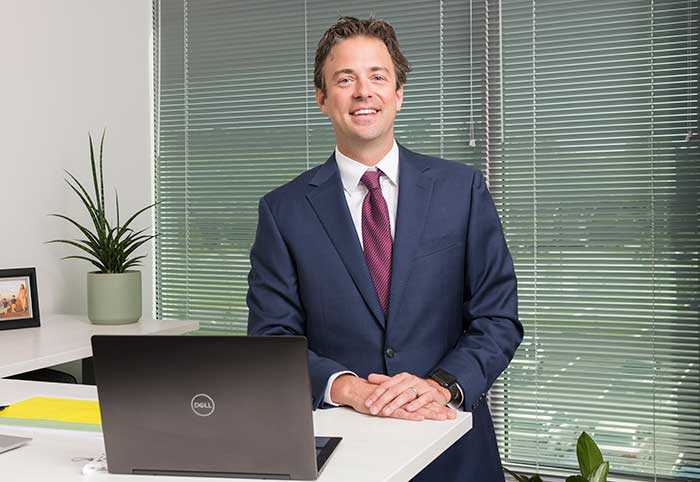
Based in Lexington, Kentucky, Edelen’s company has partnered with Savion, a Kansas City-based solar developer involved in 156 projects in 28 states, including five in Virginia, but this is Edelen’s first collaboration with Savion in the commonwealth.
With groundbreaking set for 2023, the $100 million, 75-megawatt solar farm will generate about $100,000 in annual tax revenue for Buchanan County, create about six permanent jobs and 250 construction jobs. Edelen says there will be a “heavy focus on hiring local.” He plans for workers to finish the yearlong job with “an academic credential that will certify them as utility-scale solar installers.”
The largest anticipated economic impact is the business the solar farm might attract.
“Access to green energy is a precondition for modern economic development,” Edelen says. “To be relevant to the opportunities of the digital economy, you have to have clean energy.”
Jonathan Belcher, executive director of the Virginia Coalfield Economic Development Authority, agrees. “That’s clearly where the national and global economy, [the] energy economy, is headed.”
In this case, the new energy economy will be sharing space with the old.
“They will actually be installing solar panels while they’re still mining coal,” says Del. Will Morefield, R-Tazewell, whom Kentucky-based CM Mining asked to help arrange the project. The company also plans to put several thousand mined acres in a conservation easement. Morefield calls it “one of the country’s first mining operations that is not only mining coal, but they’re making efforts to reduce the carbon footprint.”
Surface mines and solar farms have considerable overlap in infrastructure: high-capacity transmission lines; access to roads and rail lines; and flat land, according to Edelen. Surface mines require the first two and create the third.
Government support helps, too.
“Virginia has done a better job than almost any state in the entire United States in envisioning a renewable energy future,” Edelen says. That support runs from the county to the General Assembly and across party lines, he says. “Green energy isn’t partisan. It’s just smart.” ν
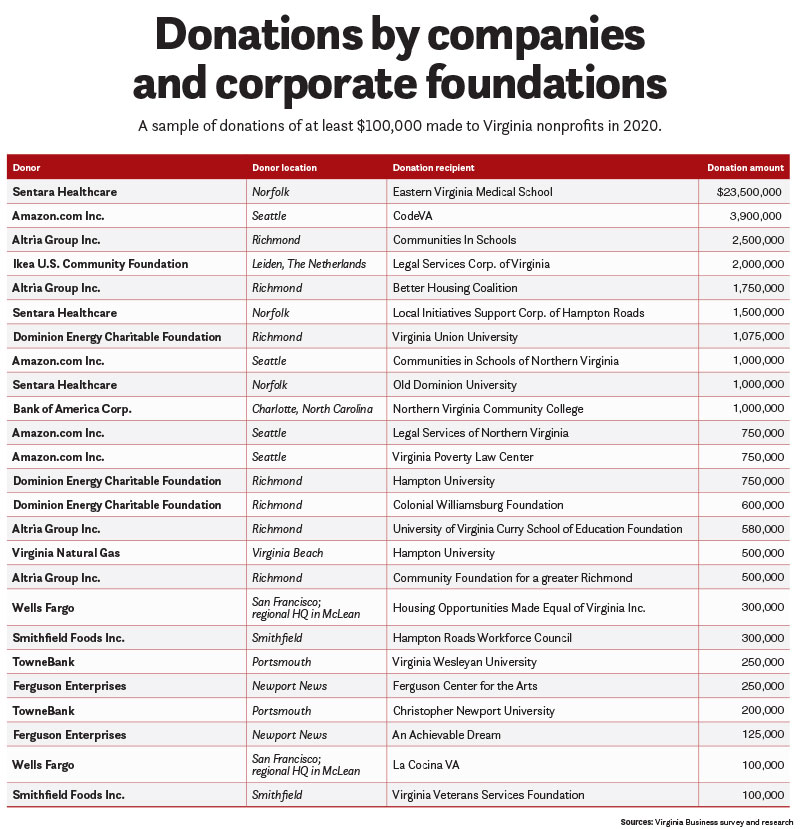
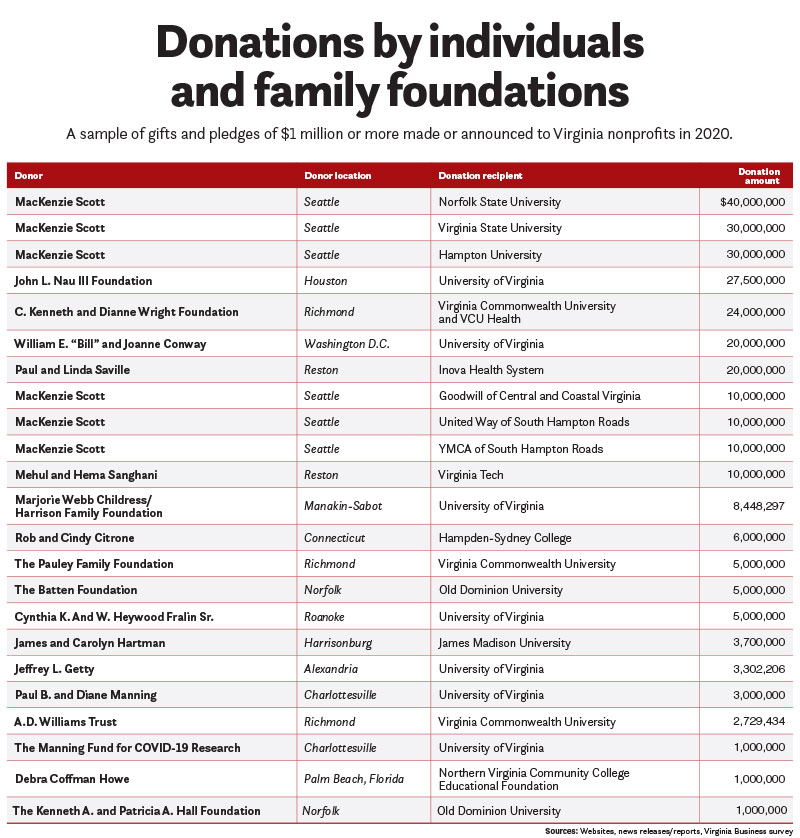
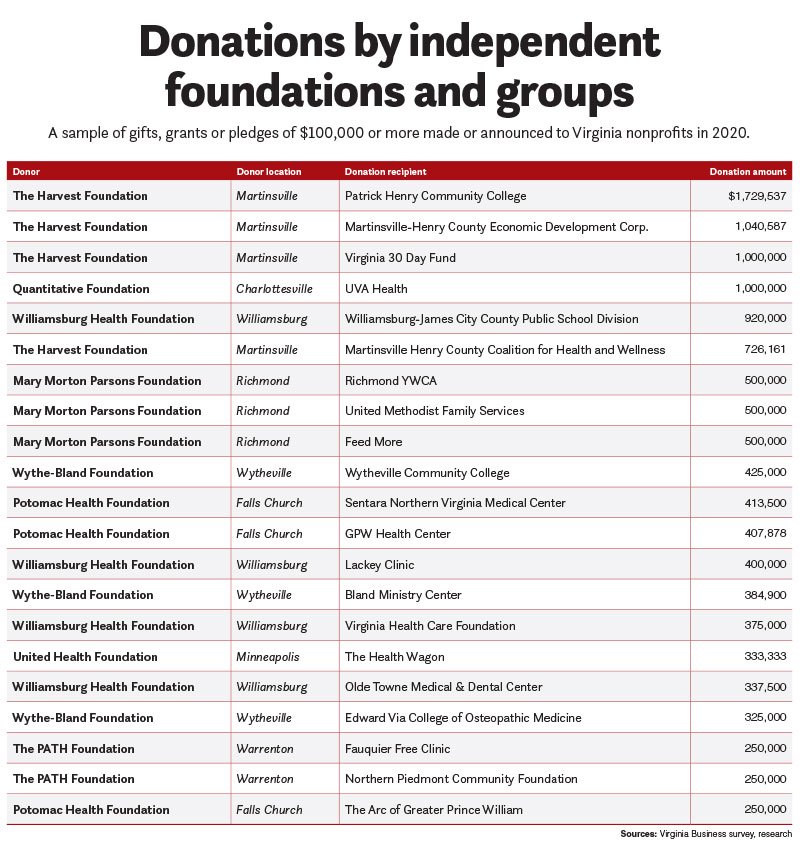
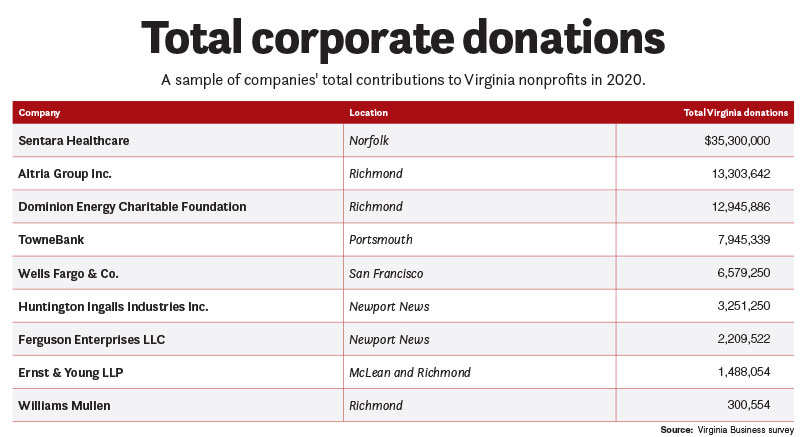
The past year or so in America has often seemed a dark time, with headlines dominated by COVID-19, the tumult surrounding social justice issues and our deeply politically divided nation. Yet, it also has been a time of breathtaking generosity, as uber-wealthy philanthropists and well-heeled corporations have opened their wallets to fund groundbreaking initiatives, especially in the fields of education and health care.
Here are the stories of two Virginia families whose altruism could make a major difference for many, many years to come, along with a roundup of some other impressive gifts made in the last year, either by Virginians or benefiting the people of the commonwealth.
The Goodwins
In 2016, then-Vice President Joe Biden launched the federal Cancer Moonshot initiative to fight the disease that killed his son, Beau. And as president, in his first joint address to Congress, Biden urged lawmakers this April to “end cancer as we know it” and support the creation of a new federal agency, the Advanced Research Project Agency for Health, which, Biden explained, would “develop breakthroughs to prevent, detect and treat diseases like Alzheimer’s, diabetes and cancer.”
Biden wants to turbocharge the fight against a disease that kills almost 600,000 Americans annually.
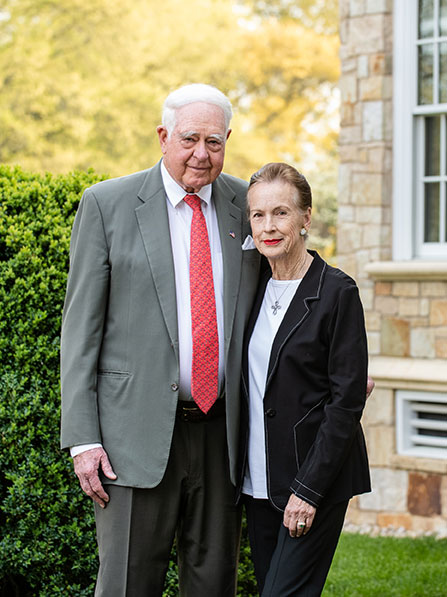
Philanthropists Bill and Alice Goodwin announced in March they are committing $250 million to establish a new national cancer research foundation. Their son Hunter died from cancer in January 2020. Photos by Caroline Martin
Virginia philanthropist William Goodwin Jr. and his wife, Alice, who lost their son Hunter to cancer in January 2020, share Biden’s zeal for finding cancer treatments and cures. The couple announced in March that they are donating $250 million to kickstart a national cancer research foundation called Break Through Cancer. Half of the funding will come from their late son’s estate.
The Goodwins have generously and consistently supported cancer research and other endeavors for 20 years. (They were in the news in April for giving $5 million to Mary Baldwin University to establish a doctor of nursing practice degree program. See page 13.)
But their funding of Break Through Cancer is on a different scope entirely. It is nothing less than an ambitious attempt to change the nature of cancer research.
Goodwin, the retired chairman and president of Richmond-based Riverstone Group LLC, explains that medical research is largely a territorial enterprise, and intellectual property — along with the royalties it generates — “is protected like it’s in a vault.” But the impressive rapidity with which vaccines to fight COVID-19 were developed through cooperative scientific efforts shows that competition is not the only way forward, or even the best way. Break Through Cancer is a daring initiative to test that theory.
The new foundation, which will be based in Boston, brings together five of the nation’s most prestigious cancer research institutions — Dana-Farber Cancer Institute in Boston; Sidney Kimmel Comprehensive Cancer Center at Johns Hopkins in Philadelphia; MD Anderson Cancer Center in Houston; Memorial Sloan Kettering Cancer Center in New York City; and Koch Institute for Integrative Cancer Research at MIT in Cambridge, Massachusetts.
Researchers at the institutions will collectively focus on four of the deadliest kinds of cancer — the kind that usually kill in 18 months or less: pancreatic cancer, ovarian cancer, glioblastoma (which killed Beau Biden) and acute myelogenous leukemia.
“We’d like to be seeing real results in three years,” Goodwin says. “If we don’t see results within five years, we aren’t making it.”
Tyler Jacks, director of MIT’s Koch Institute, will oversee Break Through Cancer. Three or four years ago, he says, the research institutions began discussing whether “there would be value in joining forces.” That long journey, he says, leads “directly to the generosity of the Goodwin family.”
The foundation is in the “brainstorming phase” now, he says, but Jacks hopes to begin funding research grants by this summer. The research teams dedicated to each of the four types of cancer will have no physical lab space but will be more akin to think tanks.
“Think of it as a poker game with five expert players all trying to come up with a winning hand,” Jacks says. “We’ll be taking the best cards from all the hands.If things go very well, we’ll see major scientific breakthroughs.”
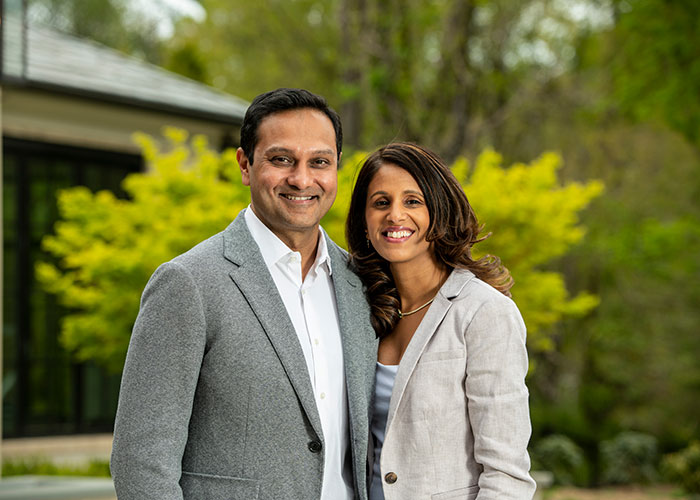
Reston-based Octo Consulting CEO Mehul Sanghani and his wife, Hema, gave $10 million to their alma mater, Virginia Tech, in 2020. The gift supports a center for artificial intelligence and data analytics as well as efforts to improve food access for students. Photo by Will Schermerhorn
The Sanghanis
Mehul Sanghani and his wife, Hema, grew up in nearby towns in Central Virginia and met when both attended Virginia Tech. Since the couple graduated in 1998 and 1999, he went on to found Reston-based Octo Consulting, which delivers information technology and artificial intelligence services to government and commercial clients. She became a manager at Fairfax-based CGI Federal Inc., which also provides IT services to federal clients.
With their shared focus on technology, it’s not surprising that the two loyal Hokies might support their alma mater’s efforts involving artificial intelligence and data
analytics. What is surprising is the size of the $10 million gift the couple made to the university last year. Announced this January, $7.4 million of their donation is earmarked to support the Sanghani Center for Artificial Intelligence and Data Analytics, formerly called the Discovery Analytics Center. The remainder of their gift will support an initiative to improve food access for students; Virginia Tech Athletics; and the Global Business and Analytics Complex planned for the Blacksburg campus.
Some of the Sanghanis’ gift also will support disadvantaged and minority students.
The Sanghanis are the youngest alumni couple to ever have made a gift of such size to their alma mater.
“Virginia Tech is where we both met and it opened the doors of opportunity to both Mehul and myself,” Hema Sanghani said in the university’s announcement. “We believe we have a responsibility to give back to the school that has afforded us so much.”
Projected to be completed in 2024, the Sanghani Center will be housed in the first building slated to open on Virginia Tech’s new $1 billion Innovation Campus in Alexandria.
“The gift will allow [Virginia Tech] to expand efforts to make strategic hires and bring on folks in AI,” says Mehul Sanghani.
Naren Ramakrishnan, who heads the Sanghani Center, expects his current faculty of 20 to grow to 30 to 35. The center’s population of about 120 full-time graduate students will double in size. “I view this as an excellent opportunity to enlarge our ambitions,” he says. “It’s a huge step and an opportunity for us.”
Ramakrishnan plans for the center to leverage the proximity of Amazon.com Inc.,
which is building its HQ2 East Coast headquarters in Arlington, and other heavy-hitting tech organizations in the area to create a “back-and-forth synergy.” The emphasis, he says, will be on “use-inspired research with practical applications.”
About $1.5 million of the Sanghanis’ gift will support The Market of Virginia Tech, a food-support program that initially will provide up to 75 students with ingredients for a full week of meals.
“There’s this cliché of college students and ramen noodles,” Sanghani says, but food security among students, especially graduate students who may have families, “is a major, major issue.” The scope of the need, he says, “was eye-opening for us.”
In a January news release announcing the Sanghanis’ gift, Virginia Tech President Tim Sands said the alumni couple’s “decision to step forward in such a meaningful way exemplifies the Virginia Tech spirit of Ut Prosim (That I May Serve).”
Other major gifts
Last year, MacKenzie Scott, ex-wife of Amazon.com Inc. founder and CEO Jeff Bezos and the world’s third-wealthiest woman, gave away nearly $6 billion to hundreds of nonprofits and organizations across the United States. She emphatically demonstrated her commitment to supporting historically Black universities and colleges with gifts of $40 million to Norfolk State University, $30 million to Virginia State University and $30 million to Hampton University. All of Scott’s gifts fell into the category of largest-ever donations to the colleges from a single donor.
In December 2020, Scott further gave $10 million to Goodwill of Central and Coastal Virginia, another “largest-ever” gift for that institution. And that same month, she split $22 million among South Hampton Roads‘ YMCA, YWCA and United Way. All three of the nonprofits described her gifts as “transformational.”
Other notable gifts made by Virginians or to Virginia-based organizations over the last year include:
A $50 million, multiyear commitment in May from Chicago-based aerospace and defense contractor Boeing to foster diversity at the Virginia Tech Innovation Campus in Alexandria. The largest corporate donation ever made to Virginia Tech, the commitment also ties the largest private donation the university ever received. Boeing President and CEO David L. Calhoun is a Virginia Tech alumnus.
A $24 million gift in December 2020 from the C. Kenneth and Dianne Wright Foundation to Virginia Commonwealth University and VCU Health Foundation. Since 1999, the Wrights, now deceased, and their namesake foundation have given the university more than $70 million. About $16 million of the most recent donation will support the C. Kenneth and Dianne Wright Center for Clinical and Translational Research, and the other $8 million will be split between the Wright Engineering Access Scholarship Program and the Health Adult Outpatient Pavilion, which is expected to open this year.
A $9 million gift in November 2020 from Amazon.com Inc. in honor of the second anniversary of its decision to locate its East Coast headquarters in Arlington. The gift will be shared among a variety of NoVa nonprofits. Community organizations that support small businesses, military families, the environment and the arts received $3.5 million, and organizations offering legal assistance, such as the Virginia Poverty Law Center, were given $3 million. Amazon gave $1 million to nonprofits dedicated to community empowerment and racial equity, such as the Arlington Branch NAACP Scholarship Program, while another $1 million was shared by health care providers such as the Arlington Free Clinic. Amazon earmarked an additional $500,000 for organizations dedicated to literacy programs and workforce development and economic development in low-income communities, including La Cocina VA and the Literacy Council of Northern Virginia.
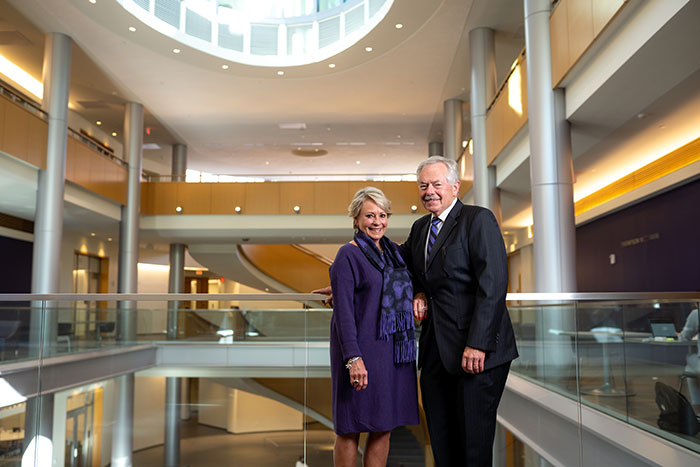
Philanthropists Carolyn and James Hartman donated $3.7 million to James Madison University toward the construction of Hartman Hall. Photo courtesy JMU Creative Media
A $3.7 million gift announced in October 2020 from James and Carolyn Hartman to James Madison University. The Hartmans’ gift helped make JMU’s $66.5 million state-of-the-art Hartman Hall possible. The new building on the Harrisonburg campus is the first step in an ambitious plan to create a College of Business learning complex.
A $2 million gift in January from the Estes family and their freight-shipping company, Estes Express Lines, to the Children’s Hospital of Richmond at Virginia Commonwealth University. The money will go toward a new inpatient facility called the Wonder Tower. The Children’s Hospital Foundation, which is dedicated to maximizing the impact of donations, will match the gift. The 16-story tower will include a pediatric trauma center, an emergency room, inpatient units, operating rooms and improved amenities for families. It is expected to be completed in 2023.
A $1 million grant in November 2020 from Bank of America to Northern Virginia Community College to help minority students with education and training. Specifically, the grant will support the community college’s short-term credential program, which provides training in areas such as information technology and health care.
This spring, for the sixth consecutive year, Richmond-based Dominion Energy Inc.’s charitable foundation made $1 million in total funding available as grants of up to $25,000 for nonprofits in 16 states, including Virginia, to help meet local housing and food needs along with improving access to medical services.
A $500,000 gift made in November 2020to Hampton University from Virginia Natural Gas to improve the university’s remote learning infrastructure. The donation was part of a $50 million, multiyear initiative by Virginia Natural Gas’ parent company, Southern Co., to provide HBCU students with scholarships and internships as well as access to upgraded technology.
With NASA on the verge of returning astronauts to the moon and one day to Mars, Virginia’s federal contractors also are taking a giant leap into space, fulfilling millions of dollars in NASA-related contracts over the next decade and possibly beyond.
In a 2020 economic impact study commissioned by NASA, Virginia was ranked sixth in the nation for spending by the aeronautics and space agency, which was responsible for generating 27,000 jobs in the commonwealth (including 2,623 workers directly employed by NASA) in 2019, as well as $2 billion in labor income and $5.5 billion in economic output, including $219.9 million in state and local tax revenue.
In 2019, NASA was responsible for hundreds of millions in sales in several Virginia industries: $489.3 million in truck transportation, $475.8 million in electronic and precision equipment repair and maintenance, and $461.3 million in scientific research and development services, mostly from the agency’s procurement budget. NASA’s Virginia presence includes Hampton’s Langley Research Center, where the Project Mercury astronauts trained, and the Wallops Flight Facility, a rocket launch site in Accomack County.
Recent headlines have focused on NASA’s Artemis program, the mission to the send astronauts back to moon and, ultimately, land the first humans on Mars. Artemis is set to send its first unmanned rocket up in early November, with plans for a new generation of astronauts, including the first woman, to land on the moon in 2024. (A Government Accountability Office report released on May 26 expressed skepticism that NASA can meet the 2024 goal, noting remaining “technical risks” and the fact that the program’s original landing goal of 2028 had been accelerated by the Trump administration in 2019.)
The November unmanned spacecraft mission will be launched with a set of rocket boosters produced by Falls Church-based Northrop Grumman. It’s part of a potential $49.5 million contract through which the Fortune 500 aerospace and defense contractor will produce twin boosters for the next three Artemis missions and three other Space Launch System flights by 2030.
Northrop Grumman also is producing the living space for astronauts during their lunar exploration missions. Known as the Habitation and Logistics Outpost — or HALO — the module is based on Northrop’s Cygnus spacecraft, which is used to deliver supplies and equipment to the International Space Station. Awarded in June 2020, the $187 million HALO contract calls for the module’s launch with a power and propulsion element by the end of 2023.
“This contract award is another significant milestone in our plan to build robust and sustainable lunar operations,” NASA Administrator Jim Bridenstine said in a statement last year. “The [Lunar] Gateway is a key component of NASA’s long-term Artemis architecture, and the HALO capability furthers our plans for human exploration at the moon in preparation for future human missions to Mars.”
David Ray, who leads Science Applications International Corp.’s space unit, says lower costs are allowing smaller companies to enter the space industry. Photo by Stephen Gosling
Rising competition
Another major player is Reston-based Science Applications International Corp. (SAIC), which is involved with several aspects of the Artemis program, including the launching system, lunar gateway, the Orion crew vehicle and the Human Landing System. The Fortune 500 contractor also has a hand in Commercial Crew Program flights to and from the International Space Station. And it provided validation and verification software services for the Mars Perseverance rover, which landed on the red planet in February. SAIC also will provide support for the eventual manned mission to Mars, ensuring that mission systems software performs correctly.
David Ray, who earlier this year became senior vice president of SAIC’s Space Business Unit, says the space contracting world is becoming more competitive.
In coming years, he suggests, tech and engineering companies of all sizes will enter the industry as the costs of space exploration and travel continue to come down. As technology evolves, he says, the satellites, sensors and payloads used on space missions are becoming smaller and less expensive, while maintaining effectiveness.
“It used to be that the cost of doing business in space was a high barrier to entry, but the lower costs create an opportunity,” he says. “It will open things up for new commercial players, with different avenues. It’s an opportunity for companies to say, ‘How do we take what we do well today, and the partnerships that are available to us now, and how can we add more value to customers in areas that weren’t in play for us a few years back?’ It’s a very exciting time.”
This shift in the space industry is already happening. Commercial firms such as SpaceX and Blue Origin — owned respectively by Elon Musk and Jeff Bezos, the world’s richest men — are pushing the boundaries of space travel, including plans from both companies to offer space tourism flights for deep-pocketed civilians as soon as this summer.
More crucially, however, these space startups also are now competing head to head with traditional, Fortune 500 defense and aerospace contractors.
Bumpy landings?
In April, NASA awarded Musk’s California-based SpaceX the contract for Artemis’ Human Landing System (HLS) that will carry the next two American astronauts to the lunar surface. SpaceX, which bid $2.89 billion, beat out Bezos’ Washington-based Blue Origin and Reston-based Fortune 500 defense contractor Leidos Holdings Inc.’s Dynetics subsidiary in Huntsville, Alabama. Each of the companies was a finalist for the contract, with each producing its own design for the lunar lander.
Blue Origin, which bid $5.99 billion, and Leidos filed formal protests with the General Accountability Office over the award. Although Leidos did not disclose its bid amount, NASA’s statement said that Dynetics’ price tag was “significantly higher” than the other finalists’ bids.
“Dynetics firmly believes our HLS design offers great potential to contribute toward NASA’s HLS program goals, and we believe NASA’s initial plan for continued competition remains the best approach to ensure program success,” the company said in a statement. “Dynetics has issues and concerns with several aspects of the acquisition process as well as elements of NASA’s technical evaluation and filed a protest with the GAO to address them. We respect this process and look forward to a fair and informed resolution of the matter.” The GAO is required to decide on the protested contract by Aug. 4.
Dynetics isn’t out of the picture, though. In the statement awarding SpaceX the contract, NASA’s Kathy Lueders said, “With time now to address the technical concerns as development continues, Dynetics could be positioned for future missions to the moon, either with NASA under Artemis or with commercial customers.”
Leidos, both under its current name and earlier iterations, has contracted for NASA for decades and is still at work on a 10-year, $2.9 billion contract providing tech support for 10 NASA centers across the country. The NEST (NASA End-user Services and Technologies) contract expires in May 2029. Leidos deemed it “a marquee win” in a statement when the company was awarded the contract in 2019.
As the mission dates get closer for the Artemis program, Virginia companies are likely to get more shots at NASA contracts.
In March, Democratic U.S. Rep. Don Beyer, who represents Virginia’s 8th District and is the new chairman of the House Subcommittee on Space and Aeronautics, said the successful test of NASA’s Space Launch System “brings us one critical step closer to returning to the moon and, someday, landing humans on Mars. After years of development, it’s gratifying to see important and encouraging progress in this key system, which we hope will eventually open opportunities for other scientific missions, in addition to NASA’s moon-Mars program.”ν
Freelance writer Mike Holtzclaw contributed to this story.
Apex Clean Energy Inc. continues working toward a day when wind turbines standing atop Botetourt County’s North Mountain might generate enough energy to power up to 21,000 homes each year.
Dubbed Rocky Forge Wind, the proposed wind farm north of Eagle Rock would be Virginia’s first onshore wind project in operation. However, some residents have filed a lawsuit in hopes of quashing it.
County and state officials have been discussing the wind energy project for six years with Charlottesville-based Apex, which constructs, owns and operates wind and solar power facilities across the nation.
In 2019, Gov. Ralph Northam announced the state government had entered into an agreement to purchase Rocky Forge Wind’s approximately 75-megawatt output — a move designed to help the state meet its goal of obtaining at least 30% of the electricity required for state agencies from renewable sources by 2022.
Limited tree clearing on the property began in mid-March “and marked the commencement of construction for Rocky Forge Wind,” Apex spokeswoman Natasha Montague says. Apex plans to erect 14 turbines, each standing 612 feet high and generating up to 5.5 megawatts apiece. The company expects the wind project to be operational in fall 2022.
However, a grassroots group called Virginians for Responsible Energy and 13 residents of Botetourt and Rockbridge counties filed a December 2020 lawsuit in Botetourt Circuit Court alleging that Rocky Forge Wind’s application to the state Department of Environmental Quality, approved last year, was “woefully incomplete” and that state reviewers rushed to approve the application even though it contained “old and irrelevant documents.”
A hearing on the matter is scheduled for Aug. 20. Jeff Scott, a member of Virginians for Responsible Energy and one of the suit’s plaintiffs, lives on about 30 acres of wilderness in Rockbridge and is concerned about the project’s impact on wildlife. “I’m not opposed to renewable energy,” he says. “I’m opposed to renewable energy that is not situated appropriately.”
In a response filed in court, attorneys representing Rocky Forge Wind charged that the lawsuit was an “opportunistic, last-ditch effort to stymie the project.”
Dan Crawford, chair of the Sierra Club’s Roanoke Group and chair of onshore wind promotion for the Virginia Chapter of the Sierra Club, believes the lawsuit, in the end, will amount only to a speed bump.
“They’ll clear the legal hassle and start construction,” Crawford predicts.
Manage Consent
This website uses cookies, web beacons, pixels, tags, software development kits, and related tracking technologies, as described in our Privacy Policy and Cookie Policy, for purposes that may include website operation, analytics, analyzing site usage, enhancing site navigation optimizing a user's experience, and third-party advertising or marketing purposes. Through these technologies, we and certain third parties may automatically collect information about your interactions with our website, such as your browsing behavior and page views. We also may share this information about your activity on our website with our social media, advertising, analytics, and other business partners. By clicking “Accept All”, you consent to the use of these technologies and that we can share information about your activity on our website with third parties in accordance with our Privacy Policy and Cookie Policy. If you do not agree with our use of non-essential tracking technologies, please click “Reject All.” You may opt out of certain non-essential technologies by clicking “Cookie Settings.”
Functional
Always active
The technical storage or access is strictly necessary for the legitimate purpose of enabling the use of a specific service explicitly requested by the subscriber or user, or for the sole purpose of carrying out the transmission of a communication over an electronic communications network.
Preferences
The technical storage or access is necessary for the legitimate purpose of storing preferences that are not requested by the subscriber or user.
Statistics
The technical storage or access that is used exclusively for statistical purposes.The technical storage or access that is used exclusively for anonymous statistical purposes. Without a subpoena, voluntary compliance on the part of your Internet Service Provider, or additional records from a third party, information stored or retrieved for this purpose alone cannot usually be used to identify you.
Advertisement
The technical storage or access is required to create user profiles to send advertising, or to track the user on a website or across several websites for similar marketing purposes.

 Sign In
 Free Newsletter