Minor League Baseball is back for 2021, after the coronavirus pandemic canceled the 2020 season. And there’s no question that this summer will look much different than a typical baseball season. But the Richmond Flying Squirrels are optimistic.
The team kicked off its season May 4. All fans who had vouchers or credits for 2020 tickets could redeem them for the 2021 season. Still, at the Diamond, the Squirrels’ home ballpark, capacity was limited to 3,448 fans as of May 15, but the team planned to return to its nearly 10,000 capacity by June 1.
“Those tickets are going to be pretty in demand,” says Trey Wilson, the Squirrels’ director of communications and broadcasting.
Various entertainment venues in Virginia, from ballparks to theme parks, expect to see a gradual increase in business during the 2021 summer season, compared with last summer, even amid uncertainty over whether some lingering COVID-19 restrictions might still be in place.
Visitation numbers at Historic Jamestowne were nearly back to pre-pandemic levels by May, even though the historic attraction was forced to close from Dec. 21 to March 1 due to regional coronavirus spikes, says Kelly Beckley, director of visitor services for Jamestown Rediscovery/Preservation Virginia, which along with the National Park Service, jointly administers Historic Jamestowne. It’s the site of the 1607 James Fort, the first permanent English settlement in the Americas and an archaeological treasure trove.
“I expect visitation numbers will continue to trend upwards as the weather grows increasingly warmer and larger numbers of people are vaccinated, making travel feel safer,” Beckley says.
There are no attendance limits in the outdoor areas of Jamestowne, where all daily tours and programs are offered. As of mid-May, people who have not been fully vaccinated were required to wear face masks inside buildings such as the archaeology museum. Also, in lieu of on-site field trips, Jamestowne has been offering virtual educational programs for schoolchildren.
“We are thrilled to be able to safely welcome visitors to Historic Jamestowne,” Beckley says. “We are continually assessing and making changes as needed to our operations in order to maintain a safe guest experience and working environment.”
A little more than 75 miles northwest from Jamestown in Hanover County’s Doswell area, the Kings Dominion amusement park reopened its gates May 22. The park did not open for its regular season in 2020, the only such closure in its 46-year-plus history. Kings Dominion’s Soak City water park opened May 29. All 2020 Kings Dominion season pass holders can extend their passes through 2021.
“We’re ready to welcome back our guests for a new season of safe family fun,” says Maggie Sellers, the park’s communications manager. “Our leadership team and associates have invested a lot of time and effort in developing stringent safety plans that incorporate guidelines and recommendations from medical experts, the CDC and health officials.”
Some Virginia communities expect to offer increased entertainment options this summer, welcoming travelers back. That’s happening in Southwest Virginia, where several national sports championships will be played this summer.
The USA Softball Gold National Championships for girls 16 years old and younger is scheduled for July in Salem. The competition draws teams from around the country, says Landon Howard, president of Visit Virginia’s Blue Ridge, a destination marketing organization in Roanoke. “These people have already bought airline tickets from multiple states, and they’re flying in with family and friends and coaches. That is huge,” Howard says.
Also, Roanoke’s Carilion Clinic Ironman 70.3, a triathlon that was canceled last year, is slated for June 6 and it’s sold out.
After the challenges of the past year, holding the competition will help the region’s psyche, Howard says. “That’s a great psychological shot in the arm for our industry and for local residents.”
Twenty years ago, John Zirkle was just starting out in the Virginia Beach hotel business as a houseman, stripping bed sheets and doing laundry. Fast-forward to today and he is general manager of the Doubletree by Hilton at Virginia Beach and president of the beach’s hotel association.
Lately, though, Zirkle’s had to recall some of his skills as a houseman. He’s been pitching in as part of the hotel’s housekeeping staff as needed. That’s been necessary in order for the Doubletree to grapple with a severe staffing shortfall amid what Zirkle calls the worst labor market he has ever seen.
“We do what you have to do, any staff member who can lend a hand,” he says.
Meanwhile, there’s strong competition for staff among hotels. “It seems like we are all fighting over the same housekeepers,” Zirkle says.
Hotels and even restaurants throughout Virginia and the nation are facing the same hiring hurdles. After a devastating year for the hospitality industry, during which the COVID-19 pandemic forced many businesses to lay off staff, hoteliers in some tourism destination markets, such as Virginia Beach, are expecting travelers to return slowly this summer as more of the population are fully vaccinated and feel comfortable with taking trips.
But to operate efficiently, businesses need employees. And many hotels are struggling to find workers for jobs ranging from front desk attendants and housekeepers to maintenance and restaurant servers.
Half full or half empty?
This summer, roughly 72% of Americans plan to travel, according to the U.S. Travel Association. That’s compared with 37% last year. And nine out of 10 of those planning to travel will be staying in the United States.
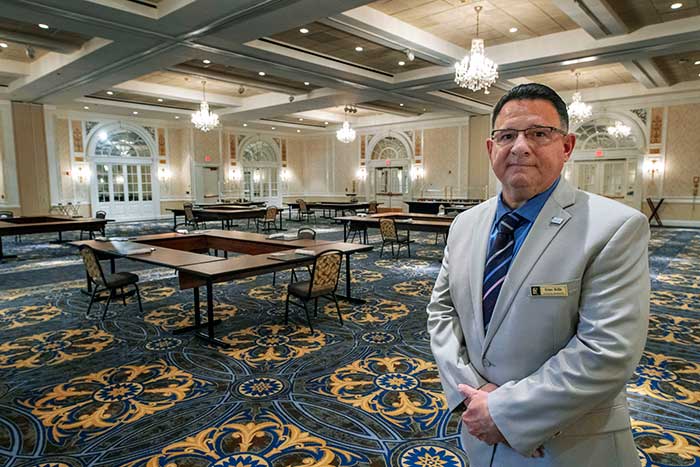
Business conference travel remains “tragic” going into the summer, says Brian Wells, general manager of the Hotel Roanoke & Conference Center. Photo by Don Petersen
But just ahead of the traditional busiest hotel season of the year, only about 40% to 50% of the jobs at Zirkle’s Doubletree were filled as of late April. Typically, his staff doubles to about 200 employees during the summer months. Reaching that total this year is questionable, he says.
“We don’t have the staff to maintain standard occupancy,” says Zirkle, whose hotel is adjacent to the new Virginia Beach Sports Center. “Normally heading into summer, we run 80% to 90% occupancy. We don’t have the staff to run the hotel at that kind of occupancy, to clean the rooms and turn them.”
Similarly, Delta Hotels by Marriott Virginia Beach Bayfront Suites, which opened in March, had filled only half of its staff positions leading into May. The hotel is offering signing bonuses and referral bonuses to attract employees for a variety of open positions.
“I have been in this business for over 25 years, and I have never seen the lack of workforce we have right now,” says Duane Gauthier, managing director of Commonwealth Lodging, a company that manages hotels in Virginia, Florida and Connecticut, including Virginia Beach Bayfront Suites.
“The hotels in general have been doing very well,” he says. “It’s the staffing components, the ability to get people to work, that is the issue.”
This all is happening as state tourism officials predict that leisure travel will improve this summer, compared with a major drop-off during the pandemic last year.
Though travel likely won’t return to pre-pandemic levels this year, “we are seeing that traveler confidence is increasing,” says Caroline Logan, director of communications for the Virginia Tourism Corp. “I think fear has abated and people are starting to move again.”
But there are a few reasons why potential tourism employees may not be seeking jobs right now, says Eric Terry, president of the Virginia Restaurant, Lodging, & Travel Association.
Some who were unemployed at the height of the pandemic still are receiving state and federal unemployment benefits through a variety of pandemic relief programs that have been extended through Sept. 4.
Parents may not be seeking work due to child care needs, as many school systems have not fully returned to in-person classes. And many laid-off hospitality workers may have changed careers, says Terry, adding that some hotel marketing and sales professionals found employment in the insurance and real estate industries.
He estimates that about 56,000 hotel jobs were lost in Virginia during the past year. Nationally in 2020, nearly 4 million hospitality jobs were lost due to the pandemic, according to the American Hotel & Lodging Association.
Hotels in leisure vacation markets are the ones bringing back most hospitality jobs, Terry says, not hotels that rely on business travelers. That’s because corporate group travel hasn’t returned to pre-pandemic levels, and it is uncertain when that will happen.
Meetings adjourned
That’s the case with the Hotel Roanoke & Conference Center, where the hotel’s business from companies and other corporate gatherings is “tragic,” says Brian Wells, general manager.
As of mid-April, the Hotel Roanoke’s conference business was 85% below pre-pandemic levels, and plans for the future were unresolved due to ongoing state attendance limits on indoor gatherings.
“Our groups that are contracted continue to have low confidence to meet,” Wells says. “It’s starting to affect our business levels this summer.”
The hotel furloughed 260 employees at the start of the pandemic, but it was able to rehire some with the help of forgivable loans through the federal Paycheck Protection Program.
Advertising on digital billboards and through job fairs, Hotel Roanoke is seeking to fill positions ranging from security officers and line chefs to room attendants and engineering staff. It’s also offering recruiting bonuses to current staff.
Even so, jobs associated with group business sales are not among the hotel’s openings. “Until [the conference and] meeting business comes back, many of the furloughed employees can’t [return]. We just don’t have work for them,” Wells says.
There’s another nationwide challenge to landing employees for hotels and restaurants: the major decline in international employees, often students, who travel to the United States through summer work programs. A Trump-era presidential proclamation to temporarily suspend entry into the United States for exchange workers with J1 visas expired March 31. Still, some J1 visa applications remained stalled, and companies worried that workers would not make it into the country for the summer season.
Nonprofit travel groups, such as New York-based InterExchange Inc., which works with Virginia Beach businesses, have written letters to encourage President Joe Biden to push the U.S. Department of State to work with consulates and embassies to hasten the processing of these visa applications.
Wooing workers
Last year, summer work travel participants under the J1 visa program dropped by 98% in Virginia and 95% across the United States, according to the Alliance for International Exchange. In Virginia, there were 116 summer work exchange students in 2020, compared with 4,621 in 2019.
Typically, these work exchange employees comprise about 12% of seasonal staff at the Doubletree by Hilton at Virginia Beach, Zirkle says. Some may find jobs at restaurants as well.
“It is a large part of the hotel and restaurant community,” he says.
Kristina Chastain has been forced to turn down requests for private parties at her Virginia Beach restaurant, Esoteric, because she can’t find enough seasonal workers. Photo by Mark Rhodes
Restaurants also are feeling the hiring crunch — particularly for seasonal staff.
Kristina Chastain receives at least three calls a day from people asking to hold private events at her craft beer and food establishment, Esoteric, in Virginia Beach. But she’s had to turn them all down because she has only enough employees to keep the restaurant operating, not to host dining events in the eatery’s private space.
She’s in a rush to find much-needed seasonal help. As of late April, she only had one seasonal employee. Typically, she hires 10 to 15 employees to work during the summer months. Many are high school and college students.
However, Chastain says, “I think there’s a lot of money circulating right now. A lot of people got a lot of stimulus money [and] maybe there’s not that pressure to go and find work.”
Chastain isn’t the only restaurant owner sweating over the search for seasonal help. Some establishments have closed for several days a week due to lack of staff, while others are attempting to attract employees with novel incentives ranging from free meals to end-of-shift cocktails, says Stacey Shiflet, executive director of the Virginia Beach Restaurant Association.
Shiflet is promoting restaurant jobs left and right, including talking with public schools in the area and discussing employment opportunities as part of panel presentations.
As consumers gain increasing confidence to travel in the wake of the pandemic, it’s both a curse and a blessing for a hospitality industry that is struggling to find workers.
“We are seeing [business] pick up as people get their vaccinations,” Shiflet says.“They are comfortable going out and dining where they hadn’t been before. Guests are coming, and people are itching to get out and travel.”
Maia Chaka, a health and physical education teacher at Virginia Beach’s Renaissance Academy, will be the National Football League’s first Black female referee, the league announced in March. A 2006 Norfolk State University alumna, Chaka has been officiating football since 2007, a journey that took her from high school games to the NCAA’s Division I, including bowl games.
Chaka is only the second woman ever to join the NFL officiating staff, and she’s been training with the league since 2014, when she was chosen to be part of its new NFL Officiating Development Program at age 31. This upcoming season, after years of work and perseverance, Chaka has been added to the NFL roster and has been recognized nationally as a trailblazer.
Although her officiating schedule will keep her busy, working with students continues to be her “No. 1 passion,” she says. “I always want to be involved in my community, always want to be within my school district, [and] I always want to be able to give back.”
Virginia Business: Let’s start by just talking about your relationship with sports. Did you like to play sports when you were younger?
Maia Chaka: I was just a gym rat, a complete gym rat growing up. I did everything at a young age: swimming, gymnastics. I played football in the neighborhood with the boys all the time. Outside of football, I organized sports, I played, I ran track, softball. I played everything competitively except for football, for the most part.
VB: Did you watch football much? Were you a fan of certain teams growing up?
Chaka: Not necessarily a fan of teams, but I watched all the time, and I played tons of [“Madden NFL” video games] on Sega Genesis.
VB: You’ve been officiating football for more than a decade now in high school and college leagues. What is the most exciting thing about being on the field as an official?
Chaka: I think just being able to see the plays up close and personal. Especially as you start to progress in your career, and you start looking at high-level competition or highly skilled players. I’m always in awe to see a player run or hurdle [over] someone. In high school, hurdling was illegal. Then once I started officiating college, and in some other professional leagues, that became a big thing. Everybody’s hurdling. When you see those kinds of moves, or when you see a nice spin move or even just a good clean hit, those are the things I enjoy the most.
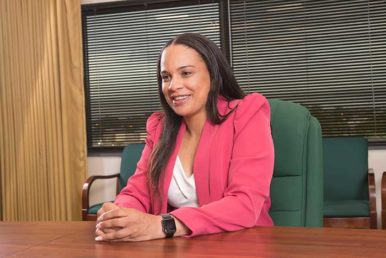
Maia Chaka will begin refereeing NFL games during the league’s upcoming 102nd season. Photo by Mark Rhodes
VB: Has anyone ever run into you?
Chaka: Never been run into. I’ve never been run over or knocked down. I’ve never fallen on the field or anything. Knock on wood. Don’t jinx me right now.
VB: In 2014, you were chosen by the NFL for its Officiating Development Program. How does that process work?
Chaka: There’s a pool of about somewhere close to 4,000 officials, give or take a few. I believe 2014 was only the second year of this development program. At that time, they were really only selecting 21 officials out of that pool of 4,000. The 21 has now grown to a larger number — closer to 30 or so — but pretty much the criteria are [that] you have to show promise and have a lot of potential. You have to be coachable. Obviously, you have to have a good under-standing of the game of football, and you have to be excelling on the level that you’re currently working. At the time, I was working for [NCAA Division I] Conference USA, and I just finished working at my first bowl game.
Obviously, there was something that they saw in me that they liked, and they wanted to just bring me into the program and train me and work with me.
I really can’t pinpoint exactly what the formula is and why the NFL chooses who they choose to be a part of the program. I just know that they just look for solid officials. You have to be solid both on the field and off the field.
VB: When you go to training, how much time does it take out of your regular, everyday life?
Chaka: Pretty much once the spring hits, you have to prepare for July. All this is before the season even starts. Like, the football season itself doesn’t really start until August, when they really start going pre-season, but after you go to [a training] clinic, you’re sent to a training camp.
At the training camp, you work a pre-season game. Once you finish your pre-season game, you now go back and work your college season. That goes from August all the way up until December and January. At the end of your college season, you’re invited to come back and work for the College Football All-Star Game [in late January].
That’s one of the games where the players are preparing for the NFL draft. You have to switch gears from your college rule book, pick up your NFL Rulebook again, and you have to use that set of rules for those players.
It’s pretty much a yearlong commitment. You sacrifice a lot of holidays. You’re going to miss out on a lot of family time. You’re going to miss out on weddings, birthdays.
VB: After you’ve done training, how long does it usually take to get hired for the NFL season?
Chaka: I think I was on the program longer than anybody else was — four straight years, then two years off. For me, it’s a little different because I was brought in so young. I worked my first Division I football game when I was 28 after only working three seasons of high school football. I interviewed for the NFL when I was 31, after only working three seasons of Division I football. When they brought me into the program, I was very green. I had a lot to learn.
VB: Do you feel like things really shifted for you in your last year of training?
Chaka: During this last year, I felt I had a great understanding of the game because I’ve been around it for a while. I’ve gotten used to what it takes to actually be a professional, what it takes to be successful.
Also, as a female, to establish a solid network of people that I could communicate with is just one of the benefits about being in the program for so long. Pretty much all the new hires, you’ve worked with them.
I’ve got an understanding of how much I had to slow down on the field. As a woman out there, we want to show that we can keep up and that we can compete with these guys, when in all actuality you have male officials that are [in their] upper 50s and 60s who don’t move that fast anymore, but they’re always in the right place to make the right call. [I had] to watch film on the older officials to really get a good understanding of how I needed to slow down. I didn’t need to sprint.
VB: Can you explain to me what a line of scrimmage official does?
Chaka: We do everything, and I’m not even lying about that. We’re probably the only position on the field that can make a call on every single play. We get everything, like the false starts, defensive offsides, anything that deals with illegal formation. We have to have a legal [ball] snap, so the play doesn’t start unless we know that we have a good clean snap. We’re the alpha and the omega of the game.
We look for blocks. We start looking for things like holding [another player] or blocking back. We also have to look for pass interference and illegal contact.
Once the play is over, we’re in charge of spotting the ball where the play ends. We’re also involved in penalty enforcement when there’s a foul that occurs on the play.
We’re the brains of the crew. It’s the most difficult position in the National Football League to work, seriously, because of how intricate everything is. You have to be able to take information and process it quickly once the play is over.
VB: That sounds like so much concentration over a three-hour period.
Chaka: It is, definitely. Players get timeouts; officials don’t. We’re on the field, we’re on our feet, no matter what the weather. It’s almost like the mailman — rain, sleet or snow, they don’t care. It could be 40 degrees below zero, and we’re still out there. We don’t get to go on the sideline by the heaters.
VB: What it was like officiating during COVID-19?
Chaka: I worked in the [Pac-12 Conference] this year. I prepared so much to work in the Pac-12, and when we were supposed to kick off in September, they canceled their season. Then they decided at the last minute that they wanted to have a season. Our season started in November, when the season usually ends. We had a lot of cancellations and movement of games. I had games that I was supposed to work on a Friday that eventually ended up being played on Sunday. Not knowing if your game was going to be canceled or if it was going to be moved, preparation is key.
VB: Why do you think that you’re the first Black woman hired as an on-field official by the NFL? Why not someone years ago, do you think?
Chaka: For me, it’s just by default. If you look at the timeframe and where I was at a specific time, there really were only two women who were working Division I football. [Ed. note: Along with Chaka, Sarah Thomas was a Division I official then. She became the NFL’s first female official in 2015.] It was so weird because it was 2011. You would think that there would be more women involved by then, but there really weren’t. [Now], there’s tons of women that are involved. We actually have a couple that are in the [NFL] development program that are working very hard and they’re actually really good. I think with them, it’s only a matter of time before they get their shots to come to the league. I just think it’s a matter of women actually stepping outside the box and trying something. Also, [for] us in these leadership positions, we have to do a better job at recruiting and giving opportunities for young ladies.
VB: What are your students’ thoughts on your accomplishment?
Chaka: My students are very excited. This is actually funny — [in-person] attendance at my school has actually increased since the announcement was made. All my students come to class now.
Even on the Zoom meetings, it’s funny, I have parents ask, “Is that your teacher? She was on the ‘Today’ show!” I’m happy that it has that type of positive effect. I am able to give them some encouragement to come to school just to achieve and just to work a little bit harder.
We specialize with kids with unique needs, like a lot of behavior problems. Our school is predominantly male, [but] I have had quite a few young ladies throughout the years. I try to be a role model for them, to lead by example and encourage them to do something different.
I just love being able to share parts of my world, expose them to something that they normally wouldn’t be exposed to.
VB: Do you plan to continue working as a teacher?
Chaka: I’m definitely going to continue working as a teacher. Well, I don’t know if I’m going to be a teacher, but I still want to be in my school district. It all depends on what opportunities arise, but working with youth is always going to be my No. 1 passion. Always.
VB: What do you imagine it will be like 10 years from now in the NFL for officials?
Chaka:At least 50-50 in terms of minorities and a staff that really represents the players and the fans, because you have a lot of women who are huge fans of football.
VB: What do you think you bring to this sport?
Chaka: I guess I’m a big fan of humanity, and I just like to bring the human aspects of things. In the game — where everything is professional, where everything is black and white a lot of times — sometimes we’ve got to just stop and think. Let’s do what’s best for the situation or what’s best for this person right now, and not necessarily because it is the hard, black-and-white rule — when you just really work for the spirit of the game. ν
Exactly when it happens remains up in the air, but the city of Martinsville is set on downsizing to town status.
It’s been about a year and a half since Martinsville City Council set in motion the complicated process of dropping the locality’s status as one of Virginia’s 38 independent cities and morphing it into the state’s 191st town, partially consolidating with Henry County. On May 26, the two governments signed a non-legally binding memorandum of understanding supporting Martinsville’s reversion to a town within Henry. Martinsville hopes to revert by July 1, 2022, but Henry County officials are eyeing a 2023 time frame.
Why did Martinsville put the reversion in motion? “Economics,” explains Martinsville Mayor Kathy Lawson. “It’s the financial aspect. We have so much duplication.”
Virginia is the only state in the nation that grants independent status to cities under its constitution, making cities and counties mutually exclusive.
Getting into the weeds of how that happened and what it means especially for small cities in rural areas is not for the faint-hearted, but the bottom line is that it leads to situations in which cities and adjacent or surrounding counties end up with parallel school systems, government administrations and constitutional officers.
Since the late 1980s, the state has let small cities petition to “revert” to town status, partially merging the former city with a surrounding county and shifting major costs, such as operating schools for example, to the county.
“The cost to provide services for the citizens of Martinsville continues to increase, while revenue does not,” City Manager Leon Towarnicki told Martinsville City Council in November 2019.
The next month, the council put the reversion process in motion.
“This is an — undeniably — a negative financial event for the county,” says George Lyle, Henry County attorney. “We think the annual expense will start off at $5 million a year,” excluding one-time capital costs such as moving courthouses.
Options under consideration to meet those financial challenges include raising the county’s real-estate tax rate by 18%, from 55 cents per $100 of assessed value to 65 cents, he adds.
Martinsville and Henry County officials entered mediation talks in late April. The state Commission on Local Government, which must weigh in on the matter, has an Aug. 8 deadline to issue a report. That document eventually will go to a three-judge panel appointed by the Virginia Supreme Court, which typically rules on reversion requests within six to nine months.
Only three former cities in Virginia have successfully reverted to town status: South Boston in 1995; Clifton Forge in 2001; and Bedford in 2013.
Inspired by Dr. Anthony Fauci, chief medical adviser to President Joe Biden and the highly visible point person for the nation’s COVID-19 pandemic response, prospective students have been flooding medical schools with applications.
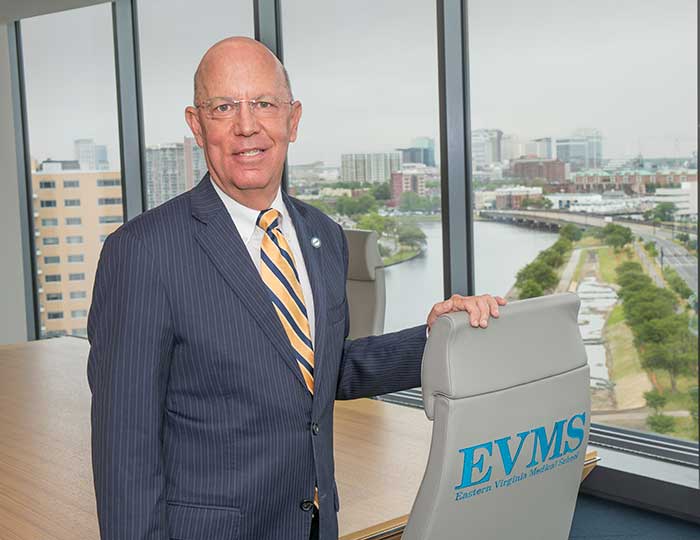
But Dr. Richard V. Homan, president and provost of Eastern Virginia Medical School and dean of its School of Medicine,has another theory about why applications have increased. He says it speaks to a sense of duty brought on by a national crisis: “It’s like 9/11, when a lot of individuals elected to go into the military. People wanted to contribute.”
Dr. Richard V. Homan, president and provost of Eastern Virginia Medical School. Photo by Mark Rhodes
The American Medical College Application Service reported a nearly 17% increase in applications last fall. During the past decade, the year-over-year increase in applications had been below 3%.
Medical schools in Virginia have experienced the same trend since the start of the pandemic.
At Eastern Virginia Medical School applications were up almost 30% — from 6,800 to more than 8,800 for 151 slots, Homan says.
The school offers more than 20 health programs, and Homan sees a heightened interest in health professions such as physician assistants and public health workers. (The national Association of Schools and Programs of Public Health reported a 20% nationwide increase in applications to master’s in public health programs last fall.)
The Virginia Tech Carilion School of Medicine in Roanoke received 6,374 applications for the class that starts this summer. That’s a 45% increase over the 4,400 annual applications the school has received on average since 2016.
“You hear the talk about the ‘Fauci effect,’” says Dr. Aubrey L. Knight, the school’s senior dean for student affairs, but there’s another important factor as well — the pandemic also moved the application process completely online for many medical schools. In the past, the application process generally started virtually and was followed up with on-campus interviews.
Dr. John J. Densmore, associate dean for admissions and student affairs at the University of Virginia School of Medicine in Charlottesville, notes that “medical schools have always interviewed people in person. The switch to virtual made it much less expensive for applicants.” U.Va.’s School of Medicine saw a 35% increase in applications for fall 2020, Densmore says.
The Virginia Commonwealth University School of Medicine in Richmond reports that applications jumped from 7,309 applicants for the fall 2020 class to 8,185 applicants for the fall 2021 class, according to Dr. Michelle Y. Whitehurst-Cook, senior associate dean for admissions.
Knight says that there were concerns that, with the virtual application process, potential Virginia Tech students might not be able to tell if they were a good fit with the school, and the school wouldn’t be able to tell whether a student was a good match. However, the process went better than he expected.
The school “was able to do a good job not only [with] virtual interviews but [with] virtual meetings,” he says, and was able to offer students detailed information about the program and the overall educational experience. “There was less of an impact than I was fearing. We don’t know whether we will be doing virtual interviews this year, but if we do it again, I won’t be as afraid.”
Virtual learning
The pandemic not only changed the application process for medical school, it also changed the way medical students are being taught and tested. The need for social distancing shifted many medical school classes from in-person to online.
“It changed the teaching process dramatically,” Densmore says. At U.Va., students traditionally spend their first 18 months largely in the classroom, followed by more than two years of hospital and clinic work.
In spring 2020, preclinical classes went entirely virtual, with course directors hurrying to change to an online format. “In the fall, there were some in-person options,” he says. “We have continued to expand that this spring, particularly as our students are vaccinated.”
On-site visits to learn clinical skills were shut down for about 12 weeks beginning in spring 2020 and students switched to virtual electives. Medical school students began returning to hospitals and clinics in summer 2020 but were limited initially by a shortage of personal protective equipment, Densmore says.
Knight has found the shift in teaching methods to be “a very mixed bag,” he says. “There are things we’ve learned from the [new] application and education process that may never go away.”
He’s heard good things from students about the revised approach to basic science education. “We’ve learned a lot about virtual learning, as well as the value of providing alternative options instead of stand-and-deliver lectures. I think that … will outlive the pandemic.”
And he believes “students were very appreciative of the ways in which we very quickly made sure we attended to their safety and to the safety of patients. Carilion was sensitive to everyone’s needs.”
Still, “when we had to pull students from hospitals and clinics, it was a big challenge to keep them on track,” Knight says. “I know it limited the patient contact they had. That’s not a good thing. We want to send our students out from here as well-versed in clinical medicine as possible. The limits have taken a toll.”
Med schools get a checkup
Dr. Christopher Woleben, the VCU School of Medicine’s interim senior associate dean for medical education and student affairs, thinks some of the pandemic-driven changes have been for the better, though, particularly in preclinical education.
“I think we’ve learned to do remote learning technology better,” such as creating virtual breakout discussion groups, says Woleben, who is also an associate professor in the school’s Department of Emergency Medicine.
Once the pandemic hit, the school quickly had Zoom video conferences up and running for preclinical students. “We continue to have some in-person experiences in small groups. Of course, we’ve had to change the rooms and the timing to make sure we’re meeting requirements for social distancing,” Woleben says. “We’re hoping to transition back to more traditional in-person classes in the fall. I think we will continue to offer opportunities for students to participate virtually. It will probably be a hybrid experience. “
From March through June 2020, Woleben continues, “we were not sure what was going on, how to keep clinical-phase students safe,” so students were temporarily moved from in-person clinical training to online elective classes.
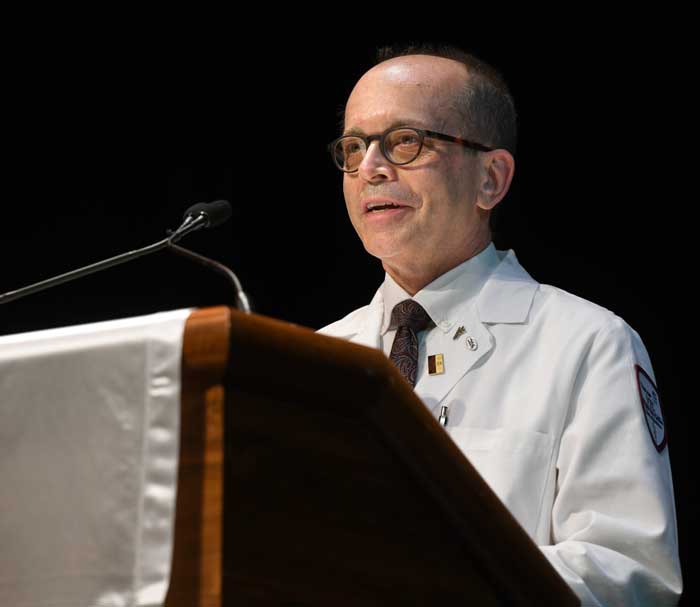
Dr. Aubrey L. Knight, senior dean for student affairs at the Virginia Tech Carilion School of Medicine. photo by Natalee Waters
Third-year students took an eight-week nonclinical course until it was deemed safe to return to the health system in July 2020.
Fourth-year medical students returned to clinical work in June 2020. With a shortened timeframe to prepare to apply for residencies, “individual schedules were designed by hand to make sure they got the experiences they needed. It was a lot of all-hands-on-deck,” he says.
Woleben is proud of his medical students’ response to the pandemic crisis. Many stepped up as volunteers to conduct contact tracing for the Medical Reserve Corps, a national network of community-based units that provide volunteer assistance for public health initiatives and emergencies. “Their question was: ‘How can I help?’”
Waleed Ahmad, who recently finished his first year at the VCU School of Medicine, applied to medical school before the pandemic hit, but by the time he started in August 2020, classes were mostly online.
The virtual experience was “pretty well done,” offering opportunities for small group meetings, says Ahmad, a native of Loudoun County and a graduate of James Madison University. He is president of the school’s class of 2024.
As a first-year student, Ahmad didn’t examine actual patients, but he did take the required Practice of Clinical Medicine class, during which students perform exams on actors who portray patients. This year, however, the class broke into small groups, employing social distancing and wearing surgical masks and face shields.
“The toughest thing” about studying medicine online, Ahmad says, has been the lack of social contact with other students. “You work together. You study for exams and then have a sense of release together. The goal is to build a sense of community and cohesiveness. Our class missed that. I hope we have that next year.”
The pandemic improved medical schools’ capabilities for delivering remote classes, says Dr. Christopher Woleben with the VCU School of Medicine. Photo by Caroline Martin
The Match game
The pandemic also disrupted a major medical school testing tradition. In March 2020, the Step 2 Clinical Skills medical licensing exam test was put on hold. The daylong in-person test was designed to assess potential physicians’ communication and physical exam skills. This January, the Federation of State Medical Boards and the National Board of Medical Examiners (NBME) — the exam’s sponsors — announced that they no longer had plans to revive it.
“The Match,” on the other hand, continues. On the third Friday of March each year, fourth-year medical students from around the nation take part in the nonprofit National Residency Match Program (NRMP). The Match determines where they will spend the next three to seven years of their residency training. The 2021 Main Residency Match saw the largest number of placements offered since the program began in 1952, with 35,194 first-year positions offered, according to the NRMP.
This year’s match was very similar to prior years, according to Woleben. He and other medical school officials say they didn’t see any last-minute changes in medical specialties on the part of this year’s fourth-year students, who are already locked into career paths.
But, Woleben says, “it will be interesting to see what happens with the third-year class. Will there be more interest in critical care, in infectious disease, in population health?”
The pandemic has raised awareness of the disparities that exist in health care, he believes, as well as making changes in the way classes are taught.
“I think that the pandemic will affect how everyone practices medicine. It will have a lasting effect.
Medical
schools in
Virginia
Virginia Commonwealth University School of Medicine
Main Campus: Richmond Website: medschool.vcu.edu Annual in-state tuition and fees1: $37,143 Dean: Dr. Peter Buckley No. of students: 765 No. of faculty: 3,461
Eastern Virginia Medical School Main Campus: Norfolk Website: evms.edu Annual in-state tuition and fees1: $32,456 President/Dean: Dr. Richard V. Homan No. of students: 1,384 No. of faculty: 545
Edward Via College of Osteopathic Medicine
Main Campus: Blacksburg
Website: vcom.edu Annual tuition and fees1: $46,900 President: Dr. Dixie Tooke-Rawlins No. of students: 2,122 No. of faculty: 133
Liberty University College of Osteopathic Medicine
Main Campus: Lynchburg Website: liberty.edu/lucom Annual tuition and fees1: $49,910 Dean: Dr. Joseph R. Johnson2 No. of students: 621 No. of faculty: 53
University of Virginia School of Medicine
Main Campus: Charlottesville Website: med.virginia.edu Annual in-state tuition and fees1: $48,690 Dean: Dr. David S. Wilkes No. of students: 630 No. of faculty: 1,254
Virginia Tech Carilion School of Medicine
Main Campus: Roanoke Website: medicine.vtc.edu Annual in-state tuition and fees1: $56,092 Dean: Dr. Lee A. Learman No. of students: 175 No. of faculty: 829
1 Estimates based on tuition plus semester, annual and one-time fees
2 Interim dean
A cluster of recent investments by pharmaceutical companies in Petersburg could set the city up to rebuild its manufacturing sector as a major player in U.S. efforts to create and secure a domestic supply chain for producing essential medicines at risk of shortages.
The development centers around the AMPAC Fine Chemicals plant in Petersburg, which was idled by its former owner, German pharmaceutical manufacturer Boehringer Ingelheim, in 2014 due to competition from foreign-made drug ingredients. Gov. Ralph Northam announced May 4 that AMPAC will invest $25 million to expand the plant, creating 125 jobs. AMPAC reactivated the plant in 2019.
This follows a January announcement that pharmaceutical manufacturer Civica Inc. will build a $124.5 million facility adjacent to the AMPAC plant that will create 186 jobs. The effort was supported by a $5.7 million grant from the state Commonwealth’s Development Opportunity Fund.
The two companies are working in partnership with the Medicines for All Institute at VCU’s College of Engineering and Phlow Corp., a company formed in 2020 to use advanced manufacturing practices developed at Medicines for All. Central to their work is a $354 million, four-year federal contract Phlow received from the U.S. Biomedical Advanced Research and Development Authority (BARDA) to produce essential medications.
Officials are lauding the pharma cluster as an “advanced manufacturing campus” that could attract similar companies bringing high-paying jobs to Petersburg, whose economy has suffered as U.S. manufacturing has declined.
Keith Boswell, president of Virginia’s Gateway Region economic development organization, says the prospect of building a global hub for an emerging pharmaceutical manufacturing sector has energized local leaders in ways he hasn’t seen in years.
“We really think this is the opportunity of a lifetime,” he says. “It’s having a brand-new industry be created out of nothing.”
The initiative was spearheaded by Virginia Commonwealth University professor Frank Gupton, CEO of Richmond-based Medicines for All Institute and Phlow co-founder, to optimize the production of active pharmaceutical ingredients.
A strategic plan released this spring by VCU emphasizes that state and local government need to invest in site readiness, workforce development and available lab space to keep the momentum going.
“You have this opportunity in front of you to do something really unique and different in a space that nobody is in right now,” says Gupton. “If you make those investments, people are out there waiting to come.”
Roughly two years ago, Facebook announced plans to lead a consortium of companies creating a new digital token currency called Libra. The partners were to include major payment processors Visa, Mastercard, PayPal and Stripe, among others. However, strong opposition from financial regulators around the world led to its shelving.
Fast-forward to 2021, as global acceptance of cryptocurrencies has become more wide- spread. Facebook CEO Mark Zuckerberg has revived the Libra plan, rebranding the currency as Diem.
In separate news last year, Facebook announced the creation of an oversight board to review the company’s content decisions. Based in London and funded by Facebook with a $130 million trust, this board has been referred to as “Facebook’s Supreme Court,” which in May issued a ruling temporarily upholding the social media network’s ban on former President Donald Trump from using the service.
Consider another tech titan, Elon Musk of Tesla Motors. He scored big in the early internet boom with a few early ventures, most notably PayPal, acquired by eBay for $1.5 billion in stock in 2002. Musk owned only 11% of PayPal stock, but it was a pretty big payday. Today, the Tesla co-founder’s net worth is estimated to be $150 billion, including his holdings in Tesla, SpaceX and SolarCity Corp. That’s more than three times the gross domestic product of Jordan and nearly as much as Qatar’s GDP.
What is less widely known is that Musk’s companies have benefited from an estimated $4.9 billion in government support. As reported by The Los Angeles Times in 2015, this includes incentives, grants, tax breaks, discounted loans and environmental credits that Tesla has since sold to other companies.
In the third quarter of 2020, Tesla reported a profit of $331 million. The company said that it had sold $397 million in energy credits that same quarter.
Also noteworthy is that SpaceX counts the Pentagon and NASA among its largest customers, with multiple contracts worth hundreds of millions.
Yet another tech titan, Jeff Bezos, CEO of Amazon.com Inc., at times the richest man in the world and owner of The Washington Post, also has an interest in space. The Bezos-founded commercial spaceflight company Blue Origin, which envisions millions of people living in low-orbit space stations, also has benefited from NASA contracts.
Amazon Web Services, the company’s cloud-computing subsidiary, counts the U.S. government among its largest customers, notably the Central Intelligence Agency, which awarded AWS an initial $600 million contract in 2013.
Apple and Alphabet (Google) are other examples of corporate giants benefiting from government funding.
Besides topping every list of the world’s richest people, the CEOs of these companies have a lot in common. Their companies are all frequent targets of regulatory action around the world. They have interests in creating their own currencies, courts and space programs, too, which makes them more like sovereign nations than any traditional business structure.
Not only are they unpinned to any specific geography or national interest, they have proven resistant to many taxation, antitrust and even labor law norms. Businesses ought to be moored for the good of society. There are higher purposes than just the creation of personal wealth.
Virginia has a vibrant and long-standing tech sector. It, too, has largely relied on Dee Cee as a top customer. But compared with these global behemoths, our so-called “beltway bandits” are small-change pikers.
The role of government goes beyond facilitating the creation of immense private wealth. Government exists to serve the common good. Regulation has failed to keep up with technology. It is time for that to change.
Chesapeake Mayor Rick West lives in the city’s Greenbrier section, so he frequently drives past Summit Pointe, the rapidly expanding mixed-use development centered around the corporate headquarters of Fortune 500 discount retailer Dollar Tree Inc.
And West likes what he sees at Summit Pointe, which is aiming to be a new pedestrian-friendly downtown district.
The latest step is Mosaic, a $68 million, 212,000-square-foot luxury apartment tower that began construction in April. When Summit Pointe’s first three phases are completed in five years or so, the development is expected to include 1.75 million square feet of office and retail space plus more than 1,400 apartment units.
“I’ve met a lot of people who have come to this part of the city because of Summit Pointe,” West says. “They’re starting businesses here because of Dollar Tree’s presence and Summit Pointe’s presence.”
In 2015, after Dollar Tree’s $8.5 billion acquisition of North Carolina-based Family Dollar Stores Inc., the company decided to expand its 200,000-square-foot “store support center” in Chesapeake’s central business district. Dollar Tree then built the 12-story corporate headquarters tower that would become the first phase for Summit Pointe.
That led Dollar Tree to form a subsidiary, Summit Pointe Realty LLC, to create the mixed-use development around its headquarters.
West described it in 2018 as “the beginning of a new Downtown Chesapeake.”
Phase Two began with the Helix apartment building, completed in summer 2020. Next came 555 Belaire, a six-story office building that was finished early this year. With Mosaic now under construction, the final element of Phase Two will likely be another residential building, which would break ground in early 2022 and be completed in fall 2023.
Even before the pandemic created an impetus for moving activities outdoors, Summit Pointe’s development plans called for plenty of outdoor spaces, such as patio dining and pocket parks, says Chris Williams, a senior vice president with Dollar Tree and Summit Pointe Realty.
There is no current time frame for the start of Summit Pointe’s Phase Three, which will ultimately begin with the extension of Belaire Avenue to better connect the development with the rest of the Greenbrier district. More residential space is almost a certainty, and if recovery from the pandemic permits, a hotel could follow in the future. “We’ll see where the market goes,” Williams says.
You could say Christina Feggans-Langston was destined to become a nurse.
“I was named Christina after one of the nurses that my mom had when she was delivering me,” says Feggans-Langston, who works for UVA Health, the same health system where she was born. “Now that I’m a nurse, I want to just keep giving back.”
In August, she will be in the inaugural class of students in the new doctor of nursing practice (DNP) degree program at Mary Baldwin University’s Murphy Deming College of Health Sciences in Fishersville. A first for Virginia, MBU’s DNP program will be delivered in a hybrid model combining online study with three visits to campus each year for intensive clinical instruction.
The DNP is a terminal degree for clinical nurses. Similar to a medical doctor, DNP degree holders can prescribe medication, order lab tests and make diagnoses. (Some nurse practitioners hold DNP degrees.)
MBU’s chief health officer, Deborah Greubel, who holds a DNP degree herself, founded MBU’s DNP program, which was funded via a $5 million gift announced in April from Richmond philanthropists Bill and Alice Goodwin. Interest in the degree and health care in general has been on the rise, she says, since the pandemic began last year. Additionally, as baby boomer nurses reach retirement age, some experts estimate the country will need one million new nurses before 2030.
“There is going to be demand. The question is whether we’re going to be able to keep up with the demand,” Greubel says.
The program will be affiliated with 600 other health institutions. It will have two inaugural cohorts of 10 to 20 students pursuing either the family nurse practitioner track or the adult gerontology acute care nurse practitioner track. Future cohorts may hold up to 40 students per track. The DNP program also offers a study track for nurses who already hold a nursing master’s degree.
MBU President Pamela R. Fox expects high interest in the program, pointing out that primary care practitioners are in demand and that fewer than 1% of nurses have doctoral degrees.
“There’s a tremendous need right now,” Fox says. “We wanted to create these new programs to help fulfill that national demand.”
As for Feggans-Langston, she’s sold on having a future as a nurse.
“I couldn’t think of any other profession [I’d rather] be in,” she says. “If there were something higher than a DNP, I’d probably do that too.”
Virginians bet $236 million on sports during April, the third full month for legal sports wagers in the commonwealth, according to data released Friday by the Virginia Lottery.
Bettors made about $217 million between April 1-30. Virginians bet 22% less in April than in March when they wagered heavily on the NCAA Division I men’s basketball tournament.
The seven licensed operators included in the April numbers were Betfair Interactive US LLC (FanDuel) in partnership with the Washington Football Team; Crown Virginia Gaming LLC (Draft Kings); BetMGM LLC;RiversPortsmouth Gaming LLC (Rivers Casino Portsmouth); Caesars Virginia LLC (William Hill); WSI US LLC (Wynn); and Unibet Interactive.
The state has placed a 15% tax on sports betting activity based on each permit holder’s adjusted gross revenue. With four operators reporting positive adjusted gross revenue, the total take for the state government was $1.65 million.
Sports betting was legalized in Virginia in mid-January.
Manage Consent
This website uses cookies, web beacons, pixels, tags, software development kits, and related tracking technologies, as described in our Privacy Policy and Cookie Policy, for purposes that may include website operation, analytics, analyzing site usage, enhancing site navigation optimizing a user's experience, and third-party advertising or marketing purposes. Through these technologies, we and certain third parties may automatically collect information about your interactions with our website, such as your browsing behavior and page views. We also may share this information about your activity on our website with our social media, advertising, analytics, and other business partners. By clicking “Accept All”, you consent to the use of these technologies and that we can share information about your activity on our website with third parties in accordance with our Privacy Policy and Cookie Policy. If you do not agree with our use of non-essential tracking technologies, please click “Reject All.” You may opt out of certain non-essential technologies by clicking “Cookie Settings.”
Functional
Always active
The technical storage or access is strictly necessary for the legitimate purpose of enabling the use of a specific service explicitly requested by the subscriber or user, or for the sole purpose of carrying out the transmission of a communication over an electronic communications network.
Preferences
The technical storage or access is necessary for the legitimate purpose of storing preferences that are not requested by the subscriber or user.
Statistics
The technical storage or access that is used exclusively for statistical purposes.The technical storage or access that is used exclusively for anonymous statistical purposes. Without a subpoena, voluntary compliance on the part of your Internet Service Provider, or additional records from a third party, information stored or retrieved for this purpose alone cannot usually be used to identify you.
Advertisement
The technical storage or access is required to create user profiles to send advertising, or to track the user on a website or across several websites for similar marketing purposes.

 Sign In
 Free Newsletter