Sign In
Upcoming Event
 Free Newsletter

2026 Virginia General Assembly preview: Dems contend with tricky budget
Marijuana, minimum wage, data centers up for discussion
Kate Andrews //January 1, 2026//
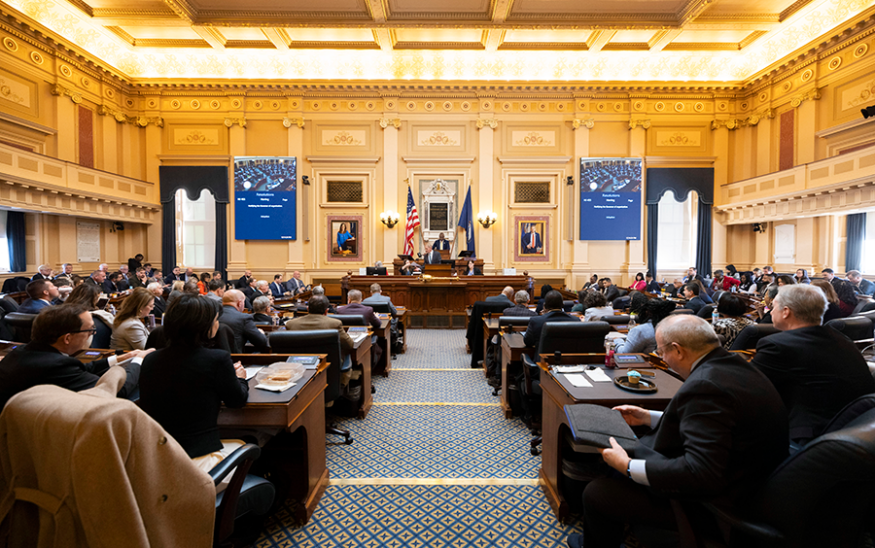
Democrats will have a larger majority in the Virginia House of Delegates in 2026, giving Speaker Don Scott more breathing room in votes.
Democrats will have a larger majority in the Virginia House of Delegates in 2026, giving Speaker Don Scott more breathing room in votes.
2026 Virginia General Assembly preview: Dems contend with tricky budget
Marijuana, minimum wage, data centers up for discussion
Kate Andrews //January 1, 2026//



After four years and a record 399 vetoes under Republican Gov. Glenn Youngkin, Virginia Democrats now have a clear path to passing legislation this year under Democratic Gov.-elect Abigail Spanberger. When the Virginia General Assembly convenes its 60-day session Jan. 14, Democrats will have a much larger majority — a whopping 64 seats — in the House of Delegates, as well as holding the governorship, and the offices of lieutenant governor and attorney general. Meanwhile, the Virginia state Senate is likely to retain its 21-19 Democratic majority following a Jan. 6 special election to fill Lt. Gov.-elect Ghazala Hashmi’s Senate seat.
Among Democrats’ priorities for 2026 are setting up a cannabis retail structure, increasing the state minimum wage to $15 an hour in 2028, and establishing a paid family and medical leave insurance program through the Virginia Employment Commission. State Sen. Jennifer Carroll Foy has also filed a bill that would roll back the state’s right-to-work law, but Spanberger says she will veto the repeal if the measure reaches her desk.
Democrats are mainly focused on pocketbook issues, following the lead of Spanberger, who won the 2025 gubernatorial election by 15 points following a campaign in which she blamed rising consumer costs on President Donald Trump’s tariffs and federal workforce cuts.
Senate Democratic Caucus Chair Mamie E. Locke said in November 2025, while announcing the caucus’ first filed bills, that Democratic legislators “are focused on tackling the costs that strain family budgets and block opportunity.”
They’re also taking the opportunity to pass legislation previously blocked by Youngkin, such as a child care financial assistance pilot program for which the state would match employer payments to help provide care for employees’ children. That bill is back this session, along with other vetoed measures.
Meanwhile, Carroll Foy, D-Woodbridge, says her right-to-work repeal bill has support, even if Spanberger opposes it. “I think we have a pro-union majority in the House and the Senate,” she says. “Despite being Democrats, we are not a monolith. I know that there are conversations that are being had among lots of different folks, but I have a clear-eyed focus. Some CEOs are making 350 times … what workers are making. One of the great ways we can restore balance is to give them the option to unionize.”
Sounds like everything’s looking up for the blue side of the aisle, right? Not so fast, says Democratic state Sen. Creigh Deeds. Virginia faces a monetary problem, which he attributes to Trump’s policies.
“We’re going to be strained,” Deeds says, pointing to an estimated $3.2 billion shortfall in Medicaid funding for the state in 2026. “I gasped when I heard that.”
Also, cuts in federal Supplemental Nutrition Assistance Program (SNAP) funding are likely to mount in the hundreds of millions, costs that would also impact the state budget if the state must make up the difference for Virginians who receive SNAP benefits.
“The economy of Virginia is shaky at best,” says Chris Saxman, a former Republican state delegate and president of Virginia FREE, a business-focused nonpartisan organization. He estimates that the loss of SNAP and other federal funding programs will place Virginia in a $7 billion hole.
“It’s the worst budget in 10 years,” Saxman says. “The majority party is going to find themselves deciding whether they are ‘abundance Democrats’ or ‘scarcity Democrats.’”
The outgoing Youngkin, who nonetheless is tasked with creating a final state budget, said late last year that despite gloomy forecasts by state budget committee staffers, he feels optimistic about the state’s fiscal outlook.
Staffers in both the House of Delegates and the state Senate reported that job growth slowed throughout 2025, with the state reporting a 3.5% unemployment rate for September 2025.
Republican Senate Minority Leader Ryan McDougle, House Minority Leader Terry Kilgore and Sen. Louise Lucas did not respond to interview requests for this story, and House Speaker Don Scott was not available before our print deadline.
Power struggle
Meanwhile, data centers and their corresponding thirst for energy remain one of the General Assembly’s hottest topics, as well as how much the state can rely on renewable energy to fulfill increased electricity demand.
Add to the mix Virginia’s looming 2045 deadline for Dominion Energy to shift 100% of its energy production to carbon-free sources, and you have a “dramatic issue of statewide concern,” says Greg Habeeb, a former Republican delegate and renewable energy and cannabis lobbyist who’s president at Gentry Locke Consulting.
Although Republicans opposed the 2020-enacted Virginia Clean Economy Act, concern about its strictures on power generation in the age of artificial intelligence and hyperscale data centers is a broader nonpartisan issue.
In late 2025, the Virginia State Corporation Commission approved Dominion’s proposed $1.47 billion natural gas power plant in Chesterfield County, which is expected to be in operation by June 1, 2029.
Opponents, including neighbors and environmental groups that argue the plant will raise residential power rates, said the decision amounted to a “blank check” for Dominion to build more natural gas plants in the future, even as the VCEA aims to limit such structures unless they’re deemed necessary for power reliability.
The commission’s decision issued in November 2025 calls Dominion’s need for more power “urgent,” and added that the need “cannot be addressed by non-carbon-emitting resources.” Dominion itself said in a statement that the new power plant is part of its all-of-the-above energy strategy laid out in the utility’s integrated resource plan (IRP) filed in October 2025 with the SCC. In late December 2025, though, the SCC paused its approval while considering a petition submitted by plant opponents.
While the IRP is not written in stone, as individual projects must receive local and state approval, the plan provides Dominion’s general energy production forecast through 2045. The utility’s 2025 plan calls for 40% more power to be produced via natural gas compared to estimates in its 2024 report.
In Dominion’s “company-preferred” plan, solar, wind and battery storage would make up 54% of its capacity mix in 2045, with 33% coming from gas and steam plants, as well as 8% from nuclear, all at an estimated cost of $91.8 billion.
That’s about a third of the estimated $270.4 billion in expenses the utility would face if all of its fossil-fuel plants were retired in 2045, Dominion wrote in the 2025 report. “The company does not see a viable path towards full retirement of all carbon-emitting resources by 2045,” the IRP says.
Habeeb, who has clients in the renewable energy sector, says he doesn’t “believe natural gas is the answer,” pointing to advancements in battery storage capacity. “But others advocate for natural gas. There are more Democratic margins this year, but don’t automatically assume they’re all anti-fossil fuel.”
Indeed, former Democratic Gov. Terry McAuliffe signed on in November as national co-chair for Natural Allies for a Clean Energy Future, a pro-natural gas organization focused on advancing the industry in Virginia, New York and New Jersey.
“With energy demand projected to rise amid the AI and data center boom, natural gas will continue to play a vital role in Virginia’s energy mix,” McAuliffe said in an email. “More than half of Virginia households already depend on natural gas for their everyday energy needs, and our renewable energy infrastructure cannot yet meet the growing demand for electricity across the commonwealth.”
‘Economy of the future’
Deeds, who sponsored failed legislation in 2024 and 2025 that would have created a state board to advise localities about utility-scale solar projects, ran into opposition from those who saw it as the state attempting to interfere with local governments’ land-use decisions. The same issue impacts legislators’ attempts to regulate data centers and energy projects on a state level.
He notes that with large projects like data centers and shipyards, one locality’s decision can affect multiple localities or entire regions.
“There are a lot of people who don’t want to examine the local governments vs. the state, but we ought to examine it,” Deeds says. “Discuss the possibility that some projects are just too big to be controlled by local governments.”
According to Saxman, “the tension is going to be between state and local governments,” as well as regional differences in attitude about data centers. While Northern Virginia residents and some officials have had their fill of data centers, “other parts of the commonwealth say, ‘We can use one of those.’”
Regarding data centers, Deeds notes that House Speaker Don Scott “wants to extend tax cuts,” but Sen. Danica Roem, who represents part of Prince William County, has constituents who are “adamantly opposed to data centers.”
In December 2025, Roem told Prince William leaders that the state legislature must prioritize limiting data centers to industrial areas and removing sales tax exemptions, but it’s unclear how those measures may fare.
The legislature’s Commission on Electric Utility Regulation has recommended a bill that would allow utilities to delay connecting industrial customers such as data centers using more than 90 megawatts of electricity if those connections would cause blackouts or brownouts.
Over the past two years, data center legislation has largely failed in the General Assembly. Last year, 33 bills were filed to increase buffers between residences, schools and data centers; limit residential power customers’ costs; and require air quality and noise studies, among other aims. According to an analysis by Inside Climate News, only five data center bills passed through the legislature in 2025, and one was vetoed by Youngkin.
Meanwhile, more data centers are in the pipeline — including two $3 billion campuses in Appomattox and Caroline counties, and Amazon Data Services’ $700 million purchase of 188.5 acres in Prince William County, which has room for 3.5 million square feet of data center space. Saxman views data centers as the “only growth mechanism right now” amid the state’s economic woes. “I get the political opposition, but we can’t let it get away from us. This is the economy of the future.”
Stirring the pot
Aside from energy discussions, Virginians can expect to see retail cannabis legislation return during the 2026 session, likely carried by Del. Paul Krizek and Sens. Lashresce Aird and Louise Lucas, Habeeb says. “I’m always cautious with legislation, but I’m optimistic that we will pass a really good bill this time.”
Habeeb anticipates that a legal retail market for marijuana products will be “up and running” by early 2027, with some tax proceeds going toward K-12 education, one of Spanberger’s priorities.
JM Pedini, executive director of pro-marijuana lobbying group Virginia NORML, says the current illegal market of marijuana sales in Virginia reaps about $3 billion a year, and if it was taxed at 10%, the state would receive about $18 million to $27 million annually.
In December 2025, Krizek, who chairs the state’s retail marijuana commission, said commission members have “designed a licensing framework that prioritizes small businesses and prevents market dominance by a few large companies,” and that the market could open as soon as Nov. 1, if the commission’s amendments pass.
Those are all views NORML supports, Pedini says, although they voice some apprehension about the ultimate legislation that will be passed. “The concern is, will the cannabis retail sales bill again become a bargaining chip, and will cannabis consumers be treated as constituents whose rights and safety matter, or just as afterthoughts?” Pedini asks.
Habeeb, who says his clients care most about “a fair market with access for everybody,” adds that the idea of incubator programs to provide capital for cannabis entrepreneurs is “not universally embraced.”
Some opponents of such programs feel they are “tilted toward the ‘big boys,’” Habeeb says, referring to national and international companies, as opposed to small, local businesses. “That’s a policy thing the GA will have to finally decide.”
Also expected is a third attempt to permit a casino in Fairfax County if voters approve a referendum, a measure that failed in 2024 and 2025. However, in December 2025, county supervisors narrowly passed a resolution to oppose casino legislation unless a majority of the board formally requests a bill.
As for other legislation likely this session, the court battle between Youngkin and Senate Democrats over university board of visitors members named by the governor and rejected by the Senate’s Privileges & Elections committee in party line votes last year will show up in the form of reform bills, Spanberger and legislators have promised.
Deeds says the legislature will “have to change how the boards of visitors are composed,” including longer terms for members so not all members of a university’s board are appointed by one governor, as is the case presently under Youngkin.
As the parent of two children enrolled at the University of Virginia and Virginia Tech, Habeeb agrees that change is needed. “It’s in everybody’s best interest for that governance issue to go away.”
This story has been updated since publication.
n