Sign In
Upcoming Event
 Free Newsletter

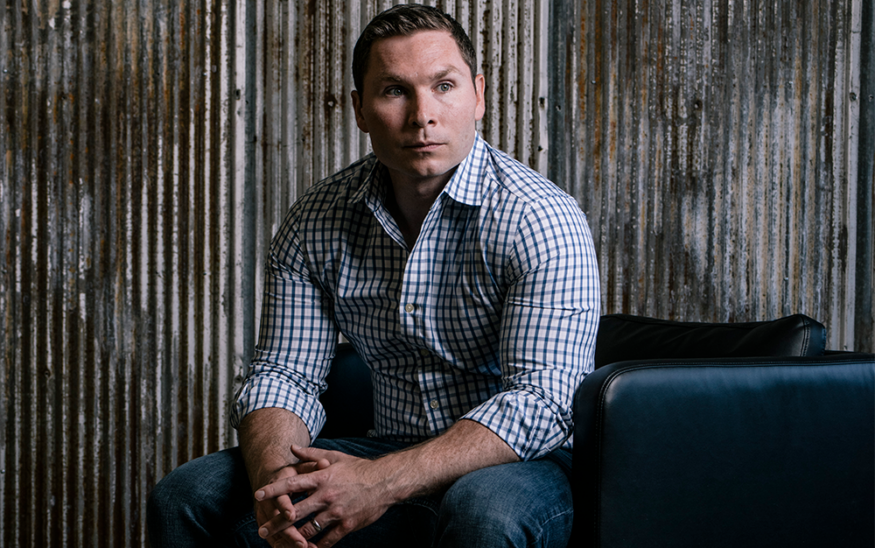
Currently, companies can easily access capital without going public, according to ID.me co-founder and CEO Blake Hall. Photo courtesy ID.me
Currently, companies can easily access capital without going public, according to ID.me co-founder and CEO Blake Hall. Photo courtesy ID.me
Virginia startups delay exits amid private funding flush



SUMMARY:
- Companies are raising more capital, staying private longer and exiting later (if at all) nationwide, and Virginia is no exception.
- Median time to IPO rose from 5.4 years in 2020 to 7.4 years in 2025, according to PitchBook analyst
- Companies have more funding options than they used to, evident in how the private investment market has ballooned.
When Blake Hall co-founded ID.me in 2010, he intended to take it public. More than 15 years later, the McLean-based digital identity company is still private. But Hall says it’s not a failure of ambition; it’s a sign of the times.
“There’s so much more capital in the private markets now that it is just easier to get access to liquidity and to defer going public than it has been, maybe like 10 to 20 years ago,” he says.
Hall acknowledges ID.me isn’t really a startup anymore, explaining it is “a growth company on the [initial public offering] track.”
The company has raised hundreds of millions across multiple late-stage rounds and is actively in the pre-IPO process, but the path has stretched longer for ID.me than it did for other businesses that previously went public.
Instead, companies are raising more capital, staying private longer and exiting later (if at all) nationwide, and Virginia is no exception. The median time from a company’s first venture capital round to IPO grew from 5.4 years in 2020 to 7.4 years in 2025, says Emily Zheng, senior VC research analyst at PitchBook. The median Series D or later company is 10 years old, up from 8.4 years in 2015.
“This means that a majority of late-stage startups have founders and early employees who have been waiting over a decade for liquidity,” Zheng notes.
Virginia companies collectively raised $2.75 billion in venture capital in 2025, according to the PitchBook-NVCA Venture Monitor. That’s roughly triple the amount raised in 2015. Nationally, megadeals of $100 million or more became more common in 2025, a sign companies would rather raise more late-stage rounds than plan for a sale or IPO.
Why are companies staying private for longer? They have more funding options than they used to, evident in how the private investment market has ballooned. BlackRock projects it’ll grow from $13 trillion in 2024 to $20 trillion by 2030. That gives founders the chance to raise more capital without the attention of being a public company.
“It’s hard to be a public company in terms of the operating rigor and the scrutiny,” Hall says. “You can clearly get access to massive liquidity without going to the public markets.”
Speed bumps
Amias Gerety, partner and head of the U.S. for Alexandria-based QED Investors, says the bar for public markets has risen. He recalls pitching an investor in 2021 on one of his portfolio companies “flirting with a [special purpose acquisition company] deal” doing $40 million in revenue and on track to hit $100 million the following year.
“I don’t have time for companies with $40 million in revenue,” Gerety says the investor told him.
“In order for it to be worth the time of the mass of public market investors, you need to have enough scalebto be interesting to them.” That threshold is roughly $500 million in revenue and a $5 billion market cap, he says.bLate-stage private rounds also provide greater proof of value for employees. Secondary transactions, in which existing shareholders sell a portion of their stake to new investors, give employees a chance to see their equity become real without forcing an IPO, Hall says.
“People can buy houses and change their lifestyle,” Hall says. “So the question might almost be the reverse: Why would you go public? You can solve for all capital needs [and] avoid this microscope that’s always over the business.”
Hall still insists, though, that ID.me will go public. “Successful IPOs [have] a predictable business,” he says. “If you have a predictable business, then being public can be amazing.”
While Hall’s company is staying private from a position of strength, not every company is.
Zheng describes the current landscape as a “tale of two markets.” After interest rates rose sharply in 2022, venture activity slowed and exits dried up. Fewer exits meant fewer cash returns to limited partners — pension funds, university endowments and wealthy individuals who supply the capital that VC firms invest — and that made them more selective about new funds they’d back. Plus, investors have become obsessed with AI-related startups since ChatGPT’s introduction in late 2022.
“This hyper-focus on top startups and AI has allowed these companies to raise seemingly unlimited amounts of private capital at rapidly rising valuations, reducing the need to exit, while the rest of VC struggles to close a single round,” Zheng says.
Meanwhile, Gerety and Hall agree the calculus for going public has changed. Hall describes an IPO as a “one-way door,” meaning once a company goes through it unprepared, there’s no easy way back. A miss on earnings can tank stock prices, resulting in diminished employee morale.
“The operating discipline to go public and have it be a wise decision over the medium to long term requires a level of excellence that a lot of young companies simply don’t have,” Hall says.
T