Sign In
Upcoming Event
 Free Newsletter

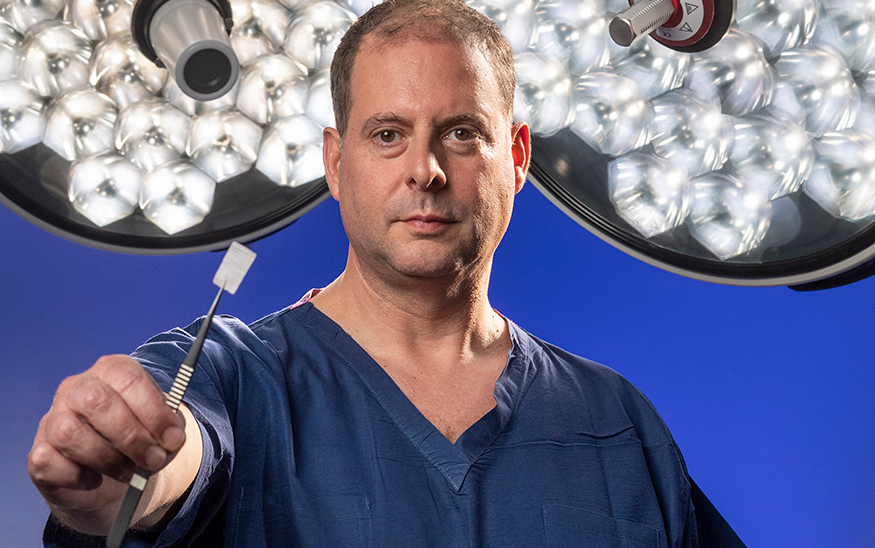
VCU’s TechTransfer and Ventures office helped Dr. Jonathan Isaacs commercialize Nerve Tape. Photo courtesy Virginia Commonwealth University
VCU’s TechTransfer and Ventures office helped Dr. Jonathan Isaacs commercialize Nerve Tape. Photo courtesy Virginia Commonwealth University
Virginia health systems guide employee-inventors to launch
Beth JoJack //June 1, 2026//



SUMMARY:
Whether bedside or in the operating room, healthcare practitioners see firsthand where medical technology falls short — and where opportunity exists.
“We love to get inventions from doctors … because their inventions fill a specific gap in the market,” says Ivelina Metcheva, assistant vice president for innovation at Virginia Commonwealth University.
Medical school may prepare pediatricians to treat strep throat, but most doctors don’t graduate with expertise in patent law or business development. That’s why several health systems in the commonwealth connect practitioners with officials trained to shepherd promising ideas for medical devices or diagnostic tools through development to commercialization.
Dr. Jonathan Isaacs, chair of VCU Health’s Division of Hand Surgery and a professor in the School of Medicine, knew his field of medicine had a problem: Repairing nerves with sutures is time-consuming and technically demanding.
About 15 years ago, Isaacs brought a kernel of an idea for a solution to VCU’s TechTransfer and Ventures office, which helps commercialize inventions created by VCU scholars and staff.
The office staff works with inventors to preserve patent rights before they share their research.
“Their goal is to get you in a situation where you’re protected,” Isaacs says.
Not every idea for an invention makes it to commercialization, but Isaacs’ did. His Nerve Tape uses biomaterial and integrated microscale hooks to connect nerves faster and more accurately. Since the product entered the market in 2024, more than 3,500 nerve tape devices have been implanted.
The business side
In 2020, Roanoke-based Carilion Clinic launched the Carilion Innovation department to support employees interested in developing medical devices and other healthcare-related inventions.
The creation of the office wasn’t a response to a single inventor who needed help. Rather, “it was really more a sense that there was, overall, a pretty big desire to be innovative and work on the future of healthcare and not any resources in place to do that,” said Aileen Helsel before she left her position as Carilion’s director of innovation in late May.
Today, when a Carilion employee comes forward with an idea, Carilion Innovation evaluates its potential — not only for profitability but also for patient impact, particularly in rural communities.
“We can pursue some things that aren’t going to be quite as lucrative as maybe other groups would require,” Helsel said.
Carilion Innovation can help with rapid prototyping and outside expertise. The office also offers funding to develop innovations, ranging from $5,000 to $50,000.
As of mid-March, Carilion Innovation was working on between eight and 10 active projects.
“We have three that are sort of preparing for a spinout for startup companies, and we have probably about five more or so that are more or less ready to be licensed,” Helsel said.
At the University of Virginia, Sharon Krueger, senior director of research commercialization programs and relationships in the medical school’s Office for Research, oversees multiple funding programs, including the U.Va. Comprehensive Cancer Center Accelerating Innovation Fund established in 2024.
The U.Va. Cancer Center has committed $1 million annually for the program and provides grants of $150,000 to innovators.
To compete for funding, applicants must clearly demonstrate how their innovation improves on existing solutions and show an understanding of the market.
“What I primarily do is kind of teach the business side and storytelling of their technology,” says Krueger.
After inventors submit detailed applications, a review board composed of scientists, licensing experts and venture capitalists select finalists for oral presentations.
Those selected for awards must meet specific milestones, positioning projects for future investment.
Even applicants who aren’t selected remain on Krueger’s radar.
“It might be a year or three years down the road where I come across some opportunity,” she says.
VCU offers a $50,000 commercialization fund that helps inventors build prototypes, conduct studies and refine their technologies for industry partners or investors.
When a license is secured, VCU inventors receive 40% of the proceeds, with the remainder distributed among the university, the inventor’s department and the relevant school.
U.Va. as a whole follows a similar model, distributing 35% of licensing revenue to inventors, with the remaining funds allocated to university programs and research support. Carilion officials declined to detail their revenue-sharing structure but said inventors do receive financial benefits.
Isaacs credits having the VCU TechTransfer and Ventures office with the success of his Nerve Tape. During development, Isaacs had trouble finding someone with the specialized expertise to engineer microhooks.
He later discovered Atlanta-based Axion Biosystems, a company with expertise in microneedles. The company’s leadership, however, wasn’t initially excited to use their technology to repair nerves, according to Isaacs.
Thankfully, VCU’s TechTransfer and Ventures office got the deal made.
“If they hadn’t navigated it perfectly, we would have ended up with nothing,” Isaacs says.
In 2019, BioCircuit Technologies spun off from Axion Biosystems to focus on Nerve Tape. Last year, the company was named to the 2025 Inc. 5000 list, recognizing the fastest-growing private companies in the United States.