Sign In
Upcoming Event
 Free Newsletter

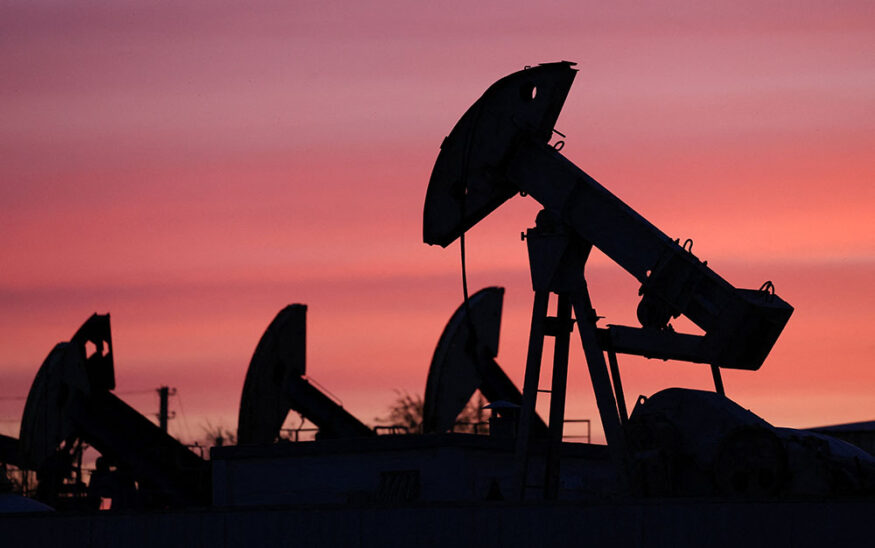
Sunset clouds glow over pump jacks at the Airankol oil field operated by Caspiy Neft in the Atyrau region, Kazakhstan, April 21, 2026. REUTERS/Pavel Mikheyev/File Photo
Sunset clouds glow over pump jacks at the Airankol oil field operated by Caspiy Neft in the Atyrau region, Kazakhstan, April 21, 2026. REUTERS/Pavel Mikheyev/File Photo
Global oil slips but Middle East fighting gives floor to drop



LONDON, May 5 (Reuters) – Global oil prices slipped on Tuesday a day after the United States launched an operation aimed at reopening the Strait of Hormuz to shipping, although exchanges of fire between the U.S. and Iran limited the decline.
Brent crude futures eased $2.99, or 2.6%, to $111.45 a barrel at 1322 GMT after settling up 5.8% on Monday. U.S. West Texas Intermediate crude fell $3.70, or 3.5%, to $102.72, after gaining 4.4% in the previous session.
Maersk said the Alliance Fairfax, a U.S.-flagged vehicle carrier, exited the Gulf via the strait accompanied by the U.S. military.
“It shows that limited safe passage is possible under current conditions and helps chip away at some of the worst-case supply disruption fears,” said Tim Waterer, chief market analyst at KCM Trade, in an email.
“However, it’s still very much a one-off event rather than a full reopening,” he added.
IRAN LAUNCHED ATTACKS ON MONDAY
Iran launched attacks in the Gulf on Monday to counter U.S. attempts to take control of the Strait, which connects the Gulf to wider markets and typically carries oil and liquefied natural gas supply equal to about 20% of global demand every day.
Several merchant ships in the Gulf reported explosions or fires on Monday, and an oil port in the United Arab Emirates, which hosts a large U.S. military base, was set ablaze by Iranian missiles.
The U.S. military said on Monday it destroyed six Iranian small boats, as well as cruise missiles and drones.
“Prices continue to trade in a highly volatile range, driven largely by ongoing tensions in the Strait of Hormuz,” said Phillip Nova’s senior market analyst Priyanka Sachdeva.
“While prices have eased slightly in recent sessions, this is not due to any real improvement in fundamentals, but rather a temporary relief after the U.S. launched ‘Project Freedom’,” she added.
(Reporting by Alex Lawler, Anushree Mukherjee and Trixie Yap; Editing by Barbara Lewis)
s