Sign In
Upcoming Event
 Free Newsletter

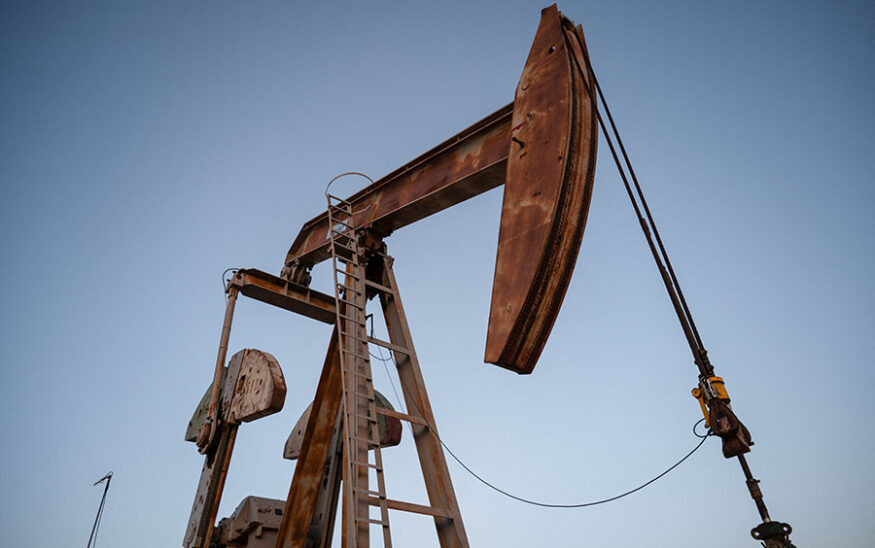
A pump jack operates outside of Midland, Texas, U.S. June 11, 2025. REUTERS/Eli Hartman
A pump jack operates outside of Midland, Texas, U.S. June 11, 2025. REUTERS/Eli Hartman
Oil prices jump 5% as Iran attacks UAE, vessels in Strait of Hormuz



NEW YORK, May 4 (Reuters) – Oil prices jumped about 5% on Monday as Iran stepped up attacks on the United Arab Emirates (UAE) and ships in the Middle East Gulf over the past 24 hours.
Brent futures rose $5.75, or 5.3%, to $113.92 per barrel at 12:03 p.m. EDT (1603 GMT), while U.S. West Texas Intermediate (WTI) crude rose $3.54, or 3.5%, to $105.48.
Iran’s Revolutionary Guards Navy issued a map that it said was expanding the areas controlled by Iran near the Strait of Hormuz to include UAE’s ports of Fujairah and Khorfakkan as well as the coast of Umm Al Quwain emirate in the UAE, according to Iranian news agencies.
About 20% of global oil and liquefied natural gas (LNG) supplies passed through the strait before the U.S. and Israel launched strikes against Iran on February 28.
President Donald Trump said on Sunday the U.S. would start helping free ships stranded in the Gulf. On Monday, the U.S. military said two U.S. Navy guided-missile destroyers had entered the Gulf to break an Iranian blockade and that two U.S. merchant ships had transited the strait.
“The path for prices remains skewed to the upside as long as flows through the strait remain restricted,” UBS analyst Giovanni Staunovo said.
South Korea said there was a fire and an explosion on a vessel operated by HMM in the strait on Monday.
Earlier, the UAE accused Iran of attacking an empty crude oil tanker belonging to Abu Dhabi state oil firm ADNOC with drones as it attempted to transit the Strait.
The United Kingdom Maritime Trade Operations (UKMTO), meanwhile, said it received a report of an incident involving a cargo vessel about 36 nautical miles north of Dubai. The UKMTO also reported a separate incident earlier in the day near the UAE.
The energy minister in the UAE, which left OPEC last week, said the country owes it to its investment partners to produce what global oil markets require without restrictions, while cooperating with other crude producers.
OPEC and its allies, known as OPEC+, said they would raise oil output targets by 188,000 barrels per day in June for seven members, marking the third consecutive monthly increase.
(Reporting by Scott DiSavino in New York and Ahmad Ghaddar in London; Additional reporting by Florence Tan and Sudarshan Varadhan; Editing by Louise Heavens, Bernadette Baum, Paul Simao, Will Dunham and Alexander Smith)
n