Sign In
Upcoming Event
 Free Newsletter


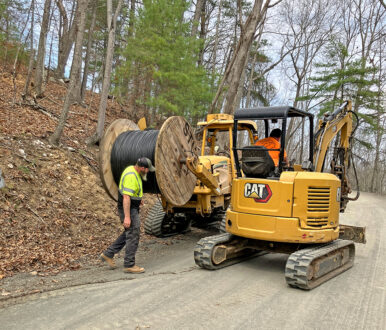
Shentel employees string fiber optic cable across utility lines as part of the statewide effort to reach universal broadband access in Virginia, especially in rural areas. Photo courtesy Shentel
Shentel employees string fiber optic cable across utility lines as part of the statewide effort to reach universal broadband access in Virginia, especially in rural areas. Photo courtesy Shentel
Virginia nears universal broadband access



Summary:
- Virginia invested $1.5 billion in broadband expansion
- BEAD program approved $545 million for 23 internet providers
- Shentel completed $52 million in broadband projects in Campbell and Franklin counties
While serving as the head of the Virginia Tobacco Region Revitalization Commission, Evan Feinman couldn’t figure out why typical economic development strategies weren’t working.
Feinman was tasked with revitalizing communities that suffered after the disappearance of the tobacco industry, breathing new life into towns that historically relied on the crop for their economic welfare. He came across places with traditionally great attributes like easy access to transportation and a strong talent pool, but businesses still weren’t coming in the way he expected.
Talking on the ground with industry stakeholders and decision-makers, Feinman realized what the problem was. While the communities had plenty to offer, it made no sense for new businesses to come to towns lacking high-speed internet.
“They says, ‘There’s no broadband. We have fiber right at the industrial site, but there’s no broadband in town,’” Feinman says. “They says, ‘I can’t tell my boss to put a $350 million factory here if he can’t email the plant manager at 2 a.m.’”
That was when Feinman knew Virginia needed to expand broadband statewide. The tobacco commission wound up laying 3,000 miles of fiber, and Feinman continued to push for universal broadband, getting Democratic gubernatorial candidate Ralph Northam to take it seriously.
After Northam’s election, he asked Feinman if he would run a statewide universal broadband program. The Virginia Telecommunications Initiative (VATI) started in 2017 under the Department of Housing and Community Development to fund public-private partnerships with a goal of expanding internet access everywhere in the state by the early 2020s.
Since then, the goalposts moved a bit, Feinman says, but Virginia remains on track to be the first state of its size to achieve universal broadband coverage.
It’s been almost a decade since Virginia started the push to bring broadband to every citizen in the commonwealth. And now, roughly 10 years later, the commonwealth is close to connecting the entire state to high-speed internet.
When Virginia’s broadband expansion started in 2017, the state estimated that 500,000 homes, businesses and community anchors lacked broadband access at that time, says Chandler Vaughan, acting director of the office of broadband under the Department of Housing and Community Development. Today, Vaughan says, nearly all those projects are funded, but 209,518 remain to be built out.
Getting this far has not been easy. There’s rural terrain to cover, there are debates over what technologies are best for which situations, and there’s money to be disbursed. All in all, Virginia has invested $1.5 billion toward expanding broadband. The first investment, in 2017, was $1 million.
‘Basic infrastructure’
Economic growth in 2026 requires broadband, says Feinman, who went on to create the federal Broadband Equity, Access, and Deployment Program (BEAD) in the Biden Administration, nationalizing what he created in Virginia.
“The simple fact is it’s a basic quality-of-life requirement, and its absence can really prevent economic growth,” says Feinman, who now is vice president of strategy at JSI, a telecommunications solutions firm that helps rural and independent broadband/telecom providers build, operate and scale fiber and digital networks. Quality internet access, he points out, has implications for everything from remote healthcare to learning opportunities for young people.
“It’s become the next layer of basic infrastructure, like things out there like roads, bridges, and electricity,” Vaughan says.
On a practical level, the work to expand broadband is a communal effort between state government, local jurisdictions and the electric utilities and telecommunications companies that install the infrastructure. VATI provides grants to local governments, which then partner with internet service providers to extend broadband connectivity. The grants are matched by private and local funds.
A major hurdle was crossed late last year, when Virginia’s final BEAD proposal to expand broadband received approval from the U.S. Department of Commerce program. The approval gave the commonwealth the go-ahead to distribute $545 million in federal funds to 23 internet service providers that could then leverage almost $430 million in private dollars toward reaching universal broadband access in Virginia.
Before the BEAD proposal was approved, broadband expansion efforts in Virginia were funded by $731 million in federal COVID-19 funds and $195 million from the state’s general fund.
There’s also another $800 million-plus that comes with the BEAD approval, Vaughan says, but the state can’t use it yet because the federal government hasn’t issued guidance.
Getting the government involved in broadband expansion was essential, Feinman says, because the economics of expanding to rural communities aren’t favorable for the private sector.
“You’ve got a fundamental math problem: A mile of fiber optic cable costs the same amount to run in Arlington that it does in Alleghany, but in Arlington, there are thousands of potential customers and in Alleghany, it might get you three,” he explains. “The return on capital in areas where the population density falls low enough isn’t there to make sense. In some instances, it’s literally negative.”
Shenandoah Telecommunications, better known as Shentel, knows this well. The 124-year-old company got its start as a farmers’ mutual telephone cooperative in Shenandoah County and puts an emphasis on expanding broadband into rural areas, Brian Byrd, government and community affairs specialist for Shentel, says.
Filling in cracks
Before VATI, expanding broadband took a bits-and-pieces approach, where there would be a grant here and a loan there, but not much in the way of coordinated efforts, Byrd says.
“We understood how difficult it was to get to these people. We knew a subsidy had to be part of the picture for rural Virginia,” says Chris Kyle, Shentel’s vice president of regulatory and industry affairs.
Having preexisting relationships in the community helped, so when VATI funding came through, Shentel knew how to use it, Kyle says. The company was awarded money to provide broadband to 18,000 locations, or “passings,” and the work is close to being done, Byrd says.
In May, Shentel announced it completed a $20 million VATI project in Campbell County, bringing service to 4,100 previously unserved homes. It also completed a $32 million project to 6,700 Franklin County homes that same month.
“We were careful about our partnerships, and the size of projects. We took a conservative, judicious approach,” he says.
Close to 100% of the 500,000 estimated connections needed to reach homes, businesses, and community anchors lacking broadband access in 2017 have been funded, Vaughan says.
BEAD allowed the commonwealth to fund broadband for 85,069 locations, he says. VATI funded 372,298, which leaves a balance of 42,633 funded by other federal programs that don’t go through the broadband office, Vaughan says.
On the construction side, VATI has allowed for build-out to 243,058 locations as of April 30, Vaughan says. BEAD and VATI-funded projects still need to connect to 209,518 locations; the remaining 47,454 have been built out by a different federal program, he says.
Construction on BEAD-funded projects is expected to start later this year, Vaughan says, pending permitting approval.
Vaughan estimates construction on the BEAD-funded projects to be finished “at the end of the decade, in 2030.” But the last-mile portion of broadband expansion might be the hardest, he says.
“The majority of what’s funded under BEAD are those that haven’t been included in previous projects, ones that fell through the cracks,” he says. “The vast majority of these are far-reaching in even rural counties, where we’re burying fiber within rock, replacing poles and rock, or running fiber a mile or two over the road before you get to the first house. The price tag reflects that too.”
Fiber vs. satellite
When it comes to what technology is used to expand broadband, Vaughan says, Virginia is a “technology-neutral state in the broadband expansion world.
“We defer to local governments that bring us applications to select their preferred provider and preferred technology,” he says. “Under the BEAD program, we received applications from private companies for the first time, talking about the feasibility of tech working and cost-effectiveness.”
Most awards have been for fiber, Vaughan says, because of its scalability.
“You’ve seen over the last 10 years, demand at household level of connectivity and data usage is skyrocketing, and you’re only going to see that more,” he says. “Those network demands are best served by technology that can meet that over time, and that’s fiber. The only limits to the speed cap of fiber are the things at the end of the network.”
Even though fiber is versatile, Vaughan says, other technologies like satellite internet access are in the portfolio as well. Satellite services Starlink (by SpaceX) and Amazon Leo have been awarded BEAD funds for Virginia projects — between the two of them, they’ll cover 11,000 locations, Vaughan says.
Satellite makes sense in very remote locations where it’s not worth it to build out fiber capacity. The BEAD process covers $10,500 per location for fiber; anything above that goes to satellite, he says.
“That’s measured on an average cost per home basis,” he clarifies. “On an average, if there’s 500 homes in a project area and a $5 million subsidy, that’s $10,000 per home, that project was allowed to move forward.”
While the commonwealth is still waiting for guidance on its $800 million in remaining BEAD funding, Vaughan says it could be used for precision agriculture, artificial intelligence literacy and workforce development.
The broadband office is also paying close attention to expanding cellular service, he says. There are too many places in Virginia where it’s hard to even make a call on a cellphone.
“What good is having fiber when you can’t step out your front door and call 911?” he asks.
p