Sign In
Upcoming Event
 Free Newsletter

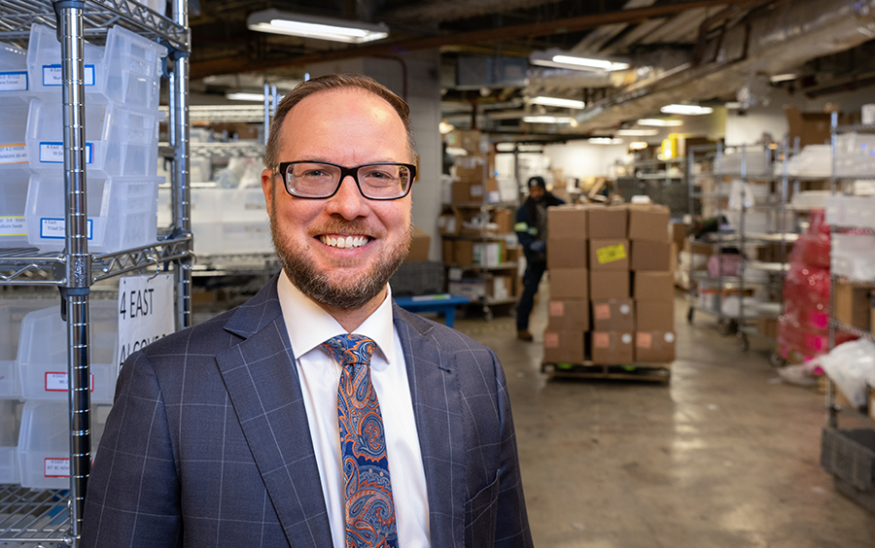
After the pandemic, health systems adopted new supply chain strategies like building emergency stockpiles, says Adam Momper, UVA Health’s supply chain administrator. Photo by Matthew R.O. Brown
After the pandemic, health systems adopted new supply chain strategies like building emergency stockpiles, says Adam Momper, UVA Health’s supply chain administrator. Photo by Matthew R.O. Brown
Health care systems navigate supply chain disruptions



Summary
- Hurricane Helene damaged a key IV fluid plant, causing nationwide shortages
- Tariffs and global consolidation worsened supply chain disruptions
- Health systems turned to stockpiling, GPOs and alternative suppliers
After Hurricane Helene tore through the Southeast in September 2024, the destruction left in its fatal wake included a flooded manufacturing site in North Cove, North Carolina, where Baxter International produces 60% of the IV fluids used in the U.S. Health systems in Virginia, like those around the country, worked quickly to adjust for the shortage that resulted.
“We didn’t have to cancel cases per se or to reduce any care or to delay any care. What we did have to do primarily was to ration fluid, which actually turned out to be a good lesson learned,” says Adam Momper, supply chain administrator for UVA Health.
The health system began tracking milliliters of fluid used per case.
“What we started to see is that in some types of cases, we would actually have a certain level of waste in a non-emergent situation or a non-shortage situation,” Momper says, leading UVA Health to change some practices, like using a 250-milliliter bag in some procedures for which a 500-milliliter bag was previously standard but often thrown out half-full.
Health systems also sought to reduce usage by finding alternatives. One example, says David Davis, vice president of supply chain at VCU Health System, was using oral fluids for dehydrated patients in some cases, as opposed to IV fluids.
The IV fluids shortage demonstrates one factor contributing to overall medical supply shortages, says Chris Rucker, chief administrative officer with Shenandoah regional health system Valley Health.
“In an attempt to lower cost, there’s consolidation in the industry, and that creates vulnerability,” he explains.
The Food and Drug Administration announced in August 2025 that the shortage of a specific IV fluid — the sodium chloride 0.9% solution — had ended, but said it continued to work with manufacturers on other IV fluids in short supply.
Before Helene, the COVID-19 pandemic brought health care supply chain struggles into the public consciousness as U.S. hospitals struggled to find personal protective equipment, but national shortages in health care supplies are far from over. In fall 2023, medical product shortages affected about 38.8 million people in the U.S., roughly 18% of the population, according to the U.S. Department of Health and Human Services’ Office of the Assistant Secretary for Planning and Evaluation.
In November 2025, the predictive data tool used by VCU Health listed 1,500 items with potential shortages.
“I think it started with the pandemic,” Davis says, “and I think from what I’ve seen, a lot of the manufacturers are just not recovered to the full extent they thought they would. And so, we definitely are seeing … the majority of health systems across the country are dealing with back orders and shortages from these manufacturers.”
At any given time, Rucker says, Valley Health is unable to get or has in short supply 20 to 40 medications and has to seek alternatives. The health system logs more than 100,000 different supplies.
“Those shortages are all related to availability of ingredients, or relationships in other countries, or the effects of weather or war on manufacturing facilities,” he says.
Adjusting course
Perhaps most noticeably, the tariffs instituted by President Donald Trump — starting in February 2025 on imports from China, Mexico and Canada, and growing in April to include almost all countries — have contributed to supply chain struggles.
For Valley Health, “It’s not necessarily tariffs driving up our costs of goods,” Rucker says, “so much as it is the foreign response to then steer those goods to other countries or other locations where they’re not experiencing the tariffs.”
That’s not the case everywhere, though. At UVA Health, Momper says he’s seen tariff costs reflected as line items or surcharges on invoices and through increased prices. In some cases, the health system has had to absorb the costs, although some contracts contain language meant to protect providers from price increases.
Virginia executives emphasize that supply chain resiliency matters beyond a data application, with real-world effects on health care.
“It matters because our patients are our No. 1 priority,” says Davis. “Our job is to make sure that our clinicians and our physicians have everything they need to take care of every patient that comes through the door.”
Along with working with clinicians to safely reduce their use of items in short supply, Virginia health systems employ additional strategies to maintain their health care supply stock, including warehousing backup inventory, joining group purchasing organizations and finding out-of-the-box solutions.
Though health systems often contract with third-party distributors, many also have created their own emergency stashes to protect against supply chain disruptions.
UVA Health and VCU Health, for example, both contract with Fortune 500 logistics and supply company Owens & Minor, headquartered in Henrico County. About 90% of UVA Health’s supplies come from Owens & Minor’s Ashland warehouse, Momper says.
Nevertheless, during the COVID pandemic, UVA Health, like other health systems, realized a strategy shift was warranted. In addition to building a safety stock of commonly used items in one warehouse, UVA Health upgraded another for perioperative surgical supplies. There, for instance, it stores circuits for the machines that anesthesia professionals use to administer gases. Without those circuits, health care teams can’t perform surgical procedures, Momper explains.
“The lessons learned from COVID have demonstrated or taught us that this is probably still the right strategy for today’s … ever-changing [health care] marketplace, and the high volume and demand of patients,” he says.
Valley Health and VCU Health also store backup stock, including PPE, in warehouses.
As part of the larger Bon Secours Mercy Health, Bon Secours Virginia receives its supplies through Advantus Health Partners, a wholly owned subsidiary of the national health system that handles supply chain operations, including warehousing backup supplies. Advantus also pays its primary distributor, Medline Industries, to keep safety stock dedicated to Bon Secours.

Banding together
Multiple Virginia health systems are members of group purchasing organizations (GPOs), which pool members’ supply needs and leverage their large-quantity orders to obtain lower prices from manufacturers and other entities.
“At its core, the purpose of a group purchasing organization is to help leverage size and scalability to drive down costs for health care,” Momper explains.
In addition to creating economies of scale, GPOs help reduce the sourcing workload, taking on tasks like identifying manufacturers and health care suppliers. And, says Momper, the GPO that UVA Health uses now requires all new contracts to have built-in resiliency plans, such as alternative manufacturing routes.
More than 80% of Valley Health’s contracts are through Nashville, Tennessee-based HealthTrust Performance Group, while both VCU Health and UVA Health are members of Premier, a Charlotte, North Carolina-based national health care GPO.
One opportunity UVA Health benefited from was a joint venture that Premier created in 2020 with manufacturer DeRoyal Industries to make disposable isolation gowns at its Powell, Tennessee, facility. UVA Health was one of about 30 other Premier members to join the venture.
“Through this partnership and this new joint venture, we essentially now have all of our gowns made domestically in Tennessee,” Momper says. “[It gives] us that better peace of mind, for example, that that product is made a state away instead of multiple countries away.”
In addition to its other supply chain services, Advantus acts as a GPO for Bon Secours and others, serving clients in 48 states. Knowing it can’t cover everything, Advantus focuses on about 650 contracts, says Chief Operating Officer John Wright.
The company doesn’t take the “peanut butter spread approach” of using several suppliers for one product, he says: “We believe that either having a primary [supplier], and in some cases and for clinically sensitive products we might have more than one — but for the most part, one — we build a much deeper relationship with that supplier.”
Alternate routes
Taking a slightly different approach, some health systems, including Valley Health, divide orders of often disrupted supplies between suppliers to better their chances of receiving those items.
“But,” Rucker points out, “that has implications for the supply cost, because if you’re only buying half as much from a manufacturer, they’re likely not to sell it to you at as great a discount.”
UVA Health tends to dual source things that every unit uses, like gauze, Momper says. It also sometimes works with the academic division to procure items that both entities need, such as office supplies.
Sometimes, though, dual sourcing or group contracts just aren’t feasible, and health systems are left holding the bag.
“I wouldn’t say this across the board,” Momper says, “but there are circumstances where we realize we might not get, say, top-tier pricing, but we’re comfortable getting second-tier pricing to ensure that we know the product’s going to be here when we need because the alternative … for example, to have to cancel a surgery, or to cancel a week’s worth of surgeries, is far more detrimental not only to our patients and patient experience in the community, but also to our finances.”
A few Virginia health systems have also borrowed supplies from others, they say. Sometimes weathering a shortage “involves relationships with neighboring health systems, and being able to say, ‘Can we buy some of this from you, or trade you some of that, or borrow this for a week and then return it when our supply comes in?’” Rucker says.
And when hospitals can’t get their hands on needed supplies, they look for alternative products. The defibrillator pads that VCU Health uses were on backorder in November 2025, Davis says, “so we have to go out and source alternative pads that go in those defibrillators,” which staff then have to learn to use.
With magic wands in short supply, the health care industry remains on a quest to achieve supply chain resilience.
“I think we’re all still trying to figure out kind of that secret sauce of how to balance cost, quality, access, timeliness, while still being good stewards and looking at costs and all of that in respect to the resiliency and making sure that we can care for all the patients that come to us,” Momper says.
s