Sign In
Upcoming Event
 Free Newsletter

Virginia Democrats target military college’s funding after anti-DEI push
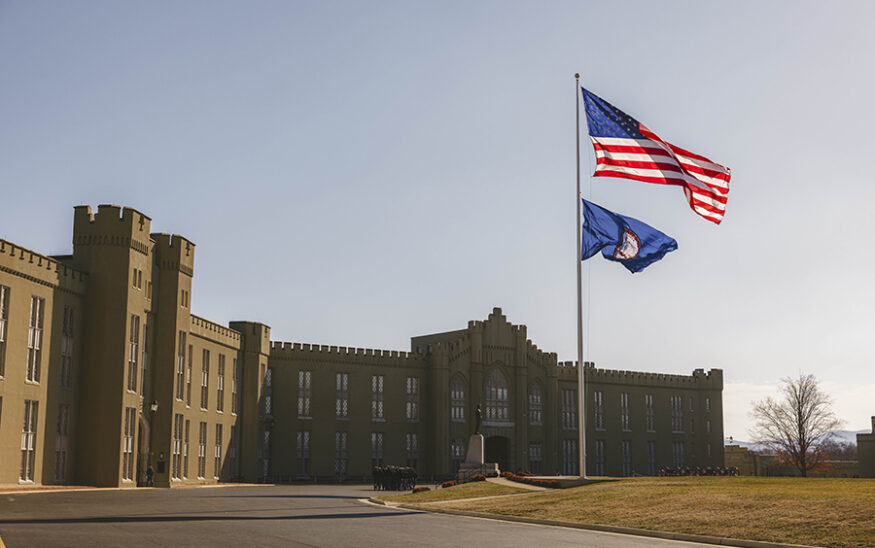
The Virginia Military Institute could be subject to a state inquiry over whether it did enough to address a history of racism and sexism at the nation's oldest state-supported military college. Photo CREDIT: Justin Ide/For The Washington Post
The Virginia Military Institute could be subject to a state inquiry over whether it did enough to address a history of racism and sexism at the nation's oldest state-supported military college. Photo CREDIT: Justin Ide/For The Washington Post
Virginia Democrats target military college’s funding after anti-DEI push



The nation’s oldest state-supported military college may face losing public funding as newly empowered Virginia Democrats seek to determine whether it has done enough to root out racism and sexism at the school.
A resolution filed Tuesday in the House of Delegates would establish a task force with broad authority to investigate whether Virginia Military Institute should continue to receive state tax dollars.
If approved, the task force would probe how VMI has responded since a 2021 state-ordered report found widespread discrimination at the school. It’s the latest in a growing push in higher education from Virginia Democrats, who now hold larger majorities in both chambers of the General Assembly and control the governor’s mansion. They’ve quickly moved to reshape how universities operate and unwind efforts from conservatives and the Trump administration to end DEI initiatives.
“We need to determine whether this is an institution capable of change,” said resolution sponsor Del. Dan Helmer (D-Fairfax), who previously forced VMI to protect students who’ve reported sexual assaults on campus. Helmer, a U.S. Military Academy at West Point graduate, said Virginia taxpayer money should not be given to an institution “incapable of separating itself from a Lost Cause ideology that promotes White supremacy.”
Each year, VMI holds a ceremony honoring cadets who fought and died for the Confederacy, and long celebrated Stonewall Jackson, who was a professor at the school. The Lost Cause narrative glorifies the South’s role in the Civil War and asserts it was fought over states’ rights.
The specter of losing state funding could pose an existential question for the future of the institute, which in the 2024-2025 academic year received 43 percent of its budget from the state.
“We are in the early stages of the legislative session and know that the delegates have planned a robust agenda,” VMI Superintendent and retired Lt. Gen. David Furness said in a statement. “While we have yet to see a resolution, we look forward to participating in the discussion and supporting the delegates.”
VMI boasts a network of influential alumni that include Dan Caine, chairman of the Joint Chiefs of Staff, and Mike Waltz, the U.S. ambassador to the United Nations.
The resolution directs the task force to determine whether VMI’s programs could be replaced by other universities and evaluate whether it makes sense for the state’s defense to have a military academy at all.
“It’s an evaluation of the product that VMI offers, the value it provides to taxpayers, and whether or not it should be a taxpayer-funded institution,” Helmer said.
House Speaker Don Scott (D-Portsmouth) and Virginia Gov. Abigail Spanberger’s office did not respond to requests for comment on the proposal. The Spirit of VMI, a political action group of conservative alumni, declined a request for comment.
The Washington Post published a story in 2020 chronicling a lynching threat and other allegations of racism from Black cadets at the campus in Lexington. Two days later, then-Gov. Ralph Northam (D), a VMI alumnus, ordered an investigation into the college’s culture. VMI’s board appointed retired Maj. Gen. Cedric Wins as interim superintendent soon after. He was named the school’s first Black superintendent the following year.
Over time, Wins instituted measures to make the school more welcoming for women and students of color. He also established a review scrutinizing the college’s numerous Confederate tributes. But those changes sparked quick backlash at the school. In 2023, Youngkin’s diversity chief – a cabinet-level position created by Northam – declared that “DEI is dead” during an appearance at VMI.
Under both former governor Glenn Youngkin (R) and the Trump administration, Republicans moved forcefully in the last year to undo diversity, equity and inclusion efforts they see as discriminatory on campuses across the country. At VMI, Youngkin appointees voted last February not to renew Wins’s contract.
Wins later blamed “bias” and “ideology” for the board’s decision.
On Saturday, hours after taking office, Spanberger took her own action at the school, appointing five people, including Northam, to VMI’s board.
Helmer’s resolution, co-sponsored by Dels. David A. Reid (D-Loudon) and Fernando J. “Marty” Martinez (D-Loudon), condemns in strong language VMI’s celebration of the Confederacy.
The resolution would establish a task force filled with members of the House of Delegates, the state Senate, a representative from the state agency overseeing universities and four civilian members appointed by House and Senate Democrats.
The group would reevaluate a 1928 state audit that found VMI provided no service that wasn’t duplicated elsewhere and recommended the state to end its funding – though the state did not ultimately do that. It would study whether other state universities could expand military programs to make up for a potential end to taxpayer-supported programing at VMI.
Helmer’s latest resolution would require the task force to finish its meetings by Nov. 30 and submit a report to the governor and General Assembly by the first day of the 2027 legislative session.
Helmer’s resolution isn’t the first time VMI has been forced to seriously reconsider its status as a taxpayer-supported college. In 1990, the Justice Department sued Virginia, arguing that VMI’s then-policy of barring female cadets violated the 14th Amendment’s guarantee of equal protection. The case was heard before the Supreme Court in 1996, where an attorney arguing for the college said that the school’s adversarial training methods would not be appropriate for women.
Six months later, the high court ruled that VMI’s all-male policy was unconstitutional in a 7 to 1 decision. (Justice Clarence Thomas, whose son attended VMI at the time, recused himself from the case.) In the majority opinion, Justice Ruth Bader Ginsburg stated that although VMI “serves the State’s sons, it makes no provision whatever for her daughters. That is not equal protection.”
VMI now had to make a choice: Keep barring women, but renounce all public funds and go private, or continue taking public funds – and finally accept female cadets. In September 1996, its Board of Visitors voted 9 to 8 to admit women and to remain public. Its first group of women enrolled in August 1997, a milestone that was celebrated on campus in 2022 for its 25th anniversary.
Among the first female graduates was Virginia state Sen. Jennifer Carroll Foy (D-Prince William). Carroll Foy declined to comment on the proposed resolution.
Before introducing the new resolution, Helmer sponsored a 2023 law that forced VMI to give immunity against punishment to cadets if they reported a sexual assault that occurred while they’d been drinking or doing drugs.
by Dan Rosenzweig-Ziff, Erin Cox, Ian Shapira (c) 2026 , The Washington Post
e