Please ensure Javascript is enabled for purposes of website accessibility

LMI names new leaders following CEO change

SUMMARY: 

  • -based promoted three executives following Josh Wilson’s appointment as CEO.
  • Christen Smith was named chief revenue officer.
  • Zaki Saleh was appointed vice president of growth operations.
  • Christine Cocrane is now senior vice president of the health and civilian market.

Following Josh Wilson’s appointment as CEO at the start of the year, LMI, a Tysons-based provider of commercial-grade technology to federal agencies, promoted several executives last week.

Christen Smith has been named chief revenue officer, Zaki Saleh has been appointed senior vice president of growth operations, and Christine Cocrane is now senior vice president of the health and civilian market.

Zaki Saleh. Photo courtesy LMI

Smith worked at LMI for nearly a decade, before leaving in 2022 to work as senior vice president of the U.S. domestic market of consulting and research firm Abt Global, according to her LinkedIn page.

In 2023, Smith returned to LMI as president of the company’s solutions division. In her new role as chief revenue officer, Smith leads the company’s market and growth strategy. She has a master’s in public affairs from Princeton University.

“With 15+ years of experience across public policy, data analytics and organizational leadership, she brings a customer-first approach to turning complex federal objectives into durable partnerships and measurable impact,” LMI wrote about Smith on a company LinkedIn post.

In his new role, Saleh will drive growth execution across the company and scale business opportunities across markets, LMI announced in a LinkedIn post.

Saleh joined LMI in 2022 as senior vice president of the company’s health and civilian market. He previously worked at federal contractor as vice president and general manager for the global health business unit, according to his LinkedIn page. He also worked for more than a decade at Falls Church-based Fortune Global 500 aerospace and defense company . He has a degree in business and economics from Wittenberg University in Ohio.

Stepping into Saleh’s former position, Cocrane will oversee project delivery, execution and overall customer satisfaction for LMI’s health and civilian clients, according to the company. 

Cocrane joined LMI as a project manager in 2010, according to her LinkedIn page. After receiving a series of promotions, she served as senior vice president of management and transformation solutions from 2020 until last summer, when she was named senior vice president of enterprise digital transformation. Cocrane has a master’s in public administration from .

Christine Cocrane. Photo courtesy LMI

Chartered under the Kennedy administration in 1961, LMI was originally formed to support logistics management for the . Doug Wagoner joined LMI as its president and CEO in 2020 and oversaw the 2022 sale of LMI’s for-profit subsidiary to investment firms Declaration Partners, Capitol Meridian Partners and 22 C Capital. The for-profit subsidiary retained the LMI name and the remaining nonprofit entity was rebranded as NobleReach Foundation.

In October 2025, LMI announced Wagoner would retire as CEO at the end of the year and transition to the chairman role.

In 2020, LMI’s revenue was $397 million, according to news reports. In October 2025, LMI announced the company had seen a 74% increase in revenue over the past five years and 40% workforce growth.

Wilson will speak at the 2026 NASA Core Flight System Symposium at LMI’s Tysons headquarters. It runs from Jan. 27-29.

Editor’s note: This story has been updated. 

Appian wins $500M Army contract

McLean-based software company announced last week that the has awarded the company a new enterprise valued at up to $500 million to support the Army’s software modernization efforts and expand -powered process automation.

Under the agreement, the Army can purchase up to $500 million in Appian platform licenses, maintenance, support services and cloud services over a 10-year period.

“This award reflects the Army’s strategic IT vision for modernization by consolidating contract actions across the Army into a single enterprise agreement to promote cost efficiencies, while embracing AI-powered process automation and low-code application development to deliver capabilities through the Army cloud environment,” Army Chief Information Officer Leonel Garciga said in a statement.

The company also announced that the Army authorized it to conditionally operate the Appian Defense Cloud, which Appian said will allow warfighters to access the latest AI technology.

According to Appian founder and Chief Technology Officer Michael Beckley, the company is enabling the Army and to move from pilot projects to mission-ready capabilities at scale.

“This enterprise agreement is about more than access to technology; it’s about outcomes,” he said in a statement.

In October 2025, Appian argued before the Supreme Court of Virginia that it should receive a record-breaking $2.04 billion jury award in a 2022 trade secrets trial against competitor Pegasystems, after the state appeals court ruled in Pega’s favor.

Earlier this year, the Virginia Supreme Court backed the appeals court’s decision and sent the case back to Circuit Court for another trial.

In 2024, Appian’s total revenue was $617 million, an annual increase of 13%. The company’s fiscal 2025 results are set to be announced in February.

Oil edges up as investors assess US tariff threats, weaker dollar

LONDON, Jan 20 (Reuters) – Oil prices were slightly higher on Tuesday as investors monitored U.S. ‘s tariff threats against European states opposing his push to acquire Greenland, while firmer global economic growth expectations and a weaker U.S. dollar supported prices.

Brent futures gained 49 cents, or 0.77%, to $64.43 a barrel at 1253 GMT, while U.S. West Texas Intermediate crude was up 56 cents, or 0.94%, at $60.

Fears of a renewed trade war escalated over the weekend after Trump said he would impose additional 10% levies from February 1 on goods imported from Denmark, Norway, Sweden, France, Germany, the Netherlands, Finland and Britain, rising to 25% on June 1 if no deal on Greenland was reached.

European Commission President Ursula von der Leyen said on Tuesday that the bloc’s executive arm is working on a package to support Arctic security and warned that the tariffs are a mistake.

The tariff threats, however, will not have an immediate impact on the oil balance, said PVM analyst Tamas Varga, who added that prices had gained some support from an upward revision of this year’s global economic growth estimate by the International Monetary Fund as well as stronger diesel prices.

CHINA DATA, WEAKER DOLLAR SUPPORT OIL

The oil market also is finding some support from better-than-expected fourth-quarter Chinese gross domestic product data released on Monday, said IG market analyst Tony Sycamore.

“This resilience in the world’s top oil importer provided a lift to demand sentiment,” he said.

China’s economy grew 5.0% last year and the country’s refinery throughput in 2025 also climbed, edging up 4.1% on a year-over-year basis, data showed on Monday. China’s crude oil output also grew 1.5%.

A sliding dollar also is supporting prices, as a weaker U.S. currency could boost oil demand by making dollar-denominated purchases cheaper.

“A weaker U.S. dollar provided some support to oil and the broader commodities complex,” ING commodities strategists said on Tuesday.

(Reporting by Enes Tunagur in London; Additional reporting by Anushree Mukherjee in Bengaluru and Jeslyn Lerh in Singapore; Editing by Alexander Smith, Joe Bavier and Paul Simao)


Congressional spending deal provides funding for 2,500 new air traffic controllers, $2.4 billion for Amtrak

WASHINGTON, Jan 20 (Reuters) – A bipartisan spending deal announced Tuesday provides funding for 2,500 air traffic controllers and $2.4 billion for U.S. passenger railroad Amtrak.

The funding deal also includes $514 million to subsidize air services to rural communities in a program called the Essential Air Service program, rejecting a proposal to cut the program by 50%, and boosts annual funding to modernize air traffic control towers by $824 million.

The bill provides $2 million for an independent study on the airspace in the Washington, DC area after a January 2025 crash between a helicopter and American Airlines passenger jet killed 67 people and exposed significant weaknesses in aviation safety.

(Reporting by David Shepardson in Washington; Editing by Andrew Heavens)


Netflix makes all-cash bid for Warner Bros assets

Summary

  • replaced its cash-and-stock bid with an $82.7B all-cash offer for Warner Bros assets
  • Warner Bros’ board unanimously backs Netflix’s $27.75-per-share proposal
  • continues to press a rival $30-per-share cash bid
  • Investors will vote on the Netflix deal at a special meeting expected by April

LOS ANGELES, Jan 20 (Reuters) – Netflix has switched to an all-cash offer for Warner Bros Discovery’s studio and streaming assets without increasing the $82.7 billion price in a bid to shut the door on Paramount’s rival efforts to snag the Hollywood giant.

The new all-cash bid – at $27.75 a share – has unanimous support from the Warner Bros board, according to a Tuesday regulatory filing.

Both Netflix and Paramount Skydance covet Warner Bros for its leading film and television studios, extensive content library and major franchises such as “Game of Thrones,” “Harry Potter” and DC Comics’ superheroes Batman and Superman.

Paramount has altered its terms and engaged in an aggressive media campaign to try to convince shareholders that its bid is superior, but Warner Bros has spurned the David Ellison-led company. It declined to comment Tuesday on Netflix’s all-cash offer.

Warner Bros will hold a special investor meeting to vote on the Netflix deal, with the streaming pioneer saying that the meeting was expected to be held by April.

“Our revised all-cash agreement will enable an expedited timeline to a stockholder vote and provide greater financial certainty,” Netflix co-CEO Ted Sarandos said in a statement.

Shares of Netflix, which is slated to report quarterly earnings after the market close, were up 0.9% before the bell. Paramount shares were down 1.9%, while Warner Bros’ shares down 0.5% in early trading.

EARLIER CASH-AND-STOCK BID REPLACED

Netflix shares have fallen almost 15% since announcing the merger on December 5, closing at $88 per share on Friday – well below the $97.91 floor price of the original bid. That drop was part of Paramount’s argument that its bid was superior.

The new $27.75-per-share offer from Netflix replaces its earlier cash-and-stock bid for $23.25 in cash and $4.50 in Netflix stock.

“The merger consideration is a fixed cash amount to be paid by an investment-grade company, providing (Warner Bros) stockholders with certainty of value and liquidity immediately upon closing the merger,” Warner Bros said.

The company’s board also disclosed its valuation for Discovery Global, a planned spin-off that will contain television assets including CNN and TNT Sports and the Discovery+ streaming service.

The board has maintained that the Netflix merger deal is superior to Paramount Skydance’s $30-per-share cash bid for the company because Warner Bros’ investors would retain a stake in the separately traded Discovery Global.

Warner Bros’ advisers used three separate approaches for valuing Discovery Global. The lowest share price they arrived at was $1.33 per share, by applying a single value across the whole company. The high end of the range they determined was a price of $6.86 a share, if the spin-off became involved in a future deal.

Paramount has said the cable spinoff central to the streaming giant’s offer is effectively worthless.

PARAMOUNT TENDER EXPIRES JAN 21

The rival bidder went to court on January 12 to expedite the disclosure of this information, so investors could evaluate the competing offers for Warner Bros. A Delaware court judge rejected the request, finding that Paramount had failed to demonstrate it would suffer irreparable harm from the alleged inadequate disclosures about Warner Bros’ cable TV business.

Paramount Skydance, whose tender offer expires on January 21, did not immediately respond to a Reuters request for comment.

“Paramount will make another appeal to shareholders. Unless Paramount raises its bid, the appeal will be window dressing,” Emarketer analyst Ross Benes said.

The race is expected to come to a head at a shareholder vote later this year as Warner investors weigh the value of cable assets.

Warner Bros reiterated its reasons for rejecting the Paramount bid, saying its all-cash offer of $30 a share was insufficient after factoring in the “price and numerous risks, costs and uncertainties.”

“Netflix’s move to go all‑cash on the Warner Bros. deal is a smart pivot at a time when its own falling share price had begun to weaken its hand,” said Matt Britzman, senior equity analyst, Hargreaves Lansdown. “A cash bid strips away uncertainty and is unquestionably more appealing from Warner Bros.’ perspective, even if it does nothing to ease regulatory scrutiny.”

A merger with Netflix would leave the combined company with roughly $85 billion in debt, compared with $87 billion for Paramount. But Netflix is worth considerably more, with a market valuation of $402 billion, compared with $12.6 billion for Paramount.

The Netflix tie-up would be less leveraged – carrying a leverage ratio of under four – than a ratio of about seven with Paramount.

Netflix also agreed to allow Warner Bros to reduce the amount of indebtedness to be borne by Discovery Global by $260 million, according to the regulatory filing.

Netflix also has an investment-grade credit rating, whereas Paramount’s bonds are rated at junk levels by S&P and would likely come under further pressure, Warner Bros said in its filing.

Winning over shareholders’ approval, however, may only be the first step in what could be a long process, given lawmakers across ⁠the political spectrum have ​voiced concerns that further media consolidation could drive up prices and reduce consumer choice.

The Ellisons have argued that their relationship with gives them an easier regulatory path to approval.

(Reporting by Dawn Chmielewski in Los Angeles, additional reporting by Aditya Soni and Harshita Varghese; editing by Dawn Kopecki, David Gregorio and Nick Zieminski)


Spanberger appoints 27 university board members, including Northam

SUMMARY: 

  • Five U.Va. board members and GMU’s rector and one board member resigned before took office, leaving 27 seats to fill
  • George Mason’s board now has quorum to conduct public meetings
  • Former Gov. Ralph Northam joins alma mater VMI’s board

On her first day in office, Gov. wasted no time in naming 27 new members to the boards of , and the , including former Gov. Ralph Northam and former U.S. Reps. Tom Davis and Jim Moran.

Spanberger appointed 12 members to George Mason’s board, which has been under quorum for several months after state Senate rejected board appointees by then-Gov. , a Republican, prompting a legal battle that went to the state’s Supreme Court last year. The Democratic Spanberger named 10 new members to U.Va.’s board and five members to VMI’s board.

With state senators winning the court case late last year, Spanberger was given the opportunity to name new board members for the three universities’ open seats much earlier than usual under Virginia law. Typically, a governor names about four new members to each public university’s board annually, so the 16-member boards are entirely made up of one governor’s nominees by the end of their four-year term.

However, at Spanberger’s request, five U.Va. board members resigned at the end of Youngkin’s term. George Mason’s rector, Charles “Cully” Stimson, a 2023 Youngkin appointee who was until recently part of the conservative think tank the Heritage Foundation, and board member Robert Pence, a former U.S. ambassador to Finland, also offered their resignations Friday, but it was not clear if Spanberger requested it.

Stimson’s critics called for his resignation last year due to what they viewed as a conflict of interest. The Project 2025 document viewed as a blueprint of the second Trump administration’s goals was created by the foundation, although Stimson himself was not listed as an author.

Faculty members and others also found fault with the George Mason’s board’s handling of multiple federal investigations into alleged antisemitism and policies that allegedly discriminated against white and Asian employment candidates, although GMU President Gregory Washington has denied discriminating against anyone in hiring and promotion decisions.

At U.Va., Rector , Vice Rector Porter Wilkinson and board members , Doug Wetmore and Dr. Stephen P. Long all resigned Friday, the day before Spanberger was sworn in, leaving 10 seats to fill. Faculty members, student organizations and others had criticized the board for what they viewed as its failure to protect academic freedom at U.Va. amid a U.S. Department of Justice investigation into former President Jim Ryan. The Trump administration accused Ryan of slow-walking the end of U.Va.’s diversity, equity and inclusion initiatives, which he denied.

Ryan resigned in June 2025 under pressure and has since blamed Sheridan, Wilkinson and Manning in part for his departure, according to a lengthy document he wrote last year. Sheridan and Wilkinson, who also led a special committee created to search for Ryan’s successor as president, did not heed Spanberger’s request that they delay choosing a new president until she could name appointees to five empty board seats.

In December 2025, former Darden School of Business Dean Scott Beardsley was hired as U.Va.’s 10th president, taking office Jan. 1. His appointment has been controversial due to its timing, and some Democrats and others have called for his dismissal, although Spanberger has not said anything publicly about Beardsley’s hiring.

In any case, removing Beardsley would be expensive. His 10-year contract with the university, signed Dec. 19, 2025, pays a $1.3 million annual base salary, and if he is dismissed without cause, Beardsley will receive 24 months’ salary, the contract says.

On Saturday, Spanberger also named five new members to VMI’s board, although no current members resigned. Last year, VMI’s board did not renew its former superintendent’s contract. Retired major general Cedric Wins, who became the institute’s first Black superintendent in 2020 following news reports citing widespread racism against Black cadets, often encountered backlash from conservative white VMI alumni during his tenure.

Currently, gubernatorial appointees join boards immediately and are allowed to vote and hold committee leadership positions, even before they are confirmed by the . However, Democratic state Sen. Aaron Rouse has filed a bill that would not allow appointees to serve on boards until they are confirmed by the legislature. Often, the full legislature is represented by the Senate Privileges & Elections Committee outside of the General Assembly’s regular session.

The following members have been named to the three university boards:

George Mason University

  • Anne Altman, former general manager of IBM Corporation’s U.S Federal Government and Industries sector;
  • Bruce Caswell, CEO of Maximus;
  • Shawn N. Chambliss-Purvis, president and CEO of Sabel Systems Technology;
  • Tom Davis, former Republican U.S. representative and previous GMU rector;
  • Paul Misener, founder and principal of Misener Innovation;
  • Trevor Montano, founder and managing member of West Potomac Capital;
  • Jim Moran, former Democratic U.S. representative and mayor of Alexandria;
  • Delbert Parks, vice president of Micron Technology;
  • George Schindler, former president and CEO of CGI;
  • Sumeet Shrivastava, president and CEO of Unissant;
  • Sean Spence, senior manager of corporate finance at BDO and adjunct professor in the Costello College of Business;
  • Jennifer Taylor, president and CEO of the Northern Virginia Technology Council

University of Virginia

  • Mike Bisceglia, president and CEO of Stauer;
  • Carlos Brown, president of Dominion Energy Services and executive vice president and chief administrative and projects officer of Dominion Energy; he also was U.Va.’s vice rector through the end of June 2025;
  • Robert Byron, chairman, co-CEO, and co-founder of Blue Vista Capital Management;
  • Peter Grant, partner of Anchormarck Holdings and former chair of U.Va.’s Honor the Future capital campaign, which concluded in 2025;
  • Owen Griffin, president and chief financial officer of Currie Medical;
  • Victoria Harker, former chief financial officer of Tegna and current Huntington Ingalls Industries board member;
  • Elizabeth Hayes, retired attorney with Akin Gump Strauss Hauer & Feld;
  • Rudene Mercer Haynes, Richmond office managing partner of Hunton Andrews Kurth;
  • Evans Poston Jr., Virginia Beach office director of Troutman Strategies; previously served as a U.Va. board member under former Gov. Ralph Northam;
  • Mohsin Syed, former chief of staff for U.S. Department of Transportation;

Virginia Military Institute

  • Michael Dick, director of the Lewis B. Puller Jr. Veterans Benefits Clinic at William & Mary School of Law and a retired Marine Corps colonel;
  • Don Hall, president and CEO of Virginia Automotive Dealers Association and a Marine Corps veteran;
  • Lester Johnson, owner of Mama J’s restaurant and a former VMI board member appointed by Northam;
  • Former Gov. Ralph Northam, a VMI alumnus, neurologist at the Children’s Hospital of the King’s Daughters and former Army medical officer;
  • Allen Damon Williams, business development officer of First Citizens Bank.

Spanberger sworn in as Virginia’s first woman governor

SUMMARY: 

  • Abigail was sworn in Saturday as Virginia’s 75th governor, the first woman to hold the office.
  • Fellow Ghazala Hashmi and Jay Jones also were sworn in as lieutenant governor and attorney general at the ceremony
  • Spanberger invoked moments from Virginia’s history, criticized “recklessness” in Washington, D.C., and urged unity among Virginians

Under cloudy skies at the Virginia State Capitol, Abigail Davis Spanberger was sworn in as Virginia’s 75th governor just after noon Saturday, becoming the first woman to hold the commonwealth’s top elected office.

and Attorney General Jay Jones also made history as the state’s first Muslim statewide office holder and Virginia’s first Black attorney general.

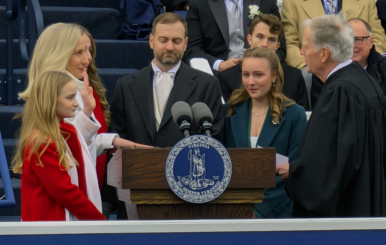
Virginia Gov. Abigail Spanberger was sworn in by Supreme Court of Virginia Senior Justice William C. Mims on Jan. 17, 2026. Photo by Kira Jenkins/Virginia Business
Virginia was sworn in by Supreme Court of Virginia Senior Justice William C. Mims on Jan. 17, 2026. Photo by Kira Jenkins/Virginia Business

All Democrats, the three officials take office at a challenging time for the nation and the commonwealth, when federal workforce layoffs and funding cuts have taken significant tolls. Spanberger’s campaign centered on affordability, protecting and creating jobs in Virginia, and strengthening the state’s education system, among other goals.

In her inaugural speech, Spanberger made many references to Virginia’s history, referring to the state’s delayed ratification in 1952 of the 19th Amendment, which gave women the right to vote in 1920, as well as former Gov. L. Douglas Wilder’s election as the state’s first Black governor in 1989. Wilder, wearing a wide-brimmed off-white hat in the stands behind Spanberger, celebrated his 95th birthday Saturday and stood to applause when Spanberger wished him happy returns.

Spanberger was sworn in by Supreme Court of Virginia Senior Justice William C. Mims.

Clad in a long, winter white double-breasted coat, turtleneck and gloves, Spanberger stood next to Hashmi, Jones and their spouses, with former governors , George Allen, Jim Gilmore, Bob McDonnell, Terry McAuliffe, and Wilder in attendance, as well as U.S. Sens. Tim Kaine and Mark Warner, also former governors. Former U.S. Sen. Chuck Robb was the sole living ex-governor not in attendance.

Joined by her husband, Virginia’s new first gentleman, Adam Spanberger, and their three daughters, Spanberger quoted the state’s first governor, Patrick Henry, from a 1799 speech: “He made an appeal to his fellow citizens, warning against the divisions that were threatening our young country,” she said. “His appeal remains timeless. He said, ‘United we stand, divided we fall. Let us not split into factions, which would destroy that union upon our existence hangs.’ That was the challenge Gov. Henry put to Virginia at the close of the 18th century, and it is the charge we must answer again today.”

She did not name by name, instead referring to “the recklessness coming out of Washington. You are worried about policies that are hurting our communities, cutting health care access, imperiling rural hospitals and driving up costs. You are worried about Washington policies that are closing off markets, hurting innovation and private industry and attacking those who have devoted their lives to public service.

“You are worried about an administration that is gilding buildings while schools crumble, breaking the social safety net and sowing fear across our communities, betraying the values of who we are as Americans here on these steps and across the commonwealth.”

To loud applause, Spanberger promised, “Our hard-working, law-abiding immigrant neighbors will know that when we say the security and safety of all our neighbors, we mean them too,” a reference to recent ICE actions in Minnesota and other states.

Known for bipartisanship during her three terms in Congress, Spanberger acknowledged that “some who are here today or watching from home may disagree with the litany of challenges and the hardships that I laid out. Your perspective may differ from mine, but that does not preclude us from working together where we may find common cause.”

She also repeated some of her campaign’s tenets, including increasing housing supply, addressing high rent and mortgage rates, lowering energy costs and keeping medical debt from spiraling.

Spanberger said that she will “work tirelessly for you and for our commonwealth,” citing the Rev. Martin Luther King Jr.’s “pilgrimage of prayer.”

“It gives me cause to reflect on what our path forward must be,” she said. “Not a pilgrimage of , certainly not a pilgrimage of partisanship, but rather a pilgrimage of promise, progress and prosperity. My fellow Virginians, as we set an example for the country and the world and, most importantly, for our children, let us choose to stand united, choose to serve one another. Choose to act together as we continue forward. Let us be united for Virginia’s future.”

Following her inauguration, Spanberger signed her first set of executive orders Saturday, including a statewide affordability directive for all executive branch agencies to submit reports within 90 days identifying ways to reduce costs for Virginians; establishing an interagency health financing task force; a comprehensive review of housing development permitting and regulations; creating the economic resiliency task force to respond to federal workforce reductions, funding cuts, tariffs and immigration impacts.

Another executive order directs the state Department of Education to review the process for appointing members to university boards of visitors, a pain point over the past year in the Youngkin administration, which had 22 board members rejected by Senate Democrats. On Friday, three board members resigned at Spanberger’s request, leaving her at least eight seats to fill.

Spanberger also rescinded Youngkin’s Executive Order 47, which required state and local law enforcement to divert resources for use in enforcing federal civil immigration laws.

Saturday’s ceremony, held in front of the historic Virginia State Capitol designed by Thomas Jefferson, included the Pledge of Allegiance led by the Girl Scouts of Virginia, a performance of the song “Shenandoah” by the Hermitage High School Select Treble & Chamber Singers, and an invocation by Father Jim Curran of Norfolk’s Basilica of St. Mary of the Immaculate Conception.

Following Spanberger’s speech and swearing-in, members of Virginia’s Indian tribes performed a traditional dance and blessing of the ground, and a group of young Muslim singers known as ADAMS Beat from Sterling sang “This Land Is Your Land.” Lance D. Watson, senior pastor of Richmond’s Saint Paul’s Baptist Church, gave the benediction.

The ceremony was followed by a parade that included Spanberger’s Henrico County alma mater Tucker High School’s Marching Tigers band, the Norfolk State University Spartan Legion Marching Band, a group of NASA employees from the Wallops and Langley facilities, Virginia State University’s National Pan-Hellenic Council All-Star Step Team and two horses ridden by Virginia 4-H members, among other groups.

5 U.Va. board members resign at Spanberger’s request

SUMMARY: 

  • According to a New York Times report, incoming Virginia governor asked at least five U.Va. board members to resign.
  • Rector , Vice Rector Porter Wilkinson and major donor Paul Manning sent letters of resignation Friday
  • has said she intends to fill five empty seats on board upon taking office Saturday, but had not publicly said she would remove members.

names 27 new board members on first day of term

UPDATED JAN. 19

Five board members resigned Friday at the request of Abigail Spanberger, who was sworn in Saturday as Virginia’s Democratic governor.

The New York Times reported Friday that U.Va. Rector Rachel Sheridan, Vice Rector Porter Wilkinson and major university donor Paul Manning, a member of the university’s board, sent letters of resignation Friday. They are reportedly among at least five people Spanberger asked to step down.

On Saturday, a U.Va. spokesperson confirmed the three resignations and said that President Scott Beardsley and other university officials thanked the three for their service.

As of Saturday, two more board members — health care executive Doug Wetmore and Dr. Stephen Long of Commonwealth Spine & Pain Specialists in the Richmond area — were removed from the university’s page. All five — as well as seven remaining members — were appointed by former Gov. Glenn Youngkin, a . Wetmore and Long were particularly outspoken conservative members of the board.

U.Va. and Spanberger’s transition team did not respond immediately to requests for comment Friday evening, and neither did Sheridan or Manning. Faculty at the flagship university, as well as Virginia’s elected Democrats and others, have called for Sheridan and Wilkinson to step down from the board for months, since former university President Jim Ryan resigned in June 2025 under pressure from the U.S. Department of Justice.

Spanberger said previously that she would be ready on “day one” to appoint five U.Va. board members, filling empty seats on the board after state Senate Democrats rejected Youngkin’s 22 appointees for seats on , and U.Va.’s boards.

However, she did not confirm publicly any plans to remove board members from any university, although governors have the ability to do so, typically for malfeasance or other unusual circumstances.

Manning’s inclusion among those asked to resign comes as more of a surprise, given that he and his wife donated $100 million to the university in 2023 to launch the $350 million Manning Institute of Biotechnology at U.Va. Manning has said that he made the donation in part due to his friendship with Ryan.

But critics said that the board did not do enough to protect the university or Ryan from attacks by the , which has taken strong measures to rid universities of diversity, equity and inclusion programs, and placed financial pressure on schools by threatening to withhold federal research funding and other federal money. Months after resigning, Ryan wrote a lengthy document about his final months in office during the DOJ’s investigation into U.Va., and said that Sheridan, Manning and Wilkinson met with DOJ officials, while he was not permitted to meet with them.

Ryan alleged that Youngkin, the three board members and attorneys hired by the board had possibly been behind the pressure to resign, instead of the DOJ. “At the very least, we had board members who were apparently more complicit than other universities,” Ryan wrote.

After the release of Ryan’s document, Manning wrote a letter to U.Va.’s Faculty Senate defending his actions in university negotiations with the DOJ.

“Based on the information available to me at the time, I ultimately became convinced that federal funding was at risk and would result in an immediate loss of financial support to the university,” he wrote. “It was, in my mind, a difficult choice between two unfortunate outcomes: real damage to the university, its people, and its academic and research mission, or the premature departure of a leader who had contributed to many successes at the university.”

Friction among factions

A Washington Post story earlier this month cited texts between board members and top U.Va. officials between June 2023 and mid-December 2025, showing friction between Youngkin appointees and board members appointed by Democratic former Gov. Ralph Northam, particularly during the DOJ’s investigation last spring that led to Ryan’s resignation.

Following her election in November 2025, Spanberger called on Sheridan and Wilkinson to pause the presidential search process for Ryan’s replacement until she could fill the board’s seats, but they forged ahead and named former Darden School of Business Dean Scott Beardsley as U.Va.’s 10th president at the end of 2025. He took office Jan. 1.

In response, the U.Va. Faculty Senate passed a resolution this week calling for Spanberger “to exercise her statutory authority, review the actions of current board members, remove those whose conduct has fallen short of the responsibilities of visitors, and appoint qualified individuals to fill all vacancies on the board.”

A “newly reconstituted” board then is asked to review the presidential search process and “determine the best path forward,” the Faculty Senate resolution stated.

In a December 2025 interview with Virginia Business, Spanberger acknowledged, “At times it seems daily, or certainly weekly, that an important constituency [at U.Va.] has voiced their complete lack of confidence [in their board and] in some cases [are] calling on them to step down. As governor-elect, I take note of the varied voices, very strong voices, who have clear reasons that they have articulated in resolutions that have passed, letters that have been written about the distrust they have. But I certainly would think it’s premature for me to make any announcements.”

‘This is war’: In texts, U.Va. board members plotted with Youngkin, decried DEI

Summary

  • Texts show close coordination between U.Va board members and Gov. ‘s administration
  • Conservative appointees pushed to end some gender transition care and dismantle programs
  • Messages reveal internal board conflicts and harsh rhetoric toward former President James Ryan
  • Records obtained via FOIA underscore growing political pressure on public universities

As Republican leaders moved to root out what they have criticized as liberal ideology at the , some conservative appointees to its board texted privately about ending “chemical and surgical mutilation” for transgender youth at its hospitals and undoing “regimes of racial classification” in its classrooms, according to nearly 1,000 pages of text messages reviewed by The Washington Post.

The board members coordinated frequently with (R) or his top aides in nearly every major debate at the flagship university in in the past year – which some observers have described as an unusual level of involvement by the state leader. The conservative appointees also spoke in candid, sometimes inflammatory terms about the university’s then-president, James E. Ryan, his supporters and diversity policies.

“This is war!” Stephen Long wrote on April 17 to a fellow board member about a professor who sought to preserve diversity, equity and inclusion programs.

Board members have often been reluctant to speak publicly on university matters outside of meetings. But the texts, exchanged between June 2023 and mid-December of last year by board members and top university officials, offer an unfiltered account of the body’s inner workings as it rolled back some gender transition care, dissolved the university’s DEI office and responded to several investigations by the , among other changes at U.Va. Ryan resigned in June amid the intensifying scrutiny.

At times, the texts show tension between conservative, moderate and more liberal board members, including one who referred to his fellow board members as “crazies.”

The messages, obtained through Virginia’s Freedom of Information Act (FOIA) by Richmond-based author Jeff Thomas and provided to The Post, also underscore the growing pressure universities are facing from the Trump administration and Republican state officials as conservatives seek to eliminate what they view as progressive indoctrination of American campuses. The U-Va. board has drawn criticism from some students, faculty and alumni, who have questioned their intentions and called for members to resign.

Thomas has previously submitted FOIA requests to U.Va. on other board member texts and about university admissions. He said he asked for texts exchanged with rector Rachel Sheridan and other top officials in November. He sued the university last month after it did not provide some messages in a timely manner, and a judge ordered their release.

The university and almost all board members mentioned in this article declined to comment or did not respond to requests for comment.

Youngkin spokesperson Rob Damschen said the involvement of the governor and his aides was “essential to responsible oversight.”

“It is appropriate, necessary and expected for board members across state agencies, departments and governing bodies to interact and seek counsel from the governor’s cabinet members,” he said. “Virginians should expect nothing less.”

Youngkin’s involvement

Many of the texts reviewed by The Post were sent when the 17-person U.Va. board was overwhelmingly composed of Youngkin appointees, with a small number of seats held by picks by his Democratic predecessor .

Youngkin has not often spoken publicly about his involvement in the university over the past year. But the texts offer new insight into communications between the board and governor.

On Feb. 16, Robert Hardie, then the board’s rector and a large Democratic donor, sent a text to Sheridan, a partner at Kirkland & Ellis who would succeed him as board chair in July. President Donald Trump had signed an executive order on Jan. 28 restricting some forms of gender transition care for youths, and the U.Va. board would soon consider a resolution on the matter.

“I think GY and JM are calling everyone to lobby them,” he wrote, referring to Youngkin and Virginia Attorney General Jason Miyares (R). Miyares had issued guidance advising university-affiliated hospitals to adhere to the Trump order.

On Feb. 21, the board voted to stop providing gender transition care to new patients while allowing care for existing patients to continue.

But some wanted the board to move further. Youngkin told another board member, Paul Manning, a friend and donor who gave $100 million to the school in 2023, that the board’s resolution might not be enough, Hardie said in another text to Sheridan.

“WH targeting us potentially if we don’t reverse GA care,” Hardie wrote in the March 2 exchange, recounting his conversation with Manning and referencing gender transition care. He said two other Youngkin board appointees would call the governor.

Weeks later, ahead of a vote to dissolve the DEI office, Hardie wrote in a text that he had asked Youngkin general counsel Richard Cullen to speak to a group on the board whom Hardie called the “crazies” and who were pushing for swift changes to diversity-related efforts and the university’s budget.

After the board’s vote passed, texts from Hardie and others described additional conversations with top Youngkin aides.

“Spoke with Aimee for a while last night and we have a strategy,” board member David Webb wrote on March 9, referring to Virginia Education Secretary Aimee Guidera.

Webb did not respond to a request for comment about what they discussed.

The texts suggest a degree of involvement by the governor’s administration in university operations that is atypical in modern Virginia history, according to multiple former board members. In addition to gender transition care and DEI efforts, board members and Ryan talked with Youngkin or aides about the university’s health system and the behavior of other members, records show.

Gov.-elect Abigail (D), who takes office Jan. 17, has said she does not believe governors should involve themselves in university operations beyond making board appointments. After the election, Spanberger had asked the U.Va. board to halt its search for a president until she could appoint new members, but the body hired a new leader in December.

The released texts, however, don’t show communications between the board and Youngkin on some other matters that have generated scrutiny.

For example, there are no references to the governor as the Trump administration increased its scrutiny of U.Va. and Ryan in June, leading the school’s leader to step down. But exchanges suggest involvement by the Youngkin administration in university operations in the immediate aftermath.

On July 1, John Harris – former chief financial officer of the Carlyle Group, where Youngkin was once co-chief executive – began a term on the U.Va. board. After a welcoming message from Sheridan, now the board’s rector, Harris texted her about a planned meeting with university officials and added, “I also spoke with the Governor regarding the matter we discussed.”

Harris said in an interview after this article published that the text was referencing a discussion with Youngkin about a financial issue unrelated to Ryan’s departure as part of Harris’s role as incoming finance committee chair.

In a separate exchange, Jennifer “J.J.” Wagner Davis, the university’s chief operating officer and briefly its acting president, texted Sheridan to say they were waiting for Youngkin and Miyares to sign off on a settlement with Ryan after his resignation announcement. If that happened, Davis wrote July 2, the board could cancel an emergency meeting due to start 20 minutes later.

The meeting was canceled shortly thereafter.

‘He’s such a snake’

The messages reveal board members hurling personal insults and calling for wholesale change when discussing university policy.

On Oct. 13, 2024, for example, then-board member Bert Ellis sent a link to an article headlined “Destroying the machine” and wrote, “This is what we need to do.”

Ellis had courted controversy before and during his time on the board, including in a 2020 incident in which he had planned to use a razor blade to remove a sign hung on a student’s dorm room door. After joining the board in 2022, he described a “battle royale for the soul of UVA” in texts with two board members.

In the newly released texts, Ellis told Sheridan last January that he thought Ryan should have been fired. Ellis was later removed from the board by Youngkin after his rhetoric drew criticism, The Post reported at the time.

During the February discussion on gender transition care, Paul Harris, a former state delegate, offered language for a board resolution in a text to Sheridan. The proposed language, he said, was sensitive to the emotional challenges of receiving the care but also insisted upon “evidence-based medicine.”

While the language used the term “gender affirming care,” he wrote that he would not object to also describing it as “chemical and surgical mutilation,” mirroring language from the Trump executive order.

In an email Thursday, Harris wrote that he had been concerned about complying with changing federal standards and wanted UVA Health to stop providing the care “in the least offensive and most respectful manner possible.”

In another exchange, board member Douglas Wetmore – who called Hardie a “clown” in another message – texted Sheridan on March 1, ahead of the vote on the DEI office, and said he believed the board was not moving aggressively enough on several fronts. “We need to move decisively at UVA to ban DEI and all forms and regimes of racial classification,” he wrote.

Long, a physician, criticized Ryan’s handling of the university’s hospital system in other messages.

“He’s such a snake – thinks I don’t know everything!!” he wrote on April 18.

Some Youngkin appointees expressed reservations about the pace of change sought by other members, though. Sheridan at times appeared as a moderating force in several internal disputes, taking calls and texts as some conservative members butted heads with Hardie. In one 2024 exchange – after hearing that faculty were considering a vote of no confidence in Ryan over the university’s handling of the Israel-Gaza war protests – she told another board member that the president would be hard to replace.

“There are very very very few, if any, alternatives that would be better,” she wrote on May 10, 2024.

The text messages also showed a wider mix of topics discussed by the board: Sheridan wrote of a new phone tree to disseminate information quickly in July, and at other times, members exchanged messages about how the school’s sports programs should respond to a changing college athletics infrastructure.

The texts also show the toll serving on the board was taking on Sheridan, who joined the body in 2023 and chaired its audit committee before becoming rector. After a March 6 meeting, she wrote to the faculty representative to the board that she was “very irritated by arrogance and ignorance (and barely veiled misogyny).”

Hardie, who appeared to have a friendship with Sheridan, also sent inflammatory messages. He grew increasingly frustrated with a group he called the “four horsemen, or should I say four horses asses,” often asking for help from Sheridan to address them.

“This has a lot of MAGA/DOGE written all over it,” Hardie wrote to Sheridan on March 5.

Hardie messaged Sheridan about keeping the head of the conservative alumni group, the Jefferson Council, off the board, the texts show.

Hardie declined to comment on the exchanges.

The rector generally avoided explicit political commentary in texts seen by The Post, though she occasionally revealed her views.

In August, after state Senate rejected Youngkin’s appointment of Jim Donovan to the U.Va. board, citing concerns about his qualifications and intentions, Sheridan texted Donovan directly.

“I hope this backfires politically,” she wrote Aug. 28, “and reveals them to be the extremists they are.”

On Thursday, Sheridan said in a statement that the text didn’t accurately reflect her views on the lawmakers.

“I respect the General Assembly’s authority on these matters but share the frustration of those four individuals that were summarily rejected without the benefit of consideration of their merit and the value these individuals have given and could have continued to give to the university community,” she wrote.


(by Dan Rosenzweig-Ziff (c) 2026 , The Washington Post)

White House seeks emergency power auction for largest US electric grid

Summary

  • urges PJM to consider an emergency to prevent rolling blackouts
  • Rapid data center growth is driving record demand and higher
  • PJM proposes “bring your own generation” rules for large
  • Governors back more than $15B in new generation to boost grid reliability

WASHINGTON, Jan 16 (Reuters) – The White House on Friday urged the largest U.S. to conduct an emergency power auction to protect against rolling blackouts as energy demand from data centers grows faster than the country can build new generation plants.

The initiative calls on , which serves 67 million customers in 13 states and Washington, D.C., to conduct an emergency procurement auction to address escalating electricity prices and growing reliability risks across the mid-Atlantic region of the United States.

PJM later on Friday unveiled its own plan, which called for big data centers to voluntarily bring their own new generation or face the potential of having their power supply curtailed during peak demand periods. The grid operator also called for the creation of an accelerated interconnection track for state-sponsored generation projects.

At a White House event, U.S. Secretary of Energy Chris Wright and Secretary of the Interior Doug Burgum joined several state governors to discuss initiatives to speed the construction of more than $15 billion in new power generation on PJM, which has been criticized for being too slow to build a cushion against rotating blackouts as demand rises.

Rapid expansion of data centers to fuel things like has stretched the resources of PJM and other regional U.S. electric grids. is seeking to combat consumer price inflation that risks undermining support for ahead of November’s midterm elections.

The White House is seeking caps on the amount existing power plants can charge in the PJM capacity market. A recent PJM capacity market auction set record-high prices for power generators that were more than 800% higher than the previous year, increasing electricity prices for homes and businesses.

The agreement would also require data centers to pay for the new generation built on their behalf – whether they show up and use the power or not – rather than buying up existing power. The concept is called BYOG, or “bring your own generation.”

PJM said it is reviewing the principles set forth by the White House and governors. PJM was not invited to the event, a PJM spokesperson told Reuters.

PJM has forecast that the grid’s peak usage in the summer will climb by about 70 gigawatts to 220 gigawatts over the next 15 years. The record summer peak for PJM was 165 gigawatts in 2006.

Since 2023, PJM says it has processed more than 170 gigawatts of new generation requests. Nearly 60 gigawatts of projects have completed PJM’s study process and have either signed or been offered generation interconnection agreements.

RISING POWER BILLS HAVE LED TO BACKLASH

Rising power bills in PJM’s region have led to a political backlash over the last year and threats by some governors to abandon the regional grid. Last summer, nine state governors wrote an open letter to the PJM board of managers criticizing the grid operator for not doing enough to address an escalating electricity affordability crisis.

“Unfortunately, what we have seen in our region is that PJM has been too damn slow to let new generation onto the grid at a time where energy demand is going up,” Pennsylvania Governor Josh Shapiro said at the White House event on Friday.

Burgum said PJM has been lucky so far in avoiding widespread blackouts.

(Reporting by Jarrett Renshaw in Philadelphia, Tim McLaughlin in New York and Timothy Gardner in Washington; Editing by Liz Hampton and Matthew Lewis)