Please ensure Javascript is enabled for purposes of website accessibility

Spanberger sworn in as Virginia’s first woman governor

SUMMARY: 

  • was sworn in Saturday as Virginia’s 75th governor, the first woman to hold the office.
  • Fellow Ghazala Hashmi and Jay Jones also were sworn in as lieutenant governor and attorney general at the ceremony
  • Spanberger invoked moments from Virginia’s history, criticized “recklessness” in Washington, D.C., and urged unity among Virginians

Under cloudy skies at the Virginia State Capitol, Abigail Davis Spanberger was sworn in as Virginia’s 75th governor just after noon Saturday, becoming the first woman to hold the commonwealth’s top elected office.

and also made history as the state’s first Muslim statewide office holder and Virginia’s first Black attorney general.
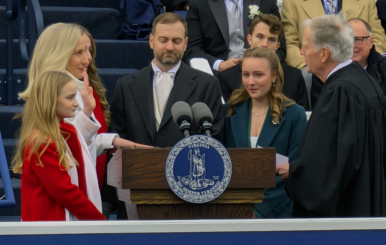
Virginia Gov. Abigail Spanberger was sworn in by Supreme Court of Virginia Senior Justice William C. Mims on Jan. 17, 2026. Photo by Kira Jenkins/Virginia Business

All Democrats, the three officials take office at a challenging time for the nation and the commonwealth, when federal workforce and funding cuts have taken significant tolls. Spanberger’s campaign centered on affordability, protecting and creating jobs in Virginia, and strengthening the state’s education system, among other goals.

In her inaugural speech, Spanberger made many references to Virginia’s history, referring to the state’s delayed ratification in 1952 of the 19th Amendment, which gave women the right to vote in 1920, as well as former Gov. L. Douglas Wilder’s election as the state’s first Black governor in 1989. Wilder, wearing a wide-brimmed off-white hat in the stands behind Spanberger, celebrated his 95th birthday Saturday and stood to applause when Spanberger wished him happy returns.

Spanberger was sworn in by Supreme Court of Virginia Senior Justice William C. Mims.

Clad in a long, winter white double-breasted coat, turtleneck and gloves, Spanberger stood next to Hashmi, Jones and their spouses, with former governors , George Allen, Jim Gilmore, Bob McDonnell, Terry McAuliffe, Ralph Northam and Wilder in attendance, as well as U.S. Sens. Tim Kaine and Mark Warner, also former governors. Former U.S. Sen. Chuck Robb was the sole living ex-governor not in attendance.

Joined by her husband, Virginia’s new first gentleman, Adam Spanberger, and their three daughters, Spanberger quoted the state’s first governor, Patrick Henry, from a 1799 speech: “He made an appeal to his fellow citizens, warning against the divisions that were threatening our young country,” she said. “His appeal remains timeless. He said, ‘United we stand, divided we fall. Let us not split into factions, which would destroy that union upon our existence hangs.’ That was the challenge Gov. Henry put to Virginia at the close of the 18th century, and it is the charge we must answer again today.”

She did not name by name, instead referring to “the recklessness coming out of Washington. You are worried about policies that are hurting our communities, cutting health care access, imperiling rural hospitals and driving up costs. You are worried about Washington policies that are closing off markets, hurting innovation and private industry and attacking those who have devoted their lives to public service.

“You are worried about an administration that is gilding buildings while schools crumble, breaking the social safety net and sowing fear across our communities, betraying the values of who we are as Americans here on these steps and across the commonwealth.”

To loud applause, Spanberger promised, “Our hard-working, law-abiding immigrant neighbors will know that when we say the security and safety of all our neighbors, we mean them too,” a reference to recent ICE actions in Minnesota and other states.

Known for bipartisanship during her three terms in Congress, Spanberger acknowledged that “some who are here today or watching from home may disagree with the litany of challenges and the hardships that I laid out. Your perspective may differ from mine, but that does not preclude us from working together where we may find common cause.”

She also repeated some of her campaign’s tenets, including increasing housing supply, addressing high rent and mortgage rates, lowering energy costs and keeping medical debt from spiraling.

Spanberger said that she will “work tirelessly for you and for our commonwealth,” citing the Rev. Martin Luther King Jr.’s “pilgrimage of prayer.”

“It gives me cause to reflect on what our path forward must be,” she said. “Not a pilgrimage of , certainly not a pilgrimage of partisanship, but rather a pilgrimage of promise, progress and prosperity. My fellow Virginians, as we set an example for the country and the world and, most importantly, for our children, let us choose to stand united, choose to serve one another. Choose to act together as we continue forward. Let us be united for Virginia’s future.”

Following her inauguration, Spanberger signed her first set of executive orders Saturday, including a statewide affordability directive for all executive branch agencies to submit reports within 90 days identifying ways to reduce costs for Virginians; establishing an interagency health financing task force; a comprehensive review of housing development permitting and regulations; creating the economic resiliency task force to respond to federal workforce reductions, funding cuts, tariffs and immigration impacts.

Another executive order directs the state Department of Education to review the process for appointing members to university boards of visitors, a pain point over the past year in the Youngkin administration, which had 22 board members rejected by Senate Democrats. On Friday, three board members resigned at Spanberger’s request, leaving her at least eight seats to fill.

Spanberger also rescinded Youngkin’s Executive Order 47, which required state and local law enforcement to divert resources for use in enforcing federal civil immigration laws.

Saturday’s ceremony, held in front of the historic Virginia State Capitol designed by Thomas Jefferson, included the Pledge of Allegiance led by the Girl Scouts of Virginia, a performance of the song “Shenandoah” by the Hermitage High School Select Treble & Chamber Singers, and an invocation by Father Jim Curran of Norfolk’s Basilica of St. Mary of the Immaculate Conception.

Following Spanberger’s speech and swearing-in, members of Virginia’s Indian tribes performed a traditional dance and blessing of the ground, and a group of young Muslim singers known as ADAMS Beat from Sterling sang “This Land Is Your Land.” Lance D. Watson, senior pastor of Richmond’s Saint Paul’s Baptist Church, gave the benediction.

The ceremony was followed by a parade that included Spanberger’s Henrico County alma mater Tucker High School’s Marching Tigers band, the Norfolk State University Spartan Legion Marching Band, a group of NASA employees from the Wallops and Langley facilities, Virginia State University’s National Pan-Hellenic Council All-Star Step Team and two horses ridden by Virginia 4-H members, among other groups.

5 U.Va. board members resign at Spanberger’s request

SUMMARY: 

  • According to a New York Times report, incoming Virginia governor asked at least five U.Va. board members to resign.
  • Rector , Vice Rector Porter Wilkinson and major donor Paul Manning sent letters of resignation Friday
  • has said she intends to fill five empty seats on board upon taking office Saturday, but had not publicly said she would remove members.

names 27 new board members on first day of term

UPDATED JAN. 19

Five board members resigned Friday at the request of Abigail Spanberger, who was sworn in Saturday as Virginia’s Democratic governor.

The New York Times reported Friday that U.Va. Rector Rachel Sheridan, Vice Rector Porter Wilkinson and major university donor Paul Manning, a member of the university’s board, sent letters of resignation Friday. They are reportedly among at least five people Spanberger asked to step down.

On Saturday, a U.Va. spokesperson confirmed the three resignations and said that President Scott Beardsley and other university officials thanked the three for their service.

As of Saturday, two more board members — health care executive Doug Wetmore and Dr. Stephen Long of Commonwealth Spine & Pain Specialists in the Richmond area — were removed from the university’s page. All five — as well as seven remaining members — were appointed by former Gov. , a . Wetmore and Long were particularly outspoken conservative members of the board.

U.Va. and Spanberger’s transition team did not respond immediately to requests for comment Friday evening, and neither did Sheridan or Manning. Faculty at the flagship university, as well as Virginia’s elected and others, have called for Sheridan and Wilkinson to step down from the board for months, since former university President Jim Ryan resigned in June 2025 under pressure from the U.S. Department of Justice.

Spanberger said previously that she would be ready on “day one” to appoint five U.Va. board members, filling empty seats on the board after state Senate Democrats rejected Youngkin’s 22 appointees for seats on George Mason University, Virginia Military Institute and U.Va.’s boards.

However, she did not confirm publicly any plans to remove board members from any university, although governors have the ability to do so, typically for malfeasance or other unusual circumstances.

Manning’s inclusion among those asked to resign comes as more of a surprise, given that he and his wife donated $100 million to the university in 2023 to launch the $350 million Manning Institute of Biotechnology at U.Va. Manning has said that he made the donation in part due to his friendship with Ryan.

But critics said that the board did not do enough to protect the university or Ryan from attacks by the , which has taken strong measures to rid universities of diversity, equity and inclusion programs, and placed financial pressure on schools by threatening to withhold federal research funding and other federal money. Months after resigning, Ryan wrote a lengthy document about his final months in office during the DOJ’s investigation into U.Va., and said that Sheridan, Manning and Wilkinson met with DOJ officials, while he was not permitted to meet with them.

Ryan alleged that Youngkin, the three board members and attorneys hired by the board had possibly been behind the pressure to resign, instead of the DOJ. “At the very least, we had board members who were apparently more complicit than other universities,” Ryan wrote.

After the release of Ryan’s document, Manning wrote a letter to U.Va.’s Faculty Senate defending his actions in university negotiations with the DOJ.

“Based on the information available to me at the time, I ultimately became convinced that federal funding was at risk and would result in an immediate loss of financial support to the university,” he wrote. “It was, in my mind, a difficult choice between two unfortunate outcomes: real damage to the university, its people, and its academic and research mission, or the premature departure of a leader who had contributed to many successes at the university.”

Friction among factions

A Washington Post story earlier this month cited texts between board members and top U.Va. officials between June 2023 and mid-December 2025, showing friction between Youngkin appointees and board members appointed by Democratic former Gov. Ralph Northam, particularly during the DOJ’s investigation last spring that led to Ryan’s resignation.

Following her election in November 2025, Spanberger called on Sheridan and Wilkinson to pause the presidential search process for Ryan’s replacement until she could fill the board’s seats, but they forged ahead and named former Darden School of Business Dean Scott Beardsley as U.Va.’s 10th president at the end of 2025. He took office Jan. 1.

In response, the U.Va. Faculty Senate passed a resolution this week calling for Spanberger “to exercise her statutory authority, review the actions of current board members, remove those whose conduct has fallen short of the responsibilities of visitors, and appoint qualified individuals to fill all vacancies on the board.”

A “newly reconstituted” board then is asked to review the presidential search process and “determine the best path forward,” the Faculty Senate resolution stated.

In a December 2025 interview with Virginia Business, Spanberger acknowledged, “At times it seems daily, or certainly weekly, that an important constituency [at U.Va.] has voiced their complete lack of confidence [in their board and] in some cases [are] calling on them to step down. As governor-elect, I take note of the varied voices, very strong voices, who have clear reasons that they have articulated in resolutions that have passed, letters that have been written about the distrust they have. But I certainly would think it’s premature for me to make any announcements.”

‘This is war’: In texts, U.Va. board members plotted with Youngkin, decried DEI

Summary

  • Texts show close coordination between U.Va board members and ‘s administration
  • Conservative appointees pushed to end some gender transition care and dismantle programs
  • Messages reveal internal board conflicts and harsh rhetoric toward former President James Ryan
  • Records obtained via FOIA underscore growing political pressure on public universities

As leaders moved to root out what they have criticized as liberal ideology at the University of Virginia, some conservative appointees to its board texted privately about ending “chemical and surgical mutilation” for transgender youth at its hospitals and undoing “regimes of racial classification” in its classrooms, according to nearly 1,000 pages of text messages reviewed by The Washington Post.

The board members coordinated frequently with Gov. (R) or his top aides in nearly every major debate at the flagship university in in the past year – which some observers have described as an unusual level of involvement by the state leader. The conservative appointees also spoke in candid, sometimes inflammatory terms about the university’s then-president, James E. Ryan, his supporters and diversity policies.

“This is war!” Stephen Long wrote on April 17 to a fellow board member about a professor who sought to preserve diversity, equity and inclusion programs.

Board members have often been reluctant to speak publicly on university matters outside of meetings. But the texts, exchanged between June 2023 and mid-December of last year by board members and top university officials, offer an unfiltered account of the body’s inner workings as it rolled back some gender transition care, dissolved the university’s DEI office and responded to several investigations by the , among other changes at U.Va. Ryan resigned in June amid the intensifying scrutiny.

At times, the texts show tension between conservative, moderate and more liberal board members, including one who referred to his fellow board members as “crazies.”

The messages, obtained through Virginia’s Freedom of Information Act (FOIA) by Richmond-based author Jeff Thomas and provided to The Post, also underscore the growing pressure universities are facing from the Trump administration and Republican state officials as conservatives seek to eliminate what they view as progressive indoctrination of American campuses. The U-Va. board has drawn criticism from some students, faculty and alumni, who have questioned their intentions and called for members to resign.

Thomas has previously submitted FOIA requests to U.Va. on other board member texts and about university admissions. He said he asked for texts exchanged with rector and other top officials in November. He sued the university last month after it did not provide some messages in a timely manner, and a judge ordered their release.

The university and almost all board members mentioned in this article declined to comment or did not respond to requests for comment.

Youngkin spokesperson Rob Damschen said the involvement of the governor and his aides was “essential to responsible oversight.”

“It is appropriate, necessary and expected for board members across state agencies, departments and governing bodies to interact and seek counsel from the governor’s cabinet members,” he said. “Virginians should expect nothing less.”

Youngkin’s involvement

Many of the texts reviewed by The Post were sent when the 17-person U.Va. board was overwhelmingly composed of Youngkin appointees, with a small number of seats held by picks by his Democratic predecessor Ralph Northam.

Youngkin has not often spoken publicly about his involvement in the university over the past year. But the texts offer new insight into communications between the board and governor.

On Feb. 16, Robert Hardie, then the board’s rector and a large Democratic donor, sent a text to Sheridan, a partner at Kirkland & Ellis who would succeed him as board chair in July. President Donald Trump had signed an executive order on Jan. 28 restricting some forms of gender transition care for youths, and the U.Va. board would soon consider a resolution on the matter.

“I think GY and JM are calling everyone to lobby them,” he wrote, referring to Youngkin and Virginia Attorney General Jason Miyares (R). Miyares had issued guidance advising university-affiliated hospitals to adhere to the Trump order.

On Feb. 21, the board voted to stop providing gender transition care to new patients while allowing care for existing patients to continue.

But some wanted the board to move further. Youngkin told another board member, Paul Manning, a friend and donor who gave $100 million to the school in 2023, that the board’s resolution might not be enough, Hardie said in another text to Sheridan.

“WH targeting us potentially if we don’t reverse GA care,” Hardie wrote in the March 2 exchange, recounting his conversation with Manning and referencing gender transition care. He said two other Youngkin board appointees would call the governor.

Weeks later, ahead of a vote to dissolve the DEI office, Hardie wrote in a text that he had asked Youngkin general counsel Richard Cullen to speak to a group on the board whom Hardie called the “crazies” and who were pushing for swift changes to diversity-related efforts and the university’s budget.

After the board’s vote passed, texts from Hardie and others described additional conversations with top Youngkin aides.

“Spoke with Aimee for a while last night and we have a strategy,” board member David Webb wrote on March 9, referring to Virginia Education Secretary Aimee Guidera.

Webb did not respond to a request for comment about what they discussed.

The texts suggest a degree of involvement by the governor’s administration in university operations that is atypical in modern Virginia history, according to multiple former board members. In addition to gender transition care and DEI efforts, board members and Ryan talked with Youngkin or aides about the university’s health system and the behavior of other members, records show.

Gov.-elect Abigail (D), who takes office Jan. 17, has said she does not believe governors should involve themselves in university operations beyond making board appointments. After the election, Spanberger had asked the U.Va. board to halt its search for a president until she could appoint new members, but the body hired a new leader in December.

The released texts, however, don’t show communications between the board and Youngkin on some other matters that have generated scrutiny.

For example, there are no references to the governor as the Trump administration increased its scrutiny of U.Va. and Ryan in June, leading the school’s leader to step down. But exchanges suggest involvement by the Youngkin administration in university operations in the immediate aftermath.

On July 1, John Harris – former chief financial officer of the Carlyle Group, where Youngkin was once co-chief executive – began a term on the U.Va. board. After a welcoming message from Sheridan, now the board’s rector, Harris texted her about a planned meeting with university officials and added, “I also spoke with the Governor regarding the matter we discussed.”

Harris said in an interview after this article published that the text was referencing a discussion with Youngkin about a financial issue unrelated to Ryan’s departure as part of Harris’s role as incoming finance committee chair.

In a separate exchange, Jennifer “J.J.” Wagner Davis, the university’s chief operating officer and briefly its acting president, texted Sheridan to say they were waiting for Youngkin and Miyares to sign off on a settlement with Ryan after his resignation announcement. If that happened, Davis wrote July 2, the board could cancel an emergency meeting due to start 20 minutes later.

The meeting was canceled shortly thereafter.

‘He’s such a snake’

The messages reveal board members hurling personal insults and calling for wholesale change when discussing university policy.

On Oct. 13, 2024, for example, then-board member Bert Ellis sent a link to an article headlined “Destroying the machine” and wrote, “This is what we need to do.”

Ellis had courted controversy before and during his time on the board, including in a 2020 incident in which he had planned to use a razor blade to remove a sign hung on a student’s dorm room door. After joining the board in 2022, he described a “battle royale for the soul of UVA” in texts with two board members.

In the newly released texts, Ellis told Sheridan last January that he thought Ryan should have been fired. Ellis was later removed from the board by Youngkin after his rhetoric drew criticism, The Post reported at the time.

During the February discussion on gender transition care, Paul Harris, a former state delegate, offered language for a board resolution in a text to Sheridan. The proposed language, he said, was sensitive to the emotional challenges of receiving the care but also insisted upon “evidence-based medicine.”

While the language used the term “gender affirming care,” he wrote that he would not object to also describing it as “chemical and surgical mutilation,” mirroring language from the Trump executive order.

In an email Thursday, Harris wrote that he had been concerned about complying with changing federal standards and wanted UVA Health to stop providing the care “in the least offensive and most respectful manner possible.”

In another exchange, board member Douglas Wetmore – who called Hardie a “clown” in another message – texted Sheridan on March 1, ahead of the vote on the DEI office, and said he believed the board was not moving aggressively enough on several fronts. “We need to move decisively at UVA to ban DEI and all forms and regimes of racial classification,” he wrote.

Long, a physician, criticized Ryan’s handling of the university’s hospital system in other messages.

“He’s such a snake – thinks I don’t know everything!!” he wrote on April 18.

Some Youngkin appointees expressed reservations about the pace of change sought by other members, though. Sheridan at times appeared as a moderating force in several internal disputes, taking calls and texts as some conservative members butted heads with Hardie. In one 2024 exchange – after hearing that faculty were considering a vote of no confidence in Ryan over the university’s handling of the Israel-Gaza war protests – she told another board member that the president would be hard to replace.

“There are very very very few, if any, alternatives that would be better,” she wrote on May 10, 2024.

The text messages also showed a wider mix of topics discussed by the board: Sheridan wrote of a new phone tree to disseminate information quickly in July, and at other times, members exchanged messages about how the school’s sports programs should respond to a changing college athletics infrastructure.

The texts also show the toll serving on the board was taking on Sheridan, who joined the body in 2023 and chaired its audit committee before becoming rector. After a March 6 meeting, she wrote to the faculty representative to the board that she was “very irritated by arrogance and ignorance (and barely veiled misogyny).”

Hardie, who appeared to have a friendship with Sheridan, also sent inflammatory messages. He grew increasingly frustrated with a group he called the “four horsemen, or should I say four horses asses,” often asking for help from Sheridan to address them.

“This has a lot of MAGA/DOGE written all over it,” Hardie wrote to Sheridan on March 5.

Hardie messaged Sheridan about keeping the head of the conservative alumni group, the Jefferson Council, off the board, the texts show.

Hardie declined to comment on the exchanges.

The rector generally avoided explicit political commentary in texts seen by The Post, though she occasionally revealed her views.

In August, after state Senate rejected Youngkin’s appointment of Jim Donovan to the U.Va. board, citing concerns about his qualifications and intentions, Sheridan texted Donovan directly.

“I hope this backfires politically,” she wrote Aug. 28, “and reveals them to be the extremists they are.”

On Thursday, Sheridan said in a statement that the text didn’t accurately reflect her views on the lawmakers.

“I respect the General Assembly’s authority on these matters but share the frustration of those four individuals that were summarily rejected without the benefit of consideration of their merit and the value these individuals have given and could have continued to give to the university community,” she wrote.


(by Dan Rosenzweig-Ziff (c) 2026 , The Washington Post)

White House seeks emergency power auction for largest US electric grid

Summary

  • urges PJM to consider an emergency to prevent rolling blackouts
  • Rapid data center growth is driving record demand and higher
  • PJM proposes “bring your own generation” rules for large
  • Governors back more than $15B in new generation to boost grid reliability

WASHINGTON, Jan 16 (Reuters) – The White House on Friday urged the largest U.S. to conduct an emergency power auction to protect against rolling blackouts as energy demand from data centers grows faster than the country can build new generation plants.

The initiative calls on , which serves 67 million customers in 13 states and Washington, D.C., to conduct an emergency procurement auction to address escalating electricity prices and growing reliability risks across the mid-Atlantic region of the United States.

PJM later on Friday unveiled its own plan, which called for big data centers to voluntarily bring their own new generation or face the potential of having their power supply curtailed during peak demand periods. The grid operator also called for the creation of an accelerated interconnection track for state-sponsored generation projects.

At a White House event, U.S. Secretary of Energy Chris Wright and Secretary of the Interior Doug Burgum joined several state governors to discuss initiatives to speed the construction of more than $15 billion in new power generation on PJM, which has been criticized for being too slow to build a cushion against rotating blackouts as demand rises.

Rapid expansion of data centers to fuel things like artificial intelligence has stretched the resources of PJM and other regional U.S. electric grids. is seeking to combat consumer price inflation that risks undermining support for Republicans ahead of November’s .

The White House is seeking caps on the amount existing power plants can charge in the PJM capacity market. A recent PJM capacity market auction set record-high prices for power generators that were more than 800% higher than the previous year, increasing electricity prices for homes and businesses.

The agreement would also require data centers to pay for the new generation built on their behalf – whether they show up and use the power or not – rather than buying up existing power. The concept is called BYOG, or “bring your own generation.”

PJM said it is reviewing the principles set forth by the White House and governors. PJM was not invited to the event, a PJM spokesperson told Reuters.

PJM has forecast that the grid’s peak usage in the summer will climb by about 70 gigawatts to 220 gigawatts over the next 15 years. The record summer peak for PJM was 165 gigawatts in 2006.

Since 2023, PJM says it has processed more than 170 gigawatts of new generation requests. Nearly 60 gigawatts of projects have completed PJM’s study process and have either signed or been offered generation interconnection agreements.

RISING POWER BILLS HAVE LED TO BACKLASH

Rising power bills in PJM’s region have led to a political backlash over the last year and threats by some governors to abandon the regional grid. Last summer, nine state governors wrote an open letter to the PJM board of managers criticizing the grid operator for not doing enough to address an escalating electricity affordability crisis.

“Unfortunately, what we have seen in our region is that PJM has been too damn slow to let new generation onto the grid at a time where energy demand is going up,” Pennsylvania Governor Josh Shapiro said at the White House event on Friday.

Burgum said PJM has been lucky so far in avoiding widespread blackouts.

(Reporting by Jarrett Renshaw in Philadelphia, Tim McLaughlin in New York and Timothy Gardner in Washington; Editing by Liz Hampton and Matthew Lewis)


Virginia Democrats move toward new map that could net House seats

Summary

  • Virginia Senate approved a constitutional amendment allowing lawmakers to redraw House districts
  • Measure could give up to four additional U.S. House seats
  • Proposal would temporarily override the state’s independent commission
  • Move comes amid a nationwide redistricting fight ahead of

Jan 16 (Reuters) – Virginia’s Democratic-controlled Senate on Friday approved a constitutional amendment that, if approved by voters, would permit lawmakers to redraw the state’s congressional lines, potentially netting Democrats up to four U.S. House of Representatives seats.

The state’s move is the latest volley in a nationwide battle over redistricting between Republicans and Democrats ahead of November’s midterm elections, when control of Congress will be at stake. Democrats need to flip only three -held districts to win a majority in the 435-seat House, making every seat critical.

Democrats in the Virginia House of Delegates, the legislature’s lower chamber, approved the amendment earlier this week. The legislature is expected to schedule a special election this spring, and lawmakers have said they will release a proposed new map before then so voters can make an informed decision.

Democrats currently hold six of the state’s 11 seats, but a new map could give them as much as a 10-1 advantage.

A constitutional amendment is necessary because Virginia’s voters approved an earlier amendment in 2020 that established an independent redistricting commission. Under Friday’s amendment, lawmakers would have the power to redraw U.S. House lines in response to any other state doing so – as several Republican states have already at Trump’s urging – until 2030, when authority would revert to the commission.

Republican lawmakers accused Democrats of abandoning their principles to punish Trump and pursue power.

“That’s really the only thing that’s behind this, is that you hate the man in the , and you want to blunt his power,” Republican Senator Christopher Head said on the Senate floor.

Democrats said the measure was an emergency move to counter Trump’s unprecedented push for Republican states to pursue redistricting in the middle of the decade.

“It’s a temporary exception to meet an extraordinary threat,” Democratic Senator Scott Surovell said.

Redistricting typically occurs at the start of each decade to incorporate new U.S. Census data. But Trump ignited a rash of redistricting fights this summer, when he successfully urged Texas Republicans to draw a new congressional map taking aim at five Democratic incumbents.

In response, California Democrats advanced a new map targeting five Republicans there. Other states, both Republican- and Democratic-led, followed suit.

Some lawmakers have resisted, however. Indiana Republicans voted down a redistricting plan last month despite pressure from the White House, a rare rebuke of the president from members of his own party.

California’s and Virginia’s efforts have blunted what initially appeared to be a significant Republican advantage in redistricting. Florida Governor Ron DeSantis, a Republican, has said his state will take up redistricting in April, which could net Republicans an additional three to five seats.


(Reporting by Joseph Ax; Editing by Daniel Wallis)


Wall Street ends flat ahead of long weekend

NEW YORK, Jan 16 (Reuters) – ended nearly flat on Friday in a choppy session ahead of the long weekend, although all three major indexes posted losses for the week as fourth-quarter kicked off.

Shares of chipmakers rose, with an index of semiconductors extending gains from Thursday.

Big U.S. banks posted mostly solid results this week as the reporting period got underway. Still, shares of banks and other financial institutions have been pressured by worries over U.S. ‘s proposed one-year cap on credit card interest rates at 10%. Financials were down for the week.

Investors also digested news that Trump said he may want to keep economic adviser Kevin Hassett in his current role, lowering market bets that Hassett would succeed Federal Reserve Chair Jerome Powell.

“To finish the week around flat with the S&P 500 still within spitting distance of 7,000 – most investors will take that as a win two weeks into the year,” said Anthony Saglimbene, chief market strategist at Ameriprise Financial.

“One of the other reasons markets have been flat-lining is we’re at the start of the earnings season,” he said. “Bank earnings are showing a generally favorable economic and business backdrop. Now we’re going to start seeing other companies tied to other sectors, and that’s going to give us a better take on fundamental conditions.”

According to preliminary data, the S&P 500 lost 5.01 points, or 0.07%, to end at 6,939.46 points, while the Composite lost 15.60 points, or 0.07%, to 23,514.42. The Industrial Average fell 87.13 points, or 0.18%, to 49,355.31.

The earnings season ramps up next week with reports from heavyweights including Netflix, Johnson & Johnson and Intel.

Investors were also cautious of making big bets ahead of the long weekend, with the stock market shut on Monday for the Martin Luther King Jr. holiday.

While stocks have largely traded in a relatively tight range in recent sessions, some options market participants expect more choppy price action in coming days following Friday’s monthly options expiration.

“Historically the middle part of January tends to be pretty choppy,” said Bruce Zaro, managing director at Granite Wealth Management in Plymouth, Massachusetts.

“Once we work our way through that, then we are likely to see a little bit better performance out to the end of the month. Hopefully, we’ll find the month positive,” which could suggest positive performance for the year, Zaro said.

The week also saw money shifting out of some heavyweight tech names into more undervalued areas, with mid-cap and small-cap stocks outpeforming the benchmark S&P 500.

(Additional reporting by Medha Singh and Pranav Kashyap in Bengaluru and Saqib Iqbal Ahmed in New York; Editing by Shinjini Ganguli, Maju Samuel and David Gregorio)


AeroFarms secures funding to delay Ringgold closure through February

SUMMARY

  • secured short-term funding to operate through Feb. 27
  • If it closes, 127 employees will lose their jobs
  • The company continues to pursue strategic options

Employees at ‘s AeroFarms, an indoor vertical farming company, appear to have jobs for at least a few more weeks.

The company has received additional short-term funding from a lender to continue core operations at its facility at ‘s , a joint industrial park for the city of and Pittsylvania County, until Feb. 27, according to a letter sent to the state dated Jan. 14. Meanwhile AeroFarms will continue “to pursue strategic options,” the notice stated.

A spokesperson for AeroFarms did not respond to a request for comment Friday.

Ken Larking, city manager of Danville, said Friday he was glad the facility wasn’t shuttering immediately. “While I’m happy they have short-term financing, it would be a lot better for everyone’s sake, if they were able to get long-term financing and provide stability for the company and its employees,” he said.

On Dec. 11, 2025, AeroFarms sent a letter to the Virginia’s Department of Workforce Development and Advancement, aka Virginia Works, reporting it would close in eight days because the company’s largest investor withdrew future financial support.  However, employees got a reprieve on Dec. 19, 2025, when the company sent out a news release announcing an existing stakeholder had agreed to provide funding.

What AeroFarms didn’t disclose in the press release was that the company could still close between Jan. 2 and Jan. 16, 2026. That detail was included in a Dec. 19, 2025, update to Virginia Works, though.

A group of 16 primarily remote employees, which include six Virginia residents, will continue to be furloughed, according to AeroFarms’ most recent state notice. If the Ringgold facility has to close Feb. 27, 127 employees, including those working remotely, would lose their jobs, the notice stated. Of those, 98 are Virginia residents.

Previously, AeroFarms told the state that 18 mostly remote employees, including seven Virginians, would be temporarily furloughed, beginning Dec. 19, 2025.

In its initial notice to the state Dec. 11, 2025, AeroFarms noted 173 employees would lose their jobs. However, the following week the company reported it had 135 remaining employees.

In April 2023, AeroFarms transferred its New Jersey commercial production to its commercial farm at Cane Creek Centre. A few months later, AeroFarms filed for voluntary protection under Chapter 11 of the U.S. Bankruptcy Code; however, the company pledged to keep up its efforts in Southern Virginia.

On Aug. 7, 2025, AeroFarms announced it had refinanced its debt to support ongoing operations at its Cane Creek Centre farm and had raised equity financing to support existing operations and fund preconstruction activities for its expansion to a second farm.

Equity was provided by existing investors including Grosvenor Food & AgTech, a London-based investor in food and  companies; Ingka Investments, a Netherlands-based investor; and Cibus Capital, a London-based investment adviser in sustainable food and agriculture, according to the August news release.

Siguler Guff, a New York-based private markets investment firm, provided AeroFarms with an asset-based loan to pay off previous debt facility from Horizon Technology Finance, a Connecticut-based venture lending platform, according to the news release.

In 2019, then-Gov. Ralph Northam announced that AeroFarms would invest $42 million to build a vertical farm in Cane Creek Centre. The company celebrated the opening of its 138,670-square-foot facility in 2022.

AeroFarms produces micro bok choy, micro kale, micro broccoli, micro arugula, micro spicy mix and micro super mix for retailers including Whole Foods, Harris Teeter and The Fresh Market.

Parsons acquires Altamira for $375M

Chantilly announced Thursday that it has acquired -based national security company Technologies for $375 million.

Parsons paid $330 million in cash at closing, with an additional $45 million cash earn out payable in the first quarter of 2027 if certain earnings before interest, taxes, depreciation and amortization (EBITDA) targets are met during 2026. Parsons anticipates Altamira will generate over $200 million of revenue this year.

Through the , Altamira’s more than 600 employees, over 90% of whom hold security clearances, will be aligned to Parsons’ defense and intelligence business unit.

“Acquiring Altamira is a strategic accelerator for our national security growth strategy, strengthening Parsons’ ability to deliver rapid and agile mission‑ready, intelligence‑driven solutions across the Department of War and the intelligence community,” Parsons President and CEO Carey Smith said in a statement.

Smith said that Altamira’s advanced intelligence, surveillance and analytics capabilities will expand Parsons’ offerings and better position the company to capture a larger share of the intelligence and multidomain operations market.

Founded in 1999, Altamira specializes in missile warnings, artificial intelligence and machine learning-enabled analytics, cyber operations, and space-based mission support. The company’s services allow customers to detect, characterize and respond to emerging threats. Before the acquisition, Altamira was a portfolio company of venture capital firm ClearSky.

“We are excited to join forces with Parsons, a partnership that reflects our shared commitment to innovation, mission excellence and delivering decisive advantages to the warfighter,” said Altamira CEO Jane Chappell in a statement.

Founded in 1944, Parsons provides technology solutions in the defense, intelligence and critical infrastructure markets. It posted $6.8 billion in 2024 revenue and has more than 19,000 employees worldwide.

Yokohama Tire plans 392 layoffs in Virginia

Yokohama Tire plans to “significantly reduce tire production” at its facility and will lay off 392 hourly and salaried employees of the plant, according to a company announcement Friday.

Salem Yokohama employees have been notified, stated, that all tire production could cease in July, followed by a full Sept. 17. That date coincides with the expiration of the collective bargaining agreement between Yokohama Tire Manufacturing Virginia and Local 1023.

The Salem plant currently employs 571 workers, according to a Yokohama Tire spokesperson.

“I am truly saddened to learn that the Yokohama plant will be laying off so many employees,” Salem City Manager Chris Dorsey said in a statement. “For generations, Yokohama has been part of the fabric of Salem, and so many of the people who worked there have also given back to our city. This won’t just be a financial impact on the city, but it is also a personal impact on the community and families who depend on these jobs.”

Mohawk Rubber Co. opened the Salem plant in 1968. Yokohama Tire acquired Mohawk in 1989. The facility expanded production in 1994 and employed 1,050 at its peak in 1996, according to Salem city government.

In 2023, company executives and Salem officials celebrated the 100 millionth Yokohama tire rolled off the line at the Salem plant.

The reduction in tire production in Salem, which will begin in March, is in response “to the expiration of certain product life cycles” and reduced demand for products manufactured there, according to Yokohama Tire. The company does not expect supply disruptions.

The Salem facility, according to Yokohama Tire, “is not well equipped to manufacture Yokohama’s required product mix or achieve the company’s manufacturing objectives in the future.”

Salaried employees who lose their jobs will receive layoff benefits under existing company policies, while affected hourly employees will receive layoff benefits in accordance with the collective bargaining agreement between Yokohama Tire and United Steelworkers Union No. 1023.

A representative of the union declined to comment Friday.

Fed should be ready to cut rates again amid job market risks

FOXBOROUGH, Massachusetts, Jan 16 (Reuters) – Federal Reserve Vice Chair for Supervision Michelle Bowman said on Friday a fragile job market that could weaken quickly means the U.S. central bank should stand ready to cut interest rates again if needed.

“Absent a clear and sustained improvement in labor market conditions, we should remain ready to adjust policy to bring it closer to neutral,” Bowman said in a speech delivered before the Outlook 26: The New England Economic Forum in Foxborough, Massachusetts. She added that while monetary policy is not on a preset course, “we should also avoid signaling that we will pause” on further rate cuts “without identifying that conditions have changed.”

Bowman added that “my baseline expectation is that economic activity will continue to expand at a solid pace and the labor market will stabilize near full employment as monetary policy becomes less restrictive.”

But she also said risks to the Fed’s inflation and job mandates are uneven, noting that price pressures are likely to abate as the impact of trade tariffs wanes, with underlying inflation close to the central bank’s 2% target.

Meanwhile, the job market, which is currently near full employment, “has become increasingly more fragile and could continue to deteriorate in the coming months,” Bowman said. She warned that conditions could change quickly, which is why the Fed should be nimble on the policy front.

Bowman described the current stance of monetary policy as “moderately restrictive” and said Fed officials should be forward-looking in setting interest rate policy. “We should rely on forecasts that are informed by a broad set of indicators and by ongoing engagement with businesses and communities across the country,” she said.

FED OFFICIALS HAVE SIGNALED NO URGENCY TO ACT

The Fed enters 2026 amid expectations among its policymakers that inflation pressures will moderate, the job market will stabilize and growth will turn in a decent performance as uncertainty from ‘s erratic economic policies abates.

Over the closing months of 2025, the Fed lowered its benchmark interest rate by three-quarters of a percentage point, to the 3.50%-3.75% range. The central bank reduced the cost of short-term borrowing in a bid to offer support to a weakening job market while still providing enough restraint to bring down still-high inflation pressures.

At the December 9-10 policy meeting, Fed officials penciled in a single quarter-percentage-point rate cut for 2026. In comments over the start of the year, they have signaled no urgency to act as they seek further evidence that inflation, which remains well over the 2% target, will abate.

As the Fed seeks data that would give it the green light to cut again, it continues to face considerable pressure from Trump over lowering rates. The president will get to select a successor to Fed Chair Jerome Powell, whose term as central bank chief ends in May, and is expected to announce the outcome of that search soon.

The battle between the president and the Fed escalated in recent days amid the revelation that the central bank is being criminally targeted by the administration over issues with costs associated with the renovation of the Fed’s headquarters. Powell said the latest attack is really about the Fed exercising independent judgment in setting rates.

In her remarks, Bowman noted some fragilities in financial markets. She said stock prices “may appear stretched” and added, “I am concerned that disappointing news on AI investment returns could lead to a sharp correction in equity prices.”

On the banking oversight front, Bowman said “we will continue to focus on improving the mergers and acquisitions review process, assessing the appropriateness of capital requirements across the banking system, addressing payments and check fraud, and strengthening examiner training and development.”

(Reporting by Michael S. Derby; Editing by Paul Simao)