Please ensure Javascript is enabled for purposes of website accessibility

Trump may become the face of economic discontent, a year after such worries helped him win big

SUMMARY:

  • win key races amid voter anger over rising costs
  • Trump acknowledges warning from voters on issues
  • remains top concern in Virginia, New Jersey, and California

WASHINGTON (AP) — President Donald Trump got a serious warning from voters that he’s out of touch with their fears about a deteriorating .

Democrats were able to run up the score in key races across the country on Tuesday by harnessing some of the same populist fervor that helped get Trump reelected a year ago — but also by focusing on the kitchen table issues the Republican had vowed to fix. Now, as the incumbent, fears about the economy have made Trump the face of much of the public’s discontent.

“We learned a lot.” Trump acknowledged on Wednesday. He later posted online that, “Affordability is our goal.”

Vice President JD Vance struck a similar tone, posting on X: “We’re going to keep on working to make a decent life affordable in this country, and that’s the metric by which we’ll ultimately be judged in 2026 and beyond.”

That followed voters in the Virginia and New Jersey governor races, the New York City mayoral contest and the California ballot proposition all citing economic concerns as a top issue. Democrats swept those elections, and it was difficult to point to any major race, anywhere, where had a key victory.

The reversal of fortune from a year ago was stark. Back then, voters returned Trump to the White House on the promise that he could quickly bring down inflation, jump-start factory hiring and shower the country in newfound wealth from steep tariffs he imposed on U.S. allies the world over.

Instead, voters now are expressing concerns that high prices for groceries, electricity bills and housing are draining their bank accounts. Trump has been defiant in insisting that he’s strengthened the economy, so — his early reactions aside — it’s not clear he’ll internalize the need to take on the same inflationary challenges that became a drag for his Democratic predecessor, Joe Biden.

‘People have 401(k)s’

There are few signs that the public is putting much confidence in Trump’s claims about an American “golden age,” nor his assertion that inflation has been tamped down into submission. Recently pressed on Americans still worried about high grocery prices, Trump pointed to the .

“Look, 401(k)s. People have 401(k)s,” the president said in an interview with CBS News’ “60 Minutes” that was broadcast on Sunday. Trump said grocery prices are falling, but the most recent inflation report shows they’re up 2.7% from a year ago.

Overall consumer prices have risen 3% over the past 12 months, which is higher than the rate going into Trump’s 2024 election win. The Federal Reserve targets inflation at 2%.

‘I don’t think it was good for Republicans’

While the stock market is surging and life looks good for tech executives with artificial intelligence investments, hiring slowed sharply this summer in the wake of Trump rolling out his .

The AP Voter Poll showed that anxiety about the economy helped the Democrats on Tuesday.

Roughly half of Virginia voters said “the economy” was the top issue, and about 6 in 10 of these voters picked Democrat Abigail Spanberger for governor, powering her to a decisive win.

In New Jersey, Democrat Mikie Sherrill won about two-thirds of voters who called “the economy” the top issue facing the state. Republican Jack Ciattarelli secured about 6 in 10 New Jersey voters who said the top issue was “taxes.”

More than half of New York City voters said the cost of living was the top issue facing the city, and Democrat Zohran Mamdani won about two-thirds of this group.

Slightly fewer than half of California voters said “the economy” was the top issue facing the state, and roughly two-thirds of those voters backed Prop 50. The measure’s approval allows Democrats to redraw congressional maps more favorable to their party in the nation’s largest state and keep up with Republicans who have moved to add potential new red House seats in Texas and elsewhere.

Trump did not actively campaign for his party ahead of Election Day 2025. With votes still being counted, he was already ducking blame, posting that he “WASN’T ON THE BALLOT.”

The morning after the election, while hosting Senate Republicans at the White House, Trump was more reflective. “Last night, it was not expected to be a victory,” he said.

The elections were largely in areas that have recently favored Democrats, so there are limits to interpreting what the results could mean for next year’s broader midterm races. But the size of Democratic margins indicated the degree of frustration with economic conditions under Trump.

“I don’t think it was good for Republicans,” Trump said. “I’m not sure it was good for anybody, but we had an interesting evening, and we learned a lot.”

Later, while traveling to Florida, to lay out what he deems to be his economic successes for an audience of business leaders and athletes, the president posted another message in which he seemed to reacting to the election’s results.

While insisting “Our Economy is BOOMING” he added, “Affordability is our goal.”

That was a departure from last weekend, when Trump threw a lavish Jazz Age-themed “Great Gatsby” party at his Florida club, Mar-a-Lago after jetting back from a trip to Asia dripping with luxury.

The has maintained that the working class will soon benefit — along with the .

“We’re going to see Main Street surge here, along with , which we’ve already seen,” Treasury Secretary Scott Bessent said this week on Fox News Channel’s “Jesse Watters Primetime.”

In the run-up to Tuesday’s elections, Trump had focused his messaging on mass deportations of immigrants in the country illegally and a push to reduce crime by deploying National Guard troops to cities with Democratic leadership. But the AP Voter Poll found that few of those casting their ballots considered crime or immigration a top priority.

“Our side needs to focus on affordability,” said Vivek Ramaswamy, a former Republican presidential candidate and Trump ally now running for Ohio governor in 2026. “Make the American dream affordable. Bring down costs, electric costs, grocery costs, health care costs and housing costs. And lay out how we’re going to do it.”
Conservative Supreme Court justices appear skeptical of Trump’s sweeping unilateral tariffs

SUMMARY:

  • weighs Trump’s emergency-based tariff authority
  • Justices Barrett and Gorsuch question limits on presidential power
  • Lower courts ruled Trump’s exceeded authority

WASHINGTON (AP) — Conservative members of the Supreme Court on Wednesday appeared skeptical of President Donald Trump’s sweeping unilateral tariffs midway through arguments in a case that’s a pivotal test of for a tool central to his broader agenda.

While the questions at times seemed to challenge the rationale for the tariffs, the arguments are still ongoing, and further questioning could shed additional light on their positions. A decision in the case could take weeks or months.

The Republican administration is trying to defend the tariffs central to Trump’s economic agenda after lower courts ruled the emergency law he invoked doesn’t give him near-limitless power to set and change duties on imports.

The Constitution says Congress has the power to levy tariffs. But the argues that in emergency situations the president can regulate importation — and that includes tariffs.

Justice Amy Coney Barrett grilled the government on that point. “Has there ever been another instance in which a statute has used that language to confer the power?” she asked.

Justices Neil Gorsuch also questioned the government on whether Trump’s position would hand congressional powers to the president.

Trump has called the case one of the most important in the country’s history and said a ruling against him would be catastrophic for the economy.

The challengers argue the 1977 Trump used doesn’t even mention tariffs, and no president before has used it to impose them. A collection of small businesses say the uncertainty is driving them to the brink of bankruptcy.

The case centers on two sets of tariffs. The first came in February on imports from Canada, and Mexico after Trump declared a national emergency over drug trafficking. The second involves the sweeping “reciprocal” tariffs on most countries that Trump announced in April.

Multiple lawsuits have been filed over the tariffs, and the court will hear suits filed by Democratic-leaning states and small businesses focused on everything from plumbing supplies to women’s cycling apparel.

Lower courts have struck down the bulk of Trump’s tariffs as an illegal use of emergency power, but the nation’s highest court may see it differently.

Trump helped shape the conservative majority court, naming three of the nine justices in his first term. The justices have so far been reluctant to check his extraordinary flex of executive power, handing him a series of wins on the court’s emergency docket.

Still, those have been short-term orders — little of Trump’s wide-ranging conservative agenda has been fully argued before the nation’s highest court. That means the outcome could set the tone for wider legal pushback against his policies.

The justices have been skeptical of executive power claims before, such as when then-President Joe Biden tried to forgive $400 billion in student loans under a different law dealing with national emergencies. The Supreme Court found the law didn’t clearly give him the power to enact a program with such a big economic impact, a legal principle known as the major questions doctrine.

The challengers say Trump’s tariffs should get the same treatment, since they’ll have a much greater economic effect, raising some $3 trillion over the next decade. The government, on the other hand, says the tariffs are different because they’re a major part of his approach to foreign affairs, an area where the courts should not be second-guessing the president.

The challengers are also trying to channel the conservative justices’ skepticism about whether the Constitution allows other parts of the government to use powers reserved for Congress, a concept known as the nondelegation doctrine. Trump’s interpretation of the law could mean anyone who can “regulate” can also impose taxes, they say.

The Justice Department counters that legal principle is for governmental agencies, not for the president.

If he eventually loses at the high court, Trump could impose tariffs under other laws, but those have more limitations on the speed and severity with which he could act. The aftermath of a ruling against him also could be complicated, if the government must issue refunds for the tariffs that had collected $195 billion in revenue as of September.

The Trump administration did win over four appeals court judges who found the 1977 International Emergency Economic Powers Act, or IEEPA, gives the president authority to regulate importation during emergencies without explicit limitations. In recent decades, Congress has ceded some tariff authority to the president, and Trump has made the most of the power vacuum.

Steelers co-owner donates $50M+ to Hampden-Sydney

SUMMARY:

  • Steelers minority owner and his wife, Cindy, make $50 million-plus gift to
  • Gift is largest in college’s history
  • launches Citrone Scholars Program, offering four-year, full-tuition merit to top prospective students

Billionaire Pittsburgh Steelers minority owner Rob Citrone and his wife, Cindy, are donating more than $50 million to Hampden-Sydney College — the largest gift in the school’s 250-year history — to launch a full-tuition scholarship program for top prospective students.

The Citrone Scholars Program will offer four-year, merit-based scholarships to help Hampden-Sydney attract and educate more “young men of intellect, character and purpose,” according to the college.

“Rob and Cindy’s investment bolsters the college’s ability to attract even more of the most talented young men to Hampden-Sydney, where they will benefit from, and contribute to, the college’s distinctive educational experience,” Hampden-Sydney President Larry Stimpert said in a statement.

Rob Citrone, co-founder of hedge fund Discovery Capital Management, serves on Hampden-Sydney’s Board of Trustees. He graduated from Hampden-Sydney in 1987 with a degree in economics and mathematics before earning his MBA at the University of Virginia’s Darden School of Business.

“Hampden-Sydney shaped the foundation of who I am — as a thinker, a leader, and a person,” he said in a statement. “The education I received here didn’t just prepare me for a career — it prepared me for life.”

Cindy Citrone is a former Hampden-Sydney trustee who remains an active member of the college’s James Madison Society. Through their C33 Foundation, the couple support a wide range of philanthropic initiatives ranging from local community engagement to global impact.

“Over many years, the Citrones’ investments in the college’s educational program have provided scholarship funding, supported student research, and helped the college launch new academic and co-curricular initiatives,” Stimpert said in a statement. “In 2020, they provided $6 million to launch Compass, the college’s signature initiative that connects classroom learning with real-world experience. This program guarantees every student a funded internship, research project or study-abroad opportunity.”

The private, men’s liberal arts college has not yet said how many scholarships will be awarded per entering class, what the selection process will entail, or when the first cohort of recipients will be chosen. It also did not specify whether the $50 million investment will support the Citrone Scholars Program permanently or if it planned to grow the program through future fundraising.

Founded in 1775, Hampden-Sydney had a 2024 enrollment of 946 students.

Industrial park near Richmond airport sells for $142M

An eight-building industrial park near the in eastern sold for $142 million, according to news releases this week.

Boston-based private equity firm Rockpoint bought Eastport Industrial Park, which has more than 1.06 million square feet, from Equus Capital Partners, a real estate investment fund manager headquartered near Philadelphia. Equus purchased the property for $138.99 million in 2022.

Located 2 miles from the Richmond airport, the 98-acre property has eight and buildings averaging 25-foot clear heights, according to Cushman & Wakefield.  The buildings range from 71,634 square feet to 174,720 square feet with 18-foot to 28-foot clear heights and 80-foot to 140-foot truck courts, according to Equus. Eastport has 182 loading positions, with 26 potential slots for additional loading positions.

The property sits near the intersection of Charles City Road and East Laburnum Avenue, close to Interstates 64 and 95. At closing, it was 97% occupied, with 19 tenants from varying industries, including logistics, pet care, medical and food and beverage.

The Richmond airport industrial submarket has a 2% vacancy rate and has seen rent growth of more than 120% since 2020, according to Cushman & Wakefield.

“Rockpoint’s investment in Eastport reflects our continued conviction in high-quality, infill light industrial assets in select growth markets,” Fred Borges, senior managing director at Rockpoint, said in a statement.

Rockpoint will manage and operate Eastport with its property services affiliate, Rockhill Management, and its industrial operating platform, Rockpoint Industrial.

“The disposition of the Eastport Industrial Park reflects the successful execution of Equus’ value-add strategy for this industrial investment,” Equus Senior Vice President Michael Brower said in a statement. Brower and Keith Knight, a vice president at Equus, oversaw the transaction for the company.

Cushman & Wakefield’s industrial advisory group mid-Atlantic sales team of Jonathan Carpenter, Graham Savage, Dawes Milchling and James Check, along with Cushman & Wakefield | Thalhimer’s Eric Robison and Bo McKown, represented Equus in the sale. John Alascio, TJ Sullivan, Chris Meloni and Michael Zelin from Cushman & Wakefield’s equity, debt and structured finance team arranged acquisition financing for Rockpoint.

Rockpoint was founded in 2003, and its predecessor firm was founded in 1994. As of June 30, Rockpoint and the predecessor firm had invested or committed to invest in 512 transactions with a peak capitalization of about $82 billion. The company managed $13 billion in net assets. Since 2020, Rockpoint has made 16 industrial investments spanning approximately 15 million square feet.

Musk the trillionaire? Debate over his Tesla pay package rages

Summary:

  • Shareholders to vote on Musk’s potential $1T compensation deal
  • Critics call pay excessive; supporters say Musk is vital to
  • Musk must meet strict sales and profit targets to qualify

NEW YORK (AP) — turned off many potential buyers of his Tesla cars and sent sales plunging with his foray into politics. But the stock has soared anyway and now he wants the company to pay him more — a lot more.

Shareholders gathering Thursday for Tesla’s annual meeting in Austin, Texas, will decide in a proxy vote whether to grant Musk, the company’s CEO and already the richest person in the world, enough stock to potentially make him history’s first trillionaire.

It’s a vote that has sparked heated debate on both sides of the issue, even drawing the pope’s comments on it as an example of income inequality.

Several pension funds have come out against the package, arguing that the board of directors is too beholden to Musk, his behavior too reckless lately and the riches offered too much.

Supporters say Musk is a genius who is the only person capable of ushering in a Tesla-dominated future in which hundreds of thousands of self-driving Tesla cars — many without steering wheels — will ferry people and humanoid Tesla robots will march around factories and homes, picking up boxes and watering plants. The pay is necessary to incentivize him, they say, and keep him focused.

Musk has threatened to walk away from the company if he doesn’t get what he wants and has blasted some of the package’s critics as “corporate terrorists.”

What is up for a vote

To get his Tesla shares, Musk has to secure approval from a majority of the company’s voting shareholders. Improving the odds, Musk gets to vote his own shares, worth 15% of the company.

Shareholders first heard about the pay package in September when the board of directors proposed it in a detailed filing to federal securities regulators. The document, running 200 pages, also contains other proposals up for a vote at the meeting, including whether to allow Tesla to invest in another Musk company, xAI, and who should serve on the board in the future.

How Musk can get $1 trillion

Musk won’t get necessarily get all of that money, or even a cent of it, if the package is approved. He first has to meet several operational and financial targets.

To get the full pay, for instance, he has to deliver to the car market 20 million Teslas over 10 years, more than double the number he has churned out over the past dozen years. He also has to massively increase the market value of the company and its operating profits and deliver one million robots, from zero today.

If he falls short of the biggest goals, though, the package could still hand him plenty of money.

Musk will get $50 billion in additional Tesla shares, for example, if he increases the company’s market value by 80%, something he did just this past year, as well as doubling vehicle sales and tripling operating earnings — or hitting any other two of a dozen operational targets.

Musk v Rockefeller

Musk is already the richest man in the world with a net worth of $493 billion, according to Forbes magazine, and well ahead of some of the wealthiest of years past.

He’s worth more than two Cornelius Vanderbilts, the shipping and railroad magnate of the 19th Century whose -adjusted wealth hit $200 billion or so at its peak. The steel giant, Andrew Carnegie, was once worth $300 billion, according to the Carnegie Corp., well below Musk’s wealth, too.

Musk is still trailing John D. Rockefeller, but he’s closing in fast. The railroad titan hit peak inflation-adjusted wealth of $630 billion in 1913, according to Guinness World Records.

What really drives Musk, or so he says

Musk says it’s not really about the money but about getting a higher Tesla stake — it will double to nearly 30% — so he can control the company. He says that’s a pressing concern given all the power Tesla may soon have, specifically something he referred to in a recent investor meeting as its future “robot army.”

That was a reference to Tesla’s Optimus division, which makes humanoid workers that will be so numerous that, as Musk put it recently, he wouldn’t want anyone else but himself to control them.

Split among shareholders

Many investors have come out in support of the package, including Baron Capital Management, whose founder called Musk indispensable to the company. “Without his relentless drive and uncompromising standards,” wrote founder Ron Baron, “there would be no Tesla.”

Critics include the biggest in the U.S. public pension fund, Calpers, and Norway’s sovereign wealth fund, the world’s largest. They argue the pay is excessive, with the Norway fund expressing concern that the board that designed it, which includes Musk’s brother, is not independent enough. Two giant corporate watchdogs, Institutional Shareholder Service and Glass Lewis, said they are voting against it, too.

Even the Vatican has weighed in, decrying the wealth gap in the world and blasting the trillion dollar offer in particular.

“If that is the only thing that has value anymore,” said Pope Leo XIV, “then we’re in big trouble.”

Musk’s record at Tesla is mixed

Judging from the stock price alone, Musk has been spectacularly successful. The company is now worth $1.5 trillion.

But a lot that runup reflects big bets by investors that Musk will be able deliver things that are difficult to pull off, and the way Musk has run the company recently doesn’t inspire confidence. He has broken numerous promises, and his tendency to say whatever is on his mind has sabotaged the company.

Just this year, for instance, he vowed to deliver driverless taxis in several cities, secure regulatory approval in Europe for his self-driving software and push sales up 20% or 30%.

Instead, his driverless robotaxis in Austin and San Francisco have human safety monitors inside. Europeans still haven’t approved his software. And Tesla sales continue to plunge, with new figures out Monday showing a stunning 50% drop last month in Germany alone.

That said, Musk has pulled off the impossible before. His company a half dozen years ago was widely feared to be near bankruptcy because he wasn’t making enough cars, but then he succeeded and the stock soared.

“He frequently teeters on the edge of disaster,” said Tesla owner and money manager Nancy Tengler, “and then pulls back just in the nick of time.”

IT firm Qbase to lay off 60 remote employees

Qbase, a Fairfax County-based IT services consultancy to the federal government and corporate clients, plans to lay off 60 remote workers by the end of the year.

Although the are expected to be completed by Dec. 30, they may continue through Jan. 12. Service desk analysts make up the largest portion of workers losing their jobs. A training coordinator, an operations manager and team leads will also be laid off.

The layoffs are expected to be permanent, and the affected employees do not have bumping rights and are not represented by a union.

Though the employees are remote, they are designated as reporting to the company’s office at Democracy Drive in , according to an Oct. 31 notice sent to the state government in compliance with the Worker Adjustment and Retraining Notification (WARN) Act.

In 2022, was acquired by , a Reston-based solutions company that works with defense, intelligence and civilian agencies. Qbase was founded in 2005 by the former chief technologists and executives of LexisNexis, the data and analytics company.

A Tyto Athene spokesperson declined to comment on the layoffs, but stated, “We’re committed to the success of our employees and will always prioritize their well-being.”

Democrat Jay Jones wins race to be Virginia attorney general despite texts endorsing violence

Summary

  • Democrat defeats Republican for Virginia .
  • Jones apologized for 2022 texts suggesting violence against a state lawmaker.
  • His win signals possible Democratic momentum heading into midterms.
  • Jones becomes Virginia’s first Black attorney general.

RICHMOND, Va. (AP) — Democrat Jay Jones was elected Tuesday as Virginia attorney general, riding a wave of voter dissatisfaction with the White House to overcome the revelation that in 2022 he sent widely condemned texts embracing violence against a fellow state lawmaker.

The former Virginia delegate defeated Republican incumbent weeks after it emerged that Jones had texted a fellow delegate suggesting the then-House speaker should get “two bullets to the head.” Jones apologized for the private messages both in statements and at a debate in October.

“At the end of the day, this election has never been about me or my opponent,” Jones said at a campaign party. “It has always been about every single one of us and the future of Virginia.”

Jones’ victory amid the controversy could signal trouble for heading into next year’s midterm elections. He weathered the storm in part by working to shift the debate away from his character and toward ‘s administration.

Jones campaigned against the impact of federal encroachment on Virginia since Trump took office in January — shrinking the civil service, levying and a Republican federal tax cut bill that argued imperiled the state’s health care system.

The win could soon add Virginia to the roster of Democratic-led states legally challenging actions taken by Trump.

A descendant of slaves, Jones is set to become the first Black attorney general in the former capital of the Confederacy. His victory is a landmark moment for Black Virginians in a statewide contest that was already poised to make history, with voters choosing between two women to elect the state’s first female governor.

Miyares faced a difficult political climate in his bid for reelection. Ever since Democrat Jimmy Carter won the White House in 1976, every time a new president has been elected, Virginia has voted in a governor the following year from the opposite party.

And while the state has had split tickets before — meaning voters backed candidates for statewide offices from a party that differs from the elected governor — they haven’t picked an attorney general from the opposite party in 20 years.

“Listen, Virginians, is like a pendulum. The public’s sentiments sway one way and then the next,” Miyares said Tuesday. “Tonight, it swung a bit too far in the wrong direction, in my opinion. And folks, it will swing back.”

Republicans had hoped to persuade swing voters to reelect Miyares but faced challenging headwinds in a state with tens of thousands of federal employees.

Outrage over Jones’ text messages is unlikely to fade once Jones is sworn into office. Republicans, including Trump and Miyares, described his conduct from three years ago as disqualifying him from the attorney general’s position in 2025.

Even Democrats and Ghazala Hashmi, the party’s candidates for governor and lieutenant governor Tuesday, had stayed silent about whether Jones still had their endorsements. Jones did, however, speak at a Spanberger campaign rally on Saturday.

Jones comes from a family of Hampton Roads politicians and civil rights pioneers. His father was also a Virginia delegate, and his grandfather was the first Black member of the Norfolk School Board. Jones previously ran for attorney general in 2021 but lost the primary to then-incumbent Mark Herring.

“My father, my mother, my uncles, my aunts endured segregation, all so that I could stand here before you today,” Jones said.

Abigail Spanberger elected Virginia governor in a historic first that boosts Democrats ahead of 2026

Summary:

RICHMOND, Va. (AP) — Democrat Abigail Spanberger won the Virginia governor’s race Tuesday, defeating Republican Lt. Gov. Winsome Earle-Sears to give Democrats a key victory heading into the 2026 midterm elections and make history as the first woman ever to lead the commonwealth.

Spanberger’s win was the first in a big night for Democrats in Virginia and around the country, casting new doubts about President Donald Trump’s political strength less than a year into his second White House term.

“We sent a message to every corner of the commonwealth, a message to our neighbors and our fellow Americans across the country,” Spanberger told supporters Tuesday night in Richmond. “We sent a message to the whole word that in 2025, Virginia chose pragmatism over partisanship. We chose our commonwealth over chaos.”

Also Tuesday, Democrat Ghazala F. Hashmi won the lieutenant governor’s race and will succeed Earle-Sears. Hashmi is the first Muslim woman to win a statewide office in the U.S. And in a night of firsts, Democratic challenger Jay Jones defeated Republican Jason Miyares to become the state’s first Black attorney general and complete a Democratic sweep of the commonwealth’s statewide posts. Democrats also retained control of the state legislature.

Spanberger, a former congresswoman and CIA case officer, won by emphasizing economic issues, a strategy that may serve as a model for other Democrats in next year’s elections as they try to break ‘ hold on power in Washington and gain ground in statehouses.

Campaigning, Spanberger often sidestepped the historic potential of her candidacy. In victory, she embraced it.

“Just a few minutes ago, Adam said to our daughters, your mom’s going to be the governor of Virginia. And I can guarantee those words have never been spoken in Virginia ever before,” she said.

“It’s a big deal,” she added, “that the girls and the young women I have met along the campaign trail now know with certainty that they can achieve anything.”

Spanberger’s eyes welled up as she told her family she loved them. Her husband and three daughters, standing behind her, wiped tears from their cheeks.

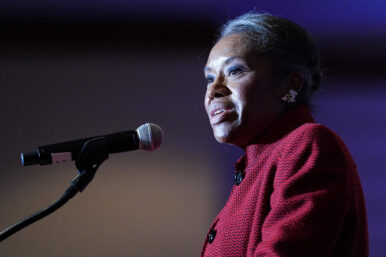
Republican Winsome Earle-Sears speaks on stage at an election night watch party after losing the Virginia governor’s race Tuesday, Nov. 4, 2025, in Leesburg, Va. (AP Photo/Eric Lee)

Spanberger was intentional in how she criticized Trump

Throughout the campaign, Spanberger made carefully crafted economic arguments against Trump’s policies, while she spent considerable sums on ads tying Earle-Sears to the president. She campaigned across the state, including in Republican-leaning areas, and in her first appearance as governor-elect she wore a bright red suit.

Yet Spanberger also emphasized her support for abortion rights in the last Southern state that has not enacted new restrictions or bans on the procedure, and she railed against Trump’s Department of Government Efficiency, the U.S. government shutdown and their negative impact on a state with several hundred thousand federal employees.

That approach helped corral Democrats’ core supporters while attracting the kinds of swing voters who elected Youngkin four years ago. It also continued a historical trend for Virginia: Since Jimmy Carter won the White House in 1976, Virginia has backed a governor from the opposite party of every first-term president in the following year. This year is a special case, given the gap between Trump’s terms.

Republicans, meanwhile, must grapple again with a battleground loss by an arch-conservative from the president’s party.

Trump never campaigned for Earle-Sears, though he did give her his tepid support. Their uneasy alliance raises questions about the ideal Republican nominee for contested general elections and how the president’s volatile standing with voters might affect GOP candidates next November. The midterm elections will settle statehouse control in dozens of states and determine whether Republicans maintain majorities in Washington for the final years of Trump’s presidency.

Earle-Sears, 61, would have become the first Black woman to be elected as a governor in the U.S.

“My opponent, Abigail, ran as a moderate,” Earle-Sears said in her concession speech. “If she governs as one, then she will unite us, and she’ll heal our divide and win our support. I hope and pray she does.”

Spanberger balanced policy and biography

Spanberger, 46, promised to protect Virginia’s from the aggressive tactics of Trump’s second administration, which has culled the civil service, levied and shepherded a reconciliation bill curtailing the state’s already fragile health care system.

Stephanie Uhl, a 38-year-old Defense Department employee, said the federal government shutdown was one reason she voted for Spanberger. Explaining that she is working without pay, she said, “I can afford (it) just fine,” but added that she’s bothered “that it affects so many other people.”

Spanberger’s background also figured heavily into her victory. As a former CIA case officer, she noted her public service and credentials. And she pitched herself as the mother of daughters educated in Virginia’s public schools and a Capitol Hill veteran who represented a swing district and worked across the aisle.

The pitch helped the Democratic nominee withstand Earle-Sears’ attacks on cultural issues, notably the Republican’s assertion that Spanberger is an extremist on transgender rights. Spanberger, who consistently argued that local school districts should decide whether transgender students can participate in competitive sports, framed Earle-Sears as more out of step with the middle of the electorate.

Her strategy echoed the approach Democrats used to flip U.S. House control in the 2018 midterms, halfway through Trump’s first presidency. Spanberger was among several high-profile, center-left women who brought national security or military credentials to campaigns in battleground districts. Another of those women, Rep. Mikie Sherrill, was elected Tuesday to become New Jersey’s Democratic governor.

Together, they were held up as examples of successful mainstream Democrats at a time when the party’s left flank has been ascendent. Zohran Mamdani, a democratic socialist, was elected mayor of New York on Tuesday.

In Congress, Spanberger was a quiet workhorse

When she first got to Washington, Spanberger concentrated on lower-profile issues: bringing broadband to rural areas, fighting drug trafficking and veterans’ services. And she quickly established a reputation for working with colleagues across the political spectrum.

In her new role, she will face tightening economic projections, rising utility costs and growing unemployment — in part because of the Trump administration’s federal contraction. But she will have the advantage of a friendly legislature. Democrats maintained their majority in the House of Delegates, and the state Senate, also controlled by Democrats, was not on the ballot this year. They are now in position to enact many policies that lawmakers advanced to Youngkin only for him to veto the bills.

Spanberger won despite a late surprise that threatened Virginia’s Democratic ticket. In October, news reports revealed that Jones had sent texts in 2022 suggesting the former Republican House speaker get “two bullets to the head.”

Republicans across the U.S., including Trump and Earle-Sears, demanded Jones drop out. He apologized and said he was ashamed of the messages but declined to leave the race.

Spanberger condemned the text messages but stopped short of asking Jones to withdraw from the race, and she notably did not withdraw her endorsement.

Losses for Big Tech pull Wall Street lower

Summary

  • S&P 500 fell 1.2%; Dow down 0.5%; lost 2%.
  • , including and Palantir, led the declines.
  • Palantir slumped 7.9% despite beating forecasts.
  • jumped amid a Novo Nordisk bidding war.

NEW YORK (AP) — Stocks fell on Wall Street Tuesday, pulled down by losses in the same big tech companies that have been the main drivers of the market’s rally so far this year.

The downturn pulled every major index further away from the all-time highs set just last week. Losses were spread broadly throughout every sector, but stocks were the heaviest weights.

Palantir Technologies, which had more than doubled so far this year, fell 7.9% despite reporting results that beat analysts’ forecasts. Nvidia also reversed course from a day earlier, falling 4%, while Microsoft fell 0.5%.

The technology sector is typically the driving force behind the market’s broader movement, including its record-setting year. Huge values for companies including Nvidia and Microsoft give them outsize influence over the broader market’s direction.

The S&P 500 fell 80.42 points, or 1.2% to 6,771.55. The index set its most recent all-time high last week, and is still up more than 15% for the year.

The Industrial Average fell 251.44 points, or 0.5%, to 47,085.24. The technology heavy Nasdaq fell 486.09 points, or 2%, to 23,348.64.

Wall Street remains focused on corporate earnings. Roughly three out of every four companies within the S&P 500 have reported their latest results, which have been mostly better than analysts expected.

“However, expectations for technology firms seem higher, and disappointments appear to be having a disproportionately negative effect,” Paul Christopher, head of global investment strategy at Wells Fargo Investment Institute, wrote in a note to investors.

Animal health care company Zoetis plunged 13.8% after cutting its sales forecast for the year. Norwegian Cruise Line slid 15.3% after giving Wall Street a mixed earnings report and forecast.

Uber slumped 5.1% despite reporting financial results that beat analysts’ expectations.

Several big companies will report their latest financial results later this week, including McDonald’s, Expedia Group and Qualcomm.

The latest round of corporate profit reports and forecasts have taken on more significance for Wall Street amid the U.S. government shutdown. Investors and economists are trying to gauge the health and direction of the U.S. without the latest economic updates on and employment.

The lack of timely economic data has also left the Federal Reserve without many of the resources it needs to make decisions on interest rate policy. That has added more doubts to whether the central bank will continue cutting its benchmark interest rate amid stubborn inflation and a weakening job market.

Consumer prices rose 3% in September, the highest increase since January. At the same time, hiring has stalled. That mix of conditions puts the Fed in a tough position. Cutting rates to help the economy endure a weakening job market could also result in hotter inflation.

The government shutdown has already resulted in a lack of monthly employment data for September and will likely result in a lack of data on consumer prices for October.

President Donald Trump’s volatile trade war with China and other nations has also added to the ongoing uncertainty over the economy’s path forward.

The central bank cut its benchmark interest rate in October for the second time this year. Fed Chair Jerome Powell has cautioned that further rate cuts aren’t guaranteed. Other Fed members have since also expressed concerns about more rate cuts with inflation remaining stubbornly above the central bank’s target of 2%.

Wall Street is forecasting a 70% chance of a rate cut at the Fed’s next meeting in December, according to CME FedWatch. That’s down from a 90.5% a week ago, just before the last Fed meeting.

Outside of earnings, fell 5.1% after Norway’s sovereign wealth fund, one of the electric car maker’s biggest investors, said Tuesday that it will vote against a proposed compensation package that could pay CEO as much as $1 trillion over a decade.

There will be more than a dozen company proposals up for a vote Thursday during Tesla’s annual meeting, but none have generated more division than Musk’s potentially massive pay package.

Yum Brands jumped 7.3% after the company said it is considering selling its Pizza Hut unit, which has struggled to compete in a crowded pizza market.

Novo Nordisk slipped 1.8% after it raised its offer to buy drugmaker Metsera, which jumped 20.5%. Novo Nordisk is trying to outbid rival Pfizer, which fell 1.5%.

European markets were mostly lower and Asian markets fell overnight.

Treasury yields edged lower in the bond market. The yield on the 10-year Treasury edged down to 4.09% from 4.10% late Monday.

Trump administration and private investors sign off on $1.4 billion deal with rare earth startups

WASHINGTON (AP) — The and private investors are partnering with two rare earth startups in a $1.4 billion deal to scale up the nation’s access to materials and that is crucial for producing an array of high-tech goods and military equipment.

The investment in and is the latest stake taken by the U.S. in a handful of private companies — including another company and chipmaker Intel — since began his second term in January. The White House has made it a priority to bolster the nation’s in a market dominated by .

Vulcan Elements manufactures rare earth magnets, while ReElement processes rare earth mineral ores and recycles old batteries and other products made with rare earths.

Rare earths are used in fighter jets, guided missiles, drones and nuclear submarines as well as smartphones and wind turbines.

The influx of cash will allow Vulcan and ReElement to ramp up their annual magnet production to 10,000 tonnes annually, the companies said.

“Our investment in Vulcan Elements will accelerate U.S. production of rare earth magnets for American manufacturers,” Secretary of Commerce Howard Lutnick said. “We are laser-focused on bringing critical mineral and rare earth manufacturing back home, ensuring America’s supply chain is strong, secure and perfectly reliable.”

The deal announced this week comes just days after Trump met with Chinese leader Xi Jinping and agreed to cut on China, which Beijing reciprocated by allowing the export of rare earth elements.

Before Xi and Trump met last week, China had imposed restrictions that would have required foreign companies to get special approval to export items that contain even small traces of rare earths elements sourced from China, even if those products were made elsewhere by foreign companies. However, it didn’t eliminate restrictions that were imposed in the spring after Trump imposed his initial round of tariffs.

China accounts for nearly 70% of the world’s rare earths mining and controls roughly 90% of global rare earths processing.

The deal includes a $620 million loan from the Department of Defense, $50 million of federal incentives from the Department of Commerce and $550 million in private capital.

The Defense Department will receive warrants in both Vulcan and ReElement, with Commerce getting a $50 million equity stake in Vulcan.

In July, the Defense Department agreed to invest $400 million in shares of the Las Vegas-based MP Materials, which runs the only American rare earths mine. The unusual direct investment in the company made the government the largest shareholder in MP Materials.

A week later, MP Materials announced a new $500 million agreement with tech giant Apple to produce more of the powerful magnets used in iPhones as well as other high-tech products like .

U.S. Steel, Lithium Americas and Trilogy Metals are among the companies the U.S. government has taken equity stakes in under Trump.

Those investments have drawn skepticism from economists, former government officials and even members of the president’s own party.

While it’s not unprecedented for the government to offer financial support to business and industries, historically those investments usually came during major economic crises.