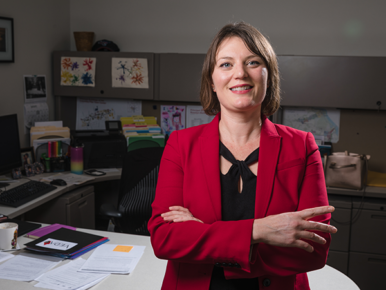
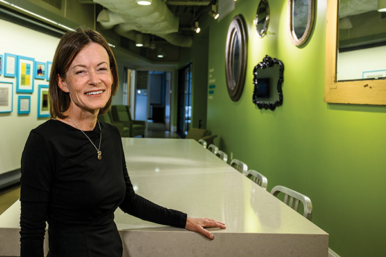
After 25 years in the transportation industry, Julie Timm went back to school to get her MBA. “I wanted to understand the business world,” explains the new CEO of the Greater Richmond Transit Company (GRTC), the region’s municipal bus system. “Sometimes when transit people talk to our business partners, it’s like we’re talking a different language.”
Formerly the Nashville Metropolitan Transit Authority’s chief development officer, Timm has already identified her priorities, including revising the operating budget of GRTC, which is jointly owned by the city and Chesterfield County.
She’s also looking to open a dialogue with area business leaders about providing annual bus passes to employees, and not just to and from work. It’s a perk that helps with employee retention, she says, and cuts down on parking concerns.
GRTC is dealing with a revenue shortage problem. The Pulse, a 7.6-mile rapid transit line initiated in June 2018, employs a Metro-type system where on-bus enforcers spot check fares. GRTC boasted a 15% increase in ridership in the Pulse’s first year, but revenue was down by $1 million, leading many to question the open fare method.
“We could close the system,” the Virginia Beach native says. “We could make it so people can’t get on stations without paying, with turnstiles, or they pay as they get on … unfortunately, that would also decrease the efficiency and time of the service.” It’s a long-running dilemma for the industry, she adds.
Public safety concerns were raised when, in October, a woman was hit and killed by a bus on the Pulse line. “It was a tragedy,”Timm says. “but the bus system has been involved in only two fatal accidents in the past 10 years. You can’t say that with the roads, or with the train network, or the air. The only way to have an accident-free system is to keep your buses in a maintenance facility, just as the only way to prevent having a car crash is never driving a car.”
Transit is on everyone’s mind, she says, referencing Virginia’s $3.7 billion agreement with CSX to increase commuter rail service throughout the state, but she advises business owners, “When you locate your business in a region, locate it near a transit line. Don’t expect transit to come to you. Transit isn’t well-funded. Putting it in areas where there isn’t current transit is hard for agencies to do.”
This is the 10th year that Virginia Business has compiled the Best Places to Work in Virginia list in collaboration with Pennsylvania-based Best Companies Group.
Nearly 200 companies applied for inclusion on the 2020 list. A hundred companies were chosen in three categories: small (15-99 U.S. employees); midsize (100-249); and large (250 or more).
Best Companies Group made its selections based on surveys conducted with the companies and their employees.
Employee surveys benchmarked companies on a list of core values: leadership and planning; corporate culture and communication; role satisfaction; work environment; relationship with supervisor; training and benefits; pay; and overall engagement.
The 2020 Best Places list, divided by category, can be found on the following pages, along with profiles of the top-ranked companies in each group.
The Virginia Talent Accelerator Program, launched last fall by the Virginia Economic Development Partnership, is set to begin its first big project in March, training an estimated 703 people to work at Morgan Olson LLC’s new plant in the Danville area at no cost to the employer.
Many will train in classrooms and the welding lab at Danville Community College, although some will train in Tennessee, according to the college. VEDP will oversee training for the first year to 18 months, and DCC will take over after that, creating a pipeline for future employees over a proposed three-year timeline, says Debra Holley, the college’s vice president of academic and student services.
“We take the people that the company hires,” explains Mike Grundmann, VEDP’s senior vice president of workforce solutions, “and we teach them how to apply their skills to the specific processes of the company.”
The largest manufacturer of walk-in delivery vans in North America, Morgan Olson plans to hire more than 350 full-time workers for its Pittsylvania County facility as soon as this summer, ultimately becoming the county’s largest private employer.
One of the major reasons the Michigan-based company decided to move its $57.8 million vehicle assembly line into the former Ikea furniture plant was the promise of employees trained on its specific technologies, says VEDP President and CEO Stephen Moret. “This is the first major project to make use of the program.”
VEDP started the accelerator program with the Virginia Community College System last year as a way to draw new business to the state.
“We’ll know more after we finish the needs analysis,” Grundmann says. “When we get the company’s processes and skill requirements together, the college will then be in position to understand the skill sets required to work at Morgan Olson. The analysis will also determine how many trainees we will need to hire on a short and long-term basis.”
“It really is a win-win for everyone,” says Alexis Ehrhardt, president and CEO of Danville Pittsylvania County Chamber of Commerce. “It’s a win for the community college, it’s a win for the employer, and it’s a win for employees who can accelerate their skills so that they can be on the job and effective immediately, and the company can be productive as quickly as possible.”
Charlottesville’s consumer tax revenues continue to grow. The city’s meals tax alone brought in more than $12.2 million last year — up 3.66% from the year before. Sales tax dollars have also increased by 2.21%, approaching $11.9 million.
Lodging tax revenue, at $5.7 million, shot up by almost 10% in a year in which the city saw 400 new hotel rooms come online.
“A year or two ago, we had an influx of hotel space,” says Chris Engel, Charlottesville’s economic development director. “Now we’re moving out of the hotel phase to a more focused commercial space phase.”
When one of Caroline County’s two banks, Virginia National Bank, shut its doors six years ago, Gary Wilson, the county’s director of economic development, wanted to do something about it. He launched a widespread effort to find a second banking institution to open a branch in Caroline, which is sandwiched between Fredericksburg and Richmond.
“I got no takers,” he says, adding that the county’s population of about 30,000 likely was not an impressive draw.
Without another bank in town, residents patronize Atlantic Union Bank, the only other bank in the county, or they drive about 15 miles to one of the nearest localities, such as Ashland. That’s especially inconvenient for retail businesses needing to make cash deposits, Wilson says.
“At this point, any new business that comes to the community, we always tell them about Atlantic Union, which is no longer a potential faux pas or conflict of interest,” he says. “It’s our only [bank].”
Caroline County’s challenges are not unlike those facing many small communities across Virginia and the nation.
Caroline is one of four largely rural Virginia counties categorized in a national November report by the Federal Reserve Board as deeply affected by bank branch closures. All of the counties listed by state, which in Virginia include Bland, Lunenburg and Surry, had 10 or fewer branches in 2012, and they lost at least 50% of those branches by 2017. About 89% of the counties named in the report are rural, containing fewer bank branches per 100 square miles than other rural counties nationally. Other Federal Reserve Banks in the country, including the Federal Reserve Bank of Richmond, had parts in preparing the report.
It’s not a secret that the number of bank branches in the state and nationwide is shrinking. Five years ago, there were 120 banks operating in Virginia, compared with 100 currently, says Bruce Whitehurst, president and CEO of the Virginia Bankers Association.
Banking experts point to a variety of reasons for this trend, from increases in bank mergers and branch consolidations to the growing use of online banking. There also are significant challenges specific to some rural communities, such as shrinking customer populations, poor broadband access and lack of adequate local talent to fill bank jobs.
“Banks are going to go where the business is,” says Brian Plum, CEO of Luray-based Blue Ridge Bank and past chairman of the Virginia Association of Community Banks. “In the banking business, it’s not just what you are going to do today but calculate what you will do tomorrow.”
‘A real gap’
Bank closures have a particularly negative impact on rural communities because in many of these areas, broadband access is limited or nonexistent, making online banking difficult or impossible for consumers.
Also, rural areas hit hardest by bank closures tend to have greater populations of older, poor and less educated people, compared with other rural communities, according to the Federal Reserve report.
The challenges surrounding bank access in rural communities are a focus for Tom Barkin, president and CEO of the Federal Reserve Bank of Richmond. In October, the bank held a conference in Harrisonburg to discuss economic and social challenges affecting the health of rural areas.
“The loss of banks creates direct costs in terms of residents’ access to financial services, but there are also large indirect costs,” said Barkin in a statement. “Anchor institutions like banks provide civic leaders and high-skilled workers who can raise the aspirations of those around them. They invest in their communities, educate others about finances, create incentives for other business and signal a community’s vibrancy.”
Take Surry County, a community of about 6,500 situated in the southeastern part of Virginia. Retired couple Dave and Diane Sheldon started a vineyard there in 2007 and moved to Surry from Massachusetts in 2010. After starting the vineyard, they opened Hampton Roads Winery LLC.
Surry had only two bank branches when the Sheldons came to the county, and one, a BB&T branch, closed four years ago. Now, Sonabank, a Virginia chartered bank with numerous locations in the state and neighboring states, is the only bank in Surry.
The Sheldons have one account with Sonabank and hold other accounts, including their mortgage, with SunTrust (now in the process of being rebranded as Truist following its merger with BB&T) — but the nearest SunTrust branches are 45 minutes away in Suffolk, Williamsburg and Hopewell. Dave Sheldon largely banks online with SunTrust, but sometimes the 45-minute drive can’t be avoided.
Banking hassles aside, Sheldon never realized at the time that he opened the wine business how little traffic would come from Surry County. Because of that, the Sheldons have been ramping up the winery’s wholesale business. In about four years, they plan to open a distribution hub — but it may not be located in Surry.
Anna Hansen, associate broker at Surry Side Realty, says the lack of local bankers for business loans and other financial services in Surry County is a problem. Also, it is especially difficult for some small business owners to get loans, largely because comparable enterprises do not exist locally, she says.
“I wish I had a ton of money to start a private bank,” Hansen says. “We have a real gap in rural communities in lending, and we have a real lack of financial literacy.”
To be sure, not all Virginia communities with few bank branches are struggling from a lack of banking options, according to some economic development and business professionals. Whitehurst says he doesn’t hear about many bank access problems in rural areas of the state, adding that community banks often do strong business in these communities.
In Southwestern Virginia’s Bland County, for instance, there are only two banks, and that doesn’t seem to be a problem for some residents, says Bland County Administrator Eric Workman. First Sentinel Bank opened a branch there in 2018 after New Peoples Bank closed its branch in 2014, citing a decreasing volume of deposits and foot traffic. BB&T (now Truist Financial Corp.) is the other branch in Bland. County residents will drive about 15 to 25 minutes to Wytheville or Bluefield for other banking options, Workman says.
Similarly, Lunenburg County, a Southern Virginia community with a population of approximately 12,000, likely could not support additional bank branches, says Glenn Millican, the county’s planner. Benchmark Community Bank is the only bank in the county, with two branches.
Nevertheless, Millican agrees that poor broadband access in the county has been “a definite deterrent to new business formation.”
‘Rural equals fewer choices’
Rural residents are accustomed to driving longer distances to access services and amenities, says Bill Baker, a broker at United Country Virginia Realty in Clarksville. Photo by Mark Rhodes
Bill Baker, a broker at United Country Virginia Realty in Clarksville, says some of his clients work with out-of-town or even out-of-state mortgage brokers. And if they have to drive 20 minutes to go to the bank, it’s not a big deal because they’re accustomed to traveling that distance for other amenities, too, he says.
“The reality is rural equals fewer choices,” Baker says.
Some community banks, like Powell Valley National Bank, are coming up with ways to bridge the digital divide with customers, often the elderly, who may not be technologically savvy. Powell Valley, headquartered in Jonesville, sends some of its clients a text message, with their approval, to notify them of important account activity, such as if a balance drops below a certain level or if a Social Security check is deposited.
“One of the things that we need to do as an industry is to continue to find ways to utilize technology for older folks, particularly in rural areas, who may not be inclined themselves to do it,” says Leton Harding, president, chairman and CEO of Powell Valley.
Even so, Millican and other state economic development officials say access to broadband is a bigger business issue than lack of bank branches in rural areas. Local governments and even Gov. Ralph Northam are working on initiatives that may improve broadband availability in these areas.
“To me, the challenge of bank branch closures is a piece of the larger puzzle of ‘how do we fix economic growth in the rural areas?’” says Plum of Blue Ridge Bank.
Meanwhile, there is growth on the horizon for Caroline County, perhaps boosting bank prospects for the future. Several large residential developments are planned and could increase the county’s population over time, Wilson says.
“It will be better for retail and banking,” he says. “We’re encouraged that the future is going to be brighter.”
Banks & thrifts
Institution
City
Phone
Website
Top executive
Va. offices
2019 deposits ($000)1
1
Capital One Bank USA2
McLean
(877) 383-4802
capitalone.com
Richard D. Fairbank
1
$77,502,585
2
E*Trade Bank4
New York; regional HQ in Arlington
(800) 387-2331
us.etrade.com
Michael A. Pizzi
1
40,745,948
3
Wells Fargo & Co.
San Francisco; regional HQ in McLean
(800) 869-3557
wellsfargo.com
Charles W. Scharf
253
35,067,748
4
Bank of America
Charlotte, N.C.
(800) 432-1000
bankofamerica.com
Brian Moynihan
121
32,506,755
5
Capital One, National Association2
McLean
(877) 383-4802
capitalone.com
Richard D. Fairbank
43
24,820,189
6
BB&T Corp. (Truist Financial Corp.)3
Winston-Salem, N.C.
(800) 226-5228
bbt.com
Kelly S. King
444
23,262,957
7
SunTrust Bank (Truist Financial Corp.)3
Atlanta
(800) 786-8787
suntrust.com
William H. Rogers Jr.
444
20,461,466
8
Atlantic Union Bank
Richmond
(800) 990-4828
atlanticunionbank.com
John Asbury
145
12,169,312
9
TowneBank
Portsmouth
(757) 391-3500
townebank.com
G. Robert Aston Jr.
32
7,173,924
10
United Bank
Charleston, W.Va.
(800) 327-9862
bankwithunited.com
Richard M. Adams
70
6,979,276
11
PNC Bank, National Association
Pittsburgh
(888) 762-2265
pnc.com
William S. Demchak
95
4,020,011
12
Carter Bank & Trust
Martinsville
(276) 656-1776
carterbankandtrust.com
Litz H. Van Dyke
76
3,178,536
13
Burke & Herbert Bank
Alexandria
(703) 549-6600
burkeandherbertbank.com
E. Hunt Burke
25
2,398,132
14
E*Trade Savings Bank4
Arlington
(800) 387-2331
us.etrade.com
Karl A. Roessner
1
1,970,498
15
TD Bank, National Association
Cherry Hill, N.J.
(800) 462-3666
tdbank.com
Bharat B. Masrani
24
1,966,651
16
Sonabank
McLean
(888) 464-2265
sonabank.com
Georgia S. Derrico
41
1,863,331
17
Citibank, National Association
New York
(212) 559-1000
citibank.com
Mary McNiff
6
1,852,000
18
First-Citizens Bank & Trust Co.
Raleigh, N.C.
(888) 323-4732
firstcitizens.com
Frank B. Holding Jr.
47
1,745,537
19
American National Bank and Trust Co.
Danville
(800) 240-8190
amnb.com
Jeffrey V. Haley
22
1,514,386
20
First Bank & Trust Co.
Lebanon
(276) 889-4622
firstbank.com
Mark Nelson
23
1,390,718
21
Citizens and Farmers Bank
West Point
(800) 296-6246
cffc.com
Tom Cherry
25
1,212,302
22
Sandy Spring Bancorp Inc.
Olney, Md.
(800) 399-5919
sandyspringbank.com
Daniel J. Schrider
15
1,191,791
23
FVCbank
Fairfax
(703) 952-3277
fvcbank.com
David W. Pijor
6
1,169,739
24
John Marshall Bank
Reston
(703) 584-0840
johnmarshallbank.com
Christopher W. Bergstrom
6
1,133,707
25
National Bank of Blacksburg
Blacksburg
(540) 951-6228
nbbank.com
F. Brad Denardo
25
1,069,940
1 As of June 30, 2019 for deposits within Virginia.
2 Subsidiary of Capital One Financial Corp. Capital One Bank is located in Virginia, but it provides banking across the U.S.
3 BB&T and SunTrust completed a merger into Truist Financial Corp. in December 2019. Both brands will publicly transition to Truist by 2022.
4 E*Trade Bank is located in Virginia, but its office provides online banking across the U.S.
Source: Federal Deposit Insurance Corp., Deposit Market Share Report, June 30, 2019
In November 2018, Virginia won big — really big — when Seattle-based Amazon.com Inc. chose Arlington County as one of two locations where it would build operations for its planned East Coast headquarters.
Virginia and New York’s Long Island City neighborhood beat out more than 230 other hopeful localities across North America that vied for the project, sending out proposals packed with economic development incentives.
A few months later, though, the news got even sweeter for Virginia after Amazon dropped plans for the New York branch, leaving Arlington as the sole locale for Amazon’s $2.5 billion second headquarters, which promises to create 25,000 high-paying jobs and add more than 8 million square feet of development to be centered in Arlington’s Crystal City, Pentagon City and Potomac Yard areas.
Amazon HQ2 is “the single biggest economic deal in history, period,” says Marian Marquez, director of Arlington Business Investment Group. Photo by Stephen Gosling
Marian Marquez, director of Arlington Business Investment Group, doesn’t mince words when she describes what that means for Arlington — and the commonwealth.
“It’s the single biggest economic deal in history,” she says, “period.”
HQ2, as the Arlington headquarters is commonly known, will not be realized overnight, of course. Amazon expects that it will take about a decade for the nascent headquarters to reach full capacity. In 2019, however, it already had established a foothold in the heart of Crystal City for what will be a steep climb ahead.
That outpost, three floors of leased space at 241 18th St. S., has been nicknamed “base camp” by Amazon in honor of it being the first location where the e-tailer planted the flag for its East Coast operational center, and its simple decor suits that moniker.
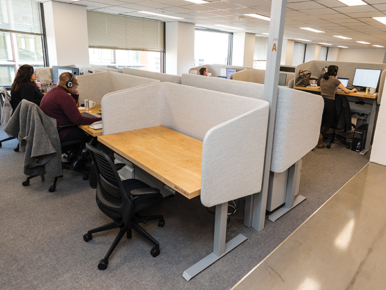
In a techie take on industrial chic, Amazon HQ2 base camp has largely unadorned walls and a monochromatic palette. Identical work stations stretch row upon row in a disorienting sameness, and meeting spaces are mostly open and austere — a cluster of stools, a simple table, a whiteboard. Privacy in this setting, so attuned to the collaborative mindset of the millennial, is provided by stepping into one of a number of soundproof booths where employees can go when they need to make private phone calls or conduct other sensitive business. The booths further provide a factor of cool in the otherwise stripped-down environment.
This minimalist design also reflects “frugality,” one of Amazon’s 14 core principles, says Amazon spokesperson Erin Mulhall. Frugality and other Amazon aphorisms — such as “It Is Always Day One” and “Invent and Simplify” — are prominently displayed in three rows of colorful circles on the wall of the base camp reception area. However, it’s the one on the bottom row, second from the left — “Think Big”— that obviously has Northern Virginia, especially Arlington County, giddy with excitement.
“Think Big” actually is quite an understatement. “Think Super Colossal” might be more on the mark.
The two towers
This mural outside the lobby of Amazon HQ2’s first office in Arlington offers a whimsical take on its “base camp” nickname. Photo by Stephen Gosling
One of the few artistic touches at Amazon’s Crystal City base camp is a whimsical mural depicting an Amazon delivery truck climbing an Everest-like mountain. An obvious nod to the outpost’s nickname, the mural is also an apt metaphor for Amazon’s unprecedented trajectory for HQ2’s development.
As noted above, Amazon initially announced its selection of Arlington and Long Island City as dual sites for its new headquarters. But Amazon pulled out of New York a few months later after encountering stiff backlash from local politicians and residents concerning — among other issues — the plan to grant Amazon nearly $3 billion in state and local tax breaks.
However, Amazon has encountered little such blowback in Virginia, where the commonwealth has promised the company more than $750 million in cash incentives in exchange for the long-range possibility of as many as 37,850 high-paying jobs at HQ2, although the e-tailer has committed only to filling 25,000 positions during the 2020s. Virginia also has pledged to invest $1 billion in a tech-talent pipeline to boost the number of in-demand computer science graduates from state universities.
In 2018, Gov. Ralph Northam said that, altogether, the commonwealth would be spending up to $2.5 billion on Amazon-linked investments in education, transportation and affordable housing. Arlington County has added to the pot by proffering a $23 million pay-for-performance grant (paid in annual installments over 15 years), plus $28 million in tax-increment financing (paid over 10 years).
One final impediment to Amazon’s HQ2 plans remained, however: A change in zoning was required to allow construction of Amazon’s proposed twin, 22-story office towers in Crystal City. The proposed 2.1 million square feet of space represented a 600,000-square-foot increase over the previously allowed density. The matter was resolved in December, after the Arlington County Board voted to allow HQ2 to move forward in exchange for Amazon’s promise to contribute a record-setting $20 million for affordable housing. (Arlington residents have raised concerns about the e-tailer’s arrival pushing local real estate prices out of reach for working families.)
At that same board meeting, Amazon also moved quickly to settle a kerfuffle that had arisen involving construction workers who were alleging payroll fraud and misclassification of jobs. Amazon fired the contractors involved in the dispute. Amazon’s global vice president of real estate and facilities, John Schoettler, told the board members, “I will tolerate absolutely none of this going forward, and people on my team will be held accountable.”
Staging at base camp
With that final hurdle overcome, Amazon now is gearing up to make its steep ascent in Arlington.
The 88,000-square-foot base camp office opened barely more than six months ago, and by the end of December Amazon had more than 400 employees in Arlington.
Amazon began hiring the first employees for HQ2 in September 2019. By the beginning of January, the company had hired more than 400 workers. Photo by Stephen Gosling
HQ2 hires will include programmers, software developers and specialists for the company’s Amazon Web Services cloud computing subsidiary as well as consumer-focused initiatives such as its Alexa virtual assistant. But the online Leviathan also will be needing many employees in fields across the business spectrum, including consumer affairs, advertising, law, finance and public relations, says Brian Riley, head of Amazon’s recruiting programs and strategies for HQ2.
Riley anticipates making 1,500 to 3,000 hires annually from now through the foreseeable future. With eye-popping figures like that, it shouldn’t come as a surprise that 6,000 people attended an Amazon HQ2 job-information day the company held back in September.
“The richness of the talent pool here helps us build something from the ground up,” Riley says. The company already employs 10,000 workers in Virginia across its various distribution centers and offices, he adds, “and we are engaged very heavily in having fewer barriers to bringing in local talent.”
Right now, Riley says, about half of the company’s new hires have been from the Northern Virginia region, but that could increase as Amazon builds more bridges to the region’s educational institutions.
To facilitate that, Amazon is seeing ways to help cultivate the workforce talent it needs across a broad group of Virginia schools, nurturing interest not only among college students but at the middle school and high school levels, too.
In addition to meeting with state education officials and higher education leaders, Amazon’s head of workforce development for HQ2, Ardine Williams, has also been working on outreach efforts with local public schools’ superintendents and has hosted children’s education events at Amazon’s Washington, D.C., office to promote teaching computer coding skills to kids.(See interview with Williams.)
After all, Williams points out, kids who are in fifth or sixth grade now are the future college graduates Amazon will be seeking to hire for HQ2 by the end of the decade. “Making sure that there are adequate numbers of teachers, and teachers who are digitally literate and providing technology in an integrated way in the classroom, is incredibly important to us,” she says.
Ascending to new heights
In a touch of kismet, the number of employees Amazon ultimately will bring to Crystal City is roughly equivalent to the number of jobs lost in the area due to the federal Base Realignment and Closure of 15 years ago.
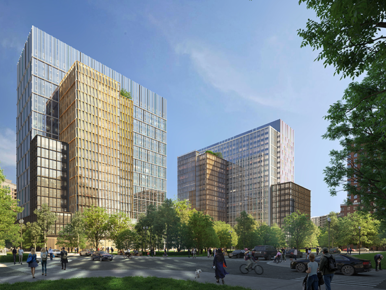
In December 2019, Arlington County granted the final approvals for Amazon HQ2’s planned twin 22-story towers, depicted in this rendering. Courtesy Amazon
Of course, all these new employees will need someplace to hang their hats and, in late December 2019, Amazon began its physical expansion beyond base camp, moving into 191,000 square feet of renovated leased space at nearby 1800 S. Bell St. That building is owned by developer and property manager JBG Smith Properties, which is leasing multiple spaces to Amazon as well as constructing HQ2’s twin office towers.
In its news releases, JBG Smith, which owns a whopping 6.2 million square feet of space in Crystal City, Pentagon City and Potomac Yard, has been rebranding the HQ2 area as “National Landing.” It’s even launched a website, nationallanding.com, which describes it as a “newly defined interconnected and walkable neighborhood.” Perhaps out of sensitivity to local feelings, Amazon is staying agnostic on the National Landing moniker, though. Spokesperson Mulhall says only that “the name is being championed by other groups.”
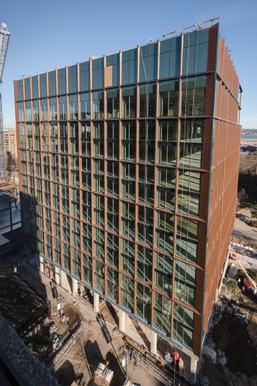
By the end of 2020, Amazon plans to lease all 14 stories of this building under construction by owner JBG Smith Properties at 1770 Crystal Drive. HQ2 will include leased space in addition to the two towers Amazon will own. Photo by Stephen Gosling
Meanwhile, Amazon additionally is slated to occupy JBG Smith’s extensively renovated, reskinned 14-story building at 1770 Crystal Drive by the end of this year. “We’re taking the whole building,” Mulhall says. Lease space is part of Amazon’s overall plan for its East Coast campus in addition to the two towers, which it will own.
Work is scheduled to begin this year on the centerpiece of HQ2, the 6.2-acre Metropolitan Park site where the towers will be raised. It’s now mostly occupied by defunct warehouses and parking lots — some surrounded by white painted fences emblazoned with cheery Amazon admonishments such as “Judge Less” and “Breathe.” Brightly colored bicycles with fake flowers woven into their spokes hang from the fences, adding an artsy touch.
The e-tailer’s plans for the Metropolitan Park site emphasize its commitment to community outreach. It will invest $14 million to double the size of a one-acre swath of green space already in place there, adding amenities such as wide sidewalks and public artwork. (Amazon is contributing $225,000 to the Arlington County Public Art Fund.) HQ2 also will include a 700-person meeting center and a 160-slot daycare facility, both open for public use, and an underground parking facility of nearly 2,000 spaces.
Bus shelters, bike lanes with protective curbing and 600 parking spaces for cyclists are also in the mix, as well as space for a farmers market and a dog park. All Amazon offices are dog-friendly, Mulhall says, adding that “up to 7,000 dogs come to work at Amazon every day.”
To further facilitate interaction with its neighborhood, the street-level floors of both HQ2 towers will be given over to 69,545 square feet of retail space, with HQ2 lobbies relegated to the second floors. The towers, which together eventually will house 12,500 employees, are set to open in 2023.
For a company with one of the most ubiquitous and recognizable logos on Planet Earth, it’s notable that the HQ2 towers will have a conspicuous lack of external Amazon branding. It’s an approach the company also follows at its Seattle headquarters, known for its distinctive trio of spheres.
The HQ2 towers will be LEED Platinum-certified and 100% powered by energy produced on-site or through credits obtained from external renewable energy sources. The towers will feature 13 green roofs and terraces, with one building trimmed in blue and the other in red in a stepped-back design intended to minimize the shadows cast over the streetscape.
Plans for 4.2 million square feet of additional Amazon office space at the 10-acre Pen Place site in Pentagon City are expected to be fleshed out this year and come to fruition in 2025.
Buoyed by Amazon’s massive commitment to HQ2, JBG Smith intends to redevelop about 2.6 million square feet in the area, including erecting five residential buildings and an office tower. A new entertainment and shopping complex anchored by a 49,000-square-foot Alamo Drafthouse Cinema is one of the developer’s priorities. Although Crystal City was once an entertainment wasteland, one of the main thoroughfares in the area, Crystal Drive, now is lined with eateries ranging from fine dining establishments such as chef José Andrés’ Spanish restaurant, Jaleo, to fast-casual emporiums such as Sweetgreen and Chick-fil-A.
The Arlington Chamber of Commerce and the Northern Virginia Economic Development Alliance forecast that all the development attendant to HQ2 will create more than 47,000 direct and indirect jobs.
As one might easily surmise, Arlington County is loving all of this.
Since the Amazon announcement, Marquez says, the county has been getting cold calls from companies around the globe that hadn’t previously considered Arlington. The county’s small-business program has been “slammed” with inquiries too, she says, from companies eager to partner with Amazon.
“People don’t realize the work that Amazon does with small businesses,” she says.
As to the future, Marquez expects “more and more momentum to come.”
“This,” she says in an understatement, “is pretty exciting for everybody.”
After a long, successful tech career working as an executive for companies such as Hewlett-Packard and Intel Corp., Ardine Williams was entitled to rest on her laurels.
It didn’t last long.
Five months into her 2014 retirement, Williams was recruited by Amazon.com Inc. to run global talent acquisition for Amazon Web Services, overseeing the hiring of 23,000 employees for the e-tailer’s rapidly growing cloud computing subsidiary.
She’s now Amazon’s vice president of workforce development for HQ2, responsible for building the 25,000-person workforce the company will need during the next decade at its $2.5 billion East Coast headquarters currently under development in Arlington.
Williams is clearly a true believer in Amazon: Two of her three grown children — her daughter and one of her twin sons — work at Amazon’s Seattle headquarters.
Since Amazon’s late 2018 announcement that it was locating HQ2 in Virginia, Williams has become a recognizable figure in the commonwealth, representing Amazon at a variety of events, including a Southwest Virginia listening tour held with Gov. Ralph Northam to promote workforce development. Last September, she offered advice to a crowd of thousands of hopeful job seekers at an outdoor career fair Amazon held in Arlington, counseling applicants to become familiar with Amazon’s leadership principles, which include thinking big, earning trust and delivering results. And in November, she delivered the keynote address at George Mason University’s Annual Symposium of the Journal of Law, Economics & Policy, discussing the gig economy.
Virginia Business spoke with Williams in December about Amazon’s collaborations to strengthen Virginia’s tech-talent pipeline and her journey from Army Signal Corps veteran to high-profile executive in charge of workforce development for what state officials have called the largest economic development project in the nation.
Virginia Business:You’ve really been the public face of HQ2. Did you know the job was going to be this visible?
Ardine Williams:I would say I’m one of many faces. There’s an awful lot of folks involved. I think that my work on workforce has had some visibility because we are adding, over the next 10 to 12 years, 25,000 [employees] but I would say there are certainly lots of other folks engaged in the effort.
VB:What sort of jobs will these HQ2 employees be performing?
Williams:We expect that this site will reflect a true headquarters-type population. What we mean by that is a couple of things: One is, the split in Seattle, as well as at our larger sites, tends to be about half tech [workers], half non-tech [workers]. The second piece is that we expect that we will have entire teams here rather than being a hub, if you will, where people choose to work. … This will be entire teams. The Alexa Skills Team that’s here is a great example. There’s a vice president running that business and he’s growing his team here. What that means is you [can] afford employees at the site greater career opportunities because there’s a richer variety of jobs at different levels.
VB:The state government has offered additional incentives for Amazon to deliver 12,000 more HQ2 jobs during the 2030s, for a total of more than 37,000. Is that something that’s on your radar?
Williams:It’s included in the agreement, and so, as the business grows, we’ll see where we are as we progress.
VB:Who have you been engaging on your listening tours and what have you been hearing?
Williams:The conversations have been with a wide range of folks, from state and local officials, school superintendents, chambers of commerce, not-for-profit organizations, so really the gamut of folks. … I think what we’re hearing has confirmed, No. 1, that the reason we came to Virginia was the talent. It’s very clear that this is a state that has a rich talent pipeline and is very much committed to continuing to grow and develop that pipeline. Then, the second piece is that there’s a great collaborative effort on the ground in a lot of locations between high schools, community colleges and four-year institutions. That’s really important because that collaboration is really what helps to ensure that students are getting exposure to emerging skills and getting the education they need to be job-competitive.
VB:How will Amazon be working with higher education to produce that skilled workforce?
Williams:Between 80% and 85% of the hires that we make have technical degrees, primarily computer science and computer science engineering. I think that that’s an important context to have because it informs a lot of the work that we do at the school level. As we engage with both two- and four-year schools, we look at a number of things. One is to help them understand where we’re seeing technology going. We have a program, for example, called AWS Educate, which is focused very specifically on cloud computing. … Northern Virginia Community College and George Mason University have a full cloud-computing degree, and that’s actually going to be more widely adopted across the state. Those are examples of where we take the expertise that we have, which is on the technical side in emerging technology, and then partner with experts and pedagogies who already have robust programs, and help create and craft programs that really prepare students for those leading-edge technology jobs.
VB:Will Amazon have input in crafting curricula at some of the universities?
Williams also has been in charge of Amazon’s Career Choice program, which helps hourly employees pursue certificates and degrees in high-demand fields such as commercial truck driving, health care and information technology. Photo by Will Schermerhorn
Williams:Yes, and it isn’t just Amazon; it’s a collaborative partnership. One of the things I would say is really exciting about the region is the level of collaboration that already exists. The Greater Washington Partnership, for example, is a great convener. And through that partnership, a number of four-year institutions and two- and four-year higher-ed institutions have gotten together under a subset called the [Capital] CoLAB and built credentials. For example, there’s one now for data analytics. Businesses got together, and [former Northrop Grumman CEO] Wes Bush … actually chaired the group. We sat down and said, “OK, everyone needs data analysts. What are the knowledge, skills and abilities, or KSAs, that we need?” And we had a lot of debate because I want tomato, you want to-mah-to, and at the end of the day, it’s really tough for schools to respond if everybody wants something a little different. It was great because we got together, as a collaborative group, and said, ‘‘This is what’s important.’’ The schools then were able to take that input and look at the coursework that they already had. Some have chosen to do it as electives. For some, it’s a minor. For others, it’s embedded in existing curriculum. Then, the businesses have agreed that those students who attain those credentials will be fast-tracked for a résumé review and interview for internships with our company. Then, we have the opportunity based on how those candidates perform … to provide that feedback to continue to improve the certificate program.
VB:What’s your background? How did you go from being a U.S. Army Signal Corps captain to where you are now?
Williams:It’s probably a beer conversation [laughs]. I had the distinct privilege of working in technology in the Signal Corps. I came on active duty just a couple of years after the Women’s Army Corps was integrated. The Signal Corps, at the time, there weren’t a lot of women, but I had the opportunity to do a lot of training at Fort Gordon, and I ended up being attached to DARPA [the Defense Advanced Research Projects Agency].I worked on operational tests and evaluation of these really leading-edge systems called “Global Positioning System,” something called “Mobile Subscriber Equipment,” which was a 50-pound cell phone, and spread spectrum radio. I had some tech training in my undergrad degree, I knew how to program, but that exposure early on to technology really helped me a lot because, in spite of a liberal arts degree, it really opened roles for me that might not have otherwise been opened. I worked in a wide variety of things, from technical writing to engineering, project management, marketing management, IP acquisition, in corporate venture capital, M&A, and then, on a leadership development role, I was rotated into HR. I’ve done a wide range of roles in HR. And then I retired.
VB:So how did you end up at Amazon?
Williams:I was in Palm Springs, California, sitting on my patio and I got a call from a headhunter who said, “Hey, I want to talk to you about this job.” I always think it’s good karma to talk to headhunters. … I tell people, I trade a day of my life every day I come to work, and the math has to work by and large, and so, it’s always good to have those conversations. I said, “You know what? I’m sitting on my patio, I’m looking at the San Jacinto Mountains, I’m sipping a martini, I’m not going back to work.” And she said, “Before you tell me no, I think we should talk.” I said, “You know, I’ll share my Rolodex with you.” And she said, “It’s Amazon Web Services.”
I’ll be honest with you: I set down my glass because I knew that Amazon Web Services was fundamentally changing the equation for business because it was shifting capital to expense. And when you shift capital to expense, particularly in startups, it’s liberating. Because now, instead of taking a significant amount of hard-earned investment dollars and putting it toward capital, which, it gets frozen in capital, they have the opportunity to leverage an IT infrastructure and applications to build out their business and conserve capital.
And so, I went up to Seattle on a lark and I interviewed. I was sure there was no way that I was going to get hired because it was probably one of the toughest interviews I had ever done. And then I called my husband after the second day and I said, “Hey, they’re not going to hire me, but if they do make me an offer, we’re going to have to talk about it because this place is really pretty amazing.”
And here I am.
VB:How did you get the gig for HQ2?
Williams:I started out leading talent acquisition for AWS. Then, I moved over to our operations team, which is basically — if you think about from clicks to doorstep when you order on our website, that’s our operations business. I was doing a lot of back-office work, so really building HR reporting capability. I led our Career Choice program and a variety of other pieces. And a colleague called me up after the [HQ2] announcement, and I was actually on my way to Europe, and [they] said, “Hey, we’re going to New York, and it’s important that we have somebody that’s well-versed in workforce and upskilling. Do you think you could come and cover a couple of meetings for us?” And I said, “Yeah, I’ll do it on my way back from Europe.” And I went to a couple of meetings, and they said, “Hey, can we borrow you for a week?” And then, “Can we borrow you for a month?” And then, “Can we borrow you for three months?” And then I talked to my boss and said, “I’m not doing anybody any favors by having my feet in both jobs.… We probably need to make a decision here.”
So the couple of meetings turned into the job, basically.
VB:In this low-unemployment market, a lot of businesses say it is very difficult to find good workers at the moment. Is Amazon also concerned about that?
Williams:I think anybody who’s not worrying about it right now is probably either telling you a story or not really thinking about it. We have the luxury of having, I think, brand recognition and being a large employer. Just to give you an example, we hire, on average, more than 300 people each day [globally], but that doesn’t mean that it isn’t difficult. It’s a very competitive market. It’s a great market right now for people who are looking for work because they have choices and they have opportunity. That means that as we engage with people, we need to make it very clear what it’s like to work here, what Amazon has to offer.
Our career day that we held two months ago was a great example of that. It was an opportunity for people to come and really learn about the company, to meet with other employees, to meet with recruiters, to understand just what Amazon is about. It’s things like that that help us continue to engage with candidates and help them understand why Amazon is an exciting place to work.
VB:You’ve also encouraged Amazon to hire military veterans, correct?
Williams:One of the things that I’m personally most proud of that I’ve done at Amazon was I built our apprenticeship program. When I was in Amazon Web Services, one of the things that we found was that veterans were an incredibly good cultural fit, but really didn’t meet the technical bar. …. We started with a pilot [apprenticeship program with the Department of Labor] in 2017, a cohort of 15. And last month, we welcomed our 600th apprentice into the program. … They’re in areas like cloud computing, data center operations, advanced manufacturing, the kinds of things that you wouldn’t typically associate with an apprenticeship. When you say “apprenticeship” to people, particularly in the U.S., they tend to think about the skilled trades, but we did an apprenticeship in software development engineering, for example, and cloud support associate solutions architect. They’re really focused on leveraging the best of that program … and taking folks who are a great fit for Amazon culture and giving them that technical uplift that they need in order to become really strong, contributing employees.
Virginia universities are getting ready for Amazon.com Inc.’s arrival, which will require the schools to produce thousands of computer scientists and engineers during the next two decades.
In November, Gov. Ralph Northam announced the Tech Talent Investment Program, which allocates $16.6 million to 11 state colleges and universities to help graduate 31,000 more computer science degree-holders by 2040. With Amazon planning to hire about 25,000 people during the next decade to work at HQ2 in Crystal City, the program will fulfill Virginia’s promise of a well-educated workforce.
But at the same time, universities will feel more pressure to hire qualified faculty when less than 5% of science and engineering graduates nationwide are receiving doctoral degrees, according to the U.S. Department of Education. Nonetheless, George Mason University and Virginia Tech plan to hire dozens of computer science and engineering educators this decade, without sacrificing industry experience or educational standards.
Tech expects to hire 25 more graduate-level faculty members for its Alexandria-based Innovation Campus by 2030, but the main thrust is in Blacksburg, where the university plans to double the number of computer science faculty to 80 or 90 during the next eight years.
Also, says Cal Ribbens, head of Tech’s computer science department, “there’s a ripple effect in the undergraduate level all across campus.” Increased computer engineering enrollment will require more math and physics faculty, he adds.
GMU, meanwhile, has already seen a spike in students in computer-related majors, with its engineering enrollment doubling since 2012. Mason has hired 91 full-time engineering faculty members since 2015 and anticipates hiring 100 more educators during the next five years.
Both schools have similar recruitment and retention approaches: offering competitive salaries and selling applicants on location and opportunities.
“We plan to do everything we can to be very aggressive,” says Ken Ball, dean of GMU’s Volgenau School of Engineering. “It is very competitive.”
Some money will come from state funds; TTIP is allocating $7.3 million to Virginia Tech and $3.2 million to GMU, and Tech expects to tap into the $20 million Commonwealth Cyber Initiative fund. Mason uses research funding to provide stipends to make faculty salaries more competitive, Ball says. But private donations to create endowed faculty positions are also critical.
“Virginia Tech is always working to engage with supporters whose philanthropy makes endowed professor positions possible,” Ribbens says.
During her 13 years of practicing law, Christy L. Murphy has been called “honey” and “sweetie” by older men when they were adversaries in legal cases.
“This is an old boys’ network,” says Murphy, 40, a partner at Bischoff Martingayle in Norfolk. “It’s hard to get people out of the mindset.”
Law firms are modernizing technology, cybersecurity and training, she says, “but many lack a concerted effort to modernize thinking about how to address and treat employees from a glass-ceiling perspective.”
Somepeople don’t think a glass ceiling exists; others think it’s no big deal, Murphy says, adding that she has encountered no issues at Bischoff Martingayle. “We are treated equally here, and other firms could learn from my current firm.”
Data show divergent courses — “stunning in their disparity” — for men and women in the legal profession, according to a recent report by the American Bar Association that explores why an alarming number of experienced women lawyers are leaving the profession.
Glass ceilings persist
More than 50% of law school graduates are women, but they represent less than 25% of equity partners in the Am Law 200, a ranking of the 200 largest U.S. firms, according to the ABA’s November 2019 report, “Walking out the Door,” by Roberta D. Liebenberg and Stephanie A. Scharf.
“Why the massive gap?” the authors write. “Why have women been fleeing law firms and the legal profession in droves?”
Female attorneys are as intellectually challenged in their work as men, according to the report, but they do not advance along the same trajectory. They report having less access than their male counterparts to the building blocks of success. In particular, female attorneys cite being overlooked for promotions, salary increases and business development opportunities.
Despite efforts by law firms to address such discrepancies, including endorsing women’s initiatives and creating women’s leadership networks, glass ceilings persist.
When it comes to the practice of law, gender is irrelevant, Murphy says. “If you’re dedicated, prepared and do really good work for your client, those are the things that make you successful in your career.”
Murphy is grateful for the senior female attorneys who came before her. “The path was forged for us,” she says, “and that path was much harder.”
While women continue to be underrepresented in management and equity positions, they are making headway.
Work-life balance
Monica T. Monday has been the managing partner at Gentry Locke Attorneys in Roanoke since 2013. Photo by Don Petersen
Monica T. Monday, managing partner of Gentry Locke Attorneys in Roanoke, was the first female lawyer to lead a large law firm in Virginia — a position she has held since 2013.
Other female partners have followed suit since then: Margaret Hardy, president of Sands Anderson and managing shareholder of its Fredericksburg office, and Courtney Paulk, president of Hirschler in Richmond.
But their numbers are few, considering that women have been entering the legal profession in large numbers for the past four decades.
“I can’t speak for everyone — only to my personal experiences,” Monday says. “I hope my story will show how all lawyers — whether women or men — can carve their own paths.”
Monday, 53, started at Gentry Locke in 1993 as a full-time lawyer and became a partner within six years.
When the opportunity arose for ownership, she was pregnant and her commute to Roanoke was more than one hour each way.
Monday’s son was born in 2004, the same year she became an owner. She worked part time and from home at least one day a week.
“The arrangement enabled me to balance my life,” Monday says. “The firm gave me the flexibility to do what would work for me.”
She was provided leadership opportunities, including serving as chairwoman of several committees, before advancing into management.
Firms invest time and resources to develop their employees, Monday says. “They do not want to lose lawyers.”
Attorneys should also ask for what they need to be successful, Monday says. “It’s important for law firms to be open and receptive to the needs of individual attorneys, male and female.”
The gender issue has been plaguing the profession for too long, she says. “In the 25 years I have been practicing law, it’s been the same conversation.”
Monday recalls speaking years ago with a senior female attorney who was lamenting the fact that women were leaving the profession.
To this day, that attorney’s words echo in Monday’s head: “We fought for you. We fought for you to be able to succeed.”
The trailblazers were women who graduated from law schools in the 1950s, 1960s and early 1970s.
Ruth Bader Ginsburg, 86, the second of only four female justices to serve on the U.S. Supreme Court, was rejected for a clerkship in her early years because of her gender.
“We have come a long way,” Monday says. “We need to have open conversations about how we can make this work for everyone.”
Mom or management?
Monday’s experience is unusual, says Alison M. McKee, an attorney at Kaufman & Canoles in Virginia Beach.
“Monica is a mom and a managing partner, but that is more the exception than the norm,” McKee says. “I don’t see a lot of women in top management or on executive committees.”
“I don’t see a lot of women in top management or on executive committees,” says Alison M. McKee, president of the Virginia Bar Association. Photo by Mark Rhodes
McKee, 59, started practicing law at Hunton & Williams (now Hunton Andrews Kurth) after graduating from the University of Virginia School of Law in 1984.
She considered leaving the firm after her second child was born, but she worked part time and became a partner in 1993. “Hunton & Williams was extremely flexible and willing to work with me,” recalls McKee, who resumed a full schedule but withdrew as a partner in 1996 after the birth of her third child. The firm encouraged her to stay on a part-time basis.
By the time her fourth child was born in 2001, her life was out of balance. She resigned and stayed home for five years to rear her two girls and two boys.
“Our profession is driven by numbers,” McKee says. To advance at large law firms, associate attorneys typically are required to hit 1,800 to 2,000 billable hours a year — “that’s a lot of hours” — and bring a targeted number of new clients to the firm.
“Because our jobs are so time-intensive and there are only so many hours in the day, especially when you’re taking care of kids, it’s hard to hit those numbers.”
McKee returned to work at Kaufman & Canoles in June 2008. President of the Virginia Bar Association, she will be only the fourth woman to hold the job in the trade group’s 132-year history.
McKee advocates alternative paths to leadership to create more gender equity. “Sometimes numbers don’t tell it all. Someone may meet the numbers but not have the best judgment to be a good manager. The numbers often tell a lot but you have to look at the bigger picture.”
Flexibility is key
Joy Fuhr, an equity partner at McGuireWoods in Richmond and national chair of the firm’s Women’s Lawyers Network, says she was able to navigate her career with the help of a nanny and a flexible work schedule.
“I haven’t done a heck of a lot else besides family and law for the past 25 years. I try to do those two things at a high level,” says Fuhr, 57.
Fifty percent of the top-tier income earners at McGuireWoods are women and 35% are department chairs, she says. The firm has an 80% retention rate of women who go through leadership training.
“Our numbers reflect our efforts,” Fuhr says. “The more diverse opinions and different perspectives, the better the overall results.”
Woody Fowler, CEO of Williams Mullen in Richmond, says recruitment, promotion and retention of female attorneys are priorities. The firm’s composition needs to reflect the communities and clients it serves, he says.
Williams Mullen has adopted family-friendly policies, including flexible work arrangements, and is revisiting how it can better help attorneys transition back to work after family leave, Fowler says.
Women partners hold about one-third of leadership positions at Williams Mullen, on par with the national industry average. But “we aspire to be better than average,” Fowler says.
Gender disparities most often arise in compensation decisions, says Ann Sullivan, founder of Sullivan Collins Law Group in Norfolk.
The boutique employment law firm was founded in 2013 for women attorneys looking for a better work/life balance and for those returning to work after a hiatus.
Pay discrepancies are not endemic to the legal profession, she says, but they are widespread among industries.
Sullivan supports open — not confidential — discussions about compensation to promote equity. Paid parental leave and flexible maternity and paternity leave would help stabilize pay inequities, she says.
According to the ABA’s “Walking out the Door” report, experienced female attorneys cited caretaking commitments as the top reason why they leave their firms.
“I know what the statistics are; I know what the pressures are,” says Cassandra “Sandy” C. Collins, a litigation partner at Hunton Andrews Kurth in Richmond.
Gender disparity never occurred to her when she was recruited fresh out of law school in 1989 to what was then Hunton & Williams.
“I’m a small-town girl,” Collins says. “I grew up in a town of 400 in eastern Kentucky. We had no lawyers in my family. My parents raised me to believe I could accomplish anything I put my mind to.”
The firm had four female partners when she started. Now close to a quarter of those attorneys, or about 90, are partners. Collins made partner in 1997.
“I fell into a practice with two fabulous male mentors,” she says. “I’ve had an incredible 30-year journey.”
The practice of law is challenging, regardless of gender, Collins says, but it’s tougher for women. “There hasn’t been as much progress and it hasn’t happened as quickly as we would like.”
What if they held a recession and no one showed up?
Last summer, economic experts began ringing warning bells of an impending downturn, as evidenced by an inverted yield curve of short-term Treasury bills vs. long-term Treasury notes. And when one combined the inverted yield rate, said to be perhaps the most accurate predictor of recessions, with the Trump administration’s ongoing U.S.-China trade war, it was enough for many financial writers to begin drafting obits for the current bull market.
And then a funny thing happened.
Or, rather, didn’t.
“Those factors that would ordinarily cause one to be concerned about a recession have dissipated,” observes Christine Chmura, CEO and chief economist for Richmond-based Chmura Economics & Analytics. “The yield curve is no longer inverted because the Federal Reserve reduced short-term interest rates. [And] the China concerns seem to be resolving.”
In fact, we’re now more than 10-and-a-half years into the longest economic expansion in U.S. history.
Yet, at virtually the same time in mid-January that President Trump signed the first phase of a new trade deal aimed at dialing back tensions with China, Forbes and other financial publications were once again warning readers about a potential 2020 recession. Factors this time included a recent Deloitte survey in which 97% of the nation’s chief financial officers predicted a recession this year.
However, the Virginia economic experts with whom I’ve been talking say that’s bull. (Pun intended.)
“I don’t see anything in the economic data that says we better buckle our seat belts,” says Bruce Yandle, a distinguished adjunct fellow at George Mason University’s Mercatus Center.
Lisa Sturtevant, chief economist for the Virginia Realtors association, says that, despite hearing “little rumblings of concern” in the media, “I’m pretty optimistic for the state’s outlook in 2020.”
She and Yandle are joined by Virginia Tech Professor of Investment Management Raman Kumar in saying there won’t be a recession this year. “If you had talked to me in March or April 2019, I would have been a lot more pessimistic,” Kumar allows.
And Chmura? She thinks the economy is solid for at least another two years.
Here are some of the points they mentioned:
Consumer confidence looks good
The U.S. consumer confidence index has remained high and that’s critical, Chmura says, “because consumers are 70% of the economy. Whenever they get nervous, that might be a sign that something is going to take a turn.”
It’s true that Target and some other traditional retailers posted disappointing holiday earnings, but financial analysts say that has more to do with competition from online shopping and services than any real dip in consumer spending or confidence.
The economy is held back by politics
The Trump administration predicted 3% growth in annual real GDP growth for 2019, but politically driven factors hampered that goal, keeping the economy closer to 2% for the year, Yandle says. The early 2019 federal government shutdown, the longest in U.S. history, had a negative impact, he says, as have trade wars with China and other nations, which harmed U.S. exports and manufacturing. Trump immigration policies have also tightened the labor pool, Yandle adds.
Unemployment is down;
wages are up
Growth has slowed a little bit, experts say, and we can probably expect that 2020’s growth will be a little less than 2019’s, but that’s mostly due to the fact that unemployment is so low, driving wages up and making workers harder to find.
Virginia has a buffer
Even in the unlikely event of a 2020 recession, Virginia’s in a strong position to weather a crisis. Not only have we seen recent significant economic development announcements from companies like Amazon and Microsoft, but our strong federal contracting community “tends to insulate us from economic recession,” Sturtevant says. “When the nation goes into a recession, Virginia tends to benefit [because] the federal government ramps up spending.”
Nothing’s guaranteed … or inevitable
While we can’t predict events such as wars or terrorist attacks that could have an adverse impact on the economy, there also isn’t an expiration date on good times, Chmura and Sturtevant say. The 2001 and 2008 recessions were caused by factors such as the dotcom and housing bubbles that are absent now.
“The truth of the matter is you need to have something to precipitate an economic downturn,” Sturtevant adds. “Australia hasn’t had a recession in 29 years, so it doesn’t have to happen.”
Manage Consent
This website uses cookies, web beacons, pixels, tags, software development kits, and related tracking technologies, as described in our Privacy Policy and Cookie Policy, for purposes that may include website operation, analytics, analyzing site usage, enhancing site navigation optimizing a user's experience, and third-party advertising or marketing purposes. Through these technologies, we and certain third parties may automatically collect information about your interactions with our website, such as your browsing behavior and page views. We also may share this information about your activity on our website with our social media, advertising, analytics, and other business partners. By clicking “Accept All”, you consent to the use of these technologies and that we can share information about your activity on our website with third parties in accordance with our Privacy Policy and Cookie Policy. If you do not agree with our use of non-essential tracking technologies, please click “Reject All.” You may opt out of certain non-essential technologies by clicking “Cookie Settings.”
Functional
Always active
The technical storage or access is strictly necessary for the legitimate purpose of enabling the use of a specific service explicitly requested by the subscriber or user, or for the sole purpose of carrying out the transmission of a communication over an electronic communications network.
Preferences
The technical storage or access is necessary for the legitimate purpose of storing preferences that are not requested by the subscriber or user.
Statistics
The technical storage or access that is used exclusively for statistical purposes.The technical storage or access that is used exclusively for anonymous statistical purposes. Without a subpoena, voluntary compliance on the part of your Internet Service Provider, or additional records from a third party, information stored or retrieved for this purpose alone cannot usually be used to identify you.
Advertisement
The technical storage or access is required to create user profiles to send advertising, or to track the user on a website or across several websites for similar marketing purposes.

 Sign In
 Free Newsletter