This year was expected to be a rough one for employers, following predictions of a coming tidal wave of costly employee lawsuits and labor complaints powered by the COVID-19pandemic and last year’s racial justice protests.
So far, though, that onslaught of litigation hasn’t materialized. Why not? Partly because the pandemic itself closed courts for months last year in Virginia, so there is a backlog of litigation to work through, say employment attorneys. And lawyers for employers and employees are waiting to see how the courts rule in any active employment-related lawsuits to help them figure out legal strategies. Plus, there are new state and federal laws to sort out.
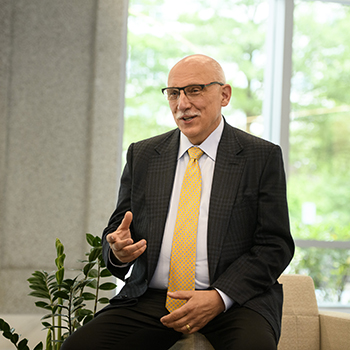
A wave is likely still coming, though, say employment attorneys, so businesses shouldn’t let their guard down. “While the sky is not falling, I still think there’s a lot of risk for employers,” says Todd Leeson, a partner at Roanoke-based Gentry Locke Attorneys.
For one thing, many employers have gone from offering incentives for vaccinations to mandating that their employees get vaccinated. And while courts have generally been upholding an employer’s right to issue employee vaccination mandates, Leeson says, there are legitimate exceptions that can be carved out for health issues and religious beliefs and that can create some room for disputes around a hot button issue that can trigger strong emotions.
“While the sky is not falling, I still think there’s a lot of risk for employers,” says Todd Leeson, a partner at Roanoke-based Gentry Locke Attorneys. Photo courtesy Gentry Locke Attorneys
“I do think the folks who are not vaccinated who perceive that they’re being singled out unfairly are going to challenge that if they end up getting fired,” says Leeson, who represents companies and employers in labor and employment cases.
Another reason businesses haven’t yet seen the predicted wave of litigation is Virginia’s particular business and legal culture, says Alexandra Cunningham, a Richmond-based partner with Hunton Andrews Kurth, who co-heads the firm’s products liability and mass tort litigation practice group. Virginia juries generally aren’t that tort-friendly, she says, and the state’s purple-shaded politics means less chance of conflict between courts and state policymakers. Virginia also has a less vulnerable workforce than other states, offering more white collar jobs that allowed work-from-home options, she says.
“I also think frankly we had a pretty strong [state] response to the virus, so we don’t have some of the issues that states like New York had,” she says, adding that better control over the pandemic generally means fewer lawsuits. “And we were late to have a surge and the guidance was already in place.”
According to a national database maintained by Hunton Andrews Kurth that tracks state and federal litigation involving COVID-19 claims, the most litigious state, California, had 2,018 pandemic-related legal complaints from January 2020 through July 2021. New York was second, with 1,743 pieces of litigation. During the same period, Virginia tallied just 135 pandemic-related complaints.
Even nationwide, the pandemic litigation count shows no surge in 2021, according to the Hunton database. Nationwide last year there were 7,734 lawsuits related to the pandemic. Through July of this year, there are 3,767 complaints.
Nevertheless, employment attorneys say they haven’t lacked for work amid the pandemic. “Firms have been incredibly busy over the past year,” Cunningham says. “Like the rest of the world, businesses have had to drink from a fire hose to figure out the obligations they have to respond to [in regards to] protecting employees and following mandates — especially at the [pandemic’s] beginning, when those mandates were changing constantly.”
Expected boom is quiet
A major development for employers is the Virginia Values Act, which went into effect in July 2020. It expands the scope of the Virginia Human Rights Act to prohibit discrimination in employment and housing based on sexual orientation and gender identity. Leeson says when the act was approved, defense attorneys predicted disaster for corporate defendants, while plaintiff’s lawyers were saying, “This is a new day in Virginia and we’re anxious to start filing these claims.” But “lo and behold,” Leeson says, “there have been very few cases” related to the act.
That’s partly because of the timing — the Virginia Values Act took effect during the pandemic — and partly because of the administrative processes the new law includes. This January, Virginia Attorney General Mark Herring created the Office of Civil Rights, which expanded and reorganized his office’s previous Division of Human Rights. Prior to the Virginia Values Act, discrimination claims based on race or gender identity would have been handled exclusively in federal courts. Now there’s a state court option with different rules and an investigation phase that can take months to complete. “There’s probably not a smooth-running machine in trying to process these complaints,” Leeson says. That could push potential litigation even farther down the road, as attorneys for both employers and workers study what the law requires and watch to see how courts respond.
Recent developments such as vaccine mandates, remote work and marijuana legalization may lead to litigation against employers, says University of Richmond law professor Henry Chambers Jr. Photo courtesy University of Richmond
There are plenty of issues that might result in litigation against employers, says Henry Chambers Jr., a professor with the University of Richmond School of Law who teaches constitutional law and employment discrimination. There are vaccine rules, the treatment of remote and in-office workers, and marijuana policies now that recreational marijuana use is legal in Virginia.
Given the social protests related to civil rights that erupted last year following the murder of George Floyd by a Minneapolis police officer, Chambers predicts workers returning to the workplace will have “shorter fuses, and they will feel freer to discuss issues in the office” that they previously might have avoided.
“It’s difficult because our workplaces can become kind of our second homes, which can be a plus and a minus,” he says. As people return to commuting and to sharing a workplace again, “there are a whole host of human resources issues that might turn into litigation.”
Compliance confusion
There also continues to be considerable confusion among businesses over pandemic-related state and federal requirements. And providing compliance advice is driving a lot of business for law firms. “It’s been that way the entire time,” says Karen Doner, founding partner of Tysons-based Doner Law, which specializes in employment law and commercial litigation.
Virginia, for example, was the first state to pass a workplace safety standard specific to COVID-19, she says. The Virginia Department of Labor and Industry’s “Final Permanent Standard for Infectious Disease Prevention of the SARS-CoV-2 Virus That Causes COVID-19” went into effect in January. Before that, Virginia employers were expected to operate under a “Temporary Permanent Standard” implemented in July 2020.
Depending on the types of tasks employees perform, state workplace requirements for employers to control and prevent the spread of COVID-19 can include a range of requirements for training, protective equipment, and reporting and notification. Virginia employers failing to comply with the state standard are subject to fines up to $12,726 for serious violations and $127,254 for willful violations.
“Many employers are under the impression that the Final Permanent Standard is no longer in effect, but it is,” Doner says. “It’s troubling that the guidance has not been clearer.”
There also continues to be considerable confusion among businesses over pandemic-related state and federal requirements, says Karen Doner with Tysons-based Doner Law. Photo by Will Schermerhorn
Additionally, employers who provide health care services or support services must comply with the federal OSHA COVID-19 Emergency Temporary Standard, which went into effect in June.
Employers remain perplexed over which of the layers of state and federal rules apply to them. Mask requirements, for example, have been hard to follow, Doner says, with differing requirements for certain work settings and rule changes from federal, state and local authorities.
With the rising threat of the COVID-19 delta variant interfering with planned returns to offices, employers can count on uncertainty to continue. And for attorneys who guide employers through the changing legal terrain, there is much to learn. The past year is “the most challenged I’ve been in my whole career,” Doner says.
Much of what’s happening now for businesses and their legal counsel is based around preventing legal liability. Jeremy Schneider, principal with the Washington, D.C., office of Jackson Lewis, represents businesses facing workplace litigation, and his firm also conducts corporate trainings to help businesses avoid litigation in a range of areas, such as diversity in hiring related to age, race, gender, religion, sexual orientation or other characteristics unrelated to job performance. “We have a lot of employers asking us to do unconscious bias training,” he says. “Now more than ever, employers need to be vigilant and aware of the problems that can arise.”
As courts work through any legal challenges to the new laws, employment attorneys are paying close attention to how courts are interpreting new laws and regulations. “It’s been fun to watch a new area develop,” says Cunningham with Hunton Andrews Kurth. “There’s a lot of new law being developed right now, so it’s interesting.”
Nicole Clark wants the nurses she supervises to do everything they can to keep themselves, their patients and co-workers safe from COVID-19.
That means wearing personal protective equipment, social distancing, frequent hand washing — and getting vaccinated against the disease.
Valley Health, a nonprofit health system that includes Winchester Medical Center and five other hospitals, as well as urgent care facilities and physician practices, announced in July that all employees, medical providers and contractors will be required to get the COVID-19 vaccine.
“This was just one more thing we could add to our toolkit to protect our patients and our staff,” says Clark, a nursing director at Winchester Medical Center.
Valley Health has about 6,300 employees, and about 72% have received a COVID-19 vaccine, according to Valley Health President and CEO Mark Nantz.
In Virginia, Inova Health System, Mary Washington Healthcare and VCU Health System also require staff to receive COVID-19 immunizations. UVA Health requires all new employees to be vaccinated before beginning work. Current employees must either be vaccinated, have had COVID-19 in the last 150 days, or be working remotely to avoid weekly COVID-19 tests.
More than 55 medical groups, including the American Medical Association, issued a statement in July supporting mandatory COVID-19 vaccines for health care workers.
“I think you’ll see more and more [health systems] require it as the days go by,” says Nantz.
That’s not to say everyone was happy with Valley Health’s new policy.
On July 26, the Front Royal Town Council heard from more than 50 residents over a proposed ordinance to prohibit town employers from terminating workers who refuse to get a COVID-19 vaccine. The council rejected the measure by 3-2.
Brittany Watson, a registered nurse at Winchester Medical Center, and her girlfriend, Katherine Hart, a nurse practitioner at nearby Valley Health Urgent Care in Martinsburg, West Virginia, planned to lead protests over the mandatory COVID-19 vaccination policy in early August.
Watson and Hart both fell ill with COVID-19 in 2020. Neither woman plans to get a vaccine. “I believe in natural immunity,” Watson says.
Nantz expects some employees will leave Valley Health over the requirement. Watson and Hart are considering opening an independent practice together.
It’s a price Valley Health System is willing to pay. “I need a vaccinated workforce that’s well-protected,” Nantz says.
Stu Shea, chairman, president and CEO of Herndon-based national security contractor Peraton Inc., is overseeing the integration of two recently acquired businesses that marked some of Virginia’s most significant business deals in 2021.
Shea has been included in both editions of Virginia Business’ annual Virginia 500 issue, a compilation of the state’s 500 most powerful and influential leaders in business, government and higher education. The 2021 edition was published in September.
Earlier this year, Peraton completed both the $7.1 billion purchase of Chantilly federal IT contractor Perspecta Inc. and the $3.4 billion acquisition of Northrop Grumman Corp.’s federal IT and mission support services business, with the backing of Peraton parent company Veritas Capital, a New York-based private equity firm.
Shea says the integration of two longstanding companies with different cultures into Peraton, which was created in 2017 after Veritas purchased then-122-year-old Harris Corp. Government Services, has been a challenge — especially amid a worldwide pandemic. He anticipates that Peraton’s workforce of 22,000 will remain steady and ultimately grow over time. In July, the company reorganized its executive team, hiring a chief information officer, chief human resources officer and chief procurement officer.
“I always had this view: ‘Be unafraid of the impossible,’” Shea says. Photo by Will Schermerhorn
Shea himself is legendary in the field of national security, having designed some of the CIA’s first computer systems in the early 1980s. He also was instrumental in the split of Science Applications International Corp. into Leidos Holdings Inc. and a new SAIC and later became president and chief operating officer for Leidos Holdings Inc.
Virginia Business:How is the integration going, both with Perspecta and with Northrop Grumman’s division?
Shea: First of all, there is the integration of all the people, places and things, and then there’s the integration of the business, the culture, attitudes and those kinds of things. From an integration standpoint, you always have to worry about, “How do I integrate our IT systems?” That’s going very, very well. “How do I integrate our business processes?” — that’s also going very well.
In our case, because we had “heritage Peraton” and then we immediately began to integrate the Northrop Grumman business and then we added to that the Perspecta business, it got a little complicated. Because Perspecta was a publicly traded company that was highly integrated, we are essentially folding ourselves into their systems. From an IT standpoint, we will get the benefit of a rigorous integrated environment.
The challenge is getting the data from Northrop Grumman, for example, because [NG’s systems are] in a completely different form and format. … They have different tools that they use for their business development. We have different tools here.
We had a lot of commonality, so we’ll integrate all the data. Once we integrate the data, you integrate the business processes that surround that. So, what’s your workflow? How do you go about your business? How do you create decisions? We have 700 [or] 800 policies right now that govern all three companies. I’d like to get that down to a couple of dozen.
As you look forward, you’re going to start making choices and [prioritize] one business over another or assimilate businesses.
That also is what unifies people because now they’re all one team, one mission, one fight, in terms of the business.
VB: You’ve had a lot of different jobs in the intelligence sector. How does this period compare with the rest of your career over the past almost 40 years?
Shea:Yes, wow, 40 years. I feel like I’m old. It’s interesting. Early in [my] career, I always considered myself a dry sponge in a wet environment. I wanted to soak up everything. I wanted to learn from people around me. I wanted to really absorb what they did and get a more comprehensive view of things. As a leader today, my responsibility is to help, train, teach [and] provide that experience to others. It’s
about developing leaders as opposed to becoming one.
Each time in your career that you advance to the next level, you take on a new set of challenges. You have more people. When I had 25 people, I thought it was a really big team. When I had 40,000, I had now reached the point where it was a big team, but it didn’t bother me as much because I had very competent leaders behind me in the organization.
Let’s [look at the] three most difficult jobs in my lifetime. The first was taking [Science Applications International Corp.], which was a publicly traded company, $11 billion, 40,000 people, 450 locations throughout the world, and splitting that into two publicly traded companies. That was considered to be an impossible job because very few companies of that size and magnitude can split. I always had this view: “Be unafraid of the impossible.”
I love jobs that are really hard, but that was a really challenging job because it was to take a single unified culture that had been together for 43 years and convince people there’s two paths, right?
The second part of it is when I stopped working at SAIC and Leidos, and I went from the leader of a 40,000-person company to a single consultant who only worked for [myself], that was a really difficult time. It was a challenge because I no longer had that mass of people behind me.
The third biggest challenge was creating something from nothing. If you think about the current Peraton, it was a divestiture from Harris. It had been the island of misfits. It was all the leftover businesses from all their acquisitions. How do you unify them into a single coherent company that could compete head-to-head with anybody? We’re still on that journey of the last four years [in] integrating Peraton.
VB: Why did you decide to make the big acquisitions of Perspecta and the Northrop Grumman division at the same time? Did it just happen that both opportunities came up now?
Shea: Well, first of all, you only buy companies when they’re available to be bought, right?
Northrop Grumman decided to sell that piece of the business. In the case of Perspecta, the board of directors decided to look at strategic alternatives, which had included a sale. We happen to have been able to purchase them because of the great financial backing by Veritas Capital.
We had always talked about having an opportunity to look at national security in a broader way. The belief that we had wasn’t just national security as defined by defense and intelligence. It was homeland security, it was cybersecurity, it was financial security, it was health security, it was the safety of our citizens.
I used to say that career success is all about three things: hard work, luck and serendipity. My belief is that when you build a company, it’s about the same kind of thing.
VB: What does the atmosphere of federal contract competition look like these days?
Shea: First of all, despite the change in administration, despite COVID and everything else that’s happening … the U.S. government, which is our principal customer, moves at pretty much the same pace over a long period of time. It’s a little bit more like a marathon. It’s not a sprint. They’ll put more money in one area, take some money out, but they are basically pretty stable in terms of the things that they fund.
What we had focused on when we [established] the company were really resilient markets, so things like space, intelligence and cyber. Within those markets, we focused on the really resilient parts or subparts of those markets.
In each of the markets we were in, we tried to take the part that had the least amount of impact to the vagaries of an administration change or Congress change or whatever: health business instead of health IT analytics, refocusing on fraud, waste and abuse inside of the health markets.
I think we are pretty well-positioned in the market. We don’t have a high concentration in any one particular [government branch], nor do we have a high concentration in any one particular program.
VB: With the May hack of Colonial Pipeline, we saw how critical cyber-security is to the nation’s infrastructure. How important is that going to be going forward?
Shea: Yes, so a little history is relevant here. In the space market, for example, there were always people talking about threats to space systems, but it wasn’t until 2007 when the Chinese blew up a satellite in orbit that people began to pay attention. It still took us almost 10 years to react to it. Cyber is the same thing.
People have been complaining about the risk to critical infrastructure like pipelines, electrical grids, waterways, all of those things … for the better part of 15 years, but today, it’s front of mind because of the Colonial Pipeline incident. It’s front of mind because [of] the North Koreans’ [2014] hack into Sony.
It’s an area that’s going to get increased attention, but the reason it’s important today is because it’s not about protecting the system. It’s about protecting our way of life that results from the loss of that system. If somebody hacks a satellite and you lose the ability to use your credit card because all credit card transactions go across satellites, all of a sudden you can’t buy food at the grocery store and you can’t buy gasoline at the gas station because everything that we do is computerized. Everything is all integrated. When you affect our way of life, it becomes important to people.
VB: How do you think robots are going to be part of our lives moving forward, and will they displace human workers in some situations?
Shea: Robots in some form have always been there in some way for the last 25 years, and I think you’ll see a lot more of that. Do I think I’m going to see robots walking through my house and serving dinner anytime soon? No, but I think for many things, I think it’s about replacing things that are just repetitive, menial.
The other thing is the dangerous things. For example, we produce a robot that is used by law enforcement and others for explosives. Robots are good for that because you can always buy another robot. You can’t buy another brother or sister.
Now, it really gets down to the risk and the cost. Is it risky to do? If it is, is it cost-efficient to do it that way? You can build a robot to do anything, but is it cost-effective?
VB: What is your larger goal for Peraton in the next five years?
Shea: What I always wanted to create was a company that was incredibly well-respected, did the very best job, the most important jobs that had to be done, the company that everybody had to count on to be there to do missions of consequence. In other words, if we don’t get it done right, somebody will die.
Whether that’s an emergency system to dispatch ambulances in a major metropolitan area or making sure that our satellites are safe or providing our best cyberdefenses in the world or managing the communications of the president of the United States, those are all things that matter.
I also want a company that is fun to work at, a place that is safe to work at, a place [where] you feel respected and rewarded for being there, and you just love being part of that larger team. If you have this feeling of coming to work every day where the things that you do matter, you love working in the environment that you’re in, you work in a good competitive environment, you’re taken care of as a family member, you’re in a safe work environment.
VB: What’s your office environment right now? Have some people returned to work in person?
Shea: We shut down all our offices [during the pandemic], except for basically people that had to be there because they work in a lab environment or a vault or something. We shut everybody else out because we wanted to protect the few that had to go into work, and everybody else went remote. For example, me, I’m sitting in my basement. This became my home office.
We’re going to start rolling back in people. We’re also going to recognize that this is a new way of life, working remotely. We’re going to actually keep some of our team off-campus. Let them continue to work from home and do that. It obviously becomes a cost savings to us.
Because of the three companies coming together, we clearly have an excess in facility space, so we’re going to do some consolidation, which will [take effect] over the next six to 18 months. I think we’ll be a better place because of it. We’ll have an integrated environment, smaller number of facilities, a lot of flexibility for our employees and [be] a safer place.
VB: Is there anything you’re excited about as you consolidate the three companies?
Shea: Well, first of all, from a cultural standpoint, we have three companies with really long traditions and history. I think bringing those three cultures together is pretty exciting. This will be a very different place because of that legacy.
We can build. We can innovate. We can have the two smartest people in the world come up with some new capability, and then we can drag that capability through subsystems to systems to major defense programs and implementing something on behalf of an entire department or agency because we have the enterprise IT skills. We get to see concept to reality from the core kernel of an idea to having it [become] a way of life for a larger organization. There are very few people that can do that.
I guess I would just say that Peraton is a company that’s like a brand-new startup that’s 125 years old.
Businesses aren’t the only organizations finding it difficult to hire employees. Amid dropping state unemployment rates and a nationwide labor shortage, Danville and Pittsylvania County have been seeking new ways to interest people in working for local government.
Pittsylvania’s Board of Supervisors approved $1,000 employee referral and sign-on bonuses in July, says Holly E. Stanfield, the county’s human resources manager. “We knew we needed to do something different to attract people to this area.”
This summer, Pittsylvania County had about 30 openings to fill, mainly in the social services department and the sheriff’s office. The county’s unemployment dropped to 4.1% in May, while the national unemployment rate was 5.8%.
Additionally, the county launched an ad campaign aimed not at specific job positions, Stanfield says, but at “people who are eager to learn, work and make an impact utilizing their skills and talents.”
Meanwhile, Danville was working to fill almost 45 job openings, according to Sara Weller, the city’s director of human resources. The city was having trouble recruiting police officers as well as unskilled and skilled labor positions, including commercial drivers license holders, mowers and mechanics.
Danville adopted a new pay rate system last year, after conducting a compensation study in late 2019 “to ensure our pay rates are consistent with average market pay in other localities of similar size, which increases our recruitment and retention,” Weller says.
But Virginia’s minimum wage rose to $9.50 an hour in May, as part of the commonwealth’s phased approach to increasing the rate to $15 by 2026, pending General Assembly approval.
As a result, Weller says, “we’re working with the consultant to work up to that $15 to see what that looks like.”
To attract job applicants, the city also has increased the amount of annual leave employees earn and the number of paid holidays, she adds.
Both the county and city are using health and wellness benefits as recruiting tools. “We have an outstanding wellness program and do offer a wellness incentive,” Stanfield says. “If an employee gets an annual exam, which most insurance plans cover, we pay $125 if they participate in that.”
And in Danville, “we offer an onsite employee health center that provides primary care to all employees at fees ranging from free to $25,” Weller says.ν
Soon after Todd Wolford became executive director of community revitalization nonprofit DowntownWytheville Inc. in 2015, he began seeking pictures of the Soda Shop, the Main Street hotspot his grandfather owned in the late ’50s and ’60s.
After locating a couple photos of his grandfather’s packed establishment, Wolford had an epiphany: His job was to bring back that vibrant downtown community his grandfather had once helped to create. “I got really motivated about doing it for the family,” he says.
Wolford went on to oversee a $4.2 million streetscape improvement initiative that has brought improved lighting and sidewalks, new street furniture and a sound system to the downtown area. “That really got things ready for business,” Wolford says.
Since then, two craft breweries and a bakery opened, and an art school expanded. “It really changed the landscape of downtown,” he says. “Then things started to pop up around it.”
The next step for downtown Wytheville’s revitalization is reopening The Millwald Theatre on Main Street, a project essential to downtown Wytheville’s future, Wolford says.
In July, board members of the nonprofit Millwald Theatre Inc. announced they’d closed on a federal New Market Tax Credit allocation provided by national asset management firm Enhanced Capital, as well as a bridge loan to allow construction to begin on the $4.5 million theater renovation, according to Mark Bloomfield, chairman of the group’s board of directors. If construction goes smoothly, the theater could reopen by September 2022.
Once the town’s “cultural and social center,” the 1928 theater hosted vaudeville performances, movies, pageants and town debates, according to its website, before it closed in 2006.
Wytheville’s town government started the ball rolling on the renovation in 2018, allocating $600,000 to purchase the theater. Organizers assembled the rest of the funding via historic tax credits, private donations and grants, including $500,000 from the Appalachian Regional Commission.
When completed, the Millwald will offer seating for 500 patrons, with updated sound and lighting, classrooms and administrative space.
About 2,000 hotel rooms sit near the intersection of Interstates 77 and 81, minutes away from the Millwald, Bloomfield points out. He wants the theater to offer movies, concerts and performances six days a week to draw visitors downtown.
“It’s going to make all the difference in the world in terms of future sustainability for the downtown business district,” he says.ν
Apex Clean Energy is appealing a decision that it ran out of time for its Rocky Forge Wind project in Botetourt County, a proposed complex of 14 mountaintop wind turbines atop North Mountain that would stand about twice as tall as the Wells Fargo tower in downtown Roanoke. Apex informed the county in early August that it would appeal. A public hearing will be held within 90 days after which the county’s board of zoning appeals will have 60 days to make a decision. In July, the county’s zoning administrator determined that
Apex had missed a May 26 deadline for county approval of a site plan. (The Roanoke Times)
Federal Reserve Bank of Richmond President and CEO Tom Barkin visited the Roanoke Chamber of Commerce on Aug. 9, offering encouragement about the economic recovery. The combination of suppressed spending, pent-up demand and excess savings means people have money to spend, Barkin said, and he doesn’t see the delta variant derailing the economic recovery. He also said the Fed has the tools to manage inflation, should it become more exacerbated, and they are watching it closely. (WDBJ)
On Aug. 13., a federal judge declined to block the blasting of bedrock on Bent Mountain for the Mountain Valley Pipeline. U.S. District Judge Elizabeth Dillon says she lacks authority to step into a dispute over the natural gas pipeline because a Bent Mountain landowner already had sought action from federal regulators. Roanoke County property owner J. Coles Terry sought a temporary injunction against the company as part of an ongoing eminent domain case, citing alleged damage to the aquifer. The Virginia Department of Environmental Quality and pipeline officials have said they’ve not seen evidence of the potential harm described by Terry. (WTRF, Virginia Mercury)
The Patton Logistics Group will invest $11 million to expand its trucking, logistics and warehousing operation in the New River Valley Commerce Park in Pulaski County, creating 63 jobs, Gov. Ralph Northam announced in August. The company will add 150,000 square feet to its 250,000-square-foot logistics center. The expansion will include a trucking operations and maintenance center that will provide infrastructure to support a future investment in electric trucks. Patton Logistics Group is composed of three affiliate companies that employ more than 150 people in Virginia. (VirginiaBusiness.com)
During an uncertain year when colleges were facing financial challenges due to the pandemic, Virginia Tech raised a record amount of money in gifts and commitments over the last year. Supporters gave $200.3 million during the last fiscal year, which ended June 30, according to the university. The university cited unprecedented participation from donors, including nearly 12,400 people contributing on Virginia Tech’s annual fundraising day in February, as the driver of the 8% increase in gifts and commitments over the previous fiscal year. The university’s undergraduate alumni giving percentage increased from 15% to 20%. (The Roanoke Times)
PEOPLE
Virginia Tech has hired Charlene Casamento as its associate vice president for enterprise administrative operations, the university announced in August. Casamento will work alongside Virginia Tech’s leadership, serving as the university’s chief administrative officer and executing university operational initiatives. She reports to Dwayne Pinkney, the university’s senior vice president and chief business officer. Casamento previously served as chief financial officer for Central Connecticut State University. She has also held roles with the Connecticut Department of Transportation and the Connecticut Department of Children and Families. (VirginiaBusiness.com)
Northern Virginia
Capital One Financial Corp. pushed back the reopening of its offices by two months to November, citing surging COVID-19 cases, CEO Richard Fairbank said in August. And when its thousands of employees do return to the McLean headquarters and elsewhere, vaccines will be required for those who want to work on site. In a letter to employees, Fairbank said the plan to reopen Capital One as a “hybrid work company” on Sept. 7 will wait until Nov. 2. Employees who choose to work on a Capital One campus or in a bank office, in addition to all contractors, vendors and visitors, will have to provide proof that they are fully vaccinated. (Washington Business Journal)
Reston-based software company Clarabridge Inc. is being acquired by Utah-based data analytics firm Qualtrics International Inc. in a nearly $1.13 billion all-stock deal, the companies announced in August. Founded in 2006, Clarabridge has customers that include United Airlines, General Motors Co. and UnitedHealthcare. Qualtrics will acquire Clarabridge through purchase of a fixed number of class A common stock shares with a share price of $37.33. The two companies’ boards have approved the deal, which is expected to close Dec. 31. Qualtrics reported 2020 revenue of $763.5 million. (VirginiaBusiness.com)
Dumfries Town Council scheduled public hearings on Sept. 13 and 21 on Colonial Downs Group Inc.‘s proposed Dumfries gaming resort, dubbed The Rose. Colonial Downs, which runs a Rosie’s Gaming Emporium in town, announced in February plans for the $389 million gaming resort. It would include a 50,000-square-foot gaming space, a 250-seat sports bar, eight other bars and restaurants, 7,000 square feet of event space, 200 hotel rooms and a 1,500-seat theater. The company wants to rezone 93.5 acres at the Potomac Landfill to planned mixed-use development and obtain a conditional-use permit. (Inside NoVa)
Commercial real estate brokerage KLNB is the choice to market the Landmark Mall redevelopment to retail tenants, now that Alexandria officials have approved preliminary plans and bond financing for the 4.2 million-square-foot mixed-use redevelopment, which will be anchored by a 1 million-square-foot Inova Health System hospital. The redevelopment, to be rebranded under a new name, is slated to include around 285,000 square feet of retail off Duke and Van Dorn streets. (Washington Business Journal)
The Washington Metropolitan Area Transit Authority has signed an agreement to redevelop the West Falls Church Metro Station site for a 1 million-square-foot mixed-use development to include apartments, townhouses, retail and public green spaces, the authority announced in August. Construction is expected to begin in 2023. The agreement was reached with FGCP-Metro LLC, a joint real estate development partnership involving Falls Church-based Rushmark Properties, Maryland’s EYA LLC and Washington, D.C.’s Hoffman & Associates. The project is the result of several years of work among Metro, the developers and Fairfax County, which approved a comprehensive plan amendment in July to support the project. (VirginiaBusiness.com)
PEOPLE
Sol Glasner is retiring as head of the Tysons Partnership. He will stay on as the group’s president and CEO through the end of the year, but in July and August he began informing the partnership’s board members and Fairfax County elected officials of his plans to retire. He’s held the position for roughly four years and served as chair of its board from 2012 to 2014, shortly after the partnership was founded. The partnership is negotiating with local businesses, property owners and county officials about how it should be run and funded going forward, with the possibility of becoming a full business improvement district, the county’s first. (Washington Business Journal)
Southwest Virginia
Abingdon Town Council allocated $2 million in federal American Rescue Plan funding to finish the town’s sports complex, which is expected to open by June 2022. The complex has four baseball fields, two multipurpose fields, a concession stand, a splash pad and access to the Creeper Trail. The town will use the funding to add lights, a second concession stand and a field house with bathrooms at the soccer section. Big Stone Gap-based construction firm Quesenberry’s Inc. is handling the project’s roughly $7.6 million construction. (SWVA Today, WCYB News 5)
Ballad Health announced in August that it would defer all elective, nonemergency surgical cases requiring overnight patient stays, due to an increase in COVID-19 cases in Southwest Virginia and Northeast Tennessee caused by the delta variant of the coronavirus. Based on the rate of growth in hospitalizations, projections of community spread and few mitigation efforts, Ballad Health estimates that inpatient hospitalization numbers could reach as high as 500. The number of inpatients the system already has is straining resources. Postponed procedures may include cardiac, orthopedic and other surgeries determined not to be emergencies. (Bristol Herald Courier)
The Bristol Chamber of Commerce revealed its “Bristol 2040 Visioning Strategic Plan” at its Aug. 11 State of the Cities event, held at the Bristol, Virginia, train station. To counteract economic growth barriers like an aging population, low wages and a brain drain to larger cities, the plan recommended focusing on eight issues: arts and tourism, the music economy, a competitive workforce, entrepreneurship, housing, leadership and collaboration, downtown Bristol and targeted business. (Bristol Herald Courier)
Mountain Empire Community College will receive almost $363,400 in federal grant money from the U.S. Department of Education to support students from disadvantaged backgrounds with financial, academic and career counseling. The college’s foundation received a grant for up to $100,000 to increase workforce development and training. In August, the Virginia Coalfield Economic Development Authority approved the funding, which will go toward scholarships, training instructional costs, retraining costs and assessments as well as customized workforce training for area businesses. (The Coalfield Progress)
The Ecotourism in Nature’s Wonderland project received $2.25 million from the Virginia Department of Mines, Minerals and Energy’s Abandoned Mine Land Economic Revitalization program to help establish a healthy habitat on 2,500 acres in Buchanan County. The project, run by Southwest Virginia Sportsmen and Virginia Department of Wildlife Resources, will turn 350 acres of a historic surface coal mine into a wildlife habitat. Located near Poplar Gap Park, the project is expected to create jobs, increase tourism to the county and help educate visitors about native wildlife. (SWVA Today)
Virginia Tourism Corp.‘s Recovery Marketing Leverage Program, which helps tourism projects recover from the pandemic, awarded $147,000 to 11 Southwest Virginia initiatives in August. Recipients included: Abingdon Convention and Visitors Bureau; Abingdon Main Street Alliance; Abingdon-based Barter Theatre; Discover Bristol; Gate City; The Martha Washington Inn & Spa in Abingdon; Lee County-based Old Virginia Hand Hewn Log Homes Inc.; Pennington Gap; St. Paul; Scott County; and Virginia Creeper Trail Club in Abingdon. (Kingsport Times-News)
PEOPLE
Scott Robertson became the director of marketing and communications for the Abingdon-based United Way of Southwest Virginia on Aug. 9. Robertson will direct strategic marketing and promotions, provide communications project management and oversee digital services. He was previously the managing editor of The Business Journal of Tri-Cities Tennessee/Virginia. Robertson has been involved in regional workforce and community health initiatives such as Region AHEAD (the Appalachian Highlands Economic Aid Directory). (VirginiaBusiness.com)
Southern Virginia
A two-phase project will bring changes to Danville Regional Airport to accommodate increased traffic anticipated from the Caesars Virginia casino expected to open in 2023. Work will include widening the taxiway, construction of a new taxi lane and aircraft parking to support a planned new t-hangar building, a jet aircraft parking ramp and a parking lot. Additionally, Danville has a $3.05 million crosswind runway rehab project planned, which will likely be paid for with a bond issued by the city of Danville. Planned work at the airport for the next two years will cost about $8 million. (Danville Register & Bee)
Patrick & Henry Community College is the new name of what was formerly called Patrick Henry Community College. The change is small — adding an ampersand between “Patrick” and “Henry,” — but it is meaningful to the two counties the college serves. The school’s namesakes are Patrick and Henry counties, not the former governor of Virginia, Patrick Henry. It isn’t the only school changing its name. John Tyler Community College will become Brightpoint Community College and Lord Fairfax Community College will become Laurel Ridge Community College. (WSLS 10 News)
In early August, Sentara Halifax Regional Hospital in South Boston announced tightened visitation rules at the hospital as the area saw a rise in COVID-19, tracking surging caseloads as the delta variant spreads rapidly among unvaccinated individuals. The Virginia Department of Health reported 1,403 new cases of COVID-19 in the state on Aug. 3, the highest total since mid-April. Under the updated policy, no visitors are allowed except in specific situations, such as emergency room and maternity ward visits, and the hospital is requiring guests to wear masks inside the building. (SoVaNow.com)
South Boston Town Council in mid-August voted down a permit for a solar power project to be built by Atlanta-based Dimension Renewable Energy on 53 acres along U.S. 360 near Edmunds Park. Council members rejected the 5.4-megawatt facility on the grounds that it would go at the wrong location at the gateway into South Boston. Stuart Rutledge, the owner of the land, said he had been trying to market the land for nearly 20 years and this was the first offer he saw as being feasible for the town. It was estimated that the solar panels would have contributed $230,000 in local tax revenue over 25 years.(South Boston News & Record)
After being open for a few months, the TAD Space in Martinsville had its grand opening on Aug. 6. Owner Wayne Draper refers to it as a playground for all creatives. The goal is to give businesses a space and the resources to get on their feet and eventually start a more thriving business community in Martinsville. What was once an antique mall in Uptown Martinsville is now home to a grand ballroom, five executive conference rooms, multiple private office suites, a professional recording studio and a podcast studio. Businesses pay daily, weekly and monthly rates to use the building. Other services include business marketing and strategy, branding, leadership training and development, and website development. (WSLS 10 News)
The 2020 U.S. Census showed a decline in the population of Danville, but the decrease may be slowing down in the longer term. Danville’s 2020 population fell from 43,055 in 2010 to 42,590, according to figures released in mid-August by the U.S. Census Bureau. There was also a drop in Pittsylvania County’s population. In Danville, the drop from 2010 to 2020 was smaller than the drop from 2000 to 2010, when the population fell from 48,411 to 43,055. (Danville Register & Bee)
Eastern Virginia
Hampton University is raising its minimum wage on campus to $13 an hour. The pay raise went into effect July 1 for the university’s hourly employees. The pay rate far exceeds the current minimum wage in Virginia, which is $9.50 an hour. The state minimum wage was raised for the first time in more than a decade this May and is set to increase again — to $11 an hour — in January 2022. Then, in January 2023, the rate will be $12 an hour. (WAVY)
Huntington Ingalls Industries‘ Technical Solutions division won a contract worth up to $346 million to provide personnel recovery and casualty evacuation services for the Department of Defense’s U.S. Africa Command, it announced Aug. 3. The task order has a one-year base period with extension options. HII will provide aircraft and operational support services. Buoyed by Newport News Shipbuilding’s more than $150 million swing back to profitability, HII reported a more than 140% increase in second quarter profits, with second quarter net income of $129 million and quarterly revenue rising 10% to $2.23 billion. (VirginiaBusiness.com, Daily Press)
Developers are teaming up with celebrities like musician Pharrell Williams and former Dallas Cowboys running back Emmitt Smith to compete for the chance to redevelop Norfolk’s Military Circle Mall. Crossroads Partnership LLC, made up of 10 companies, envisions a mix of retail, offices, a hotel, a park, and a 15,000-seat arena among other facilities. Norfolk M.C. Associates LLC calls its proposal The Well —with 477,000 square feet of office space, a hotel, 864 housing units and more than 159,000 square feet of retail and entertainment space. Wellness Circle LLC proposes green space, an arena, 1 million square feet of office space and a hotel. (The Virginian-Pilot)
Carter
Newport News’ airport in July got a boost in its yearslong effort to get flights to Washington Dulles International Airport to connect to a third major international gateway. Newport News/Williamsburg International Airport has been working to establish flight service to Dulles airport for more than three years. And it’s getting closer to that goal, having won a $847,646 U.S. Department of Transportation grant to support service to Dulles for up to two years. Local governments have pledged a total of $600,000 for the effort and the airport itself will spend $150,000 on marketing. (Daily Press)
PEOPLE
Angela Blackwell Carter is Norfolk Tourism Foundation‘s new director. The foundation is an adjunct agency to VisitNorfolk, a nonprofit organization that promotes the city as a destination for travelers, meetings and conventions. She was the Hampton Roads Chamber’s vice president for leadership programs and
Bowen
executive director of LEAD Hampton Roads, the region’s oldest and largest leadership organization, for more than two decades. (Inside Business)
Norfolk Airport Authority Executive Director Robert S. Bowen will retire effective March 1, 2022. Bowen has been working at the airport since summer 1974, when he started his career at Piedmont Aviation (later Piedmont Airlines). He joined the Airport Authority in 1988 as its director of operations and was named executive director in 2016. During Bowen’s tenure, the airport has initiated 120 capital improvement projects and introduced three new ultra-low-cost airlines. The Norfolk Airport Authority Board of Commissioners is conducting a search for his successor. (WAVY)
Evolve Manufacturing, a Winchester-based specialty composite manufacturer founded in 2013, announced in August that it will invest $1.25 million to enlarge its plant in Frederick County. The company, which plans to expand its Evolve Stone line of artificial stones that are face nailed, will add a second production line, triple its facility space and increase production for its major customers, including Home Depot. The project is expected to create 84 jobs. (VirginiaBusiness.com)
The Harrisonburg Planning Commission voted to recommend that Harrisonburg City Council deny Skylar & Talli LLC’s request to change 16,000 square feet of the ground floor originally slated for commercial use to residential space, adding about 60 beds in the Apartments at Peach Grove, near James Madison University’s Sentara Park. The developer’s representative cited buyers backing out and a lack of businesses wanting to move in, while the commission cited increased traffic. The city council will address the request on Sept. 14. (Daily News-Record)
The Valley Milk Products plant in Strasburg ceased operations in early August following a July 30 boiler explosion. The plant will be closed for six to 24 months while repairs and an investigation occur, although all 18 employees are still working there, with some taking on security roles. The building has been deemed structurally sound. Maintenance documents showed standard repairs were made to one of the plant’s two essential boilers in July. The U.S. Department of Labor and insurance companies with policies for the boiler, the plant and a neighborhood shopping center damaged from the blast are involved in the investigation. (The Winchester Star)
The Warren County Board of Supervisors is tabling the proposed two-mile Appalachian Trail Connector that would connect the south end of Front Royal to the Appalachian Trail because of its estimated $3.03 million cost. For the first phase of the project, the county hoped to use grant money from the federal Transportation Alternatives Program run by the Virginia Department of Education. It would receive $527,088 from the fund and pay $131,772. The county set aside about $167,000 in its special projects fund, but it would still need to pay the remaining nearly $1 million. Warren County Planning Director Joe Petty told the board that the county could use the money to create a park or toward its plans for other local trails. (The Northern Virginia Daily)
Waynesboro City Council approved a grant application for a plan to defuse stormwater drainage issues. The city plans to reduce nitrogen and phosphorus pollution by creating a wetlands system in the Hopeman Station subdivision, which the Waynesboro Stormwater Program identified as having the most potential for reducing pollution. The city will apply for a grant through the Stormwater Local Assistance Fund, managed by the Virginia Department of Environmental Quality. The grant would pay for half of the project, $525,000, and the city
Cornett-Scott
would pay the other half. (News Leader)
PEOPLE
On Aug. 1, the Rev. Andrea Cornett-Scott became Mary Baldwin University‘s first chief diversity officer, responsible for campuswide diversity, equity and inclusion efforts and resources. Cornett-Scott has been with Mary Baldwin since 1996, when she became its director of African American affairs. She was most recently the associate provost for inclusive excellence, during which time she established a leadership program for women of African descent. (VirginiaBusiness.com)
Central Virginia
In August, Richmond Circuit Court approved Richmond City Council’s petition to place a referendum on the November ballot for city voters to weigh in on the Urban One Inc.-backed ONE Casino + Resort project. It’s the next step in the process that started early this year with the city’s request for proposals for a casino resort. If approved by voters, the proposed $562.5 million casino would be approved to start construction in South Side Richmond near Interstate 95 on 100 acres owned by Altria Group Inc. It would be the only casino under Black ownership in the country. Urban One, which owns and operates 55 radio stations and the TV One cable network, has partnered with Peninsula Pacific Entertainment, owner of Colonial Downs Group and the Rosie’s Gaming Emporium franchise. (VirginiaBusiness.com)
Richmond Mayor Levar Stoney announced in August that all city employees will be required to be vaccinated against COVID-19, becoming the first Virginia locality to mandate vaccination. It was followed the next day by Gov. Ralph Northam‘s declaration that state employees will be required to show proof of vaccination by Sept. 1 or be tested weekly, as the delta variant has led to rising cases. Universities, businesses and other workplaces in Virginia have put in place similar requirements of employees in recent weeks as infections, hospitalizations and deaths spread among unvaccinated people. (VirginiaBusiness.com)
Virginia Commonwealth University Health System is raising its minimum wage to $15 per hour in September. The roughly 1,700 employees and contract workers affected provide food and nutrition, environmental and valet services, among other jobs. They represent about 10% of the Richmond-based system’s workforce. The move follows the University of Virginia and Sentara Healthcare’s minimum wage increases to $15 earlier this year. The state raised its hourly minimum pay from $7.25 to $9.50 in May, and on Jan. 1, 2022, the wage will increase to $11. (VirginiaBusiness.com)
Virginia State University in Petersburg and Virginia Union University in Richmond are among more than 20 historically Black colleges and universities that used federal Higher Education Emergency Relief funds to cover unpaid tuition, fees, room and board and dining, according to the United Negro College Fund. Universities were required to direct a large percentage of federal funds toward students. They could use the rest to offset revenue lost during the pandemic,but many HBCUs went further by using university money to forgive student balances. The two Richmond-area HBCUs directed nearly $8 million to the initiative, helping about 2,500 students.(Richmond Times-Dispatch)
PEOPLE
In August, Caley Edgerly took the wheel as president and CEO of Lynchburg bus dealer Sonny Merryman Inc., as former CEO Floyd Merryman III moved into his new role as executive chairman of the family business started by his father 55 years ago. Edgerly previously served as president and CEO of North Carolina-based school bus manufacturer Thomas Built Buses for six years. (VirginiaBusiness.com)
Former Richmond Commonwealth’s Attorney Michael Herring has been appointed managing partner of McGuireWoods‘ Richmond office, the law firm announced in August. After
13 years as the city’s prosecutor, Herring became a partner at McGuireWoods in 2019. He specializes in commercial litigation, government investigations and white collar criminal defense. Herring also is an adjunct professor at the University of Richmond School of Law. (VirginiaBusiness.com)
Depending on who’s in charge in Dee Cee, plans alternate on what is best for the U.S. economy. The choices are seemingly reduced to tax cuts versus government spending, but things are rarely as they seem. More accurately, these choices are two different sides of the same dollar — or trillions of dollars to be more exact.
Government dollars have one vexing thing in common: They are deficit dollars. Despite being politically savvy in a populist kind of way, tax cuts have never paid for themselves through economic growth, nor have they been offset by reduced spending. Similarly, higher spending is rarely accompanied by taxes to cover new costs.
Fiscal responsibility? For the most part, that’s just the sound of political lips flapping.
The backbone to balance budgets has always been lacking. The result is an increasing federal deficit. Still, it is a mistake to consider both tax cuts and increased spending as no more than two different flavors of the same political Kool-Aid.
The Tax Cuts and Jobs Act of 2017 (TCJA) passed under President Donald Trump was estimated by the Congressional Budget Office (CBO) to come in at a cost of roughly $2 trillion over 10 years. Republicans were all for it.
Similarly, the $1 trillion Infrastructure Investment and Jobs Act (IIJA) negotiated by President Joe Biden’s administration and passed by the Senate last month will likely be increased by an additional $2 trillion or more in “human infrastructure” spending. In fairness, not all of this is new spending. Some of it may be covered through higher taxes and some probably not. Democrats are all for it.
Fiscal responsibility? Maybe that starts with understanding that government plays a legitimate role; spending for the common good is what government should be doing. To think otherwise is to be absorbed by individual self-interest. U.S. spending for highways, bridges, airports, the power grid, broadband and even education and mental health has been well short of what’s needed for decades. It’s time for the U.S. to catch up.
The culture of American exceptionalism looks backward more than half a century to the boom following World War II. If the proposed new spending looks anything like the cost of that war, it will be well worth it and much needed, especially coming on the heels of a pandemic that took an even greater toll on American lives.
While both tax cuts and spending programs have fueled federal deficits, they are not equivalent in terms of economic outcomes. Tax cuts have led to significant inequities in income distribution. The wealthy have never been better off. It’s a telling anecdote that the richest men in the world are now spending their money on space flights, something that only the richest nations used to be able to afford.
Alternatively, government spending builds roads, bridges and other projects for the common good. The jobs created put money in the hands of working-class families who spend it on local goods and services. They pay taxes and support a growing economy, as compared with billionaires who pay little or no income taxes while spending more on personal investments and unparalleled luxuries like space flights.
When it comes to federal contracting, Virginia benefits more from federal spending than any other state in the nation. The commonwealth has the second-largest federal payroll of any state. On a per capita basis for total federal spending, including contracts, grants, payroll, retirement and nonretirement benefits, Virginia places first in the nation.
Tax cuts have been tilted toward the ultra-wealthy and have failed to trickle down money into either the common good or the hands of families needing it the most. Federal spending, on the other hand, is good for infrastructure and jobs, good for families and good for Virginia. It’s just good business.
For decades, conservationists have lobbied for the Chesapeake Bay to become a national park.
During the past year, a new twist on that old idea has gained momentum: establishing the Chesapeake Bay as a national recreation area, stretching from Hampton’s Fort Monroe north to Annapolis, Maryland.
National recreation areas extend federal protections to preserve recreational activities in places with significant natural or scenic resources. In this case, the Chesapeake Bay National Recreation Area would be managed by the National Park Service, with the designation linking dozens of existing parks and public lands in order to protect access to outdoor activities such as hiking and boating.
Boosters hope the designation could raise the Chesapeake’s profile and increase tourism in Virginia and Maryland. Last year, both states’ governors endorsed a proposal from the Chesapeake Conservancy to seek the federal designation. Two Maryland congressional representatives established a working group this year to examine the idea, which is supported by Virginia’s U.S. senators.
Impacting roughly 140 miles of the bay, the proposal has generated concern over the potential for new regulations on land use and commercial fishing. However, while commercial fishing is heavily regulated in waterways managed by the National Park Service, the Chesapeake Bay National Recreational Area’s footprint would be entirely land-based and limited to a handful of tourist sites.
Reed Perry, manager of external affairs with Chesapeake Conservancy, says the designation would link communities on both sides of the water and support bay preservation — including commercial fishing, which “is a big part of the heritage of the bay. It is a primary goal to celebrate that heritage.”
And while the project wouldn’t open the spigot for federal dollars, it would make the region eligible for some environmental grants.
If the idea becomes reality, the National Park Service will be purchasing to-be-determined land parcels to improve public waterway access. Fort Monroe, which is already partially under National Park Service management, would be the site of a possible welcome center.
Localities will have final say on land-use determinations in the designated area, says Parker Agelasto, executive director of the Capital Region Land Conservancy.
The ultimate hope is to draw to the region visitors who will return home with appreciation for the bay and those who make their livings from it.
“If people care about someone else’s workplace, they’ll work to preserve it,” Agelasto says.
On April 17, 2020, with a flourish of the pen, Virginia Gov. Ralph Northam reshaped the future of energy production in the commonwealth.
Signing the Virginia Clean Economy Act (VCEA) into law last year, Northam declared that Virginia would become a leader in fighting climate change, and, indeed, no other Southern state has passed legislation as comprehensive. Sen. Jennifer McClellan, D-Richmond, the act’s co-patron, seconded the governor’s optimism. She adds that the VCEA will not only provide Virginia with clean energy but boost its economy, already projected to grow 8% in 2021, due in part to green energy jobs.
The VCEA requires stringent energy-efficiency standards that are projected to generate as much as $3,500 in savings for the average Virginia household over the next 30 years, according to a study by Advanced Energy Economy, an industry trade association. The act’s headline-grabber, though, is its mandate that all electricity consumed in the commonwealth must have zero carbon emissions and be generated from renewable energy sources by 2050.
It’s an ambitious goal, and the onus for achieving it falls largely on its two biggest electricity suppliers, Richmond-based Dominion Energy Inc., with about 2.5 million in-state customers, and Ohio-based Appalachian Power, which services about 524,000 customers in Southwest Virginia, the Roanoke and New River valleys and the Lynchburg area. The two utilities are working purposefully to comply with the act, which gives Dominion until 2045 and Appalachian until 2050 to comply, with a provision allowing extensions if the utilities can’t provide reliable service from carbon-free sources by that point.
“You can either view this legislation as presenting a significant challenge or a great opportunity. We see it as the latter,” says Ed Baine, president of Dominion Energy Virginia. “We are making great progress toward Virginia’s clean energy future and delivering significant benefits to our customers.”
Where things stand
The efforts to move Virginia to carbon-free energy production are happening as the impacts of climate change are becoming more apparent across the globe. The Pacific Northwest and Northern Europe saw record heat waves this summer, while several European nations experienced catastrophic flooding.
In August, the United Nations issued a report stating humans “unequivocally” caused climate change, warning that global warming is nearing a tipping point. Atmospheric carbon dioxide is at its greatest concentration in at least 2 million years, temperatures are at a 6,500-year high and sea levels are rising at the fastest rate in 3,000 years, according to the Intergovernmental Panel on Climate Change report.
U.N. Secretary-General António Guterres called it a “code red for humanity,” adding, “The alarm bells are deafening. This report must sound a death knell for coal and fossil fuels, before they destroy our planet.”
Last year, under the Northam administration, Virginia passed the VCEA and became the first Southern state to join the Regional Greenhouse Gas Initiative, a coalition of mid-Atlantic and Northeastern states working to combat climate change by reducing greenhouse gas emissions from the power sector.
Close to 60% of the energy generated by Dominion in the commonwealth has been coming from sources that are neither carbon zero nor renewable, primarily natural gas and some coal. The Fortune 500 utility plans to close its coal-burning Chesterfield Power Station by May 2023, and it’s projected to close the coal-burning Clover Power Station in Halifax County in 2026. Dominion wants to keep its Virginia City Hybrid Energy Center — which burns coal, waste coal and biomass — operational until 2045.
Will Cleveland, a senior lawyer with the Southern Environmental Law Center, opposes that plan. He calls the center “a net loser” that should be shuttered much sooner. The energy center may be profitable to Dominion, he says, but the power company’s customers pay for it through site-specific surcharges on their electric bills known as rate adjustment clauses.
Most of the rest of Dominion’s energy supply in Virginia — about 40% — is generated from its four nuclear plants in North Anna and Surry. Nuclear energy is carbon zero, so it can remain in play under the VCEA. The Surry facilities are federally licensed to be operational until the early 2050s, and Dominion is seeking an extension to run the North Anna facilities until 2060. Despite having an option to build a third nuclear plant at North Anna, the utility has no current plans to do so, says Dominion’s manager of media relations, Rayhan Daudani.
Appalachian’s reliance on fossil fuels is heavier than Dominion’s. About 45% of its generating capacity comes from coal and another 28% from natural gas, with nuclear energy making up just 7% of its portfolio. (The remaining 20% comes from a mix of sources, including wind, hydroelectricity and pumped storage hydropower.)
Appalachian has no coal-burning plants in Virginia, but it does operate two in West Virginia: the 2,930-megawatt John Amos plant and the 1,330-megawatt Mountaineer plant. About half the power from these plants flows to Virginia customers. Under the VCEA, that eventually will have to stop unless Appalachian employs renewable energy certificates to offset that consumption. Against the objections of environmental groups such as the Sierra Club, Appalachian is seeking to keep these coal-burning plants operating until 2040.
The Sierra Club says that keeping the plants open is not cost-effective for customers, but Appalachian President and Chief Operating Officer Chris Beam has a different take. “If forced to make big changes up front, that would drive [consumer] prices up,” he says.
Nevertheless, to conform to federal regulations regarding wastewater systems and ash removal, the plants require $250 million in upgrades, and Appalachian is asking the State Corporation Commission to approve a $2.50 monthly rate increase to pay for the improvements. If approved, the rate increase would take effect in October.
Both companies as well as the commonwealth have their work cut out to comply with the VCEA and all will, by necessity, be making historic investments in wind power, solar power and energy storage.
Dominion has erected two pilot wind turbines as part of its plan to build the nation’s largest offshore wind farm 27 miles off the Virginia Beach coast. Photo by Mark Rhodes
Where the wind blows
Making wind power into a dominant source of energy for Virginia won’t be a breeze. Already, opposition has put the brakes on building the state’s first proposed land-based wind farm.
The planned 14-turbine Rocky Forge Wind project in the mountains of Botetourt County is opposed by the Virginians for Responsible Energy, a citizens’ group that contends that the project would degrade the landscape and pose a fire hazard. A lawyer for the group recently pointed out to the county that Rocky Forge developer Apex Clean Energy had missed a deadline for a site approval plan. After some back and forth, the county then rejected Apex’s request for an extension, leaving the project becalmed.
The Sierra Club, however, “fiercely supports” Rocky Forge. Dan Crawford, chair of the club’s Roanoke group and of its Virginia onshore wind promotion, says, “If push comes to shove, and it goes to court, I’m confident the wind farm will happen.”
Rocky Forge is also part of the state government’s plan to meet its goal of obtaining at least 30% of the electricity required for state agencies from renewable sources by 2022.
Meanwhile, Dominion is entering the offshore wind business in a mammoth way with its Coastal Virginia Offshore Wind project, a $7.8 billion, 2.6-gigawatt wind farm to be built about 27 miles offshore from Virginia Beach. Baine says it is the largest project in Dominion’s history. It also will be the country’s largest and first utility-owned wind farm, featuring about 180 wind turbines, each rising more than 800 feet above the ocean surface. Once in operation, it’s estimated that the wind farm will generate $11 million annually in state and local tax revenues, according to a study by Glen Allen-based Mangum Economics commissioned by the Hampton Roads Alliance.
At this point, the project, sited in a federal lease area, is undergoing federal regulatory review and does not appear to have hit significant headwinds. The Virginia Department of Mines, Minerals and Energy (DMME) has been working with the U.S. Bureau of Ocean Energy Management and the Army Corps of Engineers to keep the project moving as part of the Biden administration’s goal to make all electricity generation in the country green by 2035. DMME director John Warren says that a timeline to establish a second federal lease area in Virginia waters for other offshore wind projects is already in development.
Construction on the Coastal Virginia Offshore Wind farm is expected to begin in 2024. To facilitate that, Dominion is building the nation’s first U.S.-chartered wind-turbine-installation ship, the Charybdis, in Brownsville, Texas. The $500 million vessel will be able to install a wind turbine a day, with a 2026 target completion date.
Appalachian’s plans to tap into wind power are much more modest. Beam says that Appalachian will add about 200 megawatts of onshore wind power in the next five years, with an eventual goal of reaching 2,200 megawatts.
Dominion Energy’s Remington Solar facility in Fauquier County Photos courtesy Dominion Energy Inc.
Solar systems
Just six years ago, Dominion was generating only 1 megawatt of electricity from solar power — or enough to provide electricity to 250 households. Daudani blames that puny figure on solar not being cost-competitive. Since then, though, costs have come way down, and Dominion now has 5,249 megawatts of solar in operation or under development, including nine projects that the Virginia State Corporation Commission approved in May. At optimum output, these nine facilities will be capable of powering 125,000 homes.
Appalachian plans to add 210 megawatts of solar in the next five years, but Beam cautions that “the size of the projects can and may change.” His company’s end goal is to have 3,400 megawatts of solar by 2050.
Just like the wind farm in the Blue Ridge, however, land-use issues surrounding solar have begun to crop up. The VCEA specifies that all solar farms generating power for the commonwealth must be located in Virginia, and it is estimated that Virginia will need about 60 square miles of solar panels to meet its energy needs in 2050. Most of these solar farms will be in rural areas.
In June, in what could be a harbinger of battles to come, Frederick County supervisors rejected a proposal to build an 80-acre solar plant near Gore, citing concerns about preserving agriculture land and the area’s rural character. Hollow Road Solar LLC subsequently filed a $7.5 million lawsuit against the supervisors.
“Are there challenges related to land use?” says Dominion’s Baine. “Yes. There is a wide range of views on land use and property rights, [but] we are working with each and every locality to support their needs.”
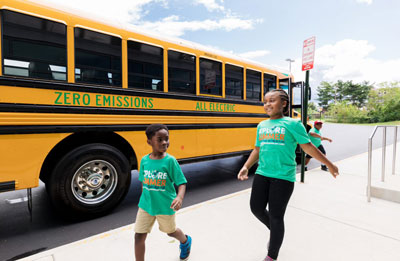
Dominion Energy plans to replace all diesel-fueled Virginia school buses with electric buses by 2030. Photos courtesy Dominion Energy Inc.
The Southern Environmental Law Center is a supporter of solar energy, but Cleveland cautions that “the purpose is not to overbuild, but to keep the lights on.” He would like to see more effort going into locating solar facilities on marginal sites such as brownfields, landfills and abandoned parking lots instead of on agricultural land. But he agrees with DMME’s Warren about initiatives to locate solar farms on previously mined sites in far Southwest Virginia. Warren calls that “a win-win situation for everyone.”
In addition to the state eyeing old mining sites for solar farms, Warren says the state government also has purchased power agreements on six solar farms as part of its 2022 goal and is encouraging community colleges to implement solar systems to generate power for individual buildings.
Warren sounds a warning, though, about the eventual success of the VCEA. The infrastructure for all green power initiatives will require mineral extraction, he says, something that many environmentalists oppose. “Establishing a domestic raw material supply chain is not environmental treason,” he says. “We have to flip the script, or we are headed down a big collision course.”
Energy storage
Of the three main sources of green energy, storing energy produced by sources like solar and wind presents the biggest challenge. The VCEA stipulates that Dominion and Appalachian must have 2,700 megawatts and 400 megawatts of storage capacity respectively by 2035, but so far, costs remain high and storage technology is less than satisfactory.
“Batteries are still pretty expensive compared to alternatives,” says Beam with Appalachian. He expects prices will come down in the next five to 10 years, but, for now, his company has a couple of bidders on small storage projects.
Dominion is investing $33 million in four pilot storage projects for a combined 16 megawatts of energy storage capacity but, once tapped, that power will last just four hours. “We’d like to see that duration get longer,” says Baine. For now, he says, “It’s a slower ramp for deployment.” It’s also a long way from the 400-megawatt requirement.
Dominion has found one solution to that problem with its innovative electric school bus program. In a $15 million pilot project started last year, Dominion provided 50 electric school buses to local school systems across Virginia. Pending General Assembly approval, Dominion proposes to put 1,000 electric school buses on the road by 2025 and to completely replace diesel-powered school buses in Virginia by 2030. When not in use, these buses could be used like a fleet of mobile batteries to supply power back to the grid, or to act as mobile power stations during power outages or emergencies. Dominion has estimated that the program would cost each of its Virginia customer households about $12 a year.
Nevertheless, both utilities are moving toward the goal of a carbon-free future, with a certain measure of faith that clean energy and storage technologies will only get better the closer they get to 2045 and 2050.
“In an ideal world, we would be all carbon-free by 2035,” says McClellan, referring to the goal date the Biden administration has set for a carbon-free electricity industry. But 2035 was a no-go in the Virginia General Assembly, and McClellan says she’s comfortable with the 2050 goal and confident that the VCEA provides the framework to meet it.
Since the law’s passage, McClellan says, “We’ve already gone from the back of the pack to the top five or six states [in solar energy generation].”
But the state senator also is a believer in the Russian proverb that became a Ronald Reagan mantra: “Trust but verify.”
“We will be monitoring progress very closely,” McClellan says.
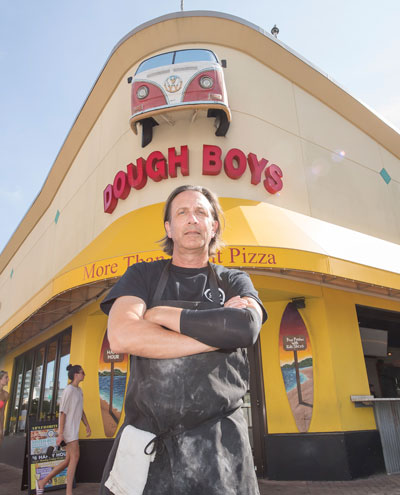
At Dough Boy’s Pizza, summer typically brings a steady stream of job applicants seeking work at one of the restaurant’s three locations on the Virginia Beach Oceanfront.
But “this year, it’s next to nothing,” says owner George Kotarides. For Kotarides and other restaurant owners, a season that had been anticipated as the triumphant closing act of the COVID-19 pandemic has instead been an exhausting, stressful slog, as available workers have been scarce.
Kotarides has been in the restaurant business since he took his first job as a dishwasher in 1978. He’s seen challenging times before when the economy has taken turns, but nothing like the last several months. “Not even close,” he says. “It’s a daily challenge, and it’s very stressful for everybody.”
Due to a phenomenon some are calling the Great American Labor Shortage, businesses across Virginia both small and large are being forced to cut back on hours and services to stay open. For example, citing labor shortages, Kings Dominion amusement park in Doswell was open fewer hours (usually 11 a.m. to 7 p.m.) than usual this summer, and it closed some weekdays during June and August.
“It’s a nightmare,” says George Kotarides, who has struggled this summer to find workers for his three Dough Boy’s Pizza restaurants on Virginia Beach’s Oceanfront. Photo by Mark Rhodes
At Dough Boy’s, Kotarides has been closing his restaurants at 10 p.m. instead of midnight and changing menus and ordering processes to adapt to a staffing level that’s 35% lower than past summers.
Nevertheless, Kotarides emphasizes he’s not complaining — he’s thankful that he’s been able to make it through the summer staying open seven days a week. He’s watched as other restaurants have reduced days of operation or gone out of business altogether.
“People are working long shifts. It’s not easy. We jockey the schedule as much as we can to keep people from being overworked, but unfortunately that doesn’t always happen,” he says. “We are not asking for sympathy — just patience.”
September could be a turning point in the tight labor market that has plagued the post-pandemic recovery. But as employers and economists watch to see whether the Sept. 4 end of expanded federal unemployment benefits and a return to in-person school will lead more workers to fill open positions, one thing is becoming apparent: This isn’t 2019.
Whether you’re looking to hire a restaurant cook or a bank compliance officer, talent acquisition strategies have changed dramatically since the pandemic began.
John Asbury, president and CEO of Richmond-based Atlantic Union Bankshares, says the labor market in Virginia looks markedly different from employment recoveries he’s witnessed after past economic slumps. “The employment challenge in Virginia is less about the unemployment rate, and more about the ability of Virginia businesses to fill their open jobs,” he says.
Between February and April 2020, total nonfarm employment in Virginia dropped by 11.7% as the state’s economy shed 480,000 jobs during the pandemic’s initial shutdown. Unemployment in Virginia peaked during April 2020 at 11.3%. This June, it stood at 4.3% — still higher than the pre-pandemic rate of 2.5%.
This paradox of relatively high unemployment paired with record numbers of job openings means that many businesses are in a squeeze to find the workers they need.
In a June report by the National Federation of Independent Businesses, 46% of small-business owners reported having job openings they could not fill — more than double the historical average of 22%.
Parsons
Douglas Parsons, executive director of the Front Royal/Warren County Economic Development Authority, says industrial employers in Warren were already seeking additional workers before the pandemic, and “when COVID hit, it just threw a wrench in everything.”
Parsons hears employers complain that expanded federal unemployment benefits have in some cases provided more money than people would earn working. “A lot of [unemployed] folks are saying that it’s not cost-effective for them to give up the benefits they are receiving from the government to come back to work,” he says.
But while many companies hope the end of expanded benefits in September will boost hiring at the lower end of the pay scale, labor experts say federal benefits aren’t the only variable at play, citing issues such as child care or concerns related to COVID-19.
Eric Terry, president of the Virginia Restaurant, Lodging and Travel Association, says that so far, his colleagues in states that opted to end expanded benefits early still aren’t seeing the influx of job applicants many had hoped for.
Pandemic power shift
Signs abound that the balance of power between workers and employers has shifted. Companies are advertising starting salaries in jobs postings and in some cases on big banners along major highways — information that previously would have been held close to the vest. And potential hires are seeking — and often getting — a degree of flexibility in where they live and how they work that very few would have dreamed possible before 2020.
In what’s being called the Great Resignation, increasing numbers of workers are jumping ship in search of more favorable working conditions.
In June, 3.9 million Americans quit their jobs — a rate of 2.7%. The so-called “quits rate” has been above 2.4% since February and in April it reached a record 2.8%, as nearly
4 million workers voluntarily left their jobs.
“The employee is in the catbird seat,” Parsons says.
This power shift is evident across all kinds of industries and jobs.
In July, 2,900 unionized workers at a Volvo Trucks plant in Dublin returned to work after negotiating a new hourly wage agreement, ending an on-and-off strike that began in April.
Harder
Large national retailers including Costco, Target and Amazon have announced wage increases in recent months. Those decisions have ripple effects for smaller businesses, forcing them to raise pay to keep up in a competitive hiring market. (And these higher labor costs are contributing to higher prices, with the U.S. Department of Labor reporting in July that consumer prices had risen 5.4% during the last year.)
“The pandemic forced us to rethink the entire relationship individuals have with work,” says Joseph Harder, an associate professor at the University of Virginia’s Darden School of Business. “It’s not just that white collar workers are demanding flexibility … but it’s also [happening with] the entry-level positions that are essential to reopening the economy. People are not working for minimum wage the way they once were. … I don’t know what would have shifted that power without the pandemic.”
“Agile” is the current buzzword among hiring professionals, as companies get creative about how to make employment offers appealing to the individuals they seek to hire.
“We are having to rethink the way we do things,” says Shawn Avery, president and CEO of the Hampton Roads Workforce Council. In addition to bonuses and higher wages, he says, businesses are finding they need to offer new or increased benefits, such as paid vacation time or funds toward education.
Remote work and a tight labor market has given Atlantic Union Bank the flexibility to hire workers from other states to fill jobs that can be performed remotely, says bank CEO John Asbury. Photo by Matthew R.O. Brown
Further complicating the situation, the highly contagious delta variant of the coronavirus has caused a surge in COVID cases this summer, along with rising hospitalizations. This has employers grappling with issues such as whether to reinstate mask mandates or to require workers to get vaccinated, knowing that this could not only result in some employee terminations or resignations, but could also scare off potential hires.
Meanwhile, residual effects of the pandemic shutdowns — such as the pandemic-related suspension of the J-1 visa program, which brings many foreign workers to Virginia resorts and theme parks — still haven’t been completely resolved, further adding to worker shortages.
What’s the purpose of the office?
Office workers who have spent the past 18 months working remotely are now demanding flexible work options.
In a national survey conducted by Prudential Financial Inc. in March, 68% of respondents said having the ability to work a hybrid schedule is ideal. Of those who worked remotely during the pandemic, 87% reported that they wanted to continue working remotely at least one day per week.
Many companies had been planning for employees to return to offices after Labor Day, but those plans were disrupted by the delta variant surge. McLean-based Capital One Financial Corp. pushed back its plans to move remote employees to hybrid work schedules to Nov. 2 from Sept. 7. In Richmond, Genworth Financial delayed returning workers to the office until at least October.
As of early August, Atlantic Union Bank in Richmond was still uncertain whether it would move forward with its plans for a Sept. 7 return. But when that reopening does occur, CEO Asbury says, the bank’s employees will return to a hybrid schedule, with “collaboration days” where everyone will be on-site, coupled with options to work from home on other days.
“This is a great experiment,” Asbury says. “The only thing we can assure you of is that whatever we do will evolve based on our actual experience. If things continue to go well, there will be more flexibility. If we have challenges, there may be less flexibility.”
Loreen Lagatta, the bank’s chief human resources officer, says the ability to offer workplace flexibility has helped Atlantic Union stay competitive in what she calls the “war for talent.”
“The organizations that are listening to their employees, that are willing to test and learn and adapt, are the ones that are continuing to move forward,” she says.
This new world of work has created a national market for talent.
“There are plenty of companies that we would never have expected to have coming after our employees in Virginia, saying, ‘You can work from home,’” Atlantic Union’s Asbury says.
Evans
Although the bank wants most of its workers to be hybrid and not fully remote, Asbury says, the pandemic’s new work models have given Atlantic Union the flexibility to hire workers from other areas of the country for roles that can be performed remotely. “The truth is, we now have more people working in more states than we ever have before,” he says.
At Sentara Healthcare, Vice President for Recruitment and Workforce Planning Pat Evans says the pandemic proved to the health system that some employees in office-based positions could successfully do their jobs remotely. “That has been a change for us,” she says. “I don’t think we saw clearly that those could be done remotely before COVID.”
As office workers return, Evans says, Sentara is often able to honor their wishes for flexibility. “If we had a closed mind to that, that would have a negative impact on retention and recruitment,” she says.
Evans says overall hiring at Sentara is up about 50% this year, as the health care system has moved forward with hires that were put on hold during the pandemic, and as Sentara’s staffing needs have continued to grow.
“We are seeing lots of interested candidates, and we still need more,” she says. “We are doing more marketing in different ways to attract a broader applicant pool.”
This includes purchasing more sponsored posts on job sites, offering sign-on and referral bonuses and offering more flexible scheduling options where appropriate.
Vaccines: Mandate or encourage?
Amid these staffing challenges, employers are also wrestling with the question of whether to require employees to be vaccinated. In a mid-July survey of 59 Virginia CEOs conducted by the Virginia Council of CEOs and the University of Richmond’s Robins School of Business, only 10% reported that they would require vaccinations for their employees.
Since that survey was conducted, a lot has changed, though.
Gov. Ralph Northam announced that all state employees would be required to get vaccinated by Sept. 1 or be subject to weekly testing. Similarly, the Pentagon announced a vaccine mandate for U.S. military members. Several large private employers, including Walmart and Google, also announced workforce vaccine mandates.
Malone
Jason Malone, an associate professor at Virginia Tech’s Pamplin College of Business, says that as larger corporations take the lead in requiring vaccines in the workplace, smaller businesses will be watching the potential consequences to job recruitment and retention.
“These smaller to mid-sized businesses are more sensitive to the job market, and they could be impacted to a greater degree by a vaccine requirement,” he says. “By taking that hardline approach, you could alienate existing employees or potential future employees.”
Hospitality workers are scarce
At the onset of the pandemic, Virginia’s leisure and hospitality industry was particularly hard-hit, eliminating 204,800 jobs — 49% of the workforce — statewide between February and April 2020, according to data from the Virginia Employment Commission. By this June, leisure and hospitality employment in Virginia stood at 330,400 jobs — still 20% below its June 2019 level.
In June, there were still 88,000 job openings in restaurants and hotels in Virginia, according to the Bureau of Labor Statistics.
“It’s a nightmare,” says Dough Boy’s restaurateur Kotarides, who was shocked when he attended a job fair for hotel and restaurant jobs in Virginia Beach shortly before the July 4 holiday. Twenty-seven employers were represented and “zero applicants showed up,” he says.
Dough Boy’s has raised wages by 35% in the past 12 months, and added benefits such as discounted insurance, free meals and quick promotion opportunities. “We are keeping people. We are thankful for that,” he says. “But people just aren’t walking in the door or applying like they normally would.”
Kotarides is interested to see whether hiring picks up after expanded unemployment benefits expire Sept. 4 — but notes that it will come too late for the tourism-related businesses that needed staff all summer.
Avery says many restaurant owners and managers are working double shifts, leaving them little to no time to recruit, train or interview new workers.
Terry
VRLTA’s Terry is hearing that the hiring situation is improving in some regions for servers and hosting jobs, but cooks, dishwashers and other back-of-the house positions remain difficult to fill. One in-state restaurant chain had to temporarily relocate employees from Richmond and put them up in hotels so that there would be enough labor to operate their Harrisonburg location, he says.
Hotels continue to struggle to find enough staff, and Terry says one permanent casualty of the pandemic staffing crunch may be that daily hotel room cleaning becomes a relic of the past. “I don’t know if you’re going to see that change for a while,” he says.
Calling the situation a “workforce crisis,” the city of Virginia Beach appropriated $400,000 to the Hampton Roads Workforce Council in July for a program that will pay $1,000 bonuses to up to 250 employees to entice them to take jobs in the tourism industry. Another $100,000 will go into a marketing program targeting potential applicants, and $50,000 will be spent on administration and research to determine why people aren’t returning to these jobs.
In early June, Northam announced that the state was launching a similar worker incentivization effort, the Virginia Return to Earn grant program. The state planned to invest $3 million to provide qualifying small businesses with matching funds to award new employees up to $1,000 signing bonuses.
Gone for good?
In a national study conducted this spring by job search site Joblist, 38% of former hospitality workers reported that they would not consider a hospitality job for their next position. More than half of these workers indicated that no pay increase or incentive would lure them back to their old jobs.
Agarwal
Vinod Agarwal studies the hospitality industry as a professor at Old Dominion University’s Dragas Center for Economic Analysis and Policy. The pandemic was a source of “creative destruction” for the industry, he says, because workers “got time to start thinking about what they wanted to do.”
Coming out of the crisis, businesses will need to be proactive in hiring and retaining workers, he adds. Employers need to think about not only compensating employees but also supporting them as individuals whose lives don’t stop when they clock out of work.
“Were you able to take care of your employees when they needed help? If you didn’t, they aren’t coming back,” Agarwal says. “Wages alone may not do the job.”
Taking care of employees beyond the paycheck has proven successful for Jay Patel, who owns three Edible Arrangements franchises in Hampton Roads and a handful of restaurant franchises on Naval Station Norfolk.
To maintain staffing for a 130% increase in business his Edible Arrangements stores experienced in 2020, Patel successfully sought a temporary change in company policy to allow parents to bring their children to work with them. He upgraded his Wi-Fi so that children could attend virtual classes at the stores and instituted a “hero bonus” raise of $2 per hour for all employees. He’s helped employees get needed car repairs and assisted them in locating affordable housing. These practices grew employee loyalty and have gotten him through the pandemic with minimal staffing challenges, he says.
A single mom from Fredericksburg, Katherine Bray quit her direct mail job and went back to school. Now she works a hybrid part-time job while taking classes. Photo by Will Schermerhorn
Caren Merrick, CEO of the Virginia Ready Initiative, says former hospitality workers make up about 12.5% of the 2,000 people who have enrolled in its Virginia Ready Scholars program to train for new careers. It’s the second-most represented industry in the program, behind health care. But health care workers are typically seeking increased training for their jobs, she says, while most hospitality workers in the program say they’re leaving their industry altogether.
Virginia Ready Scholars is a partnership among 24 private businesses and the Virginia Community College System. It places participants in one of 34 selected training programs for high-demand skilled industries and offers a $1,000 award and job interview opportunities upon completion.
“These are individuals who would have stayed [in the hospitality industry] for the rest of their career, but because they were forced to take time off, they got to reflect,” Merrick says. “They want more upward mobility. They want training. They want some flexibility.”
Shutdown brought breaking point
Katherine Bray, a 26-year-old single mother in Fredericksburg, was working at a direct mail business when the pandemic hit.
As the volume of political mail increased drastically ahead of the 2020 presidential election, she says, her employer was reluctant to add new workers out of concern of COVID-19 exposure. Bray found herself working up to 60 hours a week.
This put pressure on the child care arrangement she had with her landlord, as her oldest child’s virtual kindergarten classes were proving too much to manage around work.
“We stuck it out as long as we could,” says Bray. “I was constantly putting in applications looking for a work-at-home position.”
Bray, who had previously worked for fast food restaurants, big-box retail stores and call centers, had always known she’d need more education to land the jobs she wanted. Taking classes always seemed like too much to take on — until the pandemic.
Bray called the career and transfer services office at Germanna Community College in December 2020. As a single mother, she qualified for financial aid, she discovered, so she enrolled in classes to earn her associate degree in business management, along with four business certifications.
After her employer denied her request to reduce her weekly schedule to 30 hours so she could take classes, Bray quit her job. “I didn’t have anything else lined up, but I knew that my household could not continue the way it had been,” she says.
When she emailed the college seeking referrals for jobs she could apply for, Germanna offered her a work-study position. She now works 20 hours a week in a job that can be done partly from home while taking classes toward her degree. She pays for fewer hours of child care and feels positive about her career path.
Marie Hawley, Germanna’s coordinator of career and transfer services, says Bray’s story is representative of an increased interest in careers that have remote options and won’t be eliminated if another pandemic hits.
“Students have a strong lack of interest to work in an environment that is subject to working with the public through another pandemic,” she says. “Most are not interested in any front-facing customer services jobs.”
Banks are seeing a similar dynamic in hiring for teller positions.
“In the wake of the pandemic … what I hear a lot of banks say is that staffing their branches has been a real challenge,” says Bruce Whitehurst, president and CEO of the Virginia Banking Association.
Amy Mellinger, senior vice president and director of human resources for Powell Valley National Bank in far Southwest Virginia, says the bank, which has around 90 employees, saw nine resignations this year as of July.
“Every single one was an entry-level teller position,” Mellinger says. But the bank hasn’t had trouble filling the jobs, and new hires have come from the medical and restaurant industries.
“The last entry-level position we hired, the teller had been in the restaurant industry, at the same restaurant for 13 years,” Mellinger says. “She was ready for a change, different hours and a different career path.”
Something different
The great career rethink was a pandemic pastime for many workers.
In a January 2021 Pew Research Center survey, two-thirds of unemployed adults said they had seriously considered changing their occupation. One-third reported taking steps to gain new skills.
After being laid off from his job in electrical sales in spring 2020, Powhatan resident James Sayles was able to take a breather for a few months, due in part to expanded federal unemployment benefits.
Truck driving had always been on his career wish list, and he started looking at what credentials he’d need. Sayles was able to complete commercial driving training for tractor trailer trucks at John Tyler Community College for only $500 out-of-pocket after qualifying for a grant for Virginia residents and a $1,000 Virginia Ready scholarship.
Merrick
Virginia Ready’s Merrick says the commercial driver’s license is the No. 1 enrolled credential among the program’s 2,000 enrolled participants.
Making a complete career change at age 51 has given Sayles confidence that he’ll be able to weather future changes in the economy, and he enjoys the freedom and independence of truck driving.
Dale Bennett, president & CEO of the Virginia Trucking Association, would like to hear more stories like that. The trucking industry anticipates a nationwide need for 1.1 million new drivers over the next 10 years, due to rising demand and an agingworkforce. Additionally, Bennett says, truck driver training schools and DMV offices were shut down during the pandemic, slowing the onboarding process for new drivers.
Bennett says carriers are raising pay, offering signing bonuses as high as $10,000, and hiring drivers while they are still in training to keep their numbers up.
“We also feel good that during the pandemic, the general public got an understanding for what truck drivers mean to their everyday life,” he says. “Retail store personnel were constantly getting the question, ‘When is the next truck coming?’ It should have been, ‘When is the next driver coming?’”
A greater sense of purpose and work-life compatibility are key to recruiting in the post-pandemic market, U.Va.’s Harder says.
“The strategic question is, ‘Who are the people I absolutely cannot afford to lose?’ Go make sure they are happy enough that you don’t lose them.”
Manage Consent
This website uses cookies, web beacons, pixels, tags, software development kits, and related tracking technologies, as described in our Privacy Policy and Cookie Policy, for purposes that may include website operation, analytics, analyzing site usage, enhancing site navigation optimizing a user's experience, and third-party advertising or marketing purposes. Through these technologies, we and certain third parties may automatically collect information about your interactions with our website, such as your browsing behavior and page views. We also may share this information about your activity on our website with our social media, advertising, analytics, and other business partners. By clicking “Accept All”, you consent to the use of these technologies and that we can share information about your activity on our website with third parties in accordance with our Privacy Policy and Cookie Policy. If you do not agree with our use of non-essential tracking technologies, please click “Reject All.” You may opt out of certain non-essential technologies by clicking “Cookie Settings.”
Functional
Always active
The technical storage or access is strictly necessary for the legitimate purpose of enabling the use of a specific service explicitly requested by the subscriber or user, or for the sole purpose of carrying out the transmission of a communication over an electronic communications network.
Preferences
The technical storage or access is necessary for the legitimate purpose of storing preferences that are not requested by the subscriber or user.
Statistics
The technical storage or access that is used exclusively for statistical purposes.The technical storage or access that is used exclusively for anonymous statistical purposes. Without a subpoena, voluntary compliance on the part of your Internet Service Provider, or additional records from a third party, information stored or retrieved for this purpose alone cannot usually be used to identify you.
Advertisement
The technical storage or access is required to create user profiles to send advertising, or to track the user on a website or across several websites for similar marketing purposes.

 Sign In
 Free Newsletter