Sign In
Upcoming Event
 Free Newsletter

Spanberger talks economic priorities in exclusive Q&A
Incoming governor discusses economic development strategy, budget challenges
Kate Andrews //January 5, 2026//

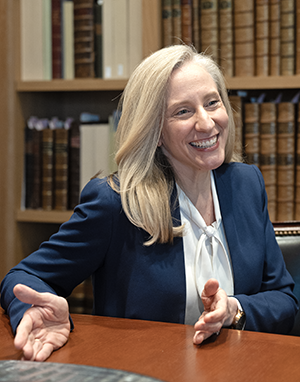
Gov.-elect Abigail Spanberger, photographed at the Virginia Museum of History & Culture, won Virginia’s governorship by a 15-point margin in the November 2025 election, leading a blue wave. Photo by Jay Paul
Gov.-elect Abigail Spanberger, photographed at the Virginia Museum of History & Culture, won Virginia’s governorship by a 15-point margin in the November 2025 election, leading a blue wave. Photo by Jay Paul
Spanberger talks economic priorities in exclusive Q&A
Incoming governor discusses economic development strategy, budget challenges
Kate Andrews //January 5, 2026//



Summary:
- Abigail Spanberger will become Virginia’s first woman governor on Jan. 17
- She outlines plans to address affordability, housing supply and workforce issues
- Spanberger warns federal cuts to Medicaid and SNAP could strain Virginia’s budget
- She aims to return Virginia to No. 1 in CNBC’s Top States for Business rankings
On Jan. 17, Abigail Spanberger will become Virginia’s 75th governor and the first woman to serve as the commonwealth’s chief executive.
A three-term member of Congress, the 46-year-old Spanberger was a U.S. postal inspector, like her father, focusing on narcotics and money laundering cases before later serving as a CIA case officer. In Congress, she was best known as a moderate Democrat who turned a formerly GOP stronghold district blue in 2018, defeating incumbent Tea Party Republican Dave Brat.
Spanberger announced in 2024 that she would not run for a fourth term in Congress, instead setting her sights on Virginia’s Executive Mansion. In November 2025, she won a resounding victory of more than 15 points over Lt. Gov. Winsome Earle-Sears, leading a Democratic sweep of all three statewide offices and gaining a 64-seat Democratic majority in the Virginia House of Delegates.
In an early December interview conducted at the Virginia Museum of History & Culture in Richmond, Spanberger spoke about her plans to lower costs for Virginians, help create more affordable housing and see the state regain the coveted No. 1 spot in CNBC’s Top States for Business — all while contending with decreased federal funds for Medicaid, SNAP and other programs that have economic forecasters making gloomy projections for 2026’s state budget.
On the personal side, Spanberger and first gentleman Adam Spanberger, along with their three daughters, will be moving into the Executive Mansion shortly.
“I think our family is a little bit nervous about the changes, but we did have the opportunity to tour the house with the kids just last weekend,” she says. “I think that was helpful to them, understanding that at the end of the day, it’s a very historic place, but it will be their home.”
Virginia Business: You won by one of the widest-ever margins in the state’s history, and some politicos deemed your victory a rebuke of President Donald Trump’s policies. Given that, what do you consider your mandate to be as governor?
Spanberger: In thinking through what is the mandate of my election and what motivated so many people to get out and vote, I think about the things I talked about on the campaign trail — issues of affordability and housing, health care, energy. It’s really standing up for the federal workforce and recognizing [that] the strength of Virginia’s economy is intertwined with the federal government.
Having a federal government that continues to attack, in many ways, Virginia’s economy is detrimental to Virginia. Chaotic policies, such as the trade and retaliatory tariffs that have been impacting so much of Virginia’s economy, [are] difficult.
What I believe is my mandate is to stand up for the people of Virginia and ensure … that those policies are focused on the core tenets of my campaign, whether it’s lowering costs or strengthening public education, or really ensuring that our communities feel the support and the vibrancy of a governor who is deeply focused on the long-term success of our commonwealth.
VB: A lot has been made about Virginia’s ranking in CNBC’s Top States for Business falling from No. 1 to No. 4 in 2025. What do you plan to do to get the state back to the top?
Spanberger: First and foremost, when those new rankings came out, I spent time digging into what it takes to be No. 1. What is the formula that they use?
They look at education, they look at housing availability, they look at transportation infrastructure, business-friendly climate, whether we have the talent pool for businesses, whether they’re in manufacturing or high-tech or whatever it may be.
And as I look at the pathway towards getting us back to being No. 1 — sorry, North Carolina! — it is making sure that we are prioritizing not just the things that CNBC cares about, but the things that Virginians care about. Housing affordability, housing supply in communities where there are jobs, and quality schools — but also ensuring that we are creating a workforce that is ready, whether it’s to go into the manufacturing field or into high-tech fields, and that we are recognizing the strengths of our universities … and community colleges.
Then there’s recognition that in the CNBC report, they attribute one of the things that impacted their [ranking of Virginia] was the fact that [Department of Government Efficiency] attacks were deeply impacting Virginia and our economy.
I would imagine that it became hard for CNBC to say this is the No. 1 place for business when hundreds of thousands of Virginia’s workforce are under attack, and the governor’s not standing up for them.
VB: A lot of those things cost a lot of money, and federal funding cuts to Medicaid and SNAP are forecast to create a budgetary hole in the billions. How do you propose Virginia handle that?
Spanberger: I think it’s an important part of the conversation that the federal government, under the Trump administration, is pulling back from its obligations. We pay our federal taxes, and then programs such as SNAP utilize and leverage the strength of the federal government to support people here in the commonwealth of Virginia. The same is true for Medicaid.
And there just are not enough dollars in a state budget to be able to backfill what we are sending federal dollars to Washington to be able to fund. But at the state level, there are actions that we can take to try and mitigate the worst of the harms, [such as] the error rate within SNAP. You want to make sure that SNAP dollars are going to those who deserve them and that those who deserve them are not accidentally or incorrectly being rejected from the program.
Virginia is on the path to lose millions upon millions of federal dollars for SNAP because of the current error rate, and so we need to make quick, quick changes and improvements to our SNAP delivery.
VB: Is there anything from the Youngkin administration that you view as needing an immediate fix?
Spanberger: I think the day-one priority is focused on strengthening some of our state agencies. Certainly, some have seen a large outflow of talent and of knowledge, whether it’s public health or education or transportation, and in fact, it’s a before-day-one priority, as I’m thinking through the appointments that I’m making to lead our secretariats.
VB: In 2020 and 2021, Democrats controlled the legislature and the governorship and passed progressive legislation like abolishing the death penalty and legalizing marijuana. You have the same advantage for 2026 and 2027, so what can Virginians expect from you?
Spanberger: The budget plays a part in everything. In addition to the constitutional requirement that we have a balanced budget, it’s imperative that we keep our AAA bond rating. That really does impact the choices that we can make. And you know, over the past number of years, in part because of federal dollars from the Inflation Reduction Act and the [American Rescue Plan Act] bills that I voted for [in Congress], there were additional federal dollars flowing to the states.
That will not be the case during the four years that I am governor, unless there’s a major shift in the choices made at the federal level, which I don’t expect. And so, what voters should expect is that I will be working on the priorities I talked about along the campaign trail — principally lowering costs, increasing housing supply, improving public education. Some of the bills that address those priorities do not have a budgetary impact, and some do. And so, it is all a balance.
VB: Regarding right-to-work legislation, you’ve said several times you oppose a full repeal, but what reforms would you agree to?
Spanberger: I’m sure you’re aware members of the Senate have introduced a [right-to-work repeal] bill, and yes, I’ve been clear that I won’t sign it, and if it gets to my desk, I’ll veto it. But I think that there is a lot that we can continue to do to ensure the strength of Virginia as a place for business, but also for our workforce.
I support increasing the minimum wage. I also support the eventual right for state employees to be able to collectively bargain, and that does fall under the right-to-work statute in Virginia.
VB: How will you deal with the Medicaid shortfall’s impact on hospitals and clinics?
Spanberger: As governor, I certainly can’t replace those dollars. But I’m looking into a multistate compact for the delivery of certain types of medical services, where you can pull a little bit of the pressure off of some of our hospital systems, or where they can downsize a bit, as they are doing with their staffing, and ideally patients won’t see the impact.
The other terrible element within [the Big, Beautiful Bill] that hasn’t gotten much media coverage is the restrictions they impose on federally backed loans for education.
If you are someone who wants to go to medical school in the commonwealth of Virginia, you cannot fund your education through federally backed loans, because the cost of that degree will be greater than the limits they are putting. So, my big concern also exists for the long-term impact on the pipeline of doctors and nurses, the workforce that we will or won’t see 10 to 15 years down the road.
VB: Virginia is seeing a lot of growth in biotech and pharmaceutical manufacturing. How do you plan to support and continue this progress?
Spanberger: During my time in Congress, I worked on legislation that was really responsive to the needs at a national level as it relates to the active pharmaceutical agreement, ingredient stockpiles and … having the versatility and ability to manufacture medications here in the United States.
As governor, I’ll continue to build on the work, [including] working to recruit businesses and investment to Virginia. Frankly, it’s a national security priority that we’d be able to provide life-saving medications to our fellow Virginians and our fellow Americans, but it’s also an extraordinary industry of development and innovation. There’s just a tremendous amount of research that’s occurring throughout Virginia and continuing to build on that and nurture this industry is a priority.
VB: Which other industries do you think could use a boost in Virginia?
Spanberger: We have often built up many of our industries around investments coming from the federal government. Certainly, I would continue to do that. And as we see manufacturing coming back in waves to the United States, newer technologies, particularly adjacent to the defense and intelligence space, [are] something I’ll continue to support.
During my time in Congress, I was proud to be present for some of the investments in my old district related to drone technologies. The uses are expansive and valuable. A real differentiator for Virginia is the strength of our university systems and the research that is occurring, whether it’s in the agriculture space or the pharmaceutical space.
VB: Some people are saying that the Virginia Clean Economy Act, which mandates that utilities move to renewable energy sources by 2045 and 2050, needs to be adjusted to reflect AI use, data center growth and higher energy demands. What is your view?
Spanberger: I think it’s important that we not abandon the goals of the Virginia Clean Economy Act. Just as we have seen real shifts in the types of technology that are using energy, we’ve also seen real shifts in some of the technologies that are part of the solutions.
We can make some changes, reforms, adjustments based on the technologies now available to us. Principally, I’ll mention battery storage. Technological advancements in battery storage can help in getting at some of those clean economy goals. We’re not on the trajectory to meet the goals of the Virginia Clean Economy Act at this moment, and that doesn’t mean we just abandon it.
VB: Does the state need more say in approving big data center campuses that currently are decided by localities?
Spanberger: In “approving,” I would say no, [but] in supporting localities as they are making decisions about what to approve, there’s information the state can provide that would be useful to localities as they’re making decisions.
But some of the legislation that we put in for drafting relates to overall transparency of anticipated usage. Part of the challenges we face is if X company might be proposing a data center in three different localities — knowing that they’re only going to build one — the accounting of whether we as a commonwealth should be planning for three or planning for one. There isn’t great transparency on that. There isn’t clear tracking of what’s actually coming, and then what’s the impact on the larger grid?
VB: Regarding university boards, would you remove anybody for malfeasance from any of the Virginia boards of visitors?
Spanberger: My priority right now is being ready day one, which is Jan. 17, to make multiple appointments, particularly for our boards that are far under complement because they have not had confirmed members.
VB: Hundreds of University of Virginia faculty members and others have said that their rector and vice rector need to go. Would you consider removing them?
Spanberger: At times it seems daily, or certainly weekly, that an important constituency [at U.Va.] has voiced their complete lack of confidence [in their board and] in some cases [are] calling on them to step down. As governor-elect, I take note of the varied voices, very strong voices, who have clear reasons that they have articulated in resolutions that have passed, letters that have been written about the distrust they have. But I certainly would think it’s premature for me to make any announcements.
VB: You haven’t taken office yet, but are you thinking about your legacy as governor and what you want to convey to younger Virginians who are watching you?
Spanberger: I want to make sure that they know that government, state government, has a function. It has a purpose. The policies that people vote on — whether at the local level, the state level or the federal level — they impact people’s lives. [The Big, Beautiful Bill] will have, across the board, negative impacts.
Or they can move us in the right direction. They can enable progress. They can enable growth of housing supply to bring down costs. They can raise the minimum wage. They can support the strengthening of our public schools.
I am eyes wide open and clear-eyed about the challenges in front of us. I may not be able to deliver on everything I want to deliver on, but I know that I can deliver progress and move us in the right direction.