Sign In
Upcoming Event
 Free Newsletter

Richmond Fed leader sees less economic uncertainty in 2026
But consumer sentiment is at all-time low, notes Barkin
Kate Andrews //January 15, 2026//
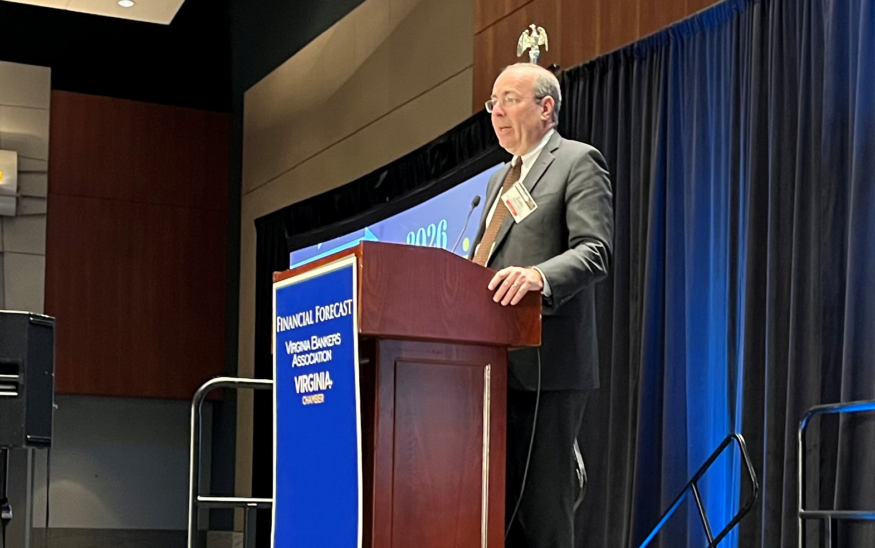
Richmond Federal Reserve Bank President and CEO Tom Barkin speaks Jan. 15, 2026, at the 2026 Financial Forecast held in Richmond by Virginia Bankers Association and the Virginia Chamber. Photo by Kate Andrews
Richmond Federal Reserve Bank President and CEO Tom Barkin speaks Jan. 15, 2026, at the 2026 Financial Forecast held in Richmond by Virginia Bankers Association and the Virginia Chamber. Photo by Kate Andrews
Richmond Fed leader sees less economic uncertainty in 2026
But consumer sentiment is at all-time low, notes Barkin
Kate Andrews //January 15, 2026//



SUMMARY:
- Richmond Fed president and CEO says labor market is softer, but he anticipates less uncertainty in 2026
- Consumer sentiment hit second-lowest reading in November 2025
- Inflation data expected to be normal in April, Barkin predicts
Richmond Federal Reserve Bank President and CEO Tom Barkin took a cue from Spotify and offered “Economy Wrapped,” his overview of the nation’s economic trends in 2025 and forecast for 2026, to the audience gathered in Richmond for the annual Virginia Bankers Association-Virginia Chamber Financial Forecast on Thursday.
Unemployment, which was 4.4% nationally for December 2025 and 3.5% in Virginia, remains low on a historic basis, Barkin noted, but it has ticked upward in the past year, and inflation has remained above the Federal Reserve’s 2% target for nearly five years.
“It’s a delicate balance,” he said. “As the labor market has softened in the past year, the [Federal Open Market Committee] cut rates further in the fall to a level now within the range of its estimates of neutral. Think of it as taking out a bit of insurance.”
Consumer sentiment also dipped to its second-lowest reading ever in November 2025, according to the University of Michigan’s report. “That’s worse sentiment, believe it or not, than during the global financial crisis. … We just have to accept that persistent weak sentiment could affect spending in time.”
To quote Elton John, Barkin said, “I guess that’s why they call it the blues.”
However, Barkin had a few brighter predictions to offer as well: “First is that 2025’s uncertainty is bound to diminish. The fog should lift, and as firms build confidence and demand in the policy environment, that should be good for hiring and good for investment.” Gas prices are down, and tax refunds next month will provide some economic stimulus, he added, and the Fed’s rate cuts over the past 16 months “should flow to the economy as well.”
Speaking to reporters after his speech, Barkin noted that reporting of U.S. employment and inflation data lagged due to the federal government shutdown last fall, but the government has been playing catch-up. Currently, “the employment data is getting close,” he said. “I’m pretty comfortable with the employment data other than the benchmark revision, which is coming.”
As for inflation data, it will likely take until April for it to reach normal levels again following the shutdown. “So, that’s a challenge,” Barkin said.
For Virginia’s economy, “the regions that are highly dependent on the government sector had a rough year,” he said. “Some of that’s actual job cuts, some of that’s just anticipation. And you definitely hear… nervousness, even in sectors like health care, [which] really haven’t gotten cuts yet.”
Not everyone in the government sector is suffering, though — defense contractors in Hampton Roads and Northern Virginia are doing well, especially compared with other sectors that have seen more cuts, Barkin said.
“We know businesses are kind of relentlessly forward-looking, and so when you talk to contractors, they’re already thinking about what are the needs the federal government’s going to have going forward, and how they adapt their workforces and their offerings to those needs,” he added. “I’d say that consumer spirit, if I could put it that way, is somewhat south of the business spirit.”
Tariffs, Barkin said, have not had as much of a broad impact on the national economy as some expected, and in Virginia and North Carolina, some manufacturers have been positively impacted by tariffs, which have driven more domestic business. However, others are negatively affected, “like a local assembly arm of a global manufacturer who’s importing foreign parts and assembling them. It’s definitely a mixed bag. Our surveys still show manufacturing in our district just bumping along.”
The Federal Reserve’s Fifth District, which includes Virginia, posted modest growth in the past few weeks, according to the latest edition of the Fed’s Beige Book released Thursday.
Barkin declined to answer a question about comments made by Federal Reserve Chair Jerome Powell on Sunday about a Department of Justice criminal probe that the Trump administration says is related to Powell’s June 2025 testimony before the U.S. Senate Banking Committee. The DOJ served the Federal Reserve with grand jury subpoenas Jan. 9.
“This unprecedented action should be seen in the broader context of the administration’s threats and ongoing pressure,” Powell said Sunday. “This new threat is not about my testimony last June or about the renovation of the Federal Reserve buildings. It is not about Congress’ oversight role; the Fed through testimony and other public disclosures made every effort to keep Congress informed about the renovation project. Those are pretexts. The threat of criminal charges is a consequence of the Federal Reserve setting interest rates based on our best assessment of what will serve the public, rather than following the preferences of the president.”
In an interview this week with Reuters, President Donald Trump said he does not intend to remove Powell from his job but added it was “too early” to say what he would ultimately do. Powell’s term as Fed chair is set to end in May, but he could remain on the Board of Governors until 2028.
P