Sign In
Upcoming Event
 Free Newsletter

New York firm selected to create Fort Monroe master plan
Hargreaves Jones wins $1.8M deal to develop plan for 565-acre site
Josh Janney //January 28, 2026//
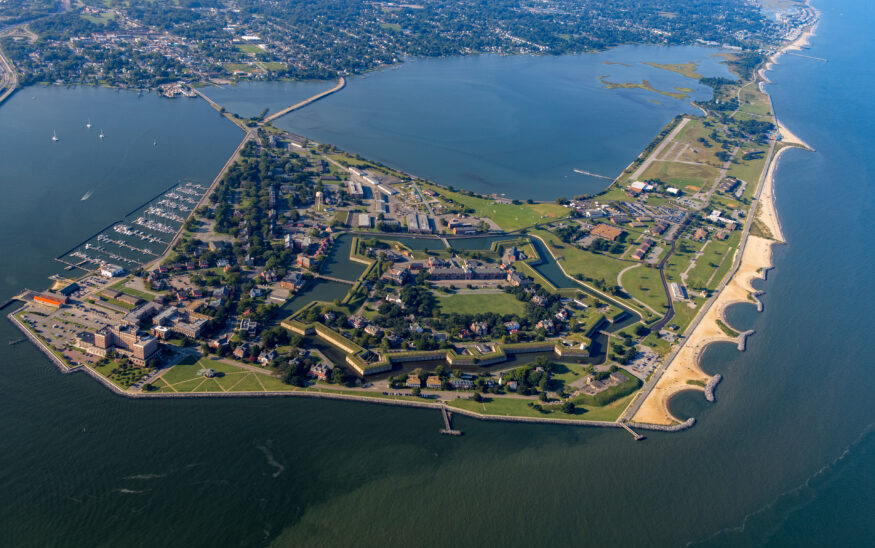
An aerial view of Fort Monroe. Photo Courtesy Fort Monroe Authority
An aerial view of Fort Monroe. Photo Courtesy Fort Monroe Authority
New York firm selected to create Fort Monroe master plan
Hargreaves Jones wins $1.8M deal to develop plan for 565-acre site
Josh Janney //January 28, 2026//



SUMMARY:
New York-based design firm Hargreaves Jones has won a $1.8 million contract to develop a plan for the next era of Fort Monroe, which was explored by Capt. Christopher Newport in the early 17th century, served as prison for former Confederate president Jefferson Davis after the Civil War, and in the 20th century was a training ground for Army units.
The first enslaved Africans brought to English-controlled North America landed at the fort in 1619, and it later became a haven for thousands of people who escaped enslavement — a legacy that earned the fort the name of “Freedom’s Fortress.”
After the fort was decommissioned in 2011, then-President Barack Obama declared 325 acres of the 565-acre Fort Monroe a national monument. The state owns about 318 acres, while the National Park Service and the U.S. Army own the remaining acres, although the Army plans to transfer the property to the NPS.
Hargreaves Jones is now charged with creating a strategy for future commercial, residential and recreational development, known as the landscape action plan, as well as how new developments will interact with historical spaces.
Fort Monroe Authority, which now controls the land, unanimously chose the New York firm for the job on Jan. 16, following an international search. Under the deal, Hargreaves Jones will receive $900,000 in the current fiscal year and $900,000 in the following fiscal year for the remainder of the job.
The plan will lay out how Fort Monroe’s land could be used and identify specific redevelopment projects that could move forward in coming years.
In the past, the authority reviewed development ideas after developers proposed them, such as Smithfield’s Pack Brothers Hospitality, which pitched a $45 million plan to build a marina and turn two historic buildings into conference space, a restaurant and a hotel. However, due to rising costs, the developers put the marina plan on indefinite hold in early 2024. Last fall, brothers Brian and Randy Pack said they still plan to develop the resort, which will be known as 37 North at Fort Monroe.
Now, Fort Monroe CEO Scott Martin says the authority intends to define a clear vision upfront, including cost and financial considerations, and then seek partners to implement it.
Exactly how much land could be redeveloped remains unclear, though Fort Monroe currently has at least 1.5 million square feet of vacant commercial space.
In their announcement, the authority said that Hargreaves Jones has a reputation for shaping economic growth, livability and quality of life. A special jury — including design and landscape deans and directors from Virginia Tech, the University of Virginia and Hampton University, as well as state preservation and cultural landscape leaders — unanimously recommended the firm to the authority after reviewing the final four candidates.
The firm’s work includes the adaptive reuse of Crissy Field near San Francisco’s Golden Gate Bridge, as well as landscape design for Queen Elizabeth Olympic Park in London.
Hargreaves Jones President Mary Margaret Jones said it felt “fantastic” to be selected for the contract, adding that it will be one of the most unusual jobs her firm has undertaken yet.
“There’s nothing else happening like it in the country at this scale,” she said. “Even the large projects we’ve worked on don’t always reach the scale, and it’s an opportunity to recognize our history, but to also chart a future path for a major piece of land in the Chesapeake Bay. It has great opportunity to be a landscape of destination.”
Jones said that in the coming months, her firm will be focused on outreach to impacted communities and stakeholders to help shape the decision-making for the plan. She said the plan needs to balance economic growth, public uses, historical preservation and the creation of a “green oasis.” In addition to enhancing the visitor experience, the plan will incorporate environmental strategies that support natural systems to thrive.
While finding a way to balance all of those interests won’t necessarily be easy, she said it’s “definitely findable and achievable.”
The goal is to finalize the plan in the fall, so it will be ready for Gov. Abigail Spanberger to sign and approve in November. The authority was created by the Virginia General Assembly, and the governor is required to sign off on the fort’s master plan, according to the authority’s spokesperson.
Martin previously said the plan will cover everything from business development, pedestrian trails and adaptative reuse of historic buildings to shoreline resilience and tree planting.
Martin said he wants people to “fall in love” with Fort Monroe and wants to lean into the idea that the site “is far from done writing history.”