Sign In
Upcoming Event
 Free Newsletter

Philanthropist gives half her fortune to George Mason
McLean businesswoman Kimmy Duong donated $20M to university
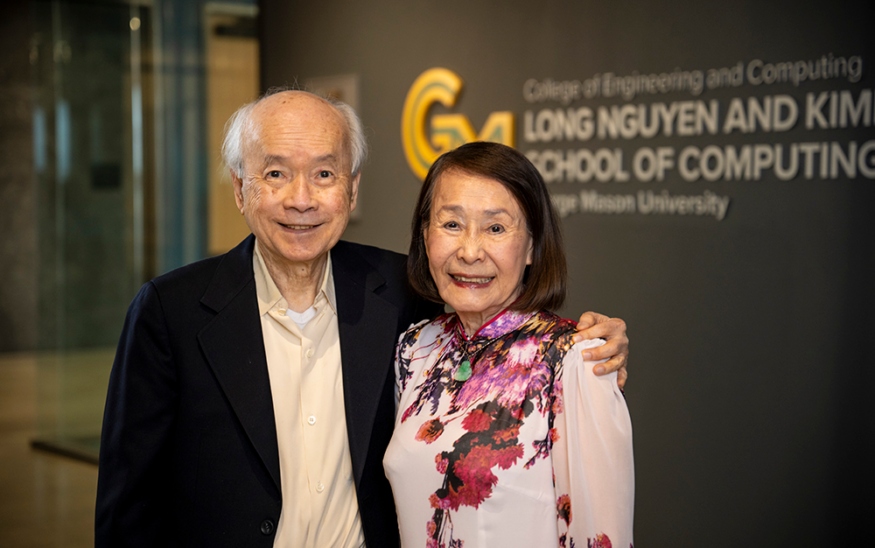
Long Nguyen and Kimmy Duong, Fairfax County business leaders, are longtime philanthropists, including at George Mason University. Photo by Will Schermerhorn
Long Nguyen and Kimmy Duong, Fairfax County business leaders, are longtime philanthropists, including at George Mason University. Photo by Will Schermerhorn
Philanthropist gives half her fortune to George Mason
McLean businesswoman Kimmy Duong donated $20M to university



Summary:
- Kimmy Duong donated $20 million to George Mason University
- School of Computing renamed for Long Nguyen and Kimmy Duong
- Scholarships awarded to 250 students in 2023
At the age of 70, when many people are easing up on their professional commitments, Kimmy Duong was busy doubling down.
It was at that age in 2015 when Duong established the Kimmy Duong Foundation because she wanted “to do more than just tag along” with the philanthropic pursuits of her husband, Long Nguyen. Since then, the McLean businesswoman has indeed done more, supporting a variety of education, health and welfare initiatives.
Last year, Duong donated $20 million, roughly half of her fortune, to George Mason University in Fairfax County — a gift announced almost 50 years to the day after she fled war-torn Vietnam. Though she arrived in the U.S. as a refugee with only $30 in her pocket, Duong didn’t need financial assistance from the government, thanks to a job with IBM. Instead, she benefited from a tremendous amount of emotional and spiritual support.
“People around were very, very, very nice in taking care of me,” Duong says. And she was eager to return the favor after achieving success as the vice chair and chief financial officer of Pragmatics, the Reston-based IT company founded by Nguyen. “One of my goals is paying back to America what they invested in me when I first came here,” she explains.
The couple have focused much of their philanthropy on ensuring that higher education remains accessible to all students because they recognize how vital it was in their lives.
“Growing up in Vietnam,” Nguyen says, “I came to see education not just as a path to a stable career, but as a powerful way to broaden one’s perspective and understanding of the world.”
Their generosity is now on display, quite literally, in various ways across George Mason’s Northern Virginia campuses.
As part of Duong’s $20 million gift last year, the university renamed its School of Computing to the Long Nguyen and Kimmy Duong School of Computing. Meanwhile, an engineering building at the Fairfax campus was named for Nguyen in honor of a $5 million gift from the couple in 2009.
Increased investments
The $25 million-plus in gifts from Duong and Nguyen are but two ways that they have given to George Mason over time, according to Trishana Bowden, vice president for advancement and alumni relations. In recognition of their philanthropy and wide-ranging support to the school, both Duong and Nguyen have received the university’s highest honorary award, the Mason Medal, in different years, she adds.
The couple first began working with the university when Nguyen served on the Board of Visitors for eight years beginning in 2002, an experience he says proved pivotal for appreciating what George Mason has to offer.
“I saw its critical role in Northern Virginia education, especially for immigrant and first-generation college students,” he says.
Duong’s decision to donate $20 million to George Mason likewise indicates her understanding of the university’s unique legacy and aspiration to serve as a bridge between talent and opportunity, Bowden notes.
“She could have chosen a number of much more established universities, but she chose George Mason — and I think she chose us because she connects with our mission,” Bowden says. “She sees the type of students we attract, and she wants to be a part of making their dream of an education possible.”
Duong’s donation established three separate endowments: two supporting scholarships and student success initiatives within the School of Computing and a third that will provide scholarships to students majoring in nursing, education or journalism.
“She did not want to leave behind other students who are in other disciplines,” Bowden says. “That is unique and I think that should be celebrated.”
While Duong credits Nguyen for sparking her interest in establishing endowments, she also likes the idea that her donation will endure for years to come.
“It’s permanent,” Bowden adds. “An endowment will last as long as George Mason and the foundation is standing.”
‘Pay it forward philosophy’
Just as Duong and Nguyen are paying forward the help they received, a hallmark of their approach to philanthropy is encouraging recipients of their scholarships to do the same. That may take time, as Duong acknowledges, because students must first worry about graduating, getting a job and supporting their family before they have the means to support others.
“They have to take one step at a time,” Duong says. “If they cannot take care of themselves, they cannot take care of anybody else.”
But once scholarship recipients achieve success, there’s an expectation that they will continue the couple’s philanthropic legacy, Nguyen adds.
“The ‘pay it forward philosophy’ asks all scholarship recipients to do charitable works in their future so that our philanthropy continues in later generations,” he says.
As more and more students receive scholarships from the couple, that will have a multiplier effect on the region. The Kimmy Duong Foundation awarded its first scholarships in 2018 to 12 students, a number that will swell to 250 this year, and George Mason students have received $337,000 in scholarship funds in an eight-year period, Duong says.
Because the bulk of Duong’s $20 million gift goes directly to scholarships for students, that will have a tremendous ripple effect, as roughly 85% of George Mason students stay in Northern Virginia post-graduation, says Kenneth Ball, dean of the College of Engineering and Computing. “When gifts like Long and Kimmy’s support students, they’re really supporting the whole region,” he says.
There was a “very, very good response” among undergraduate students who applied for scholarships for the upcoming academic year, Ball says, and offering more scholarships going forward will also help the university to recruit students who might have enrolled elsewhere, since affordability is often key in their decisions. Such dynamics, too, have a multiplier effect.
“If students are choosing George Mason over universities, that in itself is significant because as the word gets out, our reputation starts to grow,” Ball says. And at a time when so many universities are facing enrollment challenges, he adds, a well-funded scholarship program helps with recruiting top students.
Leading by example
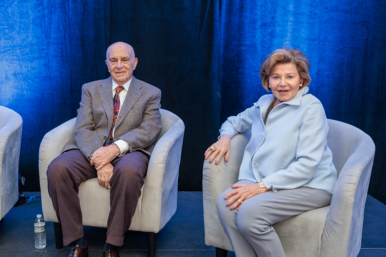
As Bowden and Ball emphasize, the couple doesn’t just show up when they have a check for the university; they’re very committed to George Mason in a variety of ways that are harder to quantify.
“It would not be unusual to hear from Kimmy certainly every week, if not more frequently,” Ball says. “She’s always willing to help out with whatever we might need.”
That might include engaging with students at events or meeting with scholarship recipients to let them know how much she cares about them, Bowden says, adding, “She’s always saying, ‘Don’t forget to pay it forward.’”
For Ball, who will celebrate 14 years at George Mason this summer, the couple were among the first people he met when he came to the university, and he’s enjoyed watching how that partnership has deepened with time. But he notes that George Mason is but one of several institutions, including the
University of Maryland, that have benefited greatly from a couple who care deeply about giving back to their community and helping young people.
“It means so much to me personally to have supporters like Kimmy and Long, not just because they’re supporting us financially, but because it’s genuine and from the heart,” he says. “I am deeply grateful to them and appreciative of their friendship.”
Bowden adds that the couple are an inspiration: “At a time when you want immigrants to be celebrated for how they really contribute to the success of our country, Kimmy and Long are powerful examples of people who believe in the American dream but didn’t just want it for themselves.”
For Duong, the beginnings of her American dream 51 years ago were stressful, as she worked multiple side jobs beyond her full-time role at IBM because she was worried she might run out of money. Her goal as a philanthropist has been to fulfill the lesson taught by her parents to help others by easing this same burden for students.
“If we can support other people, why not?” Duong says. “That’s my philosophy.”
A record year Private philanthropic support has become vital to higher education institutions in recent years as traditional sources of funding face headwinds. Nationwide, gifts to colleges and universities rose 4% to $78.8 billion in the fiscal year that ended June 30, 2025, according to the Council for the Advancement and Support of Education.
While higher education remains a top choice for donors, Virginia’s healthcare systems — and sometimes the intersection of the two — also saw significant support in 2025.
In December 2025, Norfolk-based Old Dominion University established the Joan P. Brock Institute for Nutrition Science and Health thanks to a $15 million donation from the Hampton Roads philanthropist. That followed a $20 million gift that Joan Brock made in 2024, which launched a health sciences center named in honor of her and her late husband, Macon, who co-founded Dollar Tree.
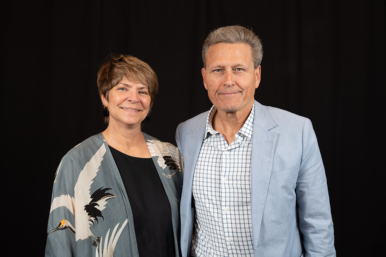
“For all of us in Virginia, our quality of life is so much dependent on our healthcare workforce and impacted by our lifestyles,” Brock says of the new institute, which will focus on expanding nutrition and lifestyle education. “The institute will make a significant difference in people’s lives, and the world will recognize the important work happening right here in Norfolk.”
Indeed, important work is already underway, as the internationally recognized physician and nutrition expert Dr. Michael Greger discussed “How Not to Age” at the institute’s inaugural lecture in March.
“I am excited for what is to come, for the doctors and nurses who will receive vital nutrition education as part of their studies, and for families across Hampton Roads and beyond who will, one day, be cared for by these healthcare professionals,” Brock says.
Nicholas and Jenny Taubman, who have a residence in Roanoke, have likewise focused on bolstering access to healthcare. In November, the couple donated $17.5 million toward a $50 million campaign to bring proton therapy to the Carilion Taubman Cancer Center at the Virginia Tech Carilion Health Sciences and Technology Campus in Roanoke. The former Advance Auto Parts CEO and U.S. ambassador to Romania and his wife previously donated $25 million to the center, which now bears their name.
While a few out-of-staters have given record-breaking donations to Virginia universities in recent years, they’re not to be outdone by Virginians.
In September 2025, best-selling author David Baldacci and his wife, Michelle, pledged $13 million to Virginia Commonwealth University and the Library of Virginia, which marked the largest-ever joint gift the two institutions have received. The donation will launch a nonpartisan initiative focused on experiential learning, curriculum development, events and programming spaces.
Finally, in February, Roanoke natives Jim and Augustine Smith donated $20 million to Virginia Tech for in-state scholarships to medical school, marking the largest scholarship in the university’s history.
s