Sign In
Upcoming Event
 Free Newsletter

Jefferson Lab breaks ground on $49M data center
Facility integral to $300M-$500M data hub planned for Newport News
Josh Janney //June 12, 2026//
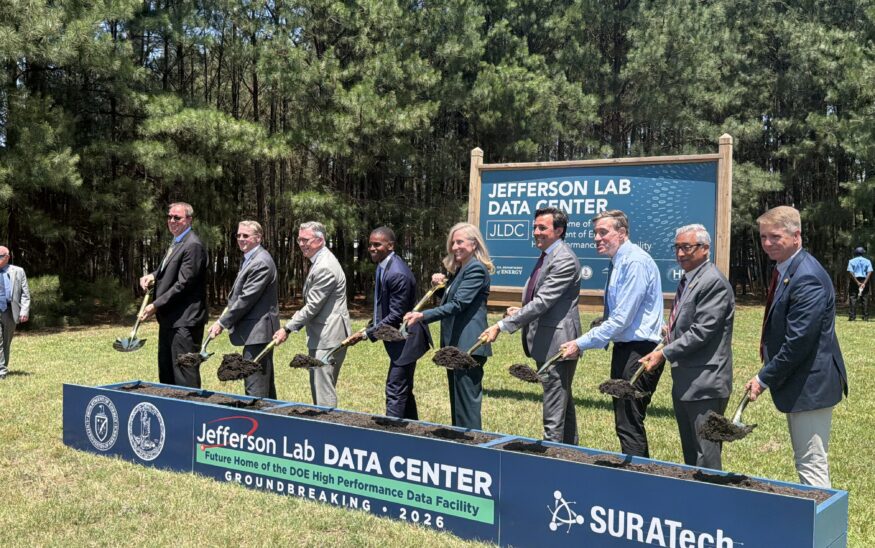
State and local officials join Jefferson Lab leadership for a ceremonial groundbreaking June 12, 2026, for the Jefferson Lab Data Center. Photo by Josh Janney
State and local officials join Jefferson Lab leadership for a ceremonial groundbreaking June 12, 2026, for the Jefferson Lab Data Center. Photo by Josh Janney
Jefferson Lab breaks ground on $49M data center
Facility integral to $300M-$500M data hub planned for Newport News
Josh Janney //June 12, 2026//



SUMMARY:
After decades of being known for nuclear physics research, Jefferson Lab is launching a new chapter centered on artificial intelligence, advanced computing and improving how scientists across the country access and use data generated at Department of Energy facilities.
Officials on Friday broke ground on the Jefferson Lab Data Center, a 30,000-square-foot facility on the Newport News campus backed by roughly $43 million in state funding and $6 million in seed funding.
The building will serve as the future home of DOE’s High Performance Data Facility, a federally supported initiative with an estimated project cost of $300 million to $500 million. Unlike large-scale commercial data centers, the JLDC is specifically sized and designed for scientific workloads and data stewardship rather than broad consumer cloud services.
At Friday’s event, DOE Under Secretary for Science Darío Gil said HPDF is a key component of DOE’s Genesis mission, an initiative aimed at accelerating scientific breakthroughs by integrating artificial intelligence and high performance computing.
“When complete, the High Performance Data Facility will be a first-of-its-kind distributed data facility that treats data as a first-class asset,” Gil said.
Rather than serving as a massive repository for scientific data, HPDF is intended to help researchers access information stored at DOE facilities around the country. Jefferson Lab Director Jens Dilling said in an interview that data will remain where it is generated, while HPDF will help scientists locate and securely use those datasets.
As an example, Dilling said a researcher might ask a broad scientific question — such as how the first molecules that formed life in the universe were generated — and use HPDF to combine relevant information from multiple DOE facilities to help answer it.
The facility will include a roughly 10,000-square-foot data hall, 10,000 square feet of supporting infrastructure and dedicated computing space for HPDF operations. Construction is expected to start later this year, with the JLDC built in about 18 months and the HPDF operational in 2030.
This month, the lab began operating under a new $1.83 billion federal contract. Southeastern Universities Research Association, which previously held the contract to operate the lab through its limited liability company, Jefferson Science Associates, is part of the new contract holder, SURATech, that also includes Virginia Tech. SURATech also has four major subcontractors: Honeywell International, Longenecker and Associates, Akima Support Operations and AtkinsRéalis.
SURATech CEO Sean Hearne said HPDF represents an opportunity for Jefferson Lab to expand beyond its traditional nuclear physics mission into a broader range of data-intensive research fields. While Jefferson Lab officials said it’s hard to gauge the full impact on job creation and economic growth, HPDF is projected to have a staff of 100 to 200 people, though not all will be based in Virginia. Lab officials envision an associated research program that will involve both academia and industry.
Numerous federal, state and local leaders, including Gov. Abigail Spanberger, U.S. Sen. Mark Warner, U.S. Reps. Bobby Scott and Rob Wittman and Newport News Mayor Phillip Jones attended Friday’s groundbreaking.
Spanberger said support for the lab has never been a partisan issue, but a “Virginia issue.”
“Jefferson Lab is Virginia’s national lab, and the High Performance Data Facility is how it becomes something even more, transitioning from a single-purpose nuclear physics lab into a multipurpose national institution with a broader mission and a longer, stronger future,” she said.
e