Sign In
Upcoming Event
 Free Newsletter


Shaila Menees, chief development officer of HCA Healthcare’s Capital Division, visits the construction site for HCA’s Scott’s Walk Emergency Room, set to open this year in Richmond. Photo by Jay Paul
Shaila Menees, chief development officer of HCA Healthcare’s Capital Division, visits the construction site for HCA’s Scott’s Walk Emergency Room, set to open this year in Richmond. Photo by Jay Paul
Health systems build out outpatient centers, freestanding ERs
Beth JoJack //March 31, 2026//



Summary:
- HCA Healthcare plans to invest nearly $60 million to build three new freestanding ERs in Virginia by late 2025.
- Bon Secours Mercy Health opened its fifth freestanding emergency center in Richmond in December 2025.
- Ambulatory surgery centers in the U.S. are projected to grow from $45.6 billion in 2024 to $55.3 billion by 2029.
Emergency care and surgeries are increasingly happening outside traditional hospital campuses in Virginia — a shift that continues to gain momentum.
As a result, construction of ambulatory surgery centers and freestanding emergency rooms is on the rise in the commonwealth.
While outpatient surgery centers and freestanding ERs serve different purposes, both are designed with an eye toward patient convenience, typically offering plenty of parking and easy access.
“The idea really is, how do we create convenient access? How do we reduce wait times? How do we improve the patient experience?” says Shaila Menees, chief development officer of HCA Healthcare Capital Division, the Nashville, Tennessee-based health care system‘s regional arm that includes 14 hospitals, eight freestanding ERs, 27 outpatient centers, and 12 urgent care centers in Virginia.
Many health system executives see standalone ERs and ambulatory surgical care centers as wins because both free up much-needed space in hospitals.
“The demand for health care services in Fredericksburg, in Virginia, in the South, in the East and nationally is exploding due to what we would call just the super-aging Medicare population of America,” says Jim Griffith, senior vice president and chief strategy officer for Mary Washington Healthcare in Fredericksburg. “They’re the sickest, most complex comorbid patients, … and whatever we, as a health care system, can move to a lower cost, lower acuity, more convenient setting makes room.”
Emergency convenience
HCA Virginia opened its first freestanding ER in Virginia in 2012 with its West Creek Emergency Center in Goochland County.
While HCA closed the West Creek facility during the pandemic, citing a need to redeploy resources amid staffing and supply chain shortages, the health care system now operates eight other freestanding ERs in Virginia. And HCA announced plans in October 2025 to commit nearly $60 million to build three new standalone ERs. Two are slated to open this summer in Chesterfield County and Richmond’s Scott’s Addition neighborhood. A third is scheduled to open later this year in Leesburg in Loudoun County.
Chesterfield, Loudoun and Richmond are projected to be among the top 10 most populous localities in the commonwealth by 2030, according to the Weldon Cooper Center for Public Service at the University of Virginia.
“We try to understand where the population is changing so that we can really bring that full continuum of care to those areas that are growing,” says Menees.
Mary Washington Healthcare operates two freestanding ERs: the Emergency Department at Lee’s Hill and the Emergency Department at Harrison Crossing.
“Especially with traffic in this area, we’ve got to take care to the patient,” says Griffith. “So, we have our two major hospitals, we have two freestanding [emergency departments], and we have plans for more.”
In December 2025, Bon Secours Mercy Health opened its $37.5 million Ashland Emergency Center. The 17,000-square-foot freestanding ER is Bon Secours’ fifth such facility in the Richmond market.
“Historically, freestanding [emergency departments] have very high patient satisfaction scores … because they’re much easier to navigate,” says Bon Secours’ Virginia state president, Michael Lutes.
Convenience doesn’t mean sacrificing care, however. Freestanding emergency departments typically come equipped with much of the same equipment found in traditional hospital ERs, such as CT scanners and ultrasound imaging machines. And they’re staffed by “the same quality providers … that we have at our hospital settings,” Lutes says.
Adds Menees: “The vast majority of time if you’re in a freestanding ER, all the things you need can occur there, unless you need to be admitted to the hospital.”
About 3% to 4% of patients are transferred from a freestanding ER to a hospital, according to Lutes. “It’s a very small amount,” he says.
That’s not to say freestanding emergency departments are a fit for every health system or every market.
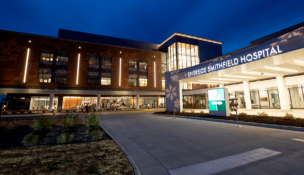
Earlier this year, Newport News-based health care system Riverside Health opened a 200,000-square-foot hospital in Smithfield.
In the early days of planning for a facility to serve residents around Isle of Wight County, Riverside Health executives considered building a freestanding emergency department but opted against it, according to Jason Kilgore, Riverside’s senior vice president of strategy and analytics.
After reviewing the data, Riverside executives felt the area would be better supported by a small hospital. “For us, it was worth the investment,” he says.
Freestanding emergency rooms also are not without critics.
A 2017 study in the Annals of Emergency Medicine found freestanding ERs in Colorado, Ohio and Texas were more likely to be located in areas with higher incomes and lower rates of Medicaid patients — raising questions about health equity.
Some consumer advocates have also expressed concerns that patients could confuse freestanding ERs with urgent care offices.
That’s an issue that can be solved, Lutes says, by providers educating patients about when to go to a primary care office and when to opt for urgent care or emergency care. “We always want to make sure that the right patient gets seen in the right setting,” he says.
Hybrid facilities could also be a solution.
Last year, Arlington County-based nonprofit health care system VHC Health demolished a strip mall in Falls Church to build a combined emergency room and urgent care facility through a partnership with Texas-based Intuitive Health.
VHC Health Vice President of Real Estate Acquisition and Development Adrian Stanton describes a common health care scenario to illustrate why such hybrid facilities work.
Chest pain can signal something as minor as heartburn — or as life-threatening as a heart attack, he points out. If it’s heartburn, the patient could be treated at an urgent care center at far lower cost than a visit to the emergency room.
But it can be hard for patients to know which route to go.
“This concept of combining the two means you don’t have to agonize over the decision,” says Stanton. “We triage you, and if it’s a heartburn, you go down the urgent care track and you pay urgent care fees.”
Expanding care options
The first ambulatory surgery center is thought to be one that opened in Arizona in the 1970s, according to the Alexandria-based Ambulatory Surgery Center Association, or ASCA.
Today, there are more than 6,500 Medicare-certified ambulatory surgery facilities performing more than 23 million outpatient procedures annually, the association reports.
The health care industry’s ambulatory surgery center segment is projected to grow from $45.6 billion in 2024 to $55.3 billion by 2029, according to the 2024 United States Ambulatory Surgery Center Market Report.
“It’s really part of a larger kind of transformation, not only in Virginia, but we’re seeing it across U.S. health care,” says Sentara Health Executive Vice President and Ambulatory Division President Prasanna Mohanty.
Construction costs of ambulatory surgical centers compared with building or expanding hospitals may explain some of the trend’s popularity among health system executives.
A small, single-specialty ambulatory surgery center with two surgical suites costs $2 million to $3 million, according to Ambula Healthcare, a California-based surgery center software company. A larger, multispecialty ambulatory surgery center can cost between $4 million and $8 million, the company reported.
By contrast, a 2023 expansion of LewisGale Hospital Montgomery in Blacksburg cost $16 million. The expansion of the hospital’s surgery department added 7,500 square feet, including two operating rooms, a 15-bed post-anesthesia care unit and storage.
Patients also like ambulatory surgery centers because they’re more convenient, and procedures often cost less than when performed in hospitals.
“Things are going more outpatient, and revenue is going to follow that,” said Griffith. “So, hospitals have to prepare.”
VCU Health opened its first ambulatory surgery center in late 2021 in Short Pump. The $21 million, 22,210-square-foot facility has six operating rooms. “We are very busy there,” says VCU Health Senior Administrator of Ambulatory Surgery Bernadette Purser.
The facility has performed so well that VCU Health is building a $90 million, four-story, 100,000-square-foot complex in rapidly growing Chesterfield County that will hold a medical office building and ambulatory surgery center featuring four operating rooms and two procedure rooms. It’s slated to open in spring 2027.
That growth reflects a broader appeal. For many patients, visiting an ambulatory surgery center for care can have advantages over going to a hospital.
“First of all, it’s a little less scary, a little less intimidating than going to the bigger hospital,” says UVA Medical Center Administrator of Perioperative Services Elizabeth Hall. “It’s usually easier parking, [and] the buildings are a smaller footprint.”
Possibly the major reason for the popularity of the outpatient surgery centers, however, is surgeries can be performed at the ambulatory centers for a lower cost than at a hospital.
“The physician’s fee is the same. The anesthesiologist’s fee is the same. … All the drugs cost the same,” says Chris Rucker, chief administrative officer for Valley Health, the Winchester-based health care system that serves West Virginia, Maryland and Virginia. “The only thing that’s a little less expensive is the charge for the operating room.
That’s largely because ambulatory surgical centers don’t have to be stocked to manage the broad spectrum of emergencies and complex cases hospitals must accommodate, experts say.
“We’re never going to do open heart surgery in an ambulatory surgery center, so we don’t have to be able to accommodate that kind of need,” Rucker explains.
The savings add up, apparently. UnitedHealth Group reported in 2021 that noncomplex, commercially insured patients save $684 on average per outpatient procedure.
That lower price tag also doesn’t mean sacrificing the quality of care. A 2018 study in the Journal of Health Economics found patients were less likely to visit an ER or be admitted to the hospital following surgery in ambulatory surgical centers than patients treated in hospital-based outpatient departments.
“Better outcomes, better patient experience and at a lower cost structure,” Mohanty says.
Procedures commonly performed at ambulatory surgery centers include orthopedic surgeries such as hip and knee replacements, hernia repairs, gynecological surgery, eye surgeries, and colonoscopies. Newer procedures being offered by some outpatient centers include heart catheterizations and ablation procedures, as well as spine surgeries.
In the coming years, more surgeries may move to the facilities. By 2028, the Trump administration plans to phase out Medicaid restrictions that prevent some 1,700 medical procedures from being performed on a outpatient basis.
For health care executives, offering procedures for healthy patients at ambulatory surgical centers has an upside: It frees up space at busy hospitals. Making room is critical because aging baby boomers require a lot of care.
Having that free space may allow health care executives to defer expensive plans to expand existing hospitals or construct new ones.
“We’ve got to continue to … decant lower acuity [services] out of the hospital to make room for the high acuity services that the Medicare population is going to need locally,” says Griffith.

Consolidating operations
Early on, ambulatory surgery centers were mostly owned by surgeons and physician groups.
“They tended to do the procedures that were more profitable,” says Alison Evans Cuellar, associate dean of research and professor of health administration and policy at George Mason University. “And they were competing with the hospitals.”
Around the 2010s, health systems began increasingly investing in ambulatory surgical centers to help grow outpatient surgery revenue.
In 2024, more than 80% of hospitals and health systems owned at least one ambulatory surgery center, according to the sixth annual hospital leadership intelligence ASC survey by Texas-based advisory firm Avanza Healthcare Strategies. That was up from 40% in 2019.
Hospitals and health systems often partner with physician groups or private equity firms in ambulatory surgical center endeavors.
For instance, in Virginia, Sentara partnered with Carient Heart & Vascular in Manassas and Polaris Heart & Vascular Clinic in Woodbridge to open an outpatient cardiovascular center in Woodbridge last summer.
In 2022, VHC Health joined with OrthoVirginia, the largest orthopedic group in Virginia, to open the McLean Tysons Orthopedic Surgery Center.
According to 2023 data from the ASCA, about 52% of ambulatory surgery centers are fully owned by physicians. Roughly 22% are jointly owned by hospitals and physicians, while 13% are owned by physicians in partnership with corporations. Another 7% are co-owned by physicians, hospitals and corporations.
About 3% are entirely hospital-owned and another 3% are fully owned by corporations.
“What you see nationally is a trend towards private equity investing in physician groups,” explains Cuellar.
A 2023 study published in the Journal of Health Economics found that when private equity invests in ambulatory surgical centers, the volume of surgeries does not increase, but the centers tend to charge nearly 50% more per case within four to five years.
It’s also anticipated that health insurance subsidiaries may step up purchases of ambulatory surgical centers, such as the $2.3 billion acquisition by UnitedHealth Group of outpatient surgery chain Surgical Care Affiliates in 2017.
On the whole, says Cuellar, ambulatory surgical centers are moving toward a future where “there are more locations owned by fewer players. And that is going to drive prices up.”