Sign In
Upcoming Event
 Free Newsletter

Boeing share price rises despite larger-than-expected Q2 loss from higher Air Force One costs
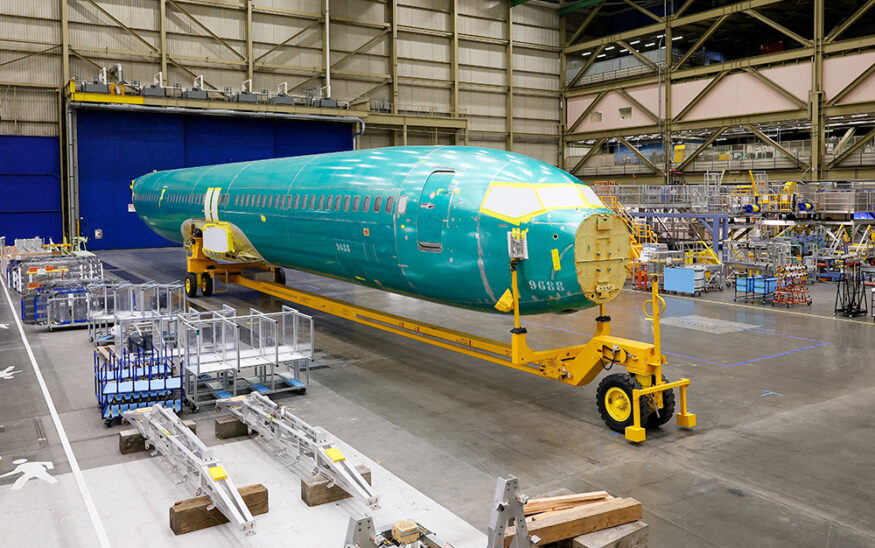
The second 737 MAX 10 to be manufactured on the new North Line is towed into the Boeing Everett Factory in Everett, Washington, U.S., July 8, 2026. Jennifer Buchanan/Seattle Times/Pool via REUTERS Pool/Pool via REUTERS/File Photo
The second 737 MAX 10 to be manufactured on the new North Line is towed into the Boeing Everett Factory in Everett, Washington, U.S., July 8, 2026. Jennifer Buchanan/Seattle Times/Pool via REUTERS Pool/Pool via REUTERS/File Photo
Boeing share price rises despite larger-than-expected Q2 loss from higher Air Force One costs



Summary:
- Boeing posts $428 million net loss in q2
- Boeing records $631 million free cash flow
- Boeing increases 737 max production to 47 jets monthly
SEATTLE, July 28 (Reuters) – Boeing on Tuesday reported a larger-than-expected quarterly loss after taking a $280 million charge on its troubled Air Force One replacement program, but generated positive free cash flow as its turnaround plans gained momentum.
It took the charge due to higher engineering costs to ensure it delivers the two delayed U.S. presidential plane replacements in 2028, contributing to a $428 million net loss for the second quarter.
Despite the charge and larger-than-expected loss, Boeing’s share price rose by 4.9% in midday trading, as investors appeared to respond to Boeing’s steady, continued progress in improving production and its increased free cash flow in the quarter.
The core loss per share of 76 cents was worse than analysts’ average expected loss per share of 30 cents, according to LSEG data, though narrower than the $1.24 per share core loss in the same period last year.
Boeing recorded $631 million of free cash flow, compared to a negative $200 million during the second quarter of 2025. The cash flow bump was due in part to higher customer payments than anticipated, according to the company.
The U.S. planemaker is maintaining its guidance of $1 billion to $3 billion in free cash flow for the year, which would be its first positive result since 2023, as it increases production of its best-selling 737 MAX narrow-body jets.
Boeing also increased capital investments in the quarter compared to last year, due largely to expanding capabilities for 787 production in South Carolina and military jet production in the St. Louis, Missouri, area.
The planemaker is also working to deliver two 747-8 jets to serve as Air Force One under a $3.9 billion fixed-price contract signed in 2018 that is now four years behind schedule and more than $1 billion over budget.
U.S. President Donald Trump accepted a Qatari-donated 747-8 jet that is serving as an Air Force One plane in the meantime, though he said this month it would soon be sent away for upgrades following questions about its security features.
IMPROVING PRODUCTION, INCREASING DELIVERIES
Boeing is currently increasing output of its best-selling 737 MAX from 42 to 47 jets a month. Increasing output is critical to the company’s ongoing financial recovery after years of crises have left it with nearly $26 billion in net debt and a dented reputation. The company aims to move to 52 a month by early next year and then to 57 jets a month.
Boeing CEO Kelly Ortberg cautioned that moving to 57 a month would require stronger performance from suppliers. He added that Boeing will need to ensure it smoothly increases production on key parts, such as wings assembly for 737s.
On its 787 jets, Ortberg said engine deliveries from GE Aerospace remain the critical factor to raising output to 10 aircraft per month and that the U.S. planemaker is working closely with GE on a recovery plan after engine shipments lagged in the first half.
Increasing 737 and 787 output is critical to paying down Boeing’s debt, which will give it financial breathing room to develop a new jetliner to compete with European rival Airbus in the lucrative narrowbody market in the 2030s.
Boeing CFO Jay Malave said during the call that he expects that by 2030, both jet programs will be as profitable as they were in 2018, before the company was enveloped in crises and controversies that it is still recovering from.
Boeing Commercial Airplanes’ quarterly operating margin improved to negative 2.7% from negative 11.9% a year earlier, helped by higher deliveries. The unit delivered 171 aircraft during the quarter, its highest quarterly total since 2018.
Despite the Air Force One charge, the company’s defense and space division’s operating margin improved to negative 0.2% from negative 2.9% a year earlier. During the quarter, Boeing received approval from the Pentagon to begin low-rate production of its T-7 Red Hawk jet trainer for the U.S. Air Force and MQ-25 aerial refueling drone for the U.S. Navy.
Boeing Global Services’ operating margin fell to 18.1% from 19.9%, taking a dent from higher costs and Boeing’s sale last year of its highly profitable digital aviation services business Jeppesen.
(Reporting by Dan Catchpole in Seattle and Nathan Gomes in Bengaluru; Editing by Jamie Freed and Nick Zieminski)
T