Sign In
Upcoming Event
 Free Newsletter

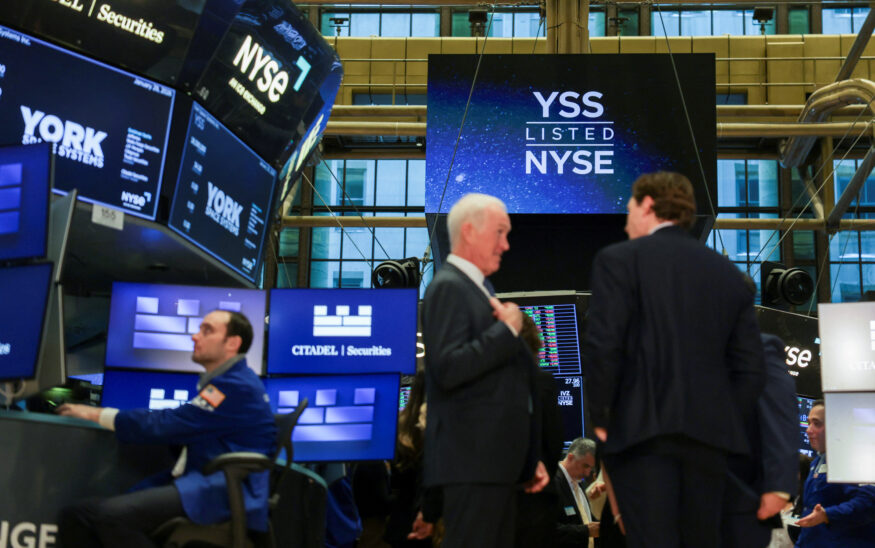
Logos of York Space Systems are displayed on screens during the company's IPO at the New York Stock Exchange (NYSE) in New York City, U.S., January 29, 2026. REUTERS/Jeenah Moon
Logos of York Space Systems are displayed on screens during the company's IPO at the New York Stock Exchange (NYSE) in New York City, U.S., January 29, 2026. REUTERS/Jeenah Moon
Wall Street ends sharply down as traders fret about AI disruption



Summary
- Software and AI-linked stocks sank as investors worried about rising competition and shrinking margins
- Nvidia and Microsoft slid nearly 3%, while Salesforce, Adobe and Intuit posted steep losses
- Palantir rallied nearly 7% after strong earnings, bucking the broader tech selloff
- S&P 500 and Nasdaq declined as investors braced for a heavy week of earnings reports
By Noel Randewich and Twesha Dikshit
Feb 3 (Reuters) – Wall Street ended sharply lower on Tuesday as investors worried about AI creating more competition for software makers, keeping them on edge ahead of quarterly reports from Alphabet and Amazon later this week.
AI heavyweights Nvidia and Microsoft each fell almost 3%. Alphabet dropped 1.2% ahead of its report on Wednesday, while Amazon declined 1.8% ahead of its Thursday report.
Investors in recent months have become pickier about AI-related stocks, looking for companies generating measurable returns from their outsized investments in the new technology.
Wall Street’s attention on Tuesday turned to technology companies that could face steeper competition and lower margins as a result of AI. One catalyst driving those concerns was Anthropic’s launch of a legal tool for its Claude AI chatbot.
“We’re looking at a lot of software names that are seen as companies that may well be disrupted when we start to see the advancement of artificial intelligence. We’re seeing a lot of software companies across the spectrum get hit,” said Art Hogan, chief market strategist at B. Riley Wealth.
Salesforce, Datadog and Adobe lost about 7%, Synopsys and Atlassian fell about 8%, and Intuit slumped 11%.
AI data firm Palantir bucked the trend, rallying almost 7% after strong quarterly results late on Monday.
The S&P 500 software and services index fell 3.8%, down for a fifth consecutive day.
“We’ve got an expensive market and expectations are really high. Many areas, especially around AI, are priced for perfection. That’s just got us in a skittish environment,” said John Campbell, senior portfolio manager, Allspring Global Investments.
Healthcare stocks came under pressure after Wegovy maker Novo Nordisk warned that it expected a steep decline in annual sales. The company’s U.S.-listed shares plummeted nearly 15%.
Rival Eli Lilly fell 3.9%, while obesity drugmaker Structure Therapeutics lost 6.75%.
Walmart climbed about 3% to become the first brick-and-mortar retailer ever to hit $1 trillion in stock market value.
Advanced Micro Devices fell 1.7% ahead of its quarterly report after the bell.
Walt Disney dipped 0.2% after it named theme parks head Josh D’Amaro as CEO, placing a longtime insider at the helm and ending succession uncertainty.
PayPal slumped 20% after it forecast 2026 profit below estimates.
The S&P 500 declined 0.84% to end the session at 6,917.81 points.
The Nasdaq declined 1.43% to 23,255.19 points, while the Dow Jones Industrial Average declined 0.34% to 49,240.99 points.
Even as the S&P 500 ended lower, advancing issues outnumbered falling ones within the index by a 1.2-to-one ratio.
With Tuesday’s losses, the S&P 500 is up about 1% in 2026 and the Nasdaq is flat.
Volume on U.S. exchanges was heavy, with 23.5 billion shares traded, compared to an average of 19.6 billion shares over the previous 20 sessions.
Six of the 11 S&P 500 sector indexes declined, led lower by information technology, down 2.17%, followed by a 1.28% loss in communication services.
EARNINGS DELUGE
With one quarter of the S&P 500 set to report quarterly results this week, analysts expect companies to have grown their earnings nearly 11% in the December quarter, up from an estimate of about 9% at the start of January, according to LSEG data.
Pfizer fell 3.3% despite posting fourth-quarter profit above estimates, while Merck rose 2.2% after its quarterly results.
PepsiCo gained 4.9% after the company announced price cuts on core brands such as Lay’s and Doritos.
Meanwhile, legislation to end a U.S. government shutdown narrowly cleared a procedural hurdle in the House of Representatives, setting up a vote on final passage later in the day.
The partial shutdown has postponed releases of key jobs data on Friday along with the JOLTS report, originally expected on Tuesday.
The S&P 500 posted 81 new highs and 28 new lows; the Nasdaq recorded 202 new highs and 311 new lows.
(Reporting by Pranav Kashyap and Twesha Dikshit in Bengaluru, and by Noel Randewich in San Francisco; Editing by Maju Samuel and Aurora Ellis)
t