Sign In
Upcoming Event
 Free Newsletter

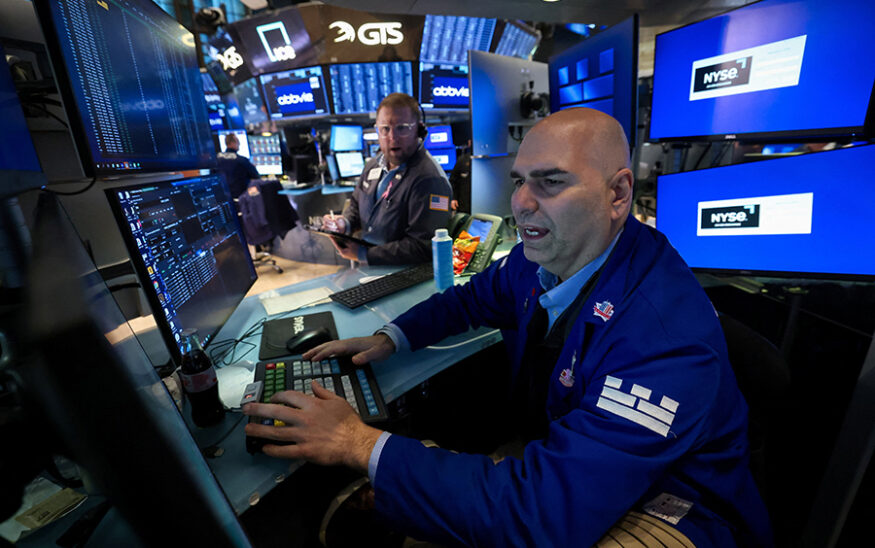
Traders work on the floor at the New York Stock Exchange (NYSE) in New York City, U.S., January 13, 2026. REUTERS/Brendan McDermid
Traders work on the floor at the New York Stock Exchange (NYSE) in New York City, U.S., January 13, 2026. REUTERS/Brendan McDermid
Wall Street ends sharply down as AI worries weigh



Feb 5 (Reuters) – Wall Street ended sharply lower on Thursday, with the Nasdaq dragged to its lowest since November by losses in Microsoft, Amazon and other tech heavyweights after Alphabet said it could double capital spending on AI in the race to dominate the emerging technology.
Shares of Alphabet fell after the Google parent said it plans as much as $185 billion in capex in 2026. Together, it and its Big Tech rivals are expected to collectively shell out more than $500 billion on AI this year.
Adding to recent losses, Microsoft, Palantir Oracle declined.
Amazon slid ahead of quarterly results it will release after the closing bell. Investors will focus on the cloud computing heavyweight’s plans for additional spending to build AI data centers.
Shares of chipmaker Nvidia , which stands to benefit from increased industry spending on AI, also declined.
Investors in recent months have grown more wary of heavy spending on AI, awaiting stronger signs those investments are actually boosting revenue and profits.
“This is the first time we’ve seen the large-cap tech companies — the Microsofts and the Alphabets and the Amazons — go through a really large capex cycle … and we’re seeing this volatility about whether this investment will translate, ultimately, into results,” said Tom Hainlin, an investment strategist at U.S. Bank Wealth Management in Minneapolis.
Investors this week have also worried that rapidly improving AI tools could eat into demand for traditional software, squeezing profit margins across the sector.
Software and data services stocks added to recent losses, with ServiceNow and Salesforce both losing ground.
The S&P 500 software and services index fell for a seventh straight session.
“The AI trade which was the accelerant last year is perhaps the extinguisher this year with people realizing that AI is going to help certain kinds of companies but it is also going to hurt, particularly software, for example,” said Melissa Brown, SimCorp’s managing director of investment decision research.
Qualcomm slid after forecasting second-quarter revenue and profit below estimates.
The CBOE volatility index, Wall Street’s “fear gauge,” briefly hit the highest in over two months.
As traders dialed back exposure to pricey AI stocks, the market’s rotation into relatively cheaper stocks gained steam in recent days.
The S&P 500 value index dipped, but remained in positive territory for the week. The S&P 500 growth index was down more than 4% for the week.
According to preliminary data, the S&P 500 lost 82.73 points, or 1.20%, to end at 6,799.99 points, while the Nasdaq Composite lost 360.33 points, or 1.57%, to 22,544.25. The Dow Jones Industrial Average fell 603.79 points, or 1.19%, to 48,897.51.
Snap topped fourth-quarter revenue estimates, but its shares declined.
Estee Lauder shares fell as the Clinique owner forecast annual results below estimates.
Fashion company Tapestry rose after raising its annual profit forecast, while Hershey climbed on a better-than-expected annual profit forecast.
The number of Americans filing new applications for unemployment increased more than expected for the week ended January 31, while job openings dropped to the lowest level in more than five years in December.
(Reporting by Pranav Kashyap and Twesha Dikshit in Bengaluru, and by Noel Randewich in San Francisco; Editing by Shinjini Ganguli, Anil D’Silva, Maju Samuel and David Gregorio)
l